重庆银行

Search documents
重庆银行跌0.89%,成交额8915.16万元,后市是否有机会?
Xin Lang Cai Jing· 2025-09-30 07:54
Core Viewpoint - Chongqing Bank's stock performance shows a slight decline, with a recent drop of 0.89% and a total market capitalization of 31.028 billion yuan [1] Financial Performance - Chongqing Bank's dividend yields over the past three years were 5.83%, 5.86%, and 4.46% respectively [2] - For the first half of 2025, the bank reported a net profit attributable to shareholders of 3.19 billion yuan, representing a year-on-year growth of 5.39% [6] Business Operations - The bank has launched various financial products to support rural revitalization, including "Rural Revitalization Loans" and "Live Pig Collateral Loans" [2] - The bank's revenue composition includes 69.84% from corporate banking, 21.95% from personal banking, and 7.41% from funding operations [6] Shareholder Activity - Chongqing Real Estate Group Co., Ltd. has acquired a stake in Chongqing Bank, holding 6.53% of the total shares [2] - Since its A-share listing, the bank has distributed a total of 6.88 billion yuan in dividends, with 4.229 billion yuan distributed over the last three years [7] Market Position - The bank's average trading cost is 9.57 yuan, with the current stock price near a support level of 8.83 yuan [5] - The bank's stock has seen a net outflow of 7.8753 million yuan today, indicating a lack of clear trend in major investor activity [3][4]
国泰海通稳健泰裕债券型发起式证券投资基金基金份额发售公告
Shang Hai Zheng Quan Bao· 2025-09-29 20:43
Fund Overview - The fund is named Guotai Haitong Stable Taiyu Bond Fund, with A class fund code 025000 and C class fund code 025001 [12] - It is a contract-based open-end bond fund with an indefinite duration [12] - The fund aims to achieve long-term stable investment returns while strictly controlling risks [13] Fund Management and Custody - The fund is managed by Shanghai Guotai Haitong Securities Asset Management Co., Ltd. and the custodian is China Construction Bank [3][58] Fundraising Details - The fundraising period is from October 9, 2025, to October 31, 2025, with a maximum fundraising limit of 3 billion RMB [3][16] - The minimum subscription amount is 1 RMB for both initial and additional subscriptions [8][14] - The fund can end fundraising early if the maximum limit is reached [3] Subscription Classes and Fees - The fund has two classes: A class, which charges subscription fees, and C class, which does not charge subscription fees [5][19] - Subscription fees for A class are tiered based on the subscription amount, while C class does not incur any subscription fees [19][20] Subscription Process - Investors must open a fund account with the management company and cannot use others' accounts for subscription [11][39] - Subscription applications are processed on a first-come, first-served basis, and once accepted, cannot be revoked [10][25] - Investors can subscribe multiple times during the fundraising period, with fees calculated separately for each application [10][24] Fundraising Conditions - The fund will only be established if the total subscription amount from the initiators reaches at least 10 million RMB and they commit to holding their shares for at least three years [16][17] - If the fund does not meet the establishment conditions, all raised funds will be returned to investors with interest [17][57] Investor Eligibility - The fund is open to individual investors, institutional investors, qualified foreign investors, and others permitted by law [7][14] - There are no limits on the total subscription amount for individual investors, but specific conditions apply to prevent any single investor from holding more than 50% of the total fund shares [4][10] Contact Information - Investors can contact the management company for inquiries regarding the fund and subscription process [6][58]


债市投资难度加大 多家银行调整策略构建对冲组合
Zheng Quan Shi Bao· 2025-09-28 22:14
Core Viewpoint - The bond market is experiencing intensified volatility and challenges, with banks facing difficulties in bond investments and adjusting their strategies accordingly [1][3][4]. Group 1: Market Conditions - The bond market is currently in a state of wide fluctuations, with the ten-year government bond yield oscillating between 1.85% and 1.9%, reflecting increased volatility [3]. - After the implementation of new tax regulations on bond interest, the attractiveness of bonds has decreased, leading to a potential reallocation of assets towards equities and other investments [2]. - In August, the trading volume of bonds declined significantly, with state-owned banks trading approximately 3.568 trillion yuan and joint-stock banks trading about 11.232 trillion yuan, marking a drop from previous months [2]. Group 2: Bank Performance - In the first half of the year, over 80% of A-share listed banks reported positive growth in investment income, with an average increase exceeding 45%, primarily driven by the realization of bond floating profits [5][6]. - Notably, the China Construction Bank achieved an investment income of 27.912 billion yuan, with a year-on-year growth exceeding 200%, significantly contributing to its revenue [6]. - However, many banks are experiencing a decline in non-interest income due to the challenging market conditions, with some reporting negative growth [4]. Group 3: Investment Strategies - Banks are adjusting their investment strategies in response to the volatile bond market, focusing on wave trading and increasing the use of derivative instruments for hedging [9][10]. - The Postal Savings Bank has adopted a more flexible asset-liability strategy, actively expanding its balance sheet to capture income opportunities amid market fluctuations [9]. - The overall sentiment among bank executives is cautious regarding the sustainability of investment income growth in the second half of the year [3][4].


上市银行“十四五回望”之资负结构与息差变迁
CMS· 2025-09-28 15:09
Investment Rating - The report maintains a recommendation for the banking industry [3] Core Insights - The report provides a comprehensive analysis of the asset-liability structure and interest margin changes of 42 A-share listed banks during the "14th Five-Year Plan" period, highlighting a shift towards corporate loans on the asset side and a stronger retail focus on the liability side [12][14] - The asset-liability structure indicates a significant increase in the proportion of corporate loans, rising from 57.02% to 63.22% from the end of 2020 to mid-2025, while the proportion of demand deposits decreased from 41.94% to 30% [12][14] - The report notes a decline in both asset yield and interest margin, with the yield on interest-earning assets dropping from 4.43% to 3.32% and the net interest margin decreasing from 2.23% to 1.53% during the same period [14][15] Summary by Sections Overall Asset-Liability Structure and Interest Margin Changes - The asset-liability structure shows an increase in loan-to-earning asset ratio from 54.19% to 56.49%, with corporate loans making up a larger share of total loans [14][15] - The average yield on interest-earning assets decreased significantly, with the loan yield falling from 5.34% to 3.82% [15] - The net interest margin for listed banks remains higher than that of commercial banks, despite a decline [14][15] Changes in Each Banking Sector's Asset-Liability Structure and Interest Margin - City commercial banks experienced a more significant increase in the proportion of corporate loans, with their interest margin narrowing less compared to other banks [18] - The report highlights that the proportion of deposits in interest-bearing liabilities for state-owned banks decreased, while it increased for rural commercial banks [18] - The decline in interest-bearing liabilities' cost rate was most pronounced in city commercial banks, leading to a smaller reduction in their interest margin [18]





深度|“债市投资难度加大”!多家银行策略生变:重波段,增对冲
券商中国· 2025-09-28 02:21
Core Viewpoint - The bond market is experiencing intense fluctuations, contrasting with the anticipated bull market in 2024, leading to increased investment difficulties for banks in 2023 [1][5]. Group 1: Market Conditions - The bond market is currently in a wide-ranging oscillation phase, with the ten-year government bond yield fluctuating within a range close to 40 basis points [1]. - After the implementation of the new tax regulations on government bond interest, the trading volume of existing bonds has seen a decline [3]. - In August, the total trading volume of bonds by major banks decreased to approximately 14.8 trillion yuan, down from 16.49 trillion yuan in July [4]. Group 2: Bank Performance and Strategies - In the first half of 2023, over 80% of A-share listed banks reported positive growth in investment income, with an average increase exceeding 45% [2][8]. - The investment income of listed banks in the first quarter and the first half of 2023 grew by 26.1% and 23.6% year-on-year, respectively [7]. - Major banks, including Construction Bank and Postal Savings Bank, saw significant increases in their investment income, with Construction Bank achieving a 200% year-on-year growth [10]. Group 3: Challenges and Adjustments - The investment difficulties have led to a negative growth in non-interest income for many banks, attributed to the divergence in market interest rates [6]. - The limited floating profit space and the need for strategic adjustments in bond trading have become apparent, with banks shifting focus to more flexible and diversified asset-liability strategies [13][14]. - The second quarter showed signs of reduced "debt selling" efforts, indicating a tightening of floating profit inventory among banks [11].



重庆银行涨0.67%,成交额9513.43万元,近3日主力净流入-798.78万
Xin Lang Cai Jing· 2025-09-26 08:06
Core Viewpoint - Chongqing Bank has shown a stable performance with a recent stock price increase and a focus on rural revitalization and agricultural financing initiatives [1][2]. Financial Performance - The bank's dividend yields over the past three years were 5.83%, 5.86%, and 4.46% respectively [2]. - For the first half of 2025, Chongqing Bank reported a net profit of 3.19 billion yuan, representing a year-on-year growth of 5.39% [6]. Shareholder Activity - Chongqing Real Estate Group has acquired a stake in Chongqing Bank, holding 6.53% of the total shares [2]. Business Overview - Chongqing Bank, established on September 2, 1996, primarily provides corporate and personal banking products and services, with a revenue composition of 69.84% from corporate banking, 21.95% from personal banking, and 7.41% from funding operations [6]. - The bank's registered address is located at 6 Yongpingmen Street, Jiangbei District, Chongqing [2]. Market Activity - The stock experienced a trading volume of 95.1343 million yuan with a market capitalization of 31.271 billion yuan [1]. - The average trading cost of the stock is 9.57 yuan, with current price levels between resistance at 9.21 yuan and support at 8.83 yuan [5].
重庆两江数字经济产业园“聚力赋能、个个精彩”——个体工商户成长助力巡展活动举行
Zhong Guo Xin Wen Wang· 2025-09-26 07:04
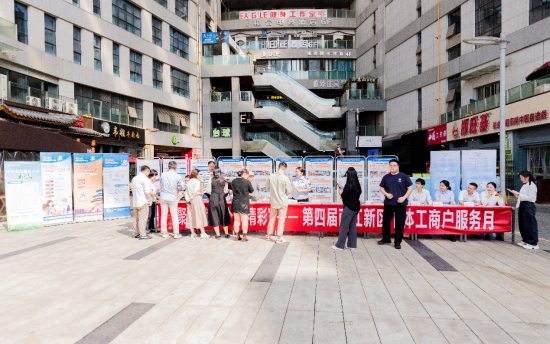
Core Points - The event "Empowerment and Excellence" for individual businesses in the Chongqing Liangjiang Digital Economy Industrial Park aims to provide face-to-face services and guidance to help individual businesses understand compliance issues and enhance their legal awareness and risk management capabilities [1][3] - The "Xingqihang" service platform offers a one-stop, full-cycle, and intelligent service for business entities, allowing them to access various services such as communication, legal, financial, insurance, and tax services online [3][4] Group 1 - The event is part of the fourth "Individual Business Service Month" series, organized by the Liangjiang New Area Market Supervision Administration [1] - Individual business owners from sectors like catering, retail, and housekeeping actively engaged in consultations, showing a strong interest in policy details and compliance [3] - The staff provided practical guidance on registration processes, annual report requirements, compliance norms, and the "individual to enterprise" transition [3] Group 2 - The "Entrepreneurship Care Package" available through the Xingqihang platform includes free communication services for six months, one year of legal consultation, and three months of tax agency services [4] - Financial institutions showcased various loan products tailored for individual businesses, such as "Shuyidai" from Zhejiang Merchants Bank, which offers credit loans up to 30 million yuan based on multi-dimensional data assessment [6][7] - The event facilitated direct interactions between business owners and bank representatives, simplifying the loan application process and making financial services more accessible [6][9] Group 3 - The Liangjiang Financial Company emphasized the importance of individual businesses in driving economic growth and employment, highlighting their role as a reflection of urban vitality and public well-being [9] - The initiative aims to break down service barriers by bringing financial services closer to the daily operations of individual businesses, effectively addressing their needs [9] - Future plans include ongoing collaboration between financial and enterprise service resources to enhance service breadth and depth for market entities in the region [9]
热度不减!城商行成科创债发行主力
Guo Ji Jin Rong Bao· 2025-09-26 03:03
Core Viewpoint - The issuance of technology innovation bonds (科创债) has gained momentum among city commercial banks, with a total issuance amount of 12.9 billion yuan in September alone, indicating strong market demand and support from policies [1][2][3]. Group 1: Issuance Details - Ten banks, primarily city commercial banks, have issued a total of 12.9 billion yuan in technology innovation bonds as of September 25, with maturities of five years and coupon rates ranging from 1.84% to 2.03% [2][3]. - Qingdao Bank successfully issued 1 billion yuan in technology innovation bonds with a coupon rate of 1.87%, aimed at supporting technology innovation businesses [2][3]. - Chongqing Three Gorges Bank's technology innovation bond saw a subscription multiple of 2.87, leading to a total issuance of 2.5 billion yuan, exceeding its initial plan [2][3]. Group 2: Market Dynamics - The primary market for technology innovation bonds is characterized by strong policy support, rapid expansion, high credit ratings of issuers, and favorable coupon rates compared to traditional bonds [3][4]. - Since the announcement by the central bank and the securities regulatory authority in May, the issuance of technology innovation bonds by financial institutions has surged, with commercial banks issuing a total of 261.5 billion yuan [3][4]. Group 3: Benefits for Banks - Issuing technology innovation bonds allows small and medium-sized banks to lower financing costs and improve their liability duration structure, reducing reliance on short-term funding [4][5]. - These banks can provide flexible and targeted financial support for local technology projects, enhancing the efficiency of fund utilization in the technology sector [4][5].
五大国有银行同日官宣:不再设立!
Zhong Guo Jing Ying Bao· 2025-09-25 15:17
Core Viewpoint - The major state-owned banks in China have announced the abolition of their supervisory boards in response to new regulations set to take effect in July 2024, aiming to streamline governance structures and enhance decision-making efficiency [1][2]. Group 1: Regulatory Changes - Five major state-owned banks, including Agricultural Bank of China and Industrial and Commercial Bank of China, received approval from the National Financial Regulatory Administration to abolish their supervisory boards [1]. - This change is driven by the new Company Law of the People's Republic of China, which will be implemented on July 1, 2024, and a subsequent notification from the National Financial Regulatory Administration [1][2]. Group 2: Implications for Governance - The cancellation of supervisory boards is expected to simplify governance structures and reduce management costs, particularly benefiting smaller banks by concentrating management resources [2]. - Decision-making efficiency is anticipated to improve as the traditional "three meetings" model (shareholders' meeting, board meeting, supervisory board) becomes less cumbersome, allowing banks to respond more swiftly to market changes [2]. - The move aligns with international corporate governance trends, bringing Chinese banks closer to mainstream global practices and enhancing the modernization of corporate governance [2]. Group 3: Role of Audit Committees - The notification clarifies that financial institutions can establish audit committees within the board of directors to assume the supervisory functions previously held by supervisory boards [2][3]. - Audit committees, typically composed of independent directors with financial and auditing expertise, are expected to enhance the professionalism of oversight in areas such as risk management and financial compliance [3]. - The integration of supervisory functions into audit committees aims to eliminate overlapping responsibilities and optimize the allocation of supervisory resources [3].

城商行板块9月25日跌0.94%,重庆银行领跌,主力资金净流出2.78亿元
Zheng Xing Xing Ye Ri Bao· 2025-09-25 08:37
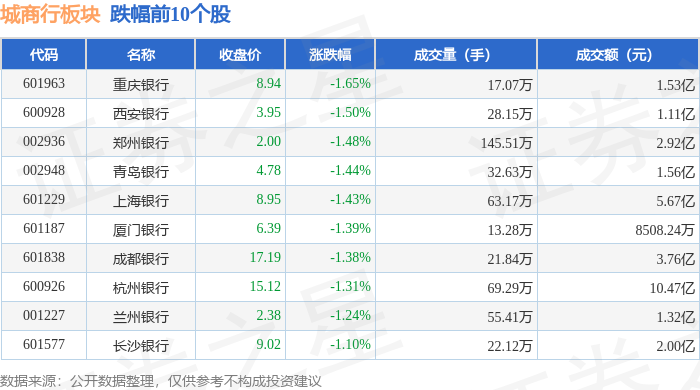
Market Performance - The city commercial bank sector declined by 0.94% on September 25, with Chongqing Bank leading the decline [1] - The Shanghai Composite Index closed at 3853.3, down 0.01%, while the Shenzhen Component Index closed at 13445.9, up 0.67% [1] Individual Stock Performance - Chongqing Bank closed at 8.94, down 1.65% with a trading volume of 170,700 shares and a transaction value of 153 million [1] - Other notable declines include Xi'an Bank down 1.50% to 3.95, Zhengzhou Bank down 1.48% to 2.00, and Qingdao Bank down 1.44% to 4.78 [1] - Shanghai Bank and Xiamen Bank also saw declines of 1.43% and 1.39%, respectively [1] Capital Flow Analysis - The city commercial bank sector experienced a net outflow of 278 million from institutional investors, while retail investors saw a net inflow of 152 million [1] - The table indicates that Suzhou Bank had a significant net outflow from institutional investors of 48.08 million, while Qilu Bank had a net inflow of 25.86 million [2] - Chongqing Bank specifically had a net outflow of 5.68 million from institutional investors but a net inflow of 10.91 million from retail investors [2]