
宁波银行

Search documents
双融日报-20251217
Huaxin Securities· 2025-12-17 01:34
Core Insights - The report indicates that the current market sentiment is at a low level, with a score of 35, categorized as "cold" [6][9] - The report highlights three key themes for investment focus: liquid cooling technology, banking stocks, and brokerage firms [6] Liquid Cooling Theme - The upcoming International AIDC Liquid Cooling Industry Chain Conference will take place on December 18-19, indicating a growing trend towards liquid cooling technology in the AI sector [6] - Major companies like NVIDIA have transitioned to liquid cooling solutions for their chips, suggesting a shift in industry standards [6] - Related stocks include Yingwei Technology (002837) and Feilong Co., Ltd. (002536) [6] Banking Sector - Banking stocks are noted for their high dividend yields, with the China Securities Bank Index yielding 6.02%, significantly higher than the 10-year government bond yield [6] - In a slowing economy with increased market volatility, banking stocks are seen as stable investment options for long-term funds such as insurance and social security [6] - Relevant banking stocks include Agricultural Bank of China (601288) and Ningbo Bank (002142) [6] Brokerage Sector - The report mentions a recent speech by the CSRC Chairman emphasizing the need for differentiated regulation and support for quality institutions in the brokerage sector [6] - The focus is shifting from mere scale and growth to high-quality development, encouraging smaller firms to differentiate their operations [6] - Key brokerage stocks highlighted are CITIC Securities (600030) and Guotai Junan Securities (601211) [6] Market Sentiment and Strategy - The market is currently in a cautious phase, with a tendency for support when sentiment scores drop below 30 and resistance when scores exceed 70 [9] - The report suggests a cautious approach to investment, focusing on fundamentally strong stocks while avoiding high-risk speculative activities [23]
多家银行调整代理上金所贵金属业务 重点“清理”无持仓不动户
Shang Hai Zheng Quan Bao· 2025-12-16 18:34
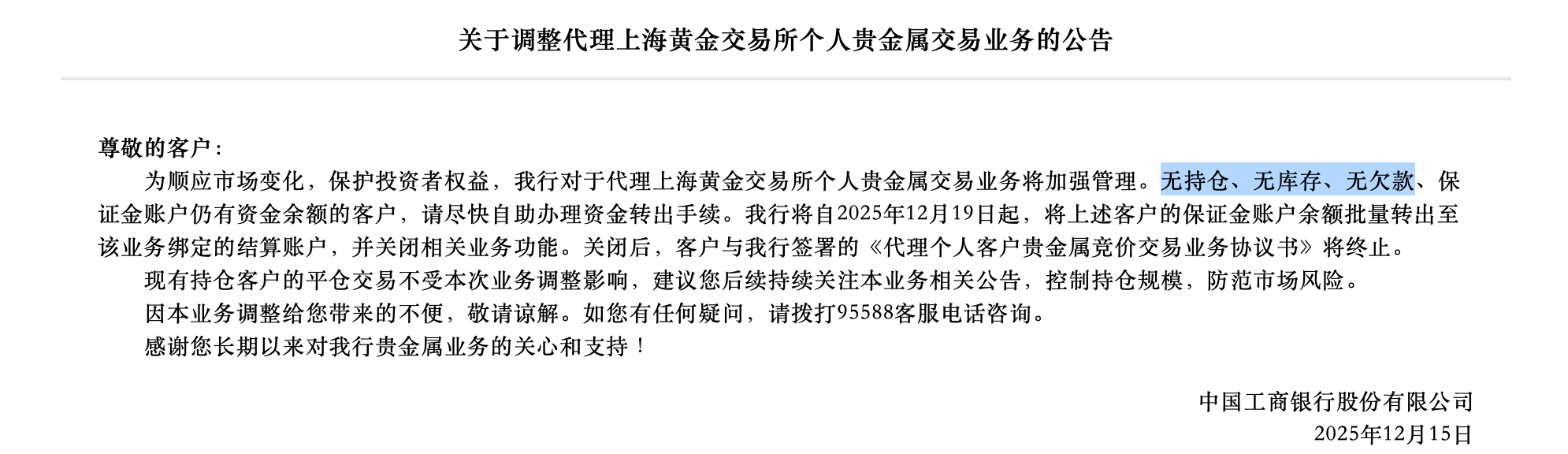
Core Viewpoint - The tightening of personal precious metal trading by banks acting as agents for the Shanghai Gold Exchange is aimed at managing market risks, complying with regulatory pressures, and fulfilling investor suitability obligations, leading to a more concentrated and mature market structure in the precious metals investment sector [1][2][3]. Group 1: Bank Actions - Several banks, including Industrial and Commercial Bank of China (ICBC), have begun to clear inactive "three-no" clients (no positions, no inventory, no debts) from their precious metal trading services [1][2]. - ICBC announced that starting December 19, 2025, it will transfer the balances of these clients' margin accounts to their settlement accounts and terminate related business functions [1]. - Other banks such as Agricultural Bank of China and China Construction Bank have also announced similar adjustments to their precious metal trading services [2]. Group 2: Market Implications - The banks' actions are seen as a response to increased compliance costs and market risk management, especially following the introduction of new gold tax regulations [2][3]. - The reduction of inactive accounts may lead to a decrease in speculative trading and a potential decline in market liquidity and trading activity in the short term [4][5]. - In the long term, the shift is expected to guide funds towards more transparent and regulated markets, reducing volatility and promoting rational trading behavior among institutional clients [5][6]. Group 3: Business Transformation - The retail precious metal business of banks is transitioning from a focus on trading channels to asset allocation services, moving away from high-risk, high-leverage products [6]. - Banks are expected to promote lower-risk investment products such as gold ETFs and physical gold sales, catering to the demand for risk-averse investment options [6]. - This transformation indicates a shift towards a "light asset" model, focusing on providing asset allocation services rather than merely facilitating transactions [6].
多家银行调整代理上海黄金交易所贵金属业务
Zheng Quan Ri Bao· 2025-12-16 16:09
Core Viewpoint - Recent adjustments by commercial banks regarding the agency business for personal precious metals trading at the Shanghai Gold Exchange are aimed at enhancing risk management and protecting investor interests due to increased market volatility and compliance requirements [1][4]. Group 1: Business Adjustments - Industrial and Commercial Bank of China (ICBC) announced on December 15 that it will strengthen management of its agency business for personal precious metals trading at the Shanghai Gold Exchange [1]. - Several banks, including major state-owned banks and joint-stock banks, have issued similar announcements regarding the adjustment of their agency business for personal precious metals trading [2][3]. - ICBC will transfer the balances of margin accounts with no positions, no inventory, and no debts to the linked settlement accounts starting December 19, 2025, and will terminate related business functions [2]. Group 2: Account Cleanup - Banks are focusing on cleaning up accounts with no positions, no inventory, and no debts, urging clients to withdraw funds [2][3]. - China Construction Bank and other banks have previously issued notices for clients to transfer their margin balances and terminate agreements related to personal precious metals trading [3]. - The adjustments reflect a broader trend among banks to suspend or stop new trading activities in personal precious metals due to compliance and market conditions [4]. Group 3: Risk Management - The agency business for personal precious metals trading involves various risks, including market, compliance, operational, and reputational risks, with market risk being the most significant [5]. - The ongoing volatility in the precious metals market is testing banks' risk management capabilities and pushing them to innovate in product offerings and customer service [5].
关于黄金交易,多家银行调整
Shang Hai Zheng Quan Bao· 2025-12-16 15:33
Core Viewpoint - The Shanghai Gold Exchange's personal precious metals trading business is tightening as banks like ICBC are actively clearing inactive "three-no" customers (no positions, no inventory, no debts) to manage market risks and comply with regulatory pressures [1][3][4]. Group 1: Bank Adjustments - Multiple banks, including ICBC, have announced adjustments to their agency business for the Shanghai Gold Exchange, with ICBC set to transfer inactive customers' margin account balances to settlement accounts starting December 19, 2025 [3]. - Other banks such as Agricultural Bank of China and Postal Savings Bank have also indicated similar adjustments, with Agricultural Bank planning to terminate agreements with inactive customers starting October 29, 2023 [3]. Group 2: Market Implications - Experts believe that the tightening of bank policies will lead to a more concentrated market with institutional clients, potentially resulting in a more mature and stable market structure [1][5][7]. - The reduction in active personal investors may lead to a decrease in trading volume and liquidity in the short term, but it could also encourage a shift towards more professional trading platforms [6][7]. Group 3: Business Transformation - The retail precious metals business of banks is transitioning from a trading channel to asset allocation services, moving away from high-risk, high-leverage products towards more stable financial products like gold ETFs [9]. - This shift indicates a broader trend in the banking sector towards providing risk-averse investment options that meet consumer demand for gold as a hedge and asset allocation tool [9].
工行将关闭贵金属“三无”客户交易 年内已有近10家银行行动
Sou Hu Cai Jing· 2025-12-16 13:49
Core Viewpoint - The Industrial and Commercial Bank of China (ICBC) will close the personal precious metals trading services for "three no" clients (no positions, no inventory, no debts) starting December 19, urging customers with remaining balances to withdraw promptly [1][4]. Group 1: Business Adjustments - ICBC's decision is part of a broader trend among nearly ten commercial banks, including Agricultural Bank of China, China Construction Bank, and others, to gradually phase out personal precious metals trading services for "three no" clients since September [4]. - The banks have been adjusting their services to protect individual investors, especially in light of increased volatility in precious metal prices, which poses significant risks for retail investors [4][5]. Group 2: Market Context - The precious metals market has shown remarkable performance this year, with international gold prices increasing by approximately 60% and silver prices rising over 110% as of December 15 [6][7]. - In response to market conditions, banks have made changes to their gold business, including adjustments to minimum investment amounts and risk management protocols [7].


“蚂蚁数科+伙伴”的组合拳,打在了产业AI的要害上
Sou Hu Cai Jing· 2025-12-16 13:42
Core Insights - The article discusses the emergence of "Agents" as a new consensus in the large model industry, highlighting the need for scalable product forms beyond just capabilities [2] - Ant Group's recent annual ecosystem partner conference introduced the upgraded "Xinglan Plan," which aims to create an open ecosystem for intelligent agents [3] Group 1: Ant Group's Strategy - The "Xinglan Plan" is not just a cooperation framework but a comprehensive mechanism for the intelligent agent industry, focusing on technology, collaboration, and commercial aspects [3] - Ant Group has opened its intelligent agent development platform (Agentar), data and knowledge engineering tools, and AI safety evaluation systems to partners [3] - The CEO of Ant Group emphasized that the true value of AI lies in its ability to solve real-world problems in various industries [3] Group 2: Challenges in AI Implementation - The transition of AI from consumer to business applications presents significant challenges, particularly in complex industries like banking, energy, and transportation [5] - Key challenges include ensuring technology is user-friendly, models provide accurate outputs, and solutions effectively enhance business efficiency and profitability [5][7] - Ant Group's VP noted that successful AI delivery requires deep integration into business processes and collaboration with partners to explore industry-specific know-how [5] Group 3: Technical Architecture - Ant Group's strategy involves a three-layer technical architecture: models, platforms, and industry applications [9] - The foundational layer consists of specialized models like Agentar-Fin for finance and EnergyTS 2.0 for energy, designed for high accuracy and industry applicability [10][11] - The middle layer is the Agentar platform, which serves as a hub for developing intelligent agents, allowing partners to build tailored solutions [12][13] Group 4: Industry Applications and Collaborations - Ant Group has collaborated with over 20 partners to create more than 100 intelligent agent solutions across various sectors, demonstrating a shift from AI tools to industry-specific assistants [16] - Examples include a smart decision-making system for Ningbo Bank that improved accuracy to 91% and a public transport AI system in Nanjing that optimized routes [16] - The collaborative approach has led to significant business outcomes, with partners reporting that 30% of their revenue comes from projects with Ant Group [18] Group 5: Future Outlook - The global enterprise AI market is projected to reach approximately $97.2 billion by 2025, with a compound annual growth rate of about 18.9% [18] - The growth is driven by strong demand for automation, intelligent workflows, and agent systems, particularly in finance, energy, and transportation [18] - Ant Group's ecosystem strategy aims to build a sustainable system that combines platform capabilities with partner collaboration to unlock market opportunities [24][26]

今年已有8家消金公司计划增资,数量超去年全年,近半为补足注册资本10亿门槛
Xin Lang Cai Jing· 2025-12-16 12:33
智通财经12月16日讯(记者 郭子硕)2025年,消费金融行业的增资热潮贯穿一整年,且临近年底动作 更加频繁。 智通财经记者日前从南京银行了解到,南银法巴消费金融有限公司(下称南银法巴消金)已完成工商变 更登记手续,其注册资本从52.15亿元大幅提升至60亿元。 而昨日晚间,长沙银行宣布计划以自有资金对湖南长银五八消费金融股份有限公司(下称长银五八消 金)进行增资,增资金额不超过15.5亿元。相应地,长沙银行的持股比例可能会从56.66%提高至 74.96%,控制权进一步得到集中。不过,最终金额将以经监管部门核准后的实际出资金额为准。 截至目前,年内已有8家机构完成或披露增资举措,数量超过去年全年,且其中50%是由注册资本不足 10亿元的消费金融公司发起。受访业内人士表示,今年消金公司增资的行业特点非常鲜明:银行系消费 金融公司主动进行规模扩张,中小机构聚焦于合规达标,第一大股东投入真金白银以提升控制权。 针对这一现象,有资深消费金融行业人士透露,当前有关部门指导已获批消金公司的注册资本要达到10 亿门槛。据此前的《消费金融公司管理办法》要求,注册资本的最低限额由3亿元提升至10亿元人民币 或者等值的可自由兑 ...
寻找科技金融“新密钥”:江苏金融创新给出科创企业融资N种解法
Mei Ri Jing Ji Xin Wen· 2025-12-16 12:23
Core Insights - The article discusses the challenges and innovations in financing technology-driven enterprises, particularly in Jiangsu Province, where traditional credit models struggle to meet the unique needs of these companies [1][4]. Group 1: Innovation in Financing - Jiangsu Province is leading in regional innovation capabilities, moving away from traditional collateral-based lending to a system using "Su Chuang Points" to evaluate innovation [2][4]. - The "Su Chuang Points Loan" product has been developed to assist enterprises in their growth, particularly in the biomedicine sector, which has high funding demands and long development cycles [3][11]. Group 2: Financial Products and Support - Since its establishment in December 2024, the Nanjing Biomedicine Sub-center has facilitated project financing totaling 225 million yuan, collaborating with banks to create tailored credit products for university research projects [3]. - By the end of Q3 2025, nearly 40,000 enterprises were classified as "priority support" or "recommended support," with a loan balance of 381.2 billion yuan under the "Su Chuang Points Loan" program [5]. Group 3: Digital Financial Innovations - Digital financial tools are enhancing the capabilities of technology finance, with banks creating comprehensive profiles and scoring systems for enterprises based on their innovation capabilities [6][7]. - The China Bank Jiangsu Branch has developed a digital financial platform that provides real-time insights into industry chains and pre-approval credit limits for technology enterprises [7]. Group 4: Policy Support and Collaboration - The People's Bank of China is working with the Jiangsu Provincial Science and Technology Department to introduce special support policies for technology finance, addressing the mismatch between traditional credit models and the needs of tech enterprises [4][8]. - The "Su Chuang Rong" product has supported technology SMEs with loans totaling 397.8 billion yuan by the end of Q3 2025, demonstrating the effectiveness of policy-driven financial support [8]. Group 5: Tailored Services for Startups - Local banks are focusing on small and micro enterprises, emphasizing non-credit services such as equity financing and resource matching to better meet the needs of early-stage technology companies [9][10]. - The establishment of specialized banking teams with expertise in finance, industry, and risk management is crucial for effectively serving technology enterprises [9]. Group 6: Comprehensive Financial Service Systems - A comprehensive financial service system has been established in Suzhou, integrating digital credit platforms and specialized financial products to support innovation and technology-driven enterprises [13][14]. - The "Innovation Index" has been developed to help financial institutions better understand and support the operational needs of innovative companies [13].

光大环境附属光大环保中国完成发行7.87亿元资产支持票据
Zhi Tong Cai Jing· 2025-12-16 11:01
智通财经APP讯,光大环境(00257)公布,公司全资附属公司光大环保中国已于2025年12月16日完成发行 光大环保(中国)有限公司2025年度第一期绿色定向资产支持票据(碳中和债)。于2025年度第一期资产支 持票据项下发行的资产支持票据的总面值为人民币7.87亿元。所得款项将用作补充其流动资金、偿还其 金融机构借款及╱或其他符合国家有关产业政策和适用法律法规的用途。 在承销协议的框架下,光大环保中国也与光大证券股份有限公司、上海浦东发展银行股份有限公司、中 国民生银行股份有限公司及宁波银行股份有限公司就发行2025年度第一期资产支持票据订立承销协议, 据此,光大证券作为主承销商,浦发银行、民生银行及宁波银行作为联席主承销商负责按照承销协议的 条款发行2025年度第一期资产支持票据。 ...
这类个人贵金属账户请注意!工商银行19日开始清理
Xin Lang Cai Jing· 2025-12-16 10:17
Core Viewpoint - The recent adjustments by major banks in China regarding personal precious metals trading reflect a cautious approach towards market risks, with several banks tightening their management of such businesses to protect investor interests [1][3][7]. Group 1: Bank Adjustments - On December 15, Industrial and Commercial Bank of China (ICBC) announced enhanced management for personal precious metals trading, urging clients with idle accounts to withdraw funds by December 19 [1][4]. - Other banks, including Agricultural Bank of China, China Construction Bank, and several regional banks, have also followed suit, indicating a broader trend of reducing personal precious metals business [1][6][7]. - The adjustments are part of a larger industry trend, with banks closing accounts that have had no trading activity for extended periods, reflecting a shift in risk management strategies [7][8]. Group 2: Market Context - The tightening of personal precious metals trading comes in the wake of a new tax policy implemented in October, which distinguishes between investment and non-investment gold, increasing compliance costs for banks [11][12]. - The new tax regulations require banks to track the use of physical gold more stringently, leading to operational challenges, particularly for smaller banks [11][12]. - The demand for gold has shifted towards more liquid financial products like ETFs, which offer lower costs and greater convenience compared to physical gold investments [12]. Group 3: Future Outlook - The global gold market has seen significant price increases, with a reported rise of over 60% in 2025, driven by economic expansion and geopolitical uncertainties [12]. - Looking ahead to 2026, the gold market is expected to experience a dynamic balance of various forces, with ongoing structural demand from investors and central banks potentially supporting prices, while economic recovery and interest rate changes may exert downward pressure [12].
