
传音控股

Search documents
【行情】全球每4部手机就有1部iPhone?最新用户设备情况出炉
Xin Lang Cai Jing· 2026-02-11 10:32
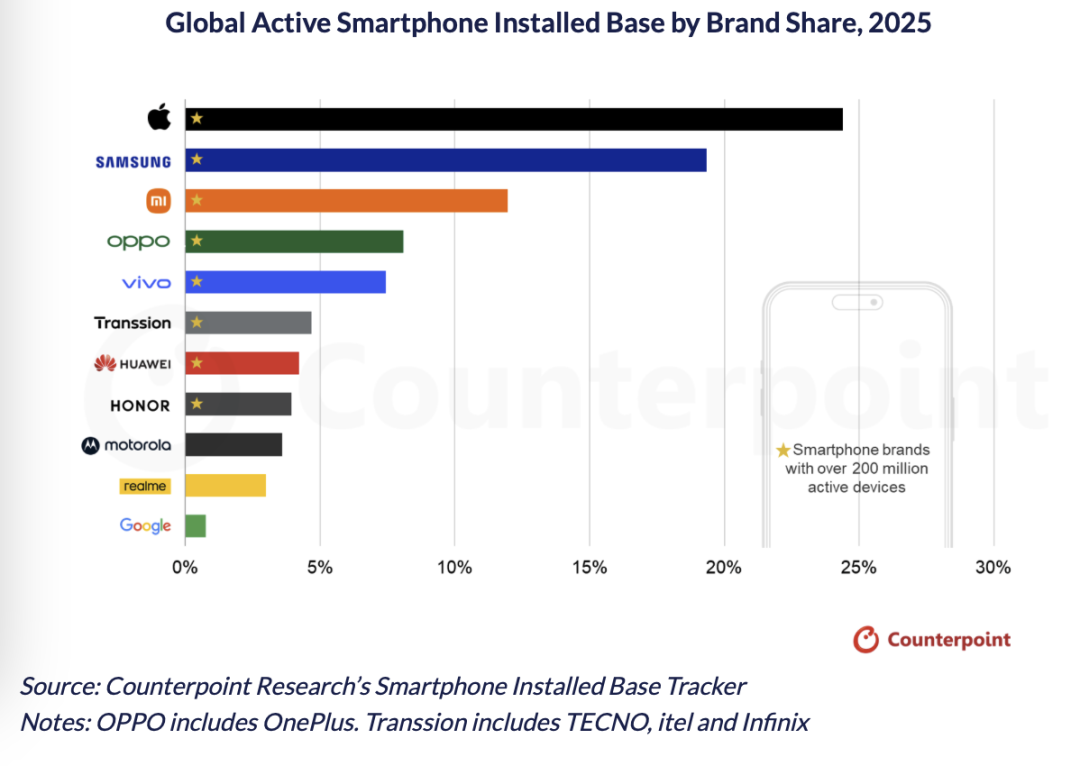
如上图所见,报告显示2025年全球智能手机设备活跃量来说,TOP10依次是:苹果、三星、小米、OPPO、vivo、传音、华为、荣耀、摩托罗拉、realme、 谷歌。 报告还提到TOP8品牌人均有2亿台以上设备,苹果和三星超10亿台,也就是近四分之一的手机是iPhone,近五分之一是三星手机。报告还提到2025年苹果 新增的手机设备比后面7家品牌加起来还多,问问大家,你现在用的哪家手机? 研究机构Counterpoint近日发布了一份2025年全球智能手机设备活跃情况。 研究机构Counterpoint近日发布了一份2025年全球智能手机设备活跃情况。 如上图所见,报告显示2025年全球智能手机设备活跃量来说,TOP10依次是:苹果、三星、小米、OPPO、vivo、传音、华为、荣耀、摩托罗拉、realme、 谷歌。 报告还提到TOP8品牌人均有2亿台以上设备,苹果和三星超10亿台,也就是近四分之一的手机是iPhone,近五分之一是三星手机。报告还提到2025年苹果 新增的手机设备比后面7家品牌加起来还多,问问大家,你现在用的哪家手机? ...


全球在使用的苹果三星手机均超过10亿部 7家国内品牌进入前10
Xin Lang Cai Jing· 2026-02-11 10:16
在活跃量进入前10的厂商中,除了摩托罗拉和真我,其余8家的活跃量是都在2亿部之上。(海蓝) 【TechWeb】2月11日消息,据外媒报道,有市场研究机 构发布了全球智能手机活跃量报告,从品牌来看苹果是 高居第1,三星电子紧随其后,两家双双超过了10亿部, 小米、OPPO、vivo等国内厂商,也都进入了前10,6家 的活跃量超过了2亿部。 市场研究机构在报告中表示,全球活跃的智能手机在 2025年同比增长2%。 具体到厂商方面,在全球目前活跃的智能手机中,苹果 所占的比例接近25%,三星电子则是接近20%,他们也 是仅有的两家活跃量超过10亿部的厂商。 活跃量进入前10的另外8家,分别是小米、OPPO、 vivo、传音、华为、荣耀、摩托罗拉、真我,其中的小米的份额是超过了10%,OPPO和vivo在5%到 10%之间。 【TechWeb】2月11日消息,据外媒报道,有市场研究机构发布了全球智能手机活跃量报告,从品牌来 看苹果是高居第1,三星电子紧随其后,两家双双超过了10亿部,小米、OPPO、vivo等国内厂商,也都 进入了前10,6家的活跃量超过了2亿部。 市场研究机构在报告中表示,全球活跃的智能手机在202 ...
TrendForce集邦咨询:存储器涨势加剧终端售价压力 2026年全球手机产量或降至约11.35支
Zhi Tong Cai Jing· 2026-02-11 09:13
Group 1 - The estimated contract price for mainstream memory capacity of 8GB+256GB is expected to rise nearly 200% in Q1 2026 compared to the same period in 2025 [1] - The BOM cost share of memory in smartphones has increased from approximately 10-15% to 30-40% [1] - TrendForce suggests that raising terminal prices has become a necessary choice for maintaining operations, prompting brands to adjust product mix or configurations in response to the ongoing surge in memory prices [1] Group 2 - Samsung, as the leading smartphone brand and a major player in the memory industry, is expected to see a decline in production volume due to overall market weakness, although the reduction will be less severe [1] - Apple, with a higher proportion of high-end models, is better positioned to absorb rising memory costs and has a consumer base more accepting of price adjustments, providing some support for its production performance [1] - Transsion, with a higher proportion of low-end models, is expected to face significant production cuts due to its sensitivity to cost fluctuations and the price sensitivity of its target customers [1] Group 3 - Vivo, Oppo, Xiaomi, and Honor will face not only memory cost pressures in 2026 but also competition from Huawei, which is focusing on promoting its HarmonyOS platform and has a relatively flexible pricing strategy [2] - TrendForce predicts that Huawei may experience the smallest production adjustment among brands and could even see growth despite the challenges [2] - The current decline in terminal sales, triggered by rising memory prices, is compounded by the fact that most electronic devices are sufficiently functional to meet consumer needs, leading to decreased replacement demand and extended upgrade cycles [2]
研报 | 存储器涨势加剧终端售价压力,2026年全球手机产量恐面临下行风险
TrendForce集邦· 2026-02-11 09:01
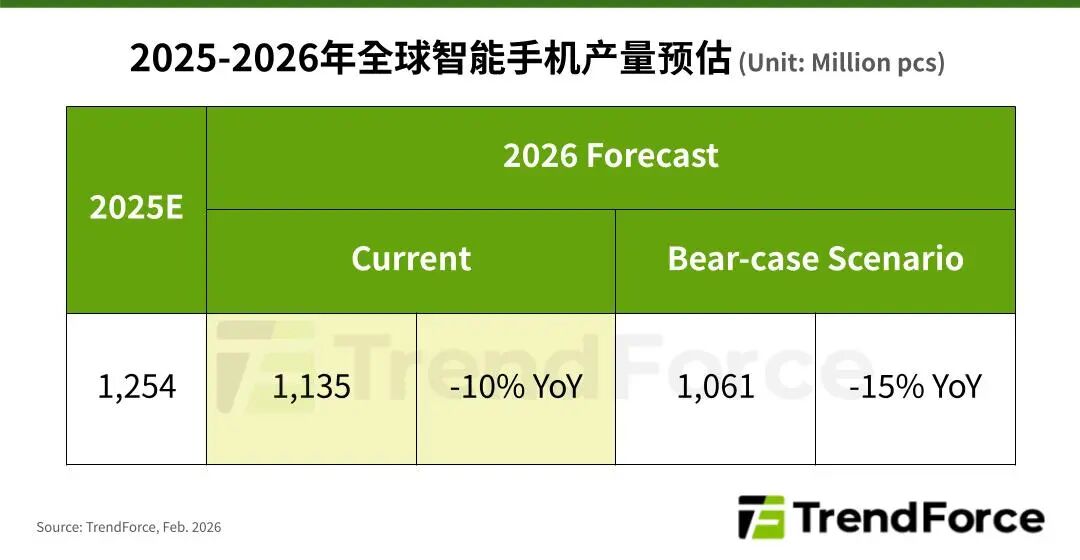
Core Insights - The global smartphone production is expected to decline by 10% in 2026 due to rising storage prices, with total production estimated at approximately 1.135 billion units [2] - In a bearish scenario, the decline could extend to 15% or more, affecting various brands differently based on their product structure and regional presence [2] Group 1: Storage Price Impact - The estimated contract price for mainstream storage (8GB + 256GB) in Q1 2026 has surged nearly 200% compared to the same period in 2025 [5] - The BOM cost share of storage in smartphones has increased from approximately 10-15% to 30-40% [5] - Brands are likely to raise terminal prices to maintain operations and may need to adjust product configurations in response to ongoing storage price increases [5] Group 2: Brand-Specific Production Outlook - Samsung, as the leading smartphone brand and a major player in the storage industry, is expected to see a decline in production, but the drop will be less severe due to its vertical integration advantages [6] - Apple, with a higher proportion of high-end models, is better positioned to absorb rising storage costs and has a consumer base more accepting of price adjustments, providing some support for its production performance [6] - Xiaomi and Transsion, which focus on low-end models, are more sensitive to cost fluctuations and are expected to experience significant production cuts in 2026 [6] Group 3: Competitive Landscape and Market Dynamics - Brands operating primarily in the Chinese market, such as Vivo, Oppo, Xiaomi, and Honor, face not only storage cost pressures but also competition from Huawei, which is expected to have a more flexible pricing strategy [6] - Huawei is projected to have the smallest production adjustment among brands and may even experience growth despite the challenging environment [6] Group 4: Consumer Behavior and Market Trends - The current decline in terminal demand is triggered by rising storage prices, but the overall functionality of electronic devices has reached a level that satisfies most consumers' daily needs, leading to longer replacement cycles [7] - Even if storage prices stabilize in the future, the underlying structural changes in consumer behavior may not reverse in the short term [7]

科大讯飞正式发布星火X2大模型,消费电子ETF(561600)备受关注
Xin Lang Cai Jing· 2026-02-11 05:37
Group 1 - The core viewpoint of the news highlights the performance of the consumer electronics sector, with the CSI Consumer Electronics Theme Index down by 0.85% as of February 11, 2026, and notable fluctuations among constituent stocks [1] - Key stocks include Shengyi Technology leading with a 2.55% increase, while Dongshan Precision experienced the largest decline at 6.21% [1] - The Consumer Electronics ETF also saw a decrease of 0.89%, with a latest price of 1.22 yuan and a trading volume of 7.855 million yuan during the session [1] Group 2 - The launch of the "Doubao AI Phone" signifies a deep integration of large model capabilities into mobile devices, with major companies like Apple and ZTE accelerating their AI product developments, marking 2026 as a pivotal year for edge AI product iteration [2] - AI functionalities are shifting from optional features to standard capabilities, driving improvements in performance metrics and customization levels for components such as camera modules and optical elements [2] - The CSI Consumer Electronics Theme Index comprises 50 listed companies involved in component production and design, with the top ten weighted stocks accounting for 53.34% of the index [2]

技术硬件与设备行业2025年信用回顾与2026年展望
新世纪评级· 2026-02-11 01:17
Investment Rating - The technology hardware and equipment industry is rated as stable for 2025 and 2026 [1] Core Insights - The technology hardware and equipment industry is experiencing a slow recovery driven by inventory replenishment cycles and AI technology, despite overall pressure from weak global economic growth since 2025. There is significant differentiation among sub-industries, with strong demand for data center equipment driven by computing power, while traditional telecom equipment shows sluggish growth [2][3] - The Chinese government has established a policy framework to support the industry, focusing on short-term growth stabilization, medium-term supply chain strengthening, and long-term innovation promotion, primarily through domestic substitution to overcome high-end equipment and material bottlenecks [2] - The industry is expected to benefit from the deepening of digital China initiatives and the industrialization of cutting-edge technologies like AI, entering a structurally growth-driven cycle. However, geopolitical disturbances and rapid technological iterations may lead to uneven recovery across the industry [5] Summary by Sections Industry Overview - The electronic information manufacturing industry is closely tied to global economic conditions, showing signs of recovery since 2024 due to inventory replenishment and AI-driven demand. It is a core industry in China's economic structure transformation and upgrade [7][8] - In 2024, the added value of China's electronic information manufacturing industry grew by 11.8%, outperforming overall industrial and high-tech manufacturing growth rates [8] Financial Performance - Sample companies in the technology hardware and equipment industry reported positive revenue growth year-on-year in 2025, aligning with industry recovery trends. However, high R&D investments and asset impairment losses have pressured net profits, while EBITDA showed year-on-year growth, indicating profit resilience [3] - The debt scale and liability ratios of sample companies have increased, with a decline in the EBITDA coverage ratio for rigid debt, although interest coverage has improved due to lower financing costs [3] Sub-Industry Insights Communication Equipment - The communication equipment sector is experiencing growth opportunities driven by AI and industrial interconnectivity, with significant demand for data center equipment but slow growth in traditional telecom network equipment. The market is highly competitive and concentrated [24][27] - The deployment of high-speed optical modules and data center switches is expected to grow significantly, while traditional telecom equipment investments are declining as operators shift focus to computing power networks [28] Computers and Peripheral Devices - The global PC and server markets are stable, with Chinese manufacturers gaining market share due to domestic substitution. The AI PC segment is becoming a core growth driver, with AI PC shipments expected to increase significantly [37][38] - The global server market is experiencing robust growth driven by AI computing demand, with significant revenue increases expected in the coming years [42] Electronic Devices, Instruments, and Components - The electronic devices, instruments, and components sector is seeing overall recovery driven by AI innovation and domestic supply chain localization. Key areas of growth include computing power chips and advanced packaging [48][49] - The semiconductor industry is entering an upward trend, with significant sales growth expected in both global and Chinese markets [56]



华强北,为什么能持续产生硬件创新?
虎嗅APP· 2026-02-10 14:12
Core Viewpoint - The article explores why Huaqiangbei, a district in Shenzhen, can continuously produce hardware innovations with minimal venture capital involvement, contrasting it with the Silicon Valley model that relies heavily on venture capital funding [4][6][18]. Group 1: System's Minimum Unit - Huaqiangbei is often referred to as "China's Electronics First Street," characterized by a vast network of trade, solution providers, and factories, functioning as a large API interface [10][12]. - The minimum unit in Huaqiangbei consists of sharp traders, solution companies, supporting factories, and a network of trust, allowing for a "Lego-style" survival philosophy where components can be easily assembled [13][14]. - This "physical open-source" approach lowers the hardware development barrier, enabling non-technical entrepreneurs to thrive [14][15]. Group 2: Why VC Fails Here - The business model in Huaqiangbei inherently rejects the venture capital logic due to different return cycles and exit mechanisms [18][22]. - Entrepreneurs in Huaqiangbei prioritize cash flow and quick returns, often completing product cycles in a matter of weeks or months, which does not align with the long-term investment horizon of VCs [22][24]. - A unique distributed financial system based on "familiar credit" allows entrepreneurs to leverage supplier credit and customer deposits to fund operations, bypassing traditional capital requirements [23][24]. Group 3: Innovation Funnel and Market Dynamics - Huaqiangbei's innovation logic is based on survival of the fittest, where low barriers to entry lead to a high volume of product experimentation [32][34]. - The market acts as the ultimate judge, with a rapid feedback loop that results in a high failure rate (95% of products) and a few successes that can become major hits [37][38]. - Unlike Silicon Valley, which reduces uncertainty through lab testing, Huaqiangbei eliminates it through market trials and rapid iteration [38]. Group 4: The Role of Chaos - Huaqiangbei's chaotic environment, often criticized for producing "high copies," is actually a source of its vitality, allowing for rapid innovation without stringent regulations [42][44]. - The lack of strict order fosters a low-cost environment for innovation, enabling entrepreneurs to test ideas quickly and adapt based on market response [45][46]. - This chaotic ecosystem has historically contributed to the development of a robust supply chain and skilled workforce in China, despite its controversial reputation [48]. Group 5: Future Challenges - Looking ahead to 2026, Huaqiangbei faces challenges from the hollowing out of hardware value due to the rise of AI and cloud computing, which may render traditional hardware innovation less relevant [56][57]. - The emergence of digital supply chain platforms could threaten Huaqiangbei's role as an intermediary, raising questions about the future of its business model [58][59]. - Despite these challenges, Huaqiangbei is evolving from a product-selling hub to a capability-selling entity, positioning itself as a global hardware innovation factory [60][61].

影视合作拉紧中非文化交流纽带
Ren Min Ri Bao· 2026-02-10 08:41
"孩子们非常喜欢《熊出没·逆转时空》这部电影!其中时空机器 等科幻元素十分吸引眼球,影片讲述的友情故事令人感动。"在南非 约翰内斯堡海德公园购物广场的一家电影院,市民帕莱萨带着两个女 儿观影后对记者说,"中国动画电影的制作水准很高,精湛的视觉效 果让人仿佛身临其境,我和孩子们都很着迷。"该电影院经理塞洛·迈 卢拉表示:"这几年,南非观众对中国电影的接受度和喜爱度越来越 高。《熊出没·逆转时空》的票房表现超出预期便是例证。" 近年来,越来越多中国影视剧登陆非洲国家荧屏,广受当地观众欢 迎。中非加强影视领域节目交流、联合制作、人才培养等多方面合 作,不断拉紧中非文化交流和情感相通的纽带。 相互展映优秀电影 讲述民心相通故事 近年来,中国与非洲国家的广电机构开展各类电视节目合作制作,已 经涌现出一批优秀影视作品。从讲述"菌草援外"故事的《幸福草》, 到展现中国援外医疗队与埃博拉病毒战斗故事的《埃博拉前线》,中 非合拍影视作品凝结着跨越国界、文化、种族的共通情感,将中非友 好的故事讲给更多人听。 2023年,在共建"一带一路"倡议提出10周年、中国援外医疗队派遣 60周年之际,中国与坦桑尼亚合拍了以中国援外医疗故事为 ...
苹果第一,小米第三!2025年全球手机出货数据出炉
Shen Zhen Shang Bao· 2026-02-09 11:10
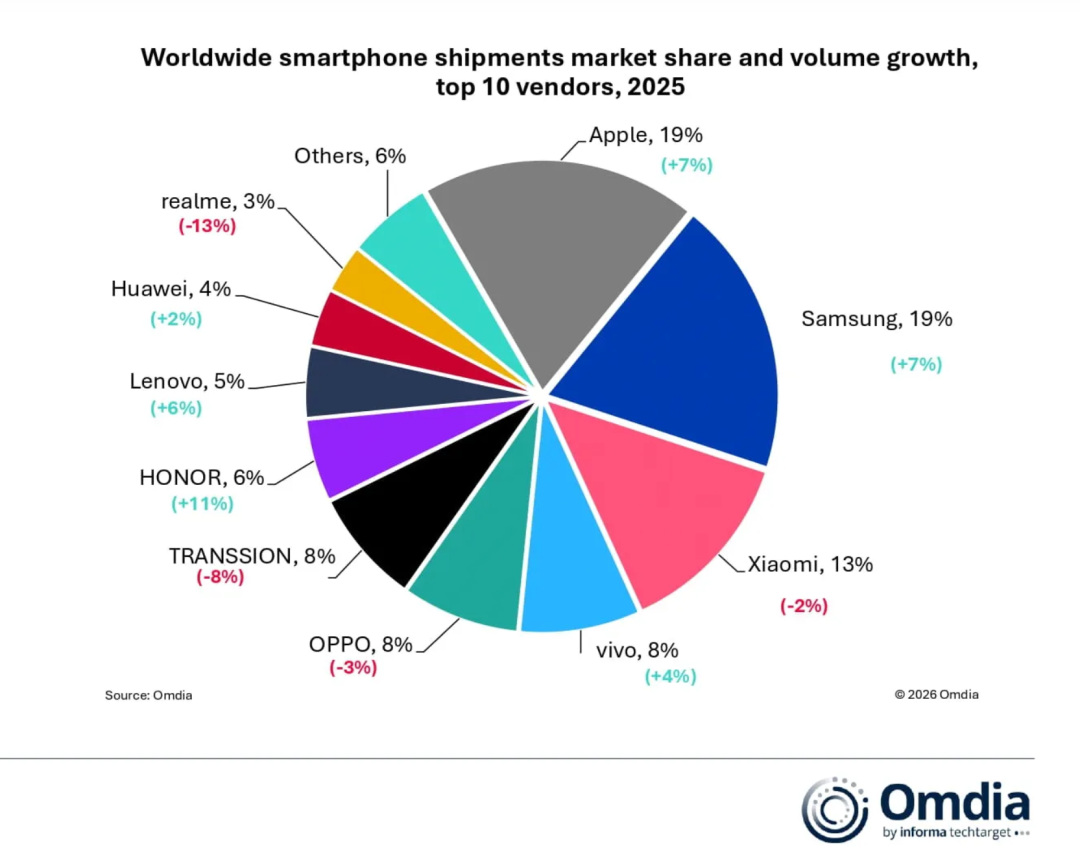
Group 1 - In 2025, Apple achieved a record annual shipment of 240.6 million iPhones, marking a 7% year-on-year increase, maintaining its position as the world's largest smartphone manufacturer for the third consecutive year [2] - Samsung rebounded in 2025 with a 7% year-on-year increase in shipments, following three years of decline, with a notable 16% increase in the fourth quarter driven by strong demand for flagship models and a recovery in the mass market [2] - Xiaomi retained its position among the top three manufacturers, but experienced a 2% decline in fourth-quarter shipments, while Vivo entered the fourth position for the first time with a 4% year-on-year increase in annual shipments [2] Group 2 - Honor achieved the highest global growth rate of 11% among the top ten manufacturers in 2025, leading in overseas shipment growth in the high-end and mid-high-end segments [3] - The global launch of the first "robot phone" HONOR ROBOT PHONE and the Honor Magic V6 foldable phone is scheduled for March 2026 at the Mobile World Congress in Barcelona [3] - Transsion, Lenovo, and Huawei reported annual shipment growth rates of 8%, 5%, and 4% respectively in 2025 [3]

影视合作拉紧中非文化交流纽带(国际视点)
Ren Min Ri Bao· 2026-02-09 00:56
Group 1 - The core viewpoint of the articles highlights the increasing popularity and acceptance of Chinese films, particularly animated films, in African countries, exemplified by the success of "Boonie Bears: Back to Earth" in South Africa [1][2] - The film "Boonie Bears: Back to Earth" has set box office records in South Africa, indicating a growing interest among local audiences for Chinese cinema [2] - Various Chinese films have been released in Africa, enriching local viewing options and fostering deeper cultural exchanges, with many viewers expressing a desire to visit China to experience its culture [2] Group 2 - The Chinese market is also opening up to African films, with events like the Beijing International Film Festival showcasing African cinema, enhancing cultural exchange [3] - Collaborative projects between Chinese and African media institutions have produced notable works, such as "Welcome to Mai Le Village," which tells stories of Chinese aid in Africa and has gained significant attention [4] - The increasing internet penetration and population in Africa present opportunities for the growth of the Chinese short drama market, with successful adaptations like "The Return of the God of War" achieving high conversion rates in Nigeria [6] Group 3 - There is a strong emphasis on talent exchange and cooperation between China and Africa, with training programs for African filmmakers in China, enhancing understanding of the Chinese film industry [7] - The development of joint productions and cultural exchanges is seen as a bridge to strengthen ties between the two regions, promoting mutual understanding and shared values [7] - The ongoing collaboration in the film industry is viewed as a significant driver for cultural exchange, with hopes for more Chinese films to be introduced to African audiences [7]