
工业富联

Search documents
电子行业跟踪报告:SW电子基金持续关注AI算力与自主可控,配置趋向多元化
Wanlian Securities· 2026-02-12 07:23
Investment Rating - The industry is rated as "Outperforming the Market" with an expected relative increase of over 10% compared to the market index in the next six months [41]. Core Insights - The SW Electronics sector's fund heavy positions and overweight ratios have increased year-on-year but decreased quarter-on-quarter, indicating a high level of interest despite recent declines [1][11]. - The focus for Q4 2025 is on AI computing power and semiconductor self-sufficiency, with key stocks including Cambricon, Haiguang Information, and SMIC leading the way [2][22]. - The semiconductor and components sectors are currently overweight, while consumer electronics have shifted to an underweight position [3][31]. Summary by Sections Fund Heavy Positions and Overweight Ratios - In Q4 2025, the SW Electronics sector's allocation ratio is 11.90%, with a quarter-on-quarter decrease of 0.52 percentage points but a year-on-year increase of 3.05 percentage points. The fund heavy position ratio is 20.22%, down 1.92 percentage points quarter-on-quarter but up 3.28 percentage points year-on-year. The overweight ratio stands at 8.32%, reflecting a quarter-on-quarter decline of 1.39 percentage points but a year-on-year increase of 0.23 percentage points [1][11][13]. Top Heavy Positions - The top ten stocks in the SW Electronics sector for Q4 2025 include Cambricon, Haiguang Information, SMIC, Luxshare Precision, and others, with semiconductor stocks making up 70% of the list. The performance of these stocks has varied, with only 40% showing gains in the quarter [2][16][22]. Focus Areas - The investment focus remains on AI computing and storage, with significant interest in companies like Cambricon and Dongshan Precision, which are leaders in their respective fields. The semiconductor self-sufficiency trend is also highlighted, with companies like Tuojing Technology and Hu Silicon Industry benefiting from domestic equipment adoption [2][22]. Subsector Allocation - The semiconductor sector is still a key focus for institutional investors, with an overweight ratio of 7.74%, despite a quarter-on-quarter decline of 0.76 percentage points. The components sector has seen a slight increase in its overweight ratio to 1.75%. In contrast, consumer electronics have shifted from overweight to underweight, now at 0.45% [3][31]. Concentration of Fund Heavy Positions - The concentration of the top five fund heavy positions in the SW Electronics sector has decreased, with their market value accounting for 35.52% of the total fund heavy positions, down 0.84 percentage points quarter-on-quarter. This trend indicates a diversification in fund allocations [3][36]. Investment Recommendations - The report suggests focusing on AI computing and semiconductor self-sufficiency as key investment opportunities. It recommends monitoring the performance of PCB and storage sectors, which are expected to benefit from the growth in AI computing [4][37].






A股狂撒3488亿春节红包!这6家每手分红超百元
2 1 Shi Ji Jing Ji Bao Dao· 2026-02-12 07:04
21世纪经济报道记者崔文静 春节临近,不少上市公司派发分红"大礼包"。 在1月1日—2月11日的短短42天内,已经有100余家上市公司分红派现。其中不乏达仁堂、泸州老窖、欧 派家居、招商银行、古井贡酒、格力电器等每手(最小持股单位)分红超100元的上市公司。 ④ 民企分红意愿明显提升,金额翻倍增长 民企春节前分红金额616亿元,同比增长1.3倍,在春节前分红中占比由2025年的8%升至18%。 科技型龙头工业富联,格力电器、伊利股份等"现金奶牛"均首次实施春节前分红,分别派发66亿元、56 亿元和30亿元。 (文章来源:21世纪经济报道) ② 金融和大消费行业继续成为分红主力 茅台、五粮液、海天味业等大消费龙头合计分红448亿元;银行业分红2434亿元,占比近七成;保险业 合计分红54亿元;11家券商分红55亿元。 ③ 分红时点整体前移,"又好又快"回馈投资者 2025年12月实施分红2647亿元,是2024年12月分红金额的3.7倍,占春节前分红总额的比重提升至七成 以上。 相较于往年,今年上市公司分红呈现四大亮点: ① 春节前分红金额再创新高 2025年12月至2026年1月底,沪深北证券交易所235家上 ...
国补及春节促销催热家电3C消费市场,消费电子ETF(561600)涨近1%
Xin Lang Cai Jing· 2026-02-12 05:25
数据显示,截至2026年1月30日,中证消费电子主题指数(931494)前十大权重股分别为寒武纪、立讯精 密、中芯国际、工业富联、兆易创新、澜起科技、京东方A、豪威集团、东山精密、生益科技,前十大 权重股合计占比53.34%。 截至2026年2月12日 13:08,中证消费电子主题指数(931494)强势上涨1.03%,成分股环旭电子上涨 10.01%,东山精密上涨6.44%,士兰微上涨5.33%,芯原股份,兴森科技等个股跟涨。消费电子 ETF(561600)上涨0.90%,最新价报1.23元。 节前消费电子利好不断,消息面上,新一轮国补落地,消费者已可在线申领数码及智能产品购新补贴。 目前市场新春消费热度已明显升温,有华为手机门店店员称,忙核销顾不上吃饭,部分热门机型出现缺 货。受铜、存储等上游原材料、零部件涨价传导,终端产品涨价趋势已现。目前已有烤箱、手机因成本 压力提价,业内预计年后部分空调产品价格或继续上调。 中国银河证券指出,建议持续关注AI端侧创新和苹果创新周期相关投资机会。电视面板保持小幅涨价 趋势,建议关注LCD面板资产低风险收益机会。 消费电子ETF紧密跟踪中证消费电子主题指数,中证消费电子 ...
质量ETF中金(515910)涨0.45%,半日成交额61.70万元
Xin Lang Cai Jing· 2026-02-12 04:04
2月12日,截止午间收盘,质量ETF中金(515910)涨0.45%,报0.670元,成交额61.70万元。质量ETF 中金(515910)重仓股方面,中际旭创截止午盘跌0.17%,紫金矿业涨1.70%,新易盛跌0.31%,贵州茅 台跌1.42%,工业富联跌0.24%,五粮液跌1.18%,洛阳钼业涨0.78%,阳光电源涨2.96%,北方华创跌 0.59%,美的集团涨0.08%。 来源:新浪基金∞工作室 质量ETF中金(515910)业绩比较基准为MSCI中国A股国际质量指数收益率,管理人为中金基金管理有 限公司,基金经理为耿帅军,成立(2021-01-21)以来回报为-33.14%,近一个月回报为-0.54%。 声明:市场有风险,投资需谨慎。本文基于第三方数据库自动发布,不代表新浪财经观点,任何在本文 出现的信息均只作为参考,不构成个人投资建议。如有出入请以实际公告为准。如有疑问,请联系 biz@staff.sina.com.cn。 ...
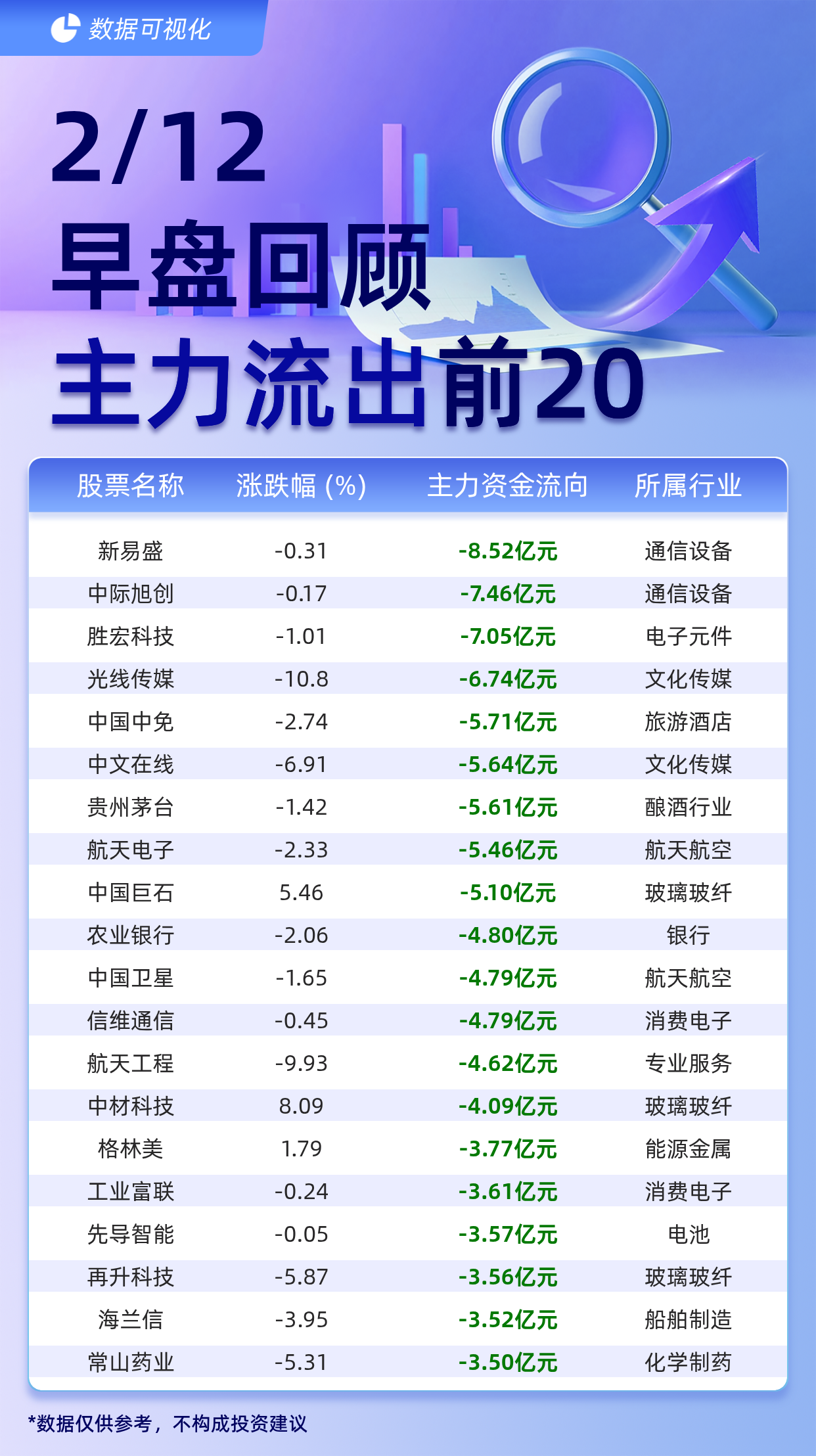
主力个股资金流出前20:新易盛流出8.52亿元、中际旭创流出7.46亿元
Jin Rong Jie· 2026-02-12 03:58
Group 1 - The main stocks with significant capital outflows include Xinyi Technology (-8.52 billion), Zhongji Xuchuang (-7.46 billion), and Shenghong Technology (-7.05 billion) [1] - Other notable stocks with capital outflows are Light Media (-6.74 billion), China Duty Free Group (-5.71 billion), and Zhongwen Online (-5.64 billion) [1] - Guizhou Moutai experienced a capital outflow of -5.61 billion, while Aerospace Electronics saw -5.46 billion [1] Group 2 - The stock performance shows that Xinyi Technology had a decline of -0.31%, and Zhongji Xuchuang decreased by -0.17% [2] - Light Media faced a significant drop of -10.8%, while Zhongwen Online fell by -6.91% [2] - Guizhou Moutai's stock decreased by -1.42%, and Aerospace Electronics dropped by -2.33% [2] Group 3 - Other companies with notable capital outflows include Agricultural Bank (-4.80 billion) and China Satellite (-4.79 billion) [3] - Industrial Fulian had a slight decline of -0.24%, while Xian Dao Intelligent saw a minimal change of -0.05% [3] - The overall trend indicates a significant capital outflow from various sectors, including telecommunications, media, and banking [1][2][3]




上证180指数上涨0.19%,上证180ETF指数基金(530280)实现3连涨
Sou Hu Cai Jing· 2026-02-12 02:00
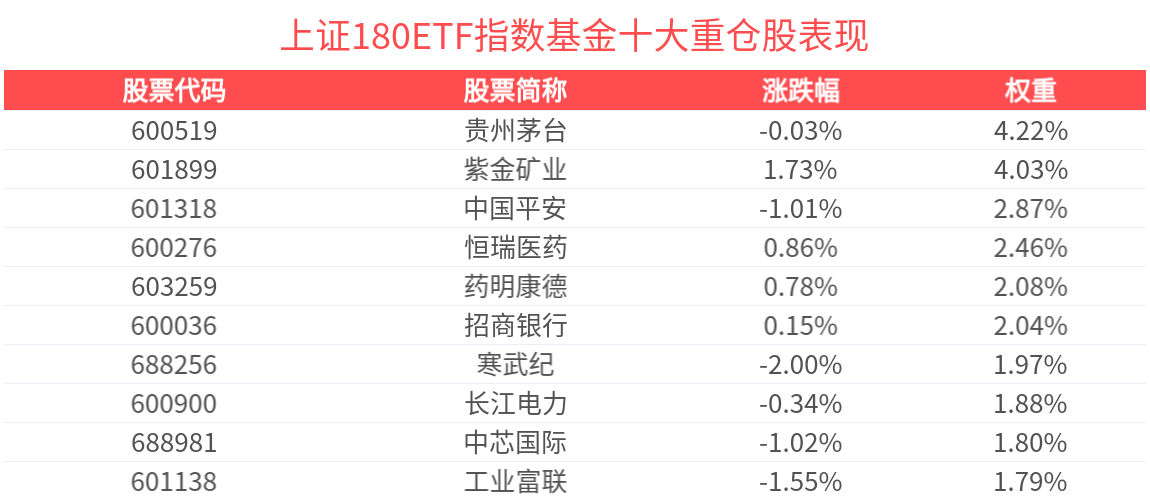
Core Viewpoint - The Shanghai 180 ETF Index Fund has shown significant growth in both scale and performance, with notable increases in net value and share volume, indicating strong investor interest and market confidence [1][3]. Performance Summary - As of February 11, 2026, the Shanghai 180 Index rose by 0.19%, with constituent stocks like China Jushi and Huayou Cobalt experiencing gains of 9.99% and 5.45% respectively [1]. - The Shanghai 180 ETF Index Fund has achieved a 14.74% increase in net value over the past six months, with a maximum monthly return of 9.13% since inception [1]. - The fund has a historical one-year profit probability of 100%, with an average monthly return of 3.08% and a monthly profit percentage of 75% [1]. Liquidity and Scale - The Shanghai 180 ETF Index Fund recorded a turnover rate of 0.43% with a trading volume of 24.91 million yuan on February 11, 2026, and an average daily trading volume of 70.58 million yuan over the past week [1]. - The fund's scale has increased by 32.33 million yuan over the past year, ranking second among comparable funds [1]. Share Growth - The number of shares for the Shanghai 180 ETF Index Fund has grown by 21 million shares in the past year, also ranking second among comparable funds [1]. Risk and Fee Structure - The fund's management fee is 0.15% and the custody fee is 0.05%, which are among the lowest in comparable funds [3]. - The maximum drawdown for the fund this year is 4.28%, with a tracking error of 0.019% over the past three months, indicating high tracking precision [3]. Top Holdings - As of January 30, 2026, the top ten weighted stocks in the Shanghai 180 Index account for 24.85% of the index, with major companies including Zijin Mining and Kweichow Moutai [3].
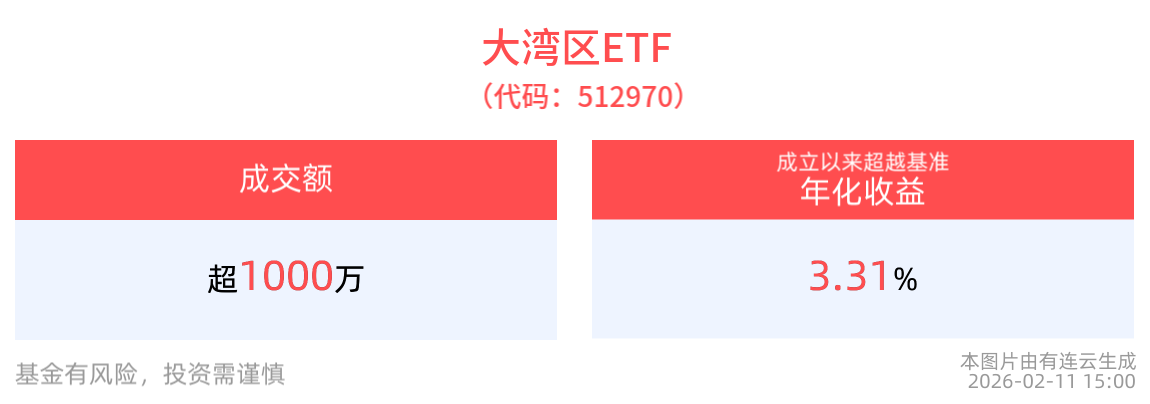
成交额超1000万元,大湾区ETF(512970)成立以来超越基准年化收益达3.31%
Xin Lang Cai Jing· 2026-02-12 01:56
Group 1 - The core index, the CSI Guangdong-Hong Kong-Macao Greater Bay Area Development Theme Index, has seen a decline of 0.63% as of February 11, 2026 [2] - The top-performing stocks include Greenmeadow with a rise of 9.95%, Xinjubang up by 8.16%, and Shengyi Technology increasing by 2.55% [2] - The ETF tracking this index, with a recent price of 1.51 yuan, has decreased by 0.59% [2] Group 2 - The Greater Bay Area ETF has a turnover rate of 16.96% during trading, with a total transaction volume of 11.77 million yuan, indicating active market participation [2] - The ETF has a one-year Sharpe ratio of 1.41 as of February 6, 2026 [2] - The maximum drawdown for the ETF this year is 5.52%, with a relative benchmark drawdown of 0.02% [2] Group 3 - The CSI Guangdong-Hong Kong-Macao Greater Bay Area Development Theme Index reflects the performance of listed companies benefiting from the Greater Bay Area development [3] - The index includes various sub-indices, selecting a maximum of 50 Hong Kong market securities, 300 companies from the Shanghai-Hong Kong-Shenzhen market, and 100 mainland market securities [3] - The top ten weighted stocks in the index account for 44.55% of the total index weight, with notable companies including Ping An Insurance, Luxshare Precision, and BYD [3][4] Group 4 - The top ten stocks by weight in the index show varied performance, with Ping An Insurance down by 1.01% and BYD up by 1.62% [4] - The weight of the top stock, Ping An Insurance, is 8.31%, while the lowest weight among the top ten is 2.63% for Mindray Medical [4]
沪深北235家公司春节前分红3488亿元创纪录,金融消费行业领跑
Jin Shi Shu Ju· 2026-02-12 01:29
Group 1 - The core viewpoint of the article highlights the increasing trend of pre-Spring Festival dividends among listed companies, with a total amount of 348.8 billion yuan, surpassing the previous year's total of 344.6 billion yuan, setting a new record [1] - The financial and consumer sectors continue to dominate dividend distributions, with the banking sector contributing 243.4 billion yuan, accounting for nearly 70% of the total, and major companies like China Merchants Bank and Industrial Bank joining the trend [1] - The willingness of private enterprises to distribute dividends has significantly increased, with a total of 61.6 billion yuan, a year-on-year growth of 130%, indicating a broader reach to investors [3] Group 2 - Major companies such as Yangtze Power and Luxshare Precision are showing strong dividend intentions, with Yangtze Power planning to distribute over 5.1 billion yuan, maintaining a high dividend rate due to its stable power generation capabilities [2] - The overall timing of dividend distributions has advanced, with a significant increase in the amount distributed in December 2025, which is 3.7 times that of December 2024, benefiting investors by allowing them to enjoy the time value of money [3] - Regulatory bodies have been promoting improvements in the dividend system, transitioning from "soft constraints" to "hard requirements," which has encouraged companies to prioritize shareholder returns [3][4]
分红金额再创新高 上市公司春节前派发超3000亿元“红包”
Zhong Guo Zheng Quan Bao· 2026-02-11 21:01
Core Viewpoint - The total dividend amount distributed by listed companies before the Spring Festival has exceeded the previous year, reaching a new high of 348.8 billion yuan, indicating a strong commitment to enhancing investor returns and satisfaction [1] Group 1: Dividend Distribution Overview - From December 2025 to January 2026, 235 listed companies on the Shanghai and Shenzhen stock exchanges distributed a total of 348.8 billion yuan in dividends before the Spring Festival, surpassing the 344.6 billion yuan from the previous year [1] - The financial and consumer sectors remain the primary contributors to dividend distributions, with banking companies alone distributing 243.4 billion yuan, accounting for nearly 70% of the total [1][2] Group 2: Industry-Specific Insights - Major banks, including China Merchants Bank and Industrial Bank, have joined the trend of pre-Spring Festival dividends, distributing a total of 37.5 billion yuan [2] - Leading consumer companies such as Kweichow Moutai, Wuliangye, and Haitian Flavoring & Food have collectively distributed 44.8 billion yuan in dividends, reflecting their commitment to enhancing intrinsic value and investor confidence [3] Group 3: Changes in Dividend Timing - The timing of dividend distributions has shifted earlier, with a total of 264.7 billion yuan distributed in December 2025, which is 3.7 times the amount from December 2024, and now accounting for over 70% of the total pre-Spring Festival dividends [4] - Major banks have also advanced their dividend payments to December 2025, with a combined total of 189.9 billion yuan [4] Group 4: Private Company Dividend Trends - The willingness of private listed companies to distribute dividends has significantly increased, with a total of 61.6 billion yuan distributed, representing a year-on-year growth of 130% and an increase in their share of total dividends from 8% to 18% [5] - Notable private companies such as Industrial Fulian, Gree Electric, and Yili have also initiated pre-Spring Festival dividends for the first time, distributing 6.6 billion yuan, 5.6 billion yuan, and 3 billion yuan respectively [5]


上市公司春节前派发超3000亿元“红包”
Zhong Guo Zheng Quan Bao· 2026-02-11 20:23
Group 1 - The total dividend amount distributed by listed companies before the Spring Festival has exceeded the previous year, reaching a new high of 348.8 billion yuan, surpassing the 344.6 billion yuan from the previous year [1] - Financial and consumer sectors continue to be the main contributors to dividends, with banking companies distributing 243.4 billion yuan, accounting for nearly 70% of the total [1] - The trend of pre-Spring Festival dividends reflects companies' commitment to enhancing investor returns and aligning dividend distribution with shareholder expectations [1][2] Group 2 - Major consumer companies such as Kweichow Moutai and Wuliangye collectively distributed 44.8 billion yuan in dividends, indicating a strong commitment to enhancing company value and investor confidence [2] - The timing of dividend distributions has generally advanced, allowing investors to benefit from earlier cash returns and better cash flow planning for the new year [3] - The willingness of private companies to distribute dividends has significantly increased, with a total of 61.6 billion yuan distributed, a 130% year-on-year growth, now accounting for 18% of the total pre-Spring Festival dividends [3] Group 3 - Regulatory bodies are promoting improvements in the dividend system, which includes restrictions on major shareholders' sell-offs for companies with low or no dividends, encouraging companies to prioritize shareholder returns [4] - The increase in cash dividends, especially among private companies, is seen as a significant indicator of the high-quality development of the capital market [4]