Blue Owl Capital Inc.

Search documents
索罗斯Q4调仓路线图:猛砍Snowflake,狂买微软、英伟达,新建仓黄金股
美股IPO· 2026-02-14 04:12
Core Viewpoint - Soros Fund Management made significant adjustments to its investment portfolio in the fourth quarter, focusing on increasing exposure to tech giants while engaging in "buy high, sell low" strategies for energy and cryptocurrency stocks [1]. Group 1: Technology Sector Investments - The fund substantially increased its holdings in core technology stocks, including adding 161,000 shares of Microsoft (MSFT.US), 118,000 shares of Nvidia (NVDA.US), and approximately 66,000 shares of Apple [3]. - In the software and mobility sectors, the fund also increased its positions by acquiring approximately 216,000 shares of Atlassian (TEAM.US), 55,000 shares of Salesforce (CRM.US), and 119,000 shares of Uber (UBER.US) [3]. Group 2: Defensive and Growth Investments - In the defensive sector and consumer space, the fund increased its holdings in utility company Exelon (EXC.US) by approximately 488,000 shares and in gaming giant Electronic Arts (EA.US) by about 318,000 shares [3]. Group 3: Reduction in High Volatility and Financial Stocks - The fund reduced its positions in high-volatility and financial stocks, significantly cutting approximately 168,000 shares of Snowflake (SNOW.US) [4]. - It also reduced its holdings in Circle Internet Group (CRCL.US) by about 151,000 shares and in Interactive Brokers (IBKR.US) by approximately 813,000 shares, indicating a cautious stance towards the financial brokerage sector [5][6]. Group 4: New Positions and Exits - The fund opened new positions by purchasing gold-related assets such as New Gold (NGD.US) and established positions in DigitalBridge (DBRG.US), Blue Owl Capital (OWL.US), Exact Sciences (EXAS.US), and Xcel Energy (XEL.US) [7]. - It completely exited positions in KeyCorp (KEY.US), CareTrust REIT (CTRE.US), Cipher Mining (CIFR.US), and KKR & Co. (KKR.US), indicating a shift away from traditional banking and certain cryptocurrency mining stocks towards more stable or defensive sectors [7]. Group 5: Overall Strategy - The overall strategy of Soros Fund Management in the fourth quarter reflects a clear approach: embracing AI and core tech assets like Microsoft and Nvidia while avoiding high-volatility cloud and data companies like Snowflake, and hedging against macroeconomic uncertainties by investing in gold stocks. This "pick and choose" adjustment strategy highlights the pursuit of certainty and safety margins amid global economic uncertainties [7].








新“次贷危机”?美国PE的“软件业贷款敞口”比财报显示的更大
Hua Er Jie Jian Wen· 2026-02-14 02:51
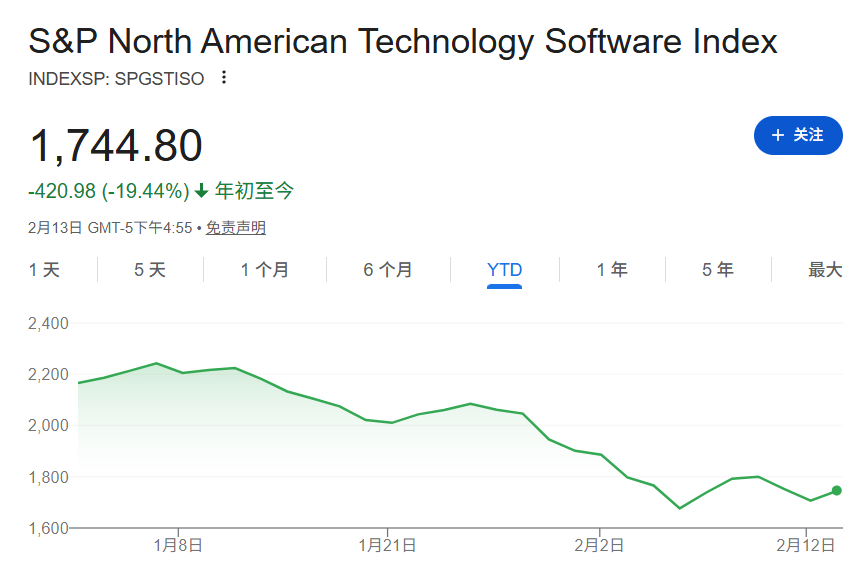
Core Insights - The private credit industry's actual loan exposure to the software sector may significantly exceed disclosed levels, with at least 250 investments worth over $9 billion not classified as software loans despite being defined as such by other lenders or sponsors [1][2] - The software sector has become the largest single industry exposure for Business Development Companies (BDCs), accounting for approximately 20% of all loans held by BDCs, compared to 13% in the broader leveraged loan market [2][6] - The classification inconsistencies among BDCs complicate the assessment of risk exposure, especially as AI technologies threaten traditional software business models [1][7] Group 1: Classification Issues - A review of disclosures from major BDCs revealed that software companies are often categorized under different industry classifications, leading to a lack of clarity regarding their actual exposure [3][4] - For instance, companies like Pricefx and Kaseya, which identify as software firms, have been classified as "business services" and "professional retail" respectively by their lenders, highlighting the discrepancies in classification standards [3][4] - This inconsistency extends even within the same company, as seen with Blue Owl Capital, where the same firms are classified differently across various funds [5] Group 2: Market Risks and Concerns - The influx of private equity funds into the software sector has been significant, with approximately 30% of private equity capital flowing into this industry over the past decade, and software accounting for 40% of all sponsor-backed private credit [6] - Recent advancements in AI technology have raised concerns about the future of software businesses, with the S&P North American Software Index dropping over 20% this year, indicating heightened market anxiety [7][10] - Analysts warn that the ongoing AI revolution is fundamentally altering the software industry, rendering historical classification guidelines obsolete and increasing scrutiny on private credit managers [10]


遭软件抛售潮波及,美股私募巨头高管纷纷出面安抚投资者
Zhi Tong Cai Jing· 2026-02-13 13:25
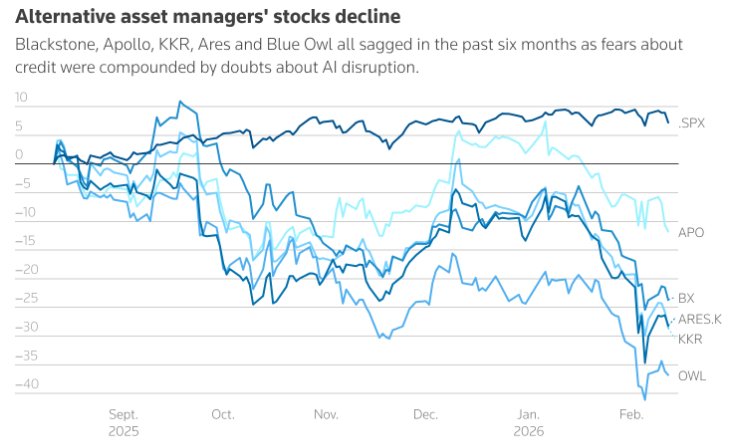
Core Viewpoint - Private equity firms are striving to convince investors that their portfolios are resilient against the recent sell-off in the software sector, driven by concerns over artificial intelligence undermining competitiveness in the industry [1] Group 1: Company Performance and Portfolio Exposure - Ares reported that approximately 6% of its overall assets are invested in software companies, with a diversified portfolio minimizing exposure to AI-related risks [2] - Apollo Global Management has less than 2% exposure to the software industry, with its private equity business having nearly zero exposure [2] - KKR has about 7% of its portfolio in the software sector, while Blue Owl has 8%, both experiencing significant stock price declines of 29% and over 36% respectively in the past six months [3][6] Group 2: Market Reactions and Investor Sentiment - Despite strong financial performance, private equity firms have seen stock sell-offs, with one firm experiencing a nearly 6% drop this week and an 11% decline over the past six months [3] - Concerns about excessive investments in AI by alternative asset management firms have led to fears of potential losses if AI fails [6][7] - Analysts suggest that the narrative around alternative asset management firms suffering losses due to AI's transformative impact may be flawed, indicating a potential misjudgment in market sentiment [7]

高盛牵头35亿美元贷款收购Clearwater Analytics(CWAN.US) 私人信贷仍看好软件赛道
Zhi Tong Cai Jing· 2026-02-13 07:47
Group 1 - A consortium of private credit firms, led by Goldman Sachs Alternative Investment Fund, will provide $3.5 billion to support the acquisition of Clearwater Analytics (CWAN.US) [1] - The debt issuance will carry a premium of 4.5 percentage points over the U.S. benchmark interest rate [1] - The acquisition, led by private equity firms Permira Holdings and Warburg Pincus, values Clearwater at approximately $8.4 billion and is expected to close by mid-2026 [1] Group 2 - Clearwater provides a cloud software platform for institutional investors in both public and private markets [2] - Recent market focus on the potential of artificial intelligence replacing software services has led to a decline in debt prices for some companies, casting a shadow over private equity investments in software [2] - The financing for the acquisitions of OneStream and Clearwater indicates that private credit institutions remain open to the software sector despite scrutiny over their exposure to risks [2]

Uh-Oh! Is Meta Platforms Following in Enron's Footsteps?
247Wallst· 2026-02-12 17:21
Core Viewpoint - Meta Platforms is facing scrutiny over its $27 billion Hyperion data center joint venture, with comparisons being drawn to Enron's accounting practices, raising concerns about off-balance-sheet tactics and potential risks to investor confidence [1][2]. Group 1: Hyperion Deal and Accounting Structure - Meta announced the Hyperion project in October, partnering with Blue Owl Capital to build a large AI data center expected to be operational by 2029, with Meta holding a 20% stake and Blue Owl owning 80% [1]. - The joint venture issued $27.3 billion in bonds, marking the largest private-credit transaction on record, to finance the project, while Meta provides construction services and a residual value guarantee [1]. - The project is classified as a variable interest entity (VIE) under accounting standards, allowing Meta to keep the assets and liabilities off its consolidated balance sheet, which helps manage its capital expenditures without inflating reported debt figures [1]. Group 2: Accounting Scrutiny and Regulatory Concerns - Ernst & Young flagged the accounting treatment of the Hyperion JV as a "critical audit matter" in Meta's annual 10-K report, indicating significant judgment and complexity involved in determining that Meta is not the primary beneficiary [1]. - Concerns have been raised about the potential underreporting of Meta's financial obligations, especially with projected capital expenditures of $115 billion to $135 billion in 2026, which could affect debt ratios and credit ratings if reclassification occurs [1]. - Critics have drawn parallels to Enron's use of VIEs to conceal liabilities, suggesting that Meta's structure may obscure risks and could lead to restatement if AI demand weakens [1]. Group 3: Investor Sentiment and Market Position - Despite the scrutiny, Meta's core advertising revenue growth and market position remain strong, suggesting that the stock is not overly risky for diversified, long-term portfolios [2]. - The situation does not equate to Enron-level fraud, as the structure is fully disclosed and audited, with no evidence of concealment or misrepresentation [1]. - Supporters of Meta argue that the arrangement complies with accounting rules and is an innovative financing method that leverages Blue Owl's expertise without undue strain on the balance sheet [1].


Uh-Oh! Is Meta Platforms Following in Enron’s Footsteps?
Yahoo Finance· 2026-02-12 17:21
Core Insights - Meta Platforms is facing scrutiny over its $27 billion Hyperion data center joint venture, raising concerns about its off-balance-sheet accounting practices [3][6][7] - The Hyperion project, in partnership with Blue Owl Capital, is set to become operational in 2029, with Meta holding a 20% stake [3][4] - The joint venture issued $27.3 billion in bonds, marking the largest private-credit transaction on record, to finance the data center infrastructure [4][7] Accounting Structure - The project is classified as a variable interest entity (VIE) under accounting standards, allowing Meta to keep the assets and liabilities off its consolidated balance sheet [5] - Meta's determination that it is not the primary beneficiary of the VIE means it has limited exposure and lacks control over key activities [5][6] - Concerns have been raised regarding the assumptions made about Meta's lack of control, which could lead to risks if those assumptions are proven incorrect [6][7] Future Projections - Meta anticipates capital expenditures between $115 billion and $135 billion by 2026 as it accelerates spending on AI infrastructure [7]
Five Point Holdings, LLC Announces New Hearthstone Residential Land Banking Investment Partnership With Blue Owl Managed Funds
Businesswire· 2026-02-10 21:16
IRVINE, Calif.--(BUSINESS WIRE)--Five Point Holdings, LLC ("Five Point†or the "Company†) (NYSE:FPH), an owner and developer of large mixed-use planned communities in California, today announced the formation of a new residential land banking investment partnership executed by its Hearthstone Residential Holdings platform ("Hearthstone†), with funds managed by Blue Owl Capital Inc. ("Blue Owl†) (NYSE: OWL). The investment partnership is designed to support the acquisition of residential homesit. ...


Blue Owl Capital (OWL)’s CEO Mark Lipschultz Says AI Could Not Temper Software and Technology-Linked Businesses
Yahoo Finance· 2026-02-10 19:56
Core Insights - Blue Owl Capital Inc. (NYSE:OWL) is identified as one of the 14 oversold value stocks to consider for investment [1] - Co-CEO Mark Lipschultz commented on the limitations of AI in stabilizing software and technology-linked businesses amid a significant market selloff [2] - The company reported strong fourth-quarter results, with adjusted EPS of $0.24, exceeding forecasts, driven by robust performance in credit and real assets [3] Financial Performance - For Q4, Blue Owl Capital achieved adjusted EPS of $0.24, surpassing the expected $0.22 [3] - New capital commitments reached $17.3 billion, contributing to total assets under management (AUM) exceeding $300 billion [3] - The software segment constitutes only 8% of total AUM, indicating limited exposure to the recent market downturn [2] Market Context - The S&P 500 software and services index experienced a selloff, losing over $800 billion since January 28, impacting technology-linked businesses [2] - Despite the market challenges, Blue Owl Capital demonstrated stable performance and minimal losses post-earnings call [2] - Analysts from Oppenheimer expressed optimism regarding the company's growth and resilience in private credit demand, even in tighter lending conditions [3]
Goldman Sachs CEO Solomon calls software rout 'too broad' as Wall Street looks to steady investor nerves
Yahoo Finance· 2026-02-10 16:49
Group 1: Market Sentiment and AI Impact - Goldman Sachs CEO David Solomon described the recent sell-off in software stocks as "a little bit too broad," suggesting that the market reaction may be overblown and urging patience among investors [1][2] - Solomon indicated that there will be both winners and losers in the software industry as companies adapt to AI advancements, emphasizing that many firms will successfully pivot [2] - Smaller alternative asset managers, such as Blue Owl, experienced significant pressure on their stocks due to their exposure to software companies affected by AI developments [3] Group 2: Company Perspectives and Future Outlook - Blue Owl's CEO criticized the notion that Fortune 500 companies would completely replace their software with AI solutions, highlighting the complexity of the transition [4] - Solomon noted that while Goldman Sachs is monitoring AI-related disruptions in the software sector, the bank's exposure to this industry is "insignificant" to its overall platform [4] - Looking ahead, Solomon expressed optimism for dealmaking in 2026, particularly in mergers and acquisitions (M&A), predicting a constructive year for capital markets [5] Group 3: Investment Banking Performance - Investment banking revenue globally has increased by 10% so far this year, driven by M&A and bond underwriting activities [6] - Major deals in investment banking this year include Elon Musk's SpaceX acquiring xAI and significant bond offerings from tech giants Oracle and Alphabet, both of which are planning substantial investments in AI [6]

Why BDC Dividend Cuts Aren't The Red Flag Investors Think
Seeking Alpha· 2026-02-09 22:05
Group 1 - High Yield Investor is celebrating its fifth anniversary by offering a 30-day money-back guarantee, encouraging new memberships with the release of their Top Picks for 2026 [1] - Private credit stocks have experienced a significant decline, highlighted by the weakness in publicly traded business development companies (BDCs) and alternative asset managers with a heavy focus on private credit [1] - The High Yield Investor team, led by Samuel Smith, focuses on balancing safety, growth, yield, and value in their investment strategies, offering various portfolio services including core, retirement, and international portfolios [1]