Databricks

Search documents
OpenAI、Space X和Anthropic,三大“超级IPO”或齐聚今年,单笔募资额预计超过2025年200家IPO总和
Hua Er Jie Jian Wen· 2026-01-02 06:13
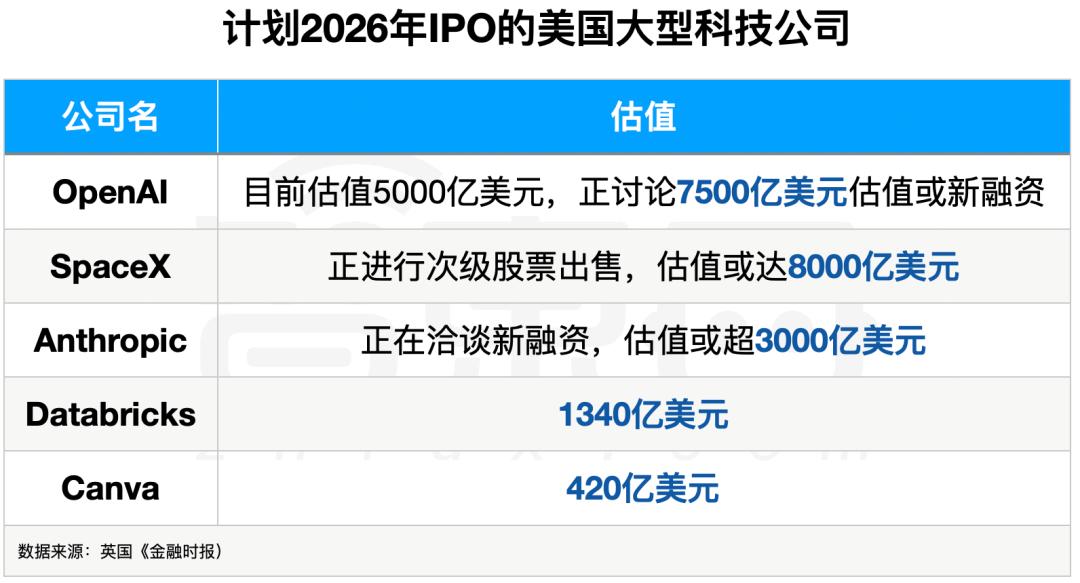
Core Insights - Wall Street is anticipating a historic capital feast as the top three U.S. tech unicorns—SpaceX, OpenAI, and Anthropic—are preparing for IPOs, potentially starting this year [1] - The successful IPO of any of these companies could surpass the total fundraising of approximately 200 IPOs in the U.S. in 2025 [1] - The IPOs are expected to generate hundreds of billions in underwriting and consulting revenue for investment banks, law firms, and venture capitalists, marking a potentially record year for profits [1] Group 1: SpaceX - SpaceX is advancing a secondary market stock sale with a valuation of up to $800 billion and plans to go public within the next 12 months if there are no major market disruptions [2] - The fundraising from SpaceX alone is expected to break the record set by Saudi Aramco's $29 billion IPO in 2019, making it the largest IPO in history [2] Group 2: OpenAI and Anthropic - OpenAI, the parent company of ChatGPT, has a current valuation of $500 billion and is negotiating a new funding round with a target valuation of $750 billion or higher [3] - Anthropic has officially engaged a prominent law firm to initiate its IPO preparations and is in discussions for a new funding round with a target valuation exceeding $300 billion [3] - Both OpenAI and Anthropic have been restructuring their governance and hiring executives with IPO experience to facilitate their public offerings [3] Group 3: Other Potential IPOs - Databricks, valued at $134 billion, and Canva, valued at $42 billion, are also on the potential IPO list for this year [3] Group 4: Market Context - The IPO market in 2026 is attempting to recover from the previous year's downturn, which saw a significant drop in large tech IPOs due to external economic pressures [5][6] - In the first nine months of 2025, the total IPO fundraising in the U.S. was just over $30 billion, indicating that any successful IPO from the three giants could significantly outpace last year's figures [6] - Despite recent market uncertainties, the prevailing view is that these three companies possess the strength to navigate economic cycles and are seen as drivers of the macro economy [6]
13万亿!巨无霸IPO扎堆今年,投资人赚疯了
3 6 Ke· 2026-01-02 03:11
Core Insights - Major US tech companies SpaceX, OpenAI, and Anthropic are preparing for IPOs this year, with expected fundraising totaling hundreds of billions of dollars, potentially exceeding the total fundraising of approximately 200 IPOs in the US by 2025 [1][7] - The combined valuation of these three companies is projected to reach an astonishing 13 trillion RMB [2] - SpaceX is expected to conduct the largest IPO in history, with a valuation of around 1.5 trillion USD (approximately 10.6 trillion RMB) anticipated for its IPO, possibly in mid to late 2026 [2][8] Company Summaries - **OpenAI**: Currently valued at 500 billion USD (approximately 3.5 trillion RMB), OpenAI is negotiating for a new valuation of 750 billion USD (approximately 5.2 trillion RMB) [4][5] - **SpaceX**: Engaged in a secondary stock sale, with a valuation expected to reach 800 billion USD (approximately 5.6 trillion RMB) [4][5] - **Anthropic**: In discussions for new financing, with a valuation expected to exceed 300 billion USD (approximately 2.1 trillion RMB) [4][6] - **Databricks**: Valued at 134 billion USD (approximately 937.1 billion RMB) [2][4] - **Canva**: Valued at 42 billion USD (approximately 293.7 billion RMB) [2][4] Market Implications - The fundraising from these IPOs is anticipated to create significant opportunities for investment banks, law firms, and investors, marking a potentially record-breaking year for returns [7][10] - The successful IPOs of these companies could lead to a substantial increase in the overall IPO fundraising total, with expectations that even one of these companies could surpass the previous record set by Saudi Aramco's IPO [8][10] - The current market sentiment towards AI and tech sectors is optimistic, despite previous uncertainties regarding AI market bubbles [10]

The biggest startups raised a record amount in 2025, dominated by AI
Yahoo Finance· 2026-01-01 11:00
Core Insights - The excitement surrounding artificial intelligence has led to a record year of fundraising for AI companies in 2025, with a total of $150 billion raised, surpassing the previous high of $92 billion in 2021 [2] Group 1: Funding and Investment - The largest private U.S. companies raised a record $150 billion in 2025, with significant allocations to major AI firms like OpenAI and Anthropic [2] - OpenAI raised $40 billion, marking the largest private funding round in history, while Anthropic secured $13 billion and Elon Musk's xAI raised $10 billion [3] - Several other AI companies, including Jeff Bezos' Project Prometheus and Databricks, exceeded the $2 billion funding threshold during the year [5] Group 2: Market Dynamics - The concentration of capital in a few large AI companies raises concerns about long-term systemic risks in the venture capital market, as highlighted by PitchBook analyst Kyle Stanford [4] - The top four funding deals accounted for over 30% of the total deal value, indicating a trend towards larger investments in fewer companies [3] Group 3: Future Projections - Big Tech companies are projected to invest more than $500 billion in 2026 to develop AI infrastructure, including networks and data centers [8] - The promise of AI in 2026 hinges on the broader adoption of "AI agents" that can autonomously perform tasks, which is expected to significantly impact the economy [7] Group 4: Public Market Impact - The AI hype has influenced the public market, with nine of the top ten most valuable companies being tech firms benefiting from AI advancements, collectively valued at over $3 trillion [6]
明略科技20251231
2025-12-31 16:02
Summary of Key Points from the Conference Call Company and Industry Overview - **Company**: Minglue Technology (明略科技) - **Industry**: AI-driven enterprise solutions, focusing on B2B applications and models, particularly in the context of Authentic AI and autonomous agents [2][8] Core Insights and Arguments - **Meta's Acquisition of Menlo**: Meta acquired Menlo for its Manas product, which utilizes LLM-driven autonomous agent capabilities to enhance AI efficiency. This acquisition marks Meta's third-largest deal in history [2][3] - **Minglue's Transformation**: Minglue is transitioning into an AI-driven enterprise, concentrating on B2B models and agent application development to create a high-efficiency human-machine collaboration platform [2][8] - **Impact of AI on Consumer Behavior**: AI applications in personal assistance and procurement are reshaping how consumers access information and shop, leading to significant competition among tech giants like Meta and Google [2][9] - **Authentic AI's Potential**: Authentic AI is expected to reconstruct the enterprise software industry, particularly in code writing and data mining, with leading companies like Anthropic, Palantir, and Databricks potentially replacing knowledge-intensive service jobs [2][11] Additional Important Content - **Stages of AI Application**: Huang Renxun categorizes AI applications into four stages: perceptual AI, generative AI, AGENT AI, and physical world robotics, highlighting the substantial computational demands of AGENT AI [2][12] - **Minglue's New Concepts**: The concept of "Agentic Marketing" was introduced, where each stakeholder has its own AI agent collaborating to reshape the advertising industry [2][13] - **Consumer Behavior Changes**: As consumers increasingly rely on AI for product selection and purchasing, marketing strategies are evolving, with niche brands gaining more visibility through AI recommendations [2][15] - **AI Agent and Tool Relationships**: The relationship between AI agents and tools can be based on API calls or GUI operations, with Minglue leading in GUI capabilities, particularly in small model performance [2][33] - **Future of AI Agents**: AI agents are seen as digital labor, with potential applications in labor-intensive industries such as law, advertising, and software development [2][37] Competitive Landscape - **Minglue's Global Competitiveness**: Minglue ranks highly in AI model performance, with its 72B model achieving the top position globally, showcasing its strength in the computer use agent domain [2][23][24] - **Challenges in the B2C Market**: Minglue opted for the B2B market to avoid the competitive pressures of the B2C space, where large companies dominate [2][30][31] Future Directions - **Technological Advancements**: The development of computer use agents is expected to require significant investment and time, with experts suggesting a decade may be needed for full automation of human tasks [2][25] - **Investment in Data**: Minglue emphasizes the importance of data investment to enhance AI capabilities and improve overall performance in the market [2][26]
IBM收购Confluent 强化数据和自动化投资组合
Sou Hu Cai Jing· 2025-12-30 14:20
Core Viewpoint - IBM has agreed to acquire Confluent, a cloud-native enterprise data streaming platform, to enhance its AI application development tools and expand its hybrid cloud and AI strategy, with the deal expected to generate significant product synergies [2][3]. Group 1: Acquisition Details - The acquisition is valued at $11 billion and is anticipated to be completed by mid-next year [2][7]. - Confluent provides services that connect and clean data sources, built on Apache Kafka, allowing customers to avoid managing their own server clusters [2][6]. Group 2: Strategic Implications - The acquisition fills a critical gap in IBM's watsonx AI platform by enabling real-time data monitoring, which is essential for developing more complex intelligent agents and applications [3][7]. - IBM is positioning itself to compete with AI-native big data companies like Snowflake and Databricks, aiming for a comprehensive AI platform that integrates real-time data consumption and processing [3][6]. Group 3: Market Context - The timing of the acquisition is strategic, as Confluent's revenue growth has been slowing, and it was reportedly seeking a buyer [6]. - This move is seen as a long-term strategy for IBM, enhancing its capabilities in managing both mobile and static data, and addressing the growing demand for generative AI and intelligent agents [5][6].



江小涓最新演讲:科创浪潮下的金融业
Xin Lang Cai Jing· 2025-12-30 12:59
Core Insights - The financial industry in China is poised for significant opportunities during the "14th Five-Year Plan" period, driven by advancements in technology and innovation [2] - The emergence of new technologies is a certainty, and the growth of science and technology enterprises is crucial for attracting investment in the sector [2] - Traditional financial institutions face challenges as new investment forces reshape the landscape of science and technology investment [3] Investment Landscape - Traditional venture capital (VC) and private equity (PE) are seeing decreased activity, while corporate venture capital (CVC) is becoming a key player in funding innovative projects [3] - Major tech companies, both domestic (like Alibaba and Tencent) and international (like Musk's companies), are actively investing in significant science and technology projects [3] - Government venture capital (GVC) is also participating in new project investments, but the effectiveness of project selection remains to be seen [3] Financial Transformation - The financial industry must accelerate its transformation in marketization, digital intelligence, and internationalization to enhance competitiveness [4] - Marketization focuses on improving the efficiency of financial resource allocation and ensuring a safe market environment for participants [4] - The digital intelligence transformation has positioned China's financial sector as a global leader, with significant advancements in digitalization prior to 2022 [4] International Opportunities - There is a broad commercial prospect for the coordinated "going out" of China's industries and financial sectors, particularly in developing countries with lower labor costs [5] - China's strong industrial and technological competitiveness can facilitate the transfer of excess capacity and stabilize domestic investor returns [5] - The solar photovoltaic industry exemplifies the potential for successful international expansion, with significant export growth expected from 2024 to 2025 [5] Conclusion - The financial industry must maintain a sense of urgency and leverage the "three transformations" to allocate substantial funds and capitalize on the influx of science and technology enterprises [5]

竞争加剧 + 估值承压,Palantir 的故事还能延续吗?
美股研究社· 2025-12-30 10:49
Core Viewpoint - The market's optimism towards Palantir (PLTR) is primarily driven by the anticipation of its Artificial Intelligence Platform (AIP), which is expected to deliver secure, reliable, and resilient AI solutions [1]. Market Expectations - The market expects Palantir's AIP to dominate the enterprise AI market, significantly contributing to the company's stock price increase over the past year [1]. - Analysts express concerns that the current market optimism may be excessive, posing risks to the company's valuation [3][4]. Competitive Landscape - Palantir faces increasing competition from major cloud computing companies like Microsoft, Amazon, and Databricks, which are rapidly developing their own AI platforms [3][7]. - Databricks, valued at $134 billion, poses a significant threat by entering Palantir's core markets with its unique data lake architecture [7]. - The rise of self-developed tools by potential clients represents a fundamental shift in the competitive landscape, as companies may prefer to develop their own solutions rather than rely on Palantir [10][11]. Financial Metrics and Valuation - Palantir's current non-GAAP P/E ratio stands at 260.61, significantly higher than the industry average of 24.55, indicating a premium valuation that reflects high investor expectations [11]. - Analysts warn that the company's growth may not justify such a high valuation, especially as competition intensifies and product differentiation diminishes [11][12]. Risks and Concerns - The company is at risk of losing pricing power as competitors' products become more comparable to Palantir's offerings, which could lead to downward pressure on prices and margins [10][11]. - Any signs of growth slowdown or reduced order sizes could trigger a reevaluation of the company's valuation, given the current high price levels [12][15]. Strategic Partnerships - Palantir has formed strategic partnerships with major cloud providers like Amazon to enhance its market position, aiming to leverage these collaborations for scaling its AIP [13]. - Despite these partnerships, analysts remain skeptical about Palantir's ability to maintain a competitive edge in a rapidly evolving market [14]. Conclusion - Analysts maintain a "hold" rating on Palantir's stock, citing the current "perfect pricing" state and the potential for significant downside risks if market conditions change [14]. - The company faces a challenging environment with increasing competition and evolving market dynamics, necessitating a cautious approach from investors [14][15].


泡沫担忧加剧,但AI创企今年仍累计融资1500亿美元
Xin Lang Cai Jing· 2025-12-29 13:49
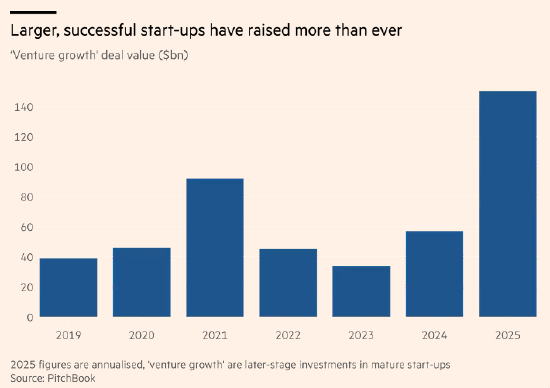
硅谷最炙手可热的初创企业今年已筹集了1500亿美元资金,其金融支持者建议它们建立"堡垒资产负债 表",以防2026年人工智能投资热潮转向破裂时能保护自己。 PitchBook数据显示,美国最大的私营公司在2025年筹集了创纪录的资金,打破了2021年920亿美元的历 史最高纪录,投资者争相支持OpenAI和Anthropic等顶级人工智能集团。 风险投资家和行业专家表示,随着公开市场开始担忧人工智能基础设施的巨额支出,这笔资金将有助于 创始人抵御投资低迷,同时也将推动增长。 "你应该趁着阳光明媚晒干草,"曾投资OpenAI、Databricks和SpaceX的Coatue合伙人卢卡斯·斯威舍 (Lucas Swisher)表示。"2026年可能会带来意想不到的事情……当市场提供选择时,就建立一个堡垒 资产负债表。" "(对于初创企业创始人来说)最大的风险是你没有筹集到足够的资金,融资环境枯竭,你的业务可能 归零,"富兰克林邓普顿(Franklin Templeton)风险投资联席主管瑞安·比格斯(Ryan Biggs)表示。"或 者你可以接受一点点股权稀释,如果业务成功了,这真的无关紧要:无论哪种方式,你仍然 ...
推特热议、AI 万亿美元新赛道,「上下文图谱」到底是什么?创业机会在哪?
Founder Park· 2025-12-29 11:51
Core Insights - The discussion around "Context Graph" emphasizes that capturing the reasoning behind decisions is more valuable than merely recording data [3][4][10] - The next trillion-dollar platform will not just enhance existing record systems with AI but will focus on understanding the reasoning behind data and actions [3][10] Group 1: Context Graph Concept - Context Graph is formed by accumulating decision traces, which include the reasoning behind decisions, exceptions, and past cases [3][8] - The core of the Context Graph is to capture the decision-making process rather than just the data itself [3][8] - The accumulation of decision traces will provide a comprehensive record of how decisions are made, transforming implicit knowledge into core data [17][18] Group 2: Importance of Decision Traces - Decision traces are essential for understanding the "why" behind decisions, which are often scattered across various communication platforms and systems [6][11] - Capturing these traces allows organizations to audit automated systems and convert exceptions into precedents, enhancing operational efficiency [19][20] - The lack of decision traces is a significant barrier for AI agents in real-world workflows, as they rely on the same critical information that human employees use for judgment [11][12] Group 3: Challenges in Building Context Graphs - Three core challenges in constructing Context Graphs include capturing tribal knowledge, referencing past decisions, and conducting cross-system analysis [21][22] - Existing systems often fail to capture the dynamic nature of decision-making processes, leading to fragmented information [23][27] - The "double clock problem" highlights the difficulty in recording both the current state and the events leading to that state, which is crucial for understanding organizational dynamics [24][26] Group 4: Opportunities for Startups - Startups have three potential paths: replacing existing record systems, modular penetration into specific workflows, or creating entirely new record systems focused on decision traces [69][70][71] - High labor costs and complex decision-making processes signal opportunities for automation through AI agents [73] - Organizations at the intersection of systems often require new roles to manage workflows, indicating a need for agents that can automate these roles and capture decision-making processes [74][75] Group 5: Future of AI and Context Graphs - The future of AI may not solely focus on continuous learning but rather on developing a world model that evolves with each decision made by agents [51][53] - Context Graphs serve as the world model for organizations, enabling simulations of future scenarios based on historical decision-making patterns [44][47] - The next trillion-dollar platform will likely emerge from capturing decision traces rather than merely enhancing existing data with AI capabilities [76][77]

Z Product|估值10亿美金的计费系统Metronome,如何成为OpenAI、英伟达首选的计价底层
Z Potentials· 2025-12-29 04:53
Core Insights - Metronome is positioned as a key infrastructure provider for AI and software companies, facilitating the transition from traditional licensing models to usage-based billing systems [3][5][11] - The company has achieved significant growth, with a total funding of $128 million and a projected valuation nearing $1 billion, indicating strong market confidence in its business model [32][35] Group 1: Company Overview - Metronome was founded in 2019 in San Francisco by Scott Woody and Kevin Liu, both former Dropbox employees, aiming to create a real-time billing infrastructure for modern software companies [5][27] - The company has raised a total of $128 million across multiple funding rounds, with notable investors including Andreessen Horowitz and New Enterprise Associates [32][34] - Metronome's client base includes major AI and cloud infrastructure companies such as OpenAI, NVIDIA, and Databricks, serving over 150 million end users [5][8] Group 2: Product and Technology - Metronome's billing system is designed to handle complex pricing models, breaking down the billing process into four layers: usage recording, billable metrics, pricing structure, and customer contracts [5][12] - The platform allows for real-time tracking of usage and costs, enabling businesses to adjust pricing dynamically without extensive engineering changes [6][21] - By automating the billing process, Metronome transforms pricing adjustments from engineering challenges into straightforward business actions, particularly suited for high-frequency AI usage scenarios [6][8] Group 3: Market Trends and Positioning - The shift from seat-based pricing to usage-based models is a significant trend in the software industry, driven by the rise of AI technologies [11][35] - Metronome's infrastructure addresses the challenges faced by companies transitioning to these new pricing models, making it a critical partner for businesses looking to align pricing with value creation [11][12] - The company is seen as a leader in the usage-based billing space, capitalizing on the growing demand for flexible and scalable billing solutions in the AI era [35]