
Reliance

Search documents
俄罗斯陷“石油危机”?亚洲卖家不好糊弄,干不过中东还被阿三坑
Sou Hu Cai Jing· 2025-09-21 09:48
Core Viewpoint - The article discusses the significant challenges faced by the Russian oil industry following Western sanctions and the shift in export dynamics towards Asian markets, particularly India and China, while highlighting the complexities and risks involved in this transition [2][6][25]. Group 1: Impact of Sanctions - The conflict in 2022 led to a drastic reduction in Russian oil exports to Europe, which previously accounted for over half of its total exports, resulting in a surplus of unsold oil [4][6]. - The European Union imposed a ban on Russian oil imports and set a price cap, forcing Russia to seek new markets in Asia [6][20]. Group 2: Shift to Asian Markets - China and India emerged as key buyers, with India's share of Russian oil imports increasing from 12% in 2021 to 37.6% in 2023, and projected to reach nearly 40% by mid-2025 [6][11]. - Despite the increase in exports to Asia, the pricing dynamics are challenging, with India negotiating significant discounts on Russian oil, at times reaching $20 per barrel [9][11]. Group 3: Economic Challenges - The revenue from oil exports has stabilized at around $20 billion per month, but the profit margins are severely compressed due to heavy discounts and high transportation costs [8][20]. - The use of the rupee for transactions has created liquidity issues for Russia, as funds are trapped in Indian banks and cannot be easily utilized for investments [13][25]. Group 4: Operational Risks - The establishment of a "shadow fleet" to circumvent sanctions has led to increased operational risks, including higher costs and potential environmental hazards [15][18]. - The fleet's capacity has been reduced due to Western sanctions targeting these vessels, further complicating Russia's ability to maintain export levels [16][24]. Group 5: Competitive Landscape - The competition from Middle Eastern producers, particularly Saudi Arabia, poses a significant threat to Russia's market share in Asia, as these countries have lower production costs and are increasing their output [20][22]. - The dynamics within OPEC+ and the strategic decisions made by Saudi Arabia to boost production are likely to further squeeze Russian oil exports [20][22]. Group 6: Long-term Outlook - While short-term trade with China and India may provide some support, the long-term outlook for Russian oil is uncertain due to ongoing sanctions, competitive pressures, and the need for innovative strategies to adapt to the changing market [25].

IIT placements gain steam; SoftBank's Vision Fund layoffs
The Economic Times· 2025-09-19 13:30
Group 1: IIT Placements - The placement season at Indian Institutes of Technology (IITs) has commenced with strong recruiter interest, particularly from trading firms like Jane Street and Millennium Management [1][3][16] - IIT Kharagpur and IIT BHU anticipate surpassing last year's placement offers, with IIT BHU expecting to exceed 1,405 offers [5][16] - IITs are enhancing their appeal to recruiters by showcasing cutting-edge research and providing training in soft skills and leadership [6][16] Group 2: SoftBank Vision Fund - SoftBank's Vision Fund is laying off 20% of its global staff as part of a strategic shift towards artificial intelligence investments, particularly the $500 billion Stargate project with OpenAI [8][16] - The Vision Fund has seen its third round of layoffs since 2022, despite reporting a net profit of $2.87 billion in Q1, its best performance since mid-2021 [8][16] - Over the past year, SoftBank has invested $9.7 billion in OpenAI and acquired stakes in Nvidia and Intel to bolster its AI ecosystem [8][16] Group 3: Pepperfry Acquisition - Realty services firm TCC Concept has signed a term sheet to acquire up to 100% of Pepperfry, although the deal value and closure timeline remain undisclosed [9][16] - The acquisition aims to enhance TCC's presence in e-commerce and digital marketplaces, while Pepperfry seeks a new direction after years of declining growth and a failed IPO attempt [9][10][16] - Pepperfry's FY24 operating revenue fell by 30.6% to ₹188.9 crore, but losses decreased by 37.4% to ₹117.4 crore [10][16] Group 4: Digital Payments for Russian Tourists - Sberbank has partnered with Indian digital payments app Cheq to enable QR-code-based UPI payments for Russian tourists in India, circumventing Visa and Mastercard networks [11][16] - This initiative allows foreign tourists without Indian bank accounts to utilize UPI, enhancing payment accessibility in India [11][16] Group 5: Digital Personal Data Privacy (DPDP) Act - India is set to finalize the rules for the Digital Personal Data Privacy (DPDP) Act by September 28, 2025, after a decade of development [14][16] - The DPDP Act aims to establish a legal framework for processing personal data, focusing on privacy and the handling of children's data [15][16]



India's M&A Boom Meets AI: Navatar Brings Salesforce-Powered Deal Origination CRM To Private Equity & Investment Banking Firms
Globenewswire· 2025-09-18 01:02
Industry Overview - India's mergers and acquisitions market has reached nearly $41 billion in 2025, driven by significant deals from major players like Reliance, JSW Group, and Tata Sons [1] - Private equity activity in India is at its highest level in over a decade, with global investors and sovereign funds actively seeking opportunities alongside influential Indian conglomerates [1] Company Expansion - Navatar, a leader in AI-powered CRM for private markets, is expanding its operations in India with a dedicated local office and founders of Indian origin, providing deep market insights and necessary technology for Indian dealmakers [2] Technology and Features - Navatar's CRM integrates seamlessly with Outlook and Salesforce, automating data capture and transforming daily activities into structured intelligence without manual entry [4] - The platform is built on Salesforce and integrated with Microsoft Copilot, offering enterprise-grade AI and privacy safeguards to ensure client confidentiality [4] - AI-driven features include automated intelligence capture, deal origination and sourcing, buyer-seller matching, document intelligence, fundraising LP intelligence, and real-time workflow insights [7] Market Impact - As global capital flows into sectors such as healthcare, consumer goods, renewables, and technology, Navatar provides the infrastructure for Indian dealmakers to scale their operations confidently [5] - Hundreds of leading firms worldwide already utilize Navatar to enhance their competitive edge in winning mandates, deepening relationships, and closing deals more efficiently [5]

X @Bloomberg
Bloomberg· 2025-09-15 12:15
Billionaire Mukesh Ambani’s Reliance companies raised about $2.4 billion through asset-backed securities, people familiar with the matter said, making it one of the largest such deals in India this year https://t.co/JrJAZBxvvA ...
The Return Of Smart Glasses, Hike Shuts Shop & More
Inc42 Media· 2025-09-15 02:30
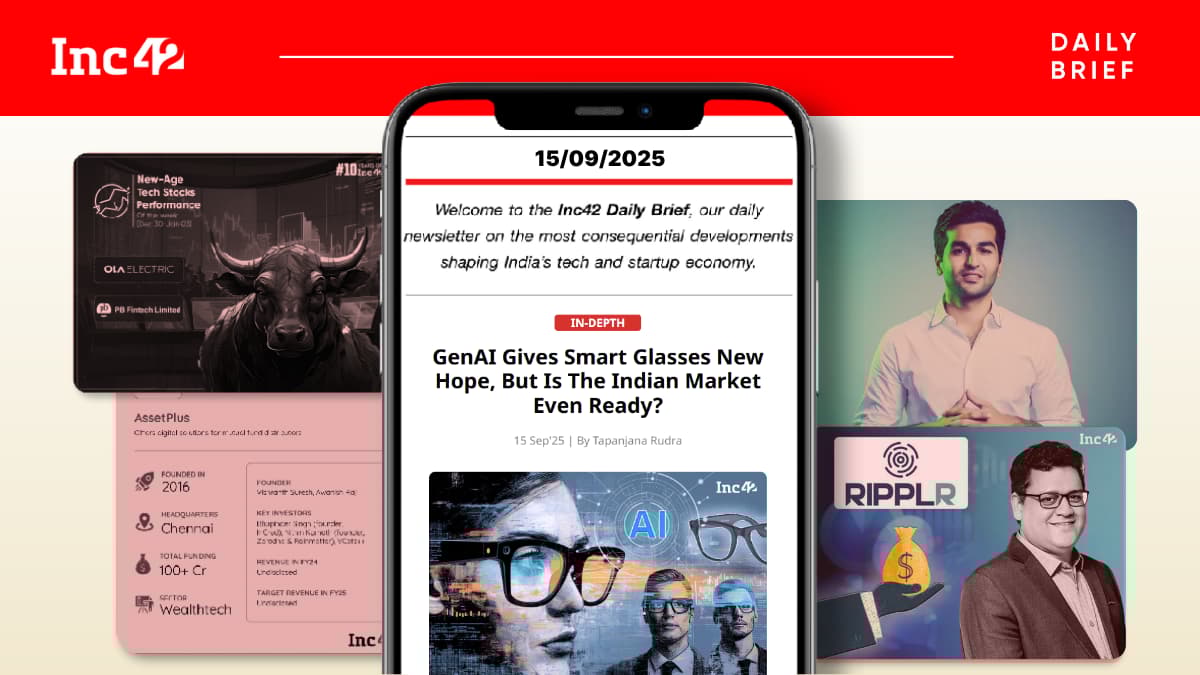
Mixed Reality and Smart Glasses - Smart glasses are experiencing a resurgence in India, with major players like Reliance and Lenskart entering the market, driven by advancements in technology and design [1][2] - Today's smart glasses are lighter and more compact compared to earlier models, featuring improved processors that enhance image quality and power efficiency [1] - Generative AI has transformed smart glasses into practical assistants, allowing users to perform about 35% of typical smartphone functions through voice commands [2] Competitive Landscape - Homegrown companies are differentiating themselves from global giants by focusing on vernacular capabilities and affordability, with products like QWR's Humbl glasses supporting Indic languages [3] - Jio Frames are expected to offer multi-language support and cloud storage integration, enhancing their appeal in the Indian market [3] Market Challenges - Premium pricing remains a significant barrier, positioning smart glasses as luxury items rather than mass-market products [4] - Privacy concerns are prevalent, as smart glasses operate in a gray area between everyday eyewear and potential surveillance tools, compounded by the lack of robust AI regulations in India [4] Future Outlook - The potential for smart glasses to become a billion-dollar wearable category hinges on overcoming privacy concerns, proving their AI capabilities, and delivering value for their premium pricing [5]
原油:供应增加抑制反弹,再次观望
Guo Tai Jun An Qi Huo· 2025-09-12 01:29
Report Summary Investment Rating The report does not provide an industry investment rating. Core View The supply increase suppresses the rebound of crude oil, and it is recommended to wait and see again. The trend strength of crude oil is 0, indicating a neutral view [1][8]. Section Summaries 1. Global Benchmark Crude Oil Price Dynamics - Brent (ICE) price is $67.49/bbl with a daily change of $1.1. The North Sea oilfield maintenance reaches its peak, and the shooting down of a Russian drone by Poland boosts the geopolitical premium [2]. - WTI (NYMEX) price is $63.67/bbl with a daily change of $1.04. Cushing inventory decreases by 2.8 million barrels weekly, and the strategic reserve repurchase starts [2]. - Dubai (Platts) price is $71.72/bbl with a daily change of $0.84. Middle - East refinery feed demand is strong, and the November spot premium hits a new high [2]. - Murban (ADNOC) price is $70.1/bbl with a daily change of -$1.02. The official selling price is lowered by $1.02 to respond to Asian buyers switching to US West Coast crude oil [2]. - Urals (CIF) price is $57.91/bbl with a daily change of $0.54. Indian refineries make bargain purchases, and the Baltic Sea loading volume increases by 15% month - on - month [2]. 2. Regional Crude Oil Spreads - Brent - WTI spread is $3.9/bbl, affected by the decline in Cushing inventory. The congestion of US Gulf export facilities intensifies, and the European arbitrage window closes [3]. - Dubai - Oman spread is $0.28/bbl, due to the Middle - East OSP cut. Saudi Arabia reduces Asian long - term contract volumes, and the spot market competition heats up [5]. - ESPO - Dubai spread is -$1.41/bbl, caused by the increase in Russian exports. Russian oil companies use a new method to avoid price limits: delivering a mixture of Omani crude oil [5]. - Midland - Cushing spread is $0.95/bbl, due to pipeline capacity constraints. An EPIC pipeline failure causes more than 5 million barrels of accumulation in the Permian Basin [5]. 3. Device Impact - Cosmo Oil's 100,000 b/d device is under maintenance from August 27 to early October, affecting Sakai crude oil. Japanese gasoline inventory drops to a five - year low, and emergency reserves are released [5]. - Sinopec Zhenhai's 200,000 b/d device maintenance is postponed to the end of September, affecting ESPO crude oil. Zhoushan's commercial crude oil inventory breaks the historical peak [5]. - BP Rotterdam's 180,000 b/d device is under maintenance from September 15 to November 10, affecting North Sea Forties. The European diesel crack spread widens by $1.2/bbl [5]. - Reliance's 660,000 b/d device is planned for maintenance in October, affecting Middle - East heavy crude oil. India's early stockpiling narrows the Middle - East fuel oil discount [5]. 4. Key Crude Oil Trade Dynamics - Persian Gulf - Japan route (VLCC): Freight is w64.5 with a weekly change of 0.15. Red Sea route insurance premiums increase by 300%, and shipowners detour around the Cape of Good Hope [6]. - US Gulf - China route (VLCC): Freight is $8.45m, an increase of $1.9m. The Panama Canal's traffic restrictions lead to tight shipping capacity [6]. - Singapore - East China route (LR2): Freight is $2.35m with a change of 0.12. China's bonded oil demand surges, and ship schedules are booked until three weeks later [6]. - West Africa - China route (Suezmax): Freight is w107.5 with a change of 0.08. India's procurement shifts to West Africa, squeezing Far - East shipping capacity [6]. 5. Comparison of Different Oil Types - 92 - octane gasoline (Singapore): Crack spread is $22/bbl, FOB price in Asia is $83.27. Indonesian Pertamina makes an emergency purchase of October cargoes, and Southeast Asian inventory drops to a three - week low [6]. - 0.5% low - sulfur fuel oil: Crack spread is $6.93/bbl, FOB price in Asia is $492.08. China's bonded refueling demand surges, and 23 ships are waiting at Zhoushan anchorage [6]. - 10ppm diesel: Crack spread is $19/bbl, FOB price in Asia is $88.12. African diesel power generation demand is in the peak season, and West African imports reach a record high [6]. - 380CST high - sulfur fuel oil: Crack spread is -$2.25/bbl, FOB price in Asia is $426. The restart of Australia's Viva refinery is delayed, and regional supply glut persists [6]. 6. Key Market News - OPEC Monthly Report: In August, OPEC+ crude oil production averaged 42.4 million barrels per day, an increase of 509,000 barrels per day compared to July as OPEC+ raised production [9]. - IEA Monthly Report: The 2025 world oil demand growth forecast is raised to 740,000 barrels per day (previously forecasted at 680,000 barrels per day) [9].
Reliance, Inc. (RS) Presents At Jefferies Mining And Industrials Conference 2025 Transcript
Seeking Alpha· 2025-09-03 22:10
Company Overview - Reliance is a metal service center company focused on processing and distribution of metals, founded in Los Angeles in 1939, with over 85 years of experience [1] - The company operates approximately 320 locations, primarily in the U.S. and North America, with some international presence [1] - Reliance has diversified its offerings, selling over 100,000 metal products to more than 125,000 customers [1] Business Strategy - The company employs a decentralized operational model, often through acquisitions, while maintaining the brand names of acquired companies [1] - Reliance believes in the value of the companies it acquires and differentiates itself from larger service center companies through its focus on diversification [1]


Reliance (RS) 2025 Conference Transcript
2025-09-03 20:32
Summary of Reliance Inc. Conference Call Company Overview - **Company Name**: Reliance Inc. - **Industry**: Metals and Mining - **Founded**: 1939 in Los Angeles - **Locations**: Approximately 320 locations, primarily in the US and North America, with some international presence - **Product Range**: Over 100,000 metal products sold to more than 125,000 customers - **Revenue**: $15 billion with an average order size of $3,000 [10] Core Business Model - **Decentralized Operations**: Focus on local relationships and decision-making to enhance customer service and profitability [5] - **Inventory Management**: Emphasis on spot pricing and limited long-term contracts, primarily in aerospace [7] - **Value-Added Processing**: Approximately 50% of orders involve value-added processing, leading to improved gross profit margins from 25%-27% to 29%-31% [11] Financial Performance - **Cash Flow**: Strong and consistent cash flows, even in down markets, with significant capital expenditures (CapEx) of about $1.8 billion over the last five years [13][11] - **Acquisitions**: Completed 76 acquisitions since IPO in 1994, with four acquisitions in 2024 [14] - **Dividends**: Regular quarterly dividends paid for 66 years, with a commitment to increase dividends sustainably [15] Market Demand and Trends - **Demand Stability**: Overall steady demand with strength in non-residential construction and data centers, while agriculture has been weaker [19][20] - **Reshoring Trends**: Increased discussions about bringing manufacturing back to the US and Mexico, particularly in the automotive and pharmaceutical sectors [23][26] - **Impact of Tariffs**: Tariffs have generally supported higher pricing levels by reducing imports, benefiting domestic mills and allowing Reliance to pass on costs to customers [27][28] Industry Dynamics - **Market Fragmentation**: Reliance represents only 16% of MSCI shipments, indicating significant growth opportunities through acquisitions and organic growth [14] - **Competitor Landscape**: Domestic mills have increased capacity, which could replace imports and maintain a balanced market [38] Challenges and Considerations - **Uncertainty in Trade Policies**: Ongoing uncertainty in trade policies is affecting customer investment decisions [17] - **Volatility in Metal Prices**: Reliance's earnings are significantly impacted by metal prices, which have been structurally higher since 2018 [57] Strategic Outlook - **Acquisition Strategy**: Focus on acquiring well-run, family-owned businesses that align with Reliance's decentralized model [42][46] - **Market Valuation**: Reliance aims to maintain a consistent valuation methodology based on normalized earnings rather than market cycles [46] Conclusion Reliance Inc. continues to navigate a complex metals and mining landscape with a strong focus on customer relationships, value-added services, and strategic acquisitions. The company is well-positioned to capitalize on market opportunities while managing the challenges posed by trade policies and metal price volatility.
X @The Wall Street Journal
The Wall Street Journal· 2025-08-29 21:18
India’s small-scale manufacturers stand to lose tens of billions of dollars in imports to the U.S. after the Trump administration slapped a 50% tariff on the country. But what’s bad for India won’t necessarily be bad for Reliance.https://t.co/Ezp8zhFdrY ...
X @TechCrunch
TechCrunch· 2025-08-29 13:23
AI Development - Reliance is launching a new subsidiary to advance India's AI ambitions [1] - The new subsidiary includes a pending partnership with OpenAI [1]