大疆

Search documents
“革新者”刘靖康打造千亿影像新贵 影石创新营收增67%与大疆对垒升级
Chang Jiang Shang Bao· 2025-11-09 23:48
Core Viewpoint - The competition between Yingshi Innovation and DJI in the smart imaging device market is intensifying, highlighted by Yingshi's founder publicly apologizing for DJI's price cuts, indicating a fierce business rivalry [1][6]. Company Overview - Liu Jingkang, the founder of Yingshi Innovation, transitioned from a tech enthusiast in college to a leader in the global smart imaging sector, with significant achievements including the development of the world's first panoramic camera brand in Apple stores [2][3]. - Yingshi Innovation's market capitalization has reached 111 billion yuan, while DJI's valuation is reported at 84 billion yuan [1]. Market Dynamics - The panoramic camera market has seen a surge due to the rise of outdoor activities and Vlog culture, leading to intensified competition between Yingshi and DJI [5]. - DJI initiated a price reduction campaign on October 9, which led to public backlash and Yingshi's apology, suggesting that Yingshi's market presence may have influenced DJI's pricing strategy [6]. Product Development - Yingshi has entered the drone market, a strategic move anticipated five years ago, with plans to launch its Antigravity panoramic drone in select markets by the fourth quarter of 2025 [7]. Market Share Discrepancies - There is a significant discrepancy in market share data between different research institutions, with one report indicating Yingshi's market share dropped to 49% while another claims it remains at 75% [8]. - Yingshi's revenue growth is notable, with projected revenues of 20.41 billion yuan, 36.36 billion yuan, and 55.74 billion yuan from 2022 to 2024, with a substantial portion coming from international markets [9]. Financial Performance - In the first three quarters of 2025, Yingshi achieved a revenue of 6.611 billion yuan, marking a year-on-year growth of 67.18%, with the third quarter alone generating 2.940 billion yuan, a 92.64% increase compared to the previous year [9].
美国脖子没那么好卡,稀土还是中国的王牌,这张牌最好用
Sou Hu Cai Jing· 2025-11-09 21:22
Core Viewpoint - China's export control on rare earths has become a significant tool in the ongoing US-China rivalry, marking a shift from passive to active defense strategies [1] Group 1: Export Control and Economic Warfare - The recent export control measures on rare earths are seen as a direct response to aggressive US policies, including the "50% ownership penetration" rule and exorbitant fees for Chinese ships entering US ports [1] - The "long-arm jurisdiction" policy not only restricts the export of raw materials but also applies to processed rare earth products that utilize Chinese technology, effectively controlling global supply chains [1] Group 2: Dependency on Chinese Supply Chains - The US estimates that it will take at least seven to eight years to completely eliminate dependence on Chinese rare earths, requiring hundreds of billions in federal investment annually [4] - Key industries such as lithium batteries, semiconductors, and pharmaceuticals are heavily reliant on Chinese materials, with over 70% of basic pharmaceutical raw materials sourced from China [7][8] Group 3: Challenges in Alternative Supply Chains - The US attempts to build alternative supply chains for rare earths face significant challenges, particularly in refining capabilities, where China holds a monopoly on advanced processing techniques [1][4] - The semiconductor industry is also at risk, with China capturing 31% of the market share in mature processes, and US manufacturers relying on Chinese firms for critical components [5] Group 4: Broader Implications of the US-China Rivalry - The geopolitical landscape is shifting, with the potential for resource management strategies extending beyond rare earths to include nickel, cobalt, and lithium [10] - The competition is not just about technology but also about systemic resilience, with China demonstrating a strong ability to adapt and innovate under pressure [15]





中润光学(688307):变焦镜头领军企业 布局影像设备+半导体应用蓄力高增
Xin Lang Cai Jing· 2025-11-09 12:30
Core Viewpoint - The company is expanding into emerging fields such as drones and imaging devices, leveraging its expertise in optical technology to drive significant revenue growth [1][2]. Group 1: Business Expansion - The company specializes in optical technology, with capabilities in developing various types of lenses, including all-glass, glass-plastic, and all-plastic lenses [1]. - The product line includes a range of zoom and fixed-focus lenses, with applications extending from smart security and defense to drones and robotic vacuum cleaners [1]. - The company has established relationships with leading firms in the smart imaging device sector, positioning itself to benefit from the increasing demand for optical lenses in drones and action cameras [1]. Group 2: Acquisition and Strategic Partnerships - The company plans to acquire a 51% stake in Dais Optoelectronics, which will allow it to consolidate and expand its presence in advanced fields such as semiconductor equipment and quantum communication [2]. - Dais Optoelectronics has committed to achieving net profits of 0.21, 0.29, and 0.40 billion yuan for the years 2025 to 2027, respectively [2]. - The partnership is expected to enhance product offerings and customer relationships, with Dais Optoelectronics specializing in precision optical components and having established collaborations with notable clients in various sectors [2]. Group 3: Financial Performance - For the first three quarters of 2025, the company reported revenues of 460 million yuan, a year-on-year increase of 44%, and a net profit of 40 million yuan, up 5% year-on-year [3]. - In the third quarter alone, revenues reached 210 million yuan, reflecting a 65% year-on-year growth and a 51% quarter-on-quarter increase, with net profits of 20 million yuan, a 10% year-on-year rise and an 86% quarter-on-quarter increase [3]. - The company is projected to achieve revenues of 680 million, 1.2 billion, and 1.62 billion yuan, and net profits of 60 million, 160 million, and 230 million yuan for the years 2025 to 2027, respectively [3].
从理光到大疆,年轻人在追逐什么样的新相机
3 6 Ke· 2025-11-09 05:55
Core Insights - The camera market is experiencing a resurgence, with a 1350% increase in film photography searches on Xiaohongshu in the first nine months of the year and a 24.1% overall growth in camera shipments in China during Q1, which is double the global growth rate [1][2] - Young consumers are increasingly seeking cameras for their aesthetic quality, as they feel that even the best smartphone cameras fall short in comparison [1][2] - The trend of outdoor activities among young people has expanded the demand for cameras, with action and panoramic cameras becoming popular choices alongside traditional brands like Canon and Fujifilm [2][3] Market Dynamics - Classic camera models maintain their value in the second-hand market, with models like the Canon A620 seeing prices rise from an original price of approximately 2600 yuan to over 1500 yuan [2] - The rise of social media has created a strong desire among consumers for high-quality images, leading to a shift in the types of cameras being sought, from DSLRs to compact and action cameras [5][9] - Rental services for cameras are becoming increasingly popular, allowing consumers to try before they buy, which lowers the barrier to entry for new users [8][9] Consumer Behavior - Young consumers are motivated by trends and the desire to capture aesthetically pleasing moments, leading to a continuous demand for new camera models [10][12] - The integration of AI technology in cameras is enhancing user experience by simplifying the shooting process and improving image quality, further driving interest in new camera purchases [15][16] - The emergence of new brands and models, such as the DJI Pocket 3, reflects the evolving preferences of consumers who prioritize portability and ease of use [12][13] Future Trends - The camera industry is likely to see continued growth as younger generations seek innovative and user-friendly devices that cater to their social media needs [16][17] - Companies are focusing on developing AI-driven imaging solutions that simplify the photography process, making it accessible to a broader audience [16][17] - The ongoing evolution of consumer preferences indicates that the demand for cameras will remain strong, with a focus on lightweight, intelligent, and high-quality output devices [16][17]

科技周报|小红书拿下支付牌照;影石回应大疆“价格战”
Di Yi Cai Jing· 2025-11-09 03:11
Group 1 - Xiaohongshu has obtained a payment license through its wholly-owned subsidiary, indicating a strategic move to enhance its local life and e-commerce business operations [1] - The payment license, originally issued to Dongfang Electronic Payment Co., is valid until May 2, 2026, and allows for the operation of stored value accounts [1] - This move is seen as a critical step in Xiaohongshu's long-term strategy to convert community traffic into commercial value by bridging the gap between content and transaction [1] Group 2 - Yingshi Innovation's chairman Liu Jingkang addressed concerns regarding DJI's price competition, stating it has created conditions for market expansion [2] - The company's net profit declined due to significant investments in custom chips and strategic projects, but other profit indicators improved when excluding these factors [2] - DJI's aggressive pricing strategy has prompted Yingshi to offer limited-time discounts on its products, although the full impact of this competition is yet to be reflected in financial results [2] Group 3 - Game Science's producer Feng Ji highlighted that 7 out of the 10 highest-grossing games globally are related to Chinese companies, showcasing China's dominance in the gaming industry [3] - The success of "Black Myth: Wukong" is attributed to the growth of China's gaming market and talent pool over the past decade [3] - China is recognized as the largest gaming market in terms of user base and revenue, contributing significantly to the global gaming landscape [3] Group 4 - Ele.me is reportedly undergoing a rebranding to "Taobao Flash Sale," indicating a deeper integration with Alibaba's e-commerce ecosystem [4] - The merger of Ele.me and Taobao Flash Sale reflects Alibaba's strategy to enhance its instant retail and e-commerce operations [4] - Observers are speculating about the potential merger and the strategic ambitions of Alibaba in combining various retail formats [4] Group 5 - XPeng's new humanoid robot IRON was unveiled, featuring a solid-state battery and advanced AI capabilities [6] - The robot's design emphasizes a human-like appearance, raising questions about the balance between technological innovation and marketing [6] - The focus on aesthetics may overshadow the importance of advancing technology in the robotics industry [6] Group 6 - The anticipated foldable iPhone is expected to launch in September 2026, featuring a design that includes a 5.5-inch outer screen and a 7.8-inch inner screen [7] - The foldable smartphone market is projected to grow significantly, with estimates of 24 million units sold by 2026 following Apple's entry [7] - Analysts emphasize the need for software and hardware innovations to enhance the user experience in foldable devices [7] Group 7 - TCL Technology's plan to participate in the restructuring of Shanshan Group was not approved by creditors, creating uncertainty about the outcome [8] - The restructuring aimed to secure a stake in Shanjin Optoelectronics, enhancing supply chain resilience [8] - The global polarizer market is witnessing a competitive landscape, with Shanjin Optoelectronics expected to hold significant market shares in the coming years [8] Group 8 - iFLYTEK launched the X1.5 version of its Spark large model, featuring advanced AI capabilities and a significant increase in inference efficiency [9] - The company reported a substantial growth in its developer community, indicating a rising interest in AI applications [9] - The release of Spark X1.5 marks a milestone in domestic AI technology, positioning it as a leader in the global market [9]
请回答「Knock Knock 世界」NO. 251109
声动活泼· 2025-11-09 02:38
Core Points - The article discusses the increasing prevalence of electric vehicles (EVs) over traditional gasoline cars, highlighting a shift in consumer preferences and market trends [9] - It mentions the development of the DJI drone and its market dominance, indicating a significant impact on the technology and drone industry [9] - The article also touches on the importance of mathematics competitions like Olympiad Math and the Chopin Competition, suggesting their role in educational development [10] Group 1 - The article notes that more families are considering switching to electric vehicles, reflecting a broader trend towards sustainability and environmental consciousness [9] - It raises questions about the mechanisms behind the popularity of gaming and its parallels with educational competitions, indicating a cultural shift in how youth engage with learning [10] - The piece emphasizes the significance of space exploration and the potential for ordinary people to travel to space in the future, showcasing advancements in the aerospace industry [8] Group 2 - The podcast "Knock Knock World" is introduced as a platform for youth to explore global events and diverse perspectives, indicating a growing interest in educational media [11] - The podcast is available on multiple audio platforms, with a subscription model priced at 365 yuan per year, suggesting a monetization strategy for educational content [14] - The article highlights the importance of engaging young audiences in discussions about global issues, reflecting a trend in youth education and media consumption [13]

影石创新进军无人机暴露增长“焦虑”,Q3研发、销售费用翻倍
Feng Huang Wang Cai Jing· 2025-11-08 12:35
Group 1 - The core viewpoint of the article highlights the competitive dynamics between YingShi Innovation and DJI, with both companies encroaching on each other's market territories, leading to a price war and concerns over market share decline [1][2][4] - YingShi has launched a new drone brand targeting the consumer market dominated by DJI, while DJI has introduced a panoramic camera to compete directly with YingShi's main products [2][4] - The competition has resulted in a significant impact on YingShi's profitability, with a decline in gross margin due to the price war initiated by DJI [1][9] Group 2 - In Q3 2025, YingShi's revenue reached 6.611 billion yuan, a year-on-year increase of 67.18%, but the net profit attributable to shareholders fell by 5.95% to 792 million yuan [7] - The company's gross margin for Q3 was 47.6%, down 6.7 percentage points year-on-year, attributed to the ongoing price competition in the industry [9] - Research and sales expenses have surged, with R&D expenses increasing by 127% to 1.085 billion yuan in the first three quarters of 2025, and sales expenses rising by 102.6% to 1.13 billion yuan [8] Group 3 - The market share data presents conflicting reports, with one report indicating YingShi's market share has dropped from 85%-92% to 49%, while another report claims it remains at 75% [5] - The discrepancy in market share data arises from different statistical methodologies used by the reporting agencies [5] - YingShi's entry into the drone market is seen as a necessary strategy to diversify its revenue streams and reduce reliance on its core panoramic camera business, which has limited growth potential [6] Group 4 - The company is currently in the testing phase for its drone products, which have not yet generated revenue, putting pressure on overall profitability [7] - Cash flow from operating activities has decreased by 4.89% to 930 million yuan in the first three quarters of 2025, influenced by increased inventory levels [10] - The company is expanding its sales channels through e-commerce platforms and offline sales, which has also contributed to rising sales expenses [8]

影石创新进军无人机暴露增长“焦虑”,Q3研发、销售费用翻倍
凤凰网财经· 2025-11-08 12:18
Core Viewpoint - The competition between YingShi Innovation and DJI is intensifying, with both companies encroaching on each other's core markets, leading to concerns about market share decline and profitability pressures [3][5][9]. Group 1: Competition Dynamics - YingShi Innovation has launched a drone brand targeting the consumer market dominated by DJI, while DJI has introduced a panoramic camera to compete directly with YingShi's main products [3][5]. - The price war initiated by DJI has impacted YingShi's profit margins, with a notable decline in gross margin reported for Q3 [4][11]. - YingShi's CEO acknowledged the competitive landscape, stating that the entry of competitors into new markets creates opportunities for market expansion [6][9]. Group 2: Market Share and Financial Performance - According to different reports, YingShi's market share in the global panoramic camera market has reportedly dropped from 85%-92% to 49%, while DJI captured 43% of the market [6][8]. - Contrarily, another report claims YingShi still holds a 75% market share, indicating discrepancies in data sources and methodologies [7][8]. - For the first three quarters of 2025, YingShi reported revenues of 6.611 billion, a year-on-year increase of 67.18%, but net profit decreased by 5.95% [9][10]. Group 3: Cost Structure and Profitability - The company's R&D expenses surged by 127% to 1.085 billion in the first three quarters of 2025, contributing to the decline in net profit [10]. - Sales expenses also increased significantly, reaching 1.13 billion, a 102.6% year-on-year rise, further straining profitability [10]. - The gross margin for Q3 was reported at 47.6%, down 6.7 percentage points, attributed to the ongoing price competition in the industry [11].

西方最怕的不是华为、大疆,而是这十家你从没有听过的中国企业!
Xin Lang Cai Jing· 2025-11-07 22:19
Core Viewpoint - The article emphasizes that the West is more concerned about ten lesser-known Chinese companies than it is about well-known firms like Huawei and DJI [1] Group 1 - The article suggests that these ten Chinese companies possess significant capabilities that could pose a threat to Western interests [1] - It highlights the growing influence and technological advancements of these companies in various sectors [1] - The piece indicates that the West's fear stems from the potential of these companies to disrupt existing market dynamics and geopolitical balances [1]

递表港交所,极飞科技锚定农业“管”环节:它的无人机市占率与“龙头大哥”仍有差距,加速出海能否破局?
Mei Ri Jing Ji Xin Wen· 2025-11-07 12:12
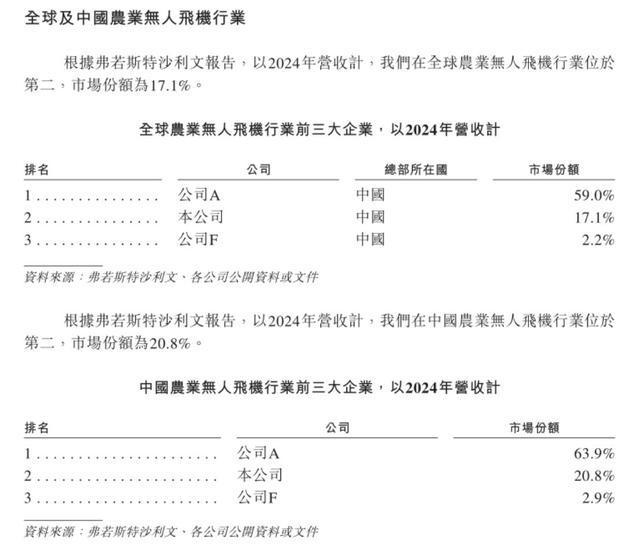
Core Insights - Guangzhou XAG Technology Co., Ltd. (XAG) held its annual conference, marking its first public appearance after submitting an IPO application to the Hong Kong Stock Exchange, attracting attention from investors and media [1] - XAG reported a net profit of 134 million RMB in the first half of this year, surpassing the total profit of the previous year, with a goal to achieve profitability in 2024 [1][6] - The company aims to address the "unmanned farming" issue through automation in agricultural management, focusing on water, fertilizer, pesticide, and monitoring [1][7] Company Overview - XAG was founded in 2007 and initially explored various drone applications before focusing on agricultural drones, particularly after realizing customer demand for their drone control systems [6] - The company has shifted its strategy to emphasize the replacement of labor with robotics in agriculture, responding to labor shortages and an aging population [6][7] Market Position - XAG holds a 17.1% market share in the global agricultural drone market, ranking second behind DJI, which has a 59% share [2][3] - In the domestic market, XAG's share is 20.8%, with DJI leading at over 60%, indicating a significant competitive gap [10] Product Development - XAG's agricultural drones accounted for 89% of its revenue in the first half of 2023, up from 78.6% in 2022, highlighting the growing importance of this product line [7][8] - The company has introduced new products, including smart fertilization systems and autonomous driving devices for agricultural machinery, while continuing to enhance its drone capabilities [7][9] Financial Performance - XAG's overseas revenue has increased significantly, with figures of 146 million RMB in 2022, 163 million RMB in 2023, and projected 371 million RMB in 2024, indicating a growing international presence [9] - The company plans to use IPO proceeds for R&D and expanding its global sales and service network, reflecting its ambition to tap into larger agricultural robot markets [9] Competitive Landscape - The agricultural drone market is characterized by high concentration, with the top two companies holding over 80% of the market share in China [10] - XAG has been improving its product performance while reducing prices, with drone prices dropping from 200,000 RMB in 2015 to under 40,000 RMB in 2024, while enhancing functionality [10][12] - The gross margin for XAG's agricultural drones has improved from 26.8% in 2022 to 34.1% in the first half of 2023, indicating better cost management and efficiency [12]