领益智造

Search documents
中国稀土战略地位进一步强化,稀土ETF嘉实(516150)近5日“吸金”22.51亿元,机构:稀土价格有望进一步上涨
Xin Lang Cai Jing· 2025-10-22 02:23
Core Insights - The China Rare Earth Industry Index has decreased by 1.58% as of October 22, 2025, with mixed performance among constituent stocks, led by Shengxin Lithium Energy with a rise of 1.81% [1] - The recent tightening of rare earth export controls by the Ministry of Commerce is expected to strengthen China's strategic position in the rare earth market, potentially leading to increased prices [3] Group 1: Market Performance - The rare earth ETF, Jiashi, has seen a turnover of 1.52% and a transaction volume of 1.61 billion yuan, with its latest scale reaching 10.875 billion yuan, marking a new high since its inception [2] - Over the past week, Jiashi's shares increased by 5.76 million, leading the comparable funds in terms of new share growth [2] - In the last five trading days, Jiashi has experienced net inflows on four occasions, totaling 2.251 billion yuan [2] Group 2: Fund Performance - As of October 21, 2025, Jiashi's net value has increased by 91.40% over the past two years, ranking 79th out of 2,358 index equity funds, placing it in the top 3.35% [2] - The highest monthly return since inception for Jiashi was 41.25%, with the longest consecutive monthly gain being four months and a maximum increase of 83.89% [2] Group 3: Industry Dynamics - The recent policy changes include increased export controls on five categories of medium and heavy rare earths, as well as restrictions on equipment, technology, and raw materials across the entire industry chain [3] - These measures are expected to complicate the establishment of independent rare earth supply chains overseas, thereby enhancing China's competitive advantage in the long term [3] - The limitations on overseas supply of rare earth magnetic materials are anticipated to boost demand for high-performance ferrite permanent magnets, leading to a significant increase in orders [3] Group 4: Key Stocks - The top ten weighted stocks in the China Rare Earth Industry Index account for 61.96% of the index, with notable performers including Northern Rare Earth and China Rare Earth, which saw declines of 2.69% and 1.81% respectively [2][5]


超七成预喜,A股三季报密集交卷
Zheng Quan Shi Bao· 2025-10-22 00:27
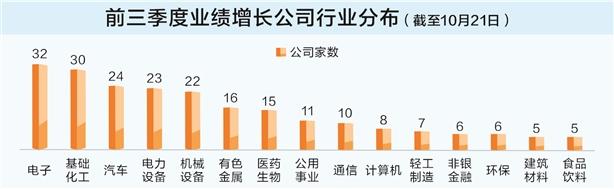
在业绩创历史新高的同时,部分公司股价也在同步走强。数据宝统计,上述85家公司中,近一个月内盘 中股价创历史新高的有17家,包括思源电气、扬杰科技、瀚蓝环境、神马电力、山东黄金等均于10月份 创下历史高点。思源电气10月21日收盘上涨7.32%,当天创下历史新高。该公司今年前三季度实现净利 润21.91亿元,同比增长46.94%。 如人工智能龙头寒武纪-U,今年前三季度公司实现净利润16.05亿元,同比扭亏为盈,这是其历史同期 首次盈利。另一只与算力芯片相关的海光信息,今年前三季度实现净利润19.61亿元,同比增长 28.56%;报告期内,该公司加速客户端导入,推动高端处理器产品的市场版图扩展,实现了公司营业 收入的显著增长。此外,电子领域龙头公司如立讯精密、领益智造、瑞芯微、长川科技、思特威、扬杰 科技等业绩均取得大幅增长。 基础化工行业有30家公司入围,这些公司或受益于化工产品涨价,或受益于新产能投产、新业务的拓展 等。如锂矿龙头盐湖股份,公司预计今年前三季度净利润为43亿元至47亿元,同比增长36.89%至 49.62%;报告期内,公司主要产品氯化钾价格上升,带动该业务板块盈利增长。同样受益于氯化钾涨 价 ...
A股三季报密集交卷 超七成已披露公司报喜
Zheng Quan Shi Bao· 2025-10-21 17:31
与历史对比来看,数据宝统计,上述业绩增长的公司中,剔除上市不满三年的公司,今年前三季度净利 润创同期历史新高的有85家。 截至10月21日收盘,这85家公司中,有7家公司A股市值超千亿元,分别是中国人寿、立讯精密、中国 船舶、中科曙光、新华保险、山东黄金、小商品城。中国人寿是其中市值最高的公司,最新A股市值达 9160.27亿元,公司预计今年前三季度净利润约1567.85亿元至1776.89亿元,同比增长约50%至70%。 在业绩创历史新高的同时,部分公司股价也在同步走强。数据宝统计,上述85家公司中,近一个月内盘 中股价创历史新高的有17家,包括思源电气、扬杰科技、瀚蓝环境、神马电力、山东黄金等均于10月份 创下历史高点。思源电气10月21日收盘上涨7.32%,当天创下历史新高。该公司今年前三季度实现净利 润21.91亿元,同比增长46.94%。 (文章来源:证券时报) 当前正值A股三季报密集披露阶段,一批业绩高增长公司受到投资者普遍关注。据证券时报·数据宝统 计,截至目前,共有360家上市公司已披露三季报业绩数据。按照三季报、业绩快报、预告净利润下限 (无下限则取公告数值)计算,合计有254家公司前三季度 ...
定向可转债支付走俏 科技企业并购“得心应手”
Zheng Quan Shi Bao· 2025-10-21 17:23
Core Viewpoint - The adoption of targeted convertible bonds for mergers and acquisitions (M&A) is gaining popularity among listed companies due to their dual characteristics of equity and debt, providing flexibility and reducing financial pressure compared to traditional cash payments [1][3]. Group 1: Adoption of Targeted Convertible Bonds - Since the introduction of targeted convertible bonds for restructuring projects, 16 A-share listed companies have announced plans to use this method for M&A, alongside issuing shares and cash payments [1][2]. - Companies like Changhong High-Tech and Huahai Chengke are actively pursuing M&A using targeted convertible bonds, indicating a trend among tech firms [2][4]. - Targeted convertible bonds allow companies to issue bonds that can be converted into shares under certain conditions, providing a flexible payment structure for M&A transactions [2][3]. Group 2: Benefits for Technology Companies - Over 60% of the companies utilizing targeted convertible bonds for asset purchases are from the Sci-Tech Innovation Board and the Growth Enterprise Market, primarily targeting technology firms [4][5]. - The characteristics of technology companies, such as being asset-light and having high R&D investments, make targeted convertible bonds a suitable financing option, allowing for differentiated pricing and supporting valuation stability [5][6]. - The mechanism of targeted convertible bonds provides capital support flexibility for tech firms while allowing investors to mitigate risks and share in future growth [5][6]. Group 3: Enhancing M&A Efficiency - The use of targeted convertible bonds, along with other innovative tools, has significantly improved the efficiency of M&A transactions, reducing costs and risks associated with traditional methods [6]. - The flexible design and lower financing costs of targeted convertible bonds enhance market activity and promote resource integration and industrial collaboration [6]. - However, complexities in the terms of targeted convertible bonds may introduce challenges in understanding and negotiation, alongside potential credit and market valuation risks [6].

智能眼镜销量攀升 部分公司已步入收获期
Zheng Quan Ri Bao· 2025-10-21 16:39
Core Insights - The global smart glasses market is projected to reach 4.065 million units in the first half of 2025, marking a year-on-year growth of 64.2% [1] - By 2029, the market is expected to exceed 40 million units, with China's market share steadily increasing and a compound annual growth rate (CAGR) of 55.6% from 2024 to 2029, the highest globally [1] Market Dynamics - The smart glasses market is categorized into audio glasses, camera glasses, and AR glasses, all of which saw sales increases in the first half of this year, with China's total retail sales reaching 468,000 units, a 148% year-on-year increase [2] - The rapid sales growth is attributed to continuous product innovation and significant demand expansion, particularly among young consumers who favor tech products [2] - Major companies like Meta are launching new products, enhancing the feasibility of consumer-grade smart glasses and pushing them into mainstream markets [2] Company Activities - Numerous companies are actively entering the smart glasses industry, with over 25 new products launched from January to August this year [3] - Companies such as Thunder Innovation, Liweike Technology, Rokid, Goertek, and others are introducing smart glasses products or solutions, indicating a competitive landscape [3] - The industry is entering a phase of intensive new product releases, with expectations of increased benefits for related listed companies as competition intensifies [3] Supply Chain Developments - Shenzhen Baiwei Storage Technology has become a core supplier for major global wearable tech clients, including Meta, Google, and Xiaomi, providing ROM and RAM chips for AI/AR glasses and smartwatches [4] - Guangdong Lingyi Technology focuses on the R&D and manufacturing of core components for wearable devices, continuously expanding in the AI glasses and smart wearable sectors [4]


智能眼镜销量攀升部分公司已步入收获期
Zheng Quan Ri Bao Zhi Sheng· 2025-10-21 16:38
智能眼镜有望成为人工智能落地新载体,备受各大厂商和消费者关注。《证券日报》记者了解到,近期 多家上市公司积极布局智能眼镜产业,其中部分公司已步入收获期。 市场空间广阔 根据洛图科技发布的报告,智能眼镜可分为音频眼镜、可拍摄眼镜和AR眼镜三大类。今年上半年,三 类细分产品销量悉数上涨,中国智能眼镜市场的全渠道零售量为46.8万台,同比增长148%。 本报记者 李雯珊 见习记者 张美娜 国际数据公司IDC近日发布的数据显示,2025上半年,全球智能眼镜市场出货量达406.5万台,同比增长 64.2%。 IDC预计,到2029年全球智能眼镜市场出货量将突破4000万台,其中,中国市场份额将稳步提升,预计 五年复合增长率(2024年至2029年)将达到55.6%,增速位居全球首位。 多家公司积极布局 多家产业链上市公司正积极布局智能眼镜产业,抢占市场机遇。据不完全统计,今年1月份至8月份智能 眼镜新品超25款。 在传统XR(扩展现实)智能硬件厂商方面,雷鸟创新技术(深圳)有限公司(以下简称"雷鸟创 新")、安徽李未可科技有限公司、杭州灵伴科技有限公司(Rokid)、歌尔股份有限公司、四川影目科 技有限公司(以下简称" ...
多家上市公司“试水”定向可转债重组 备受科技企业青睐
Zheng Quan Shi Bao· 2025-10-21 10:32
Core Viewpoint - The adoption of targeted convertible bonds as a payment method for mergers and acquisitions (M&A) is gaining popularity among listed companies due to their "dual attributes" of equity and debt, providing flexibility and reducing financial pressure [1][4]. Group 1: Adoption of Targeted Convertible Bonds - Since the introduction of targeted convertible bonds for M&A, 16 A-share listed companies have announced plans to use this payment method alongside equity and cash [1][3]. - The "M&A Six Guidelines" encourage companies to utilize a combination of equity, targeted convertible bonds, and cash to enhance transaction flexibility [1][3]. - Companies in the technology sector, particularly those listed on the Sci-Tech Innovation Board and the Growth Enterprise Market, show a preference for using targeted convertible bonds in their M&A activities [1][5]. Group 2: Benefits of Targeted Convertible Bonds - Targeted convertible bonds offer a dual design of "debt protection + equity flexibility," meeting the needs for principal security while allowing for shared growth benefits through conversion options [1][6]. - Compared to traditional cash payments, targeted convertible bonds reduce financial pressure and delay the dilution of existing shareholders' control [4][6]. - The low-interest nature of targeted convertible bonds makes them a cost-effective financing option, alleviating cash flow concerns for companies [4][6]. Group 3: Focus on Technology Companies - Over 60% of the companies planning to use targeted convertible bonds for asset purchases are from the Sci-Tech Innovation Board and the Growth Enterprise Market, primarily targeting technology firms [5][6]. - The technology sector's characteristics, such as being asset-light and having high R&D investments, make traditional valuation methods less effective, thus benefiting from the flexible pricing allowed by targeted convertible bonds [6][7]. - The acquisition activities in sectors like semiconductors and new materials reflect a growing interest in technology stocks and the urgent need for resource integration in industrial upgrades [6][7]. Group 4: Efficiency in M&A Transactions - The use of innovative tools like targeted convertible bonds, M&A loans, and funds has significantly improved the efficiency of M&A transactions, reducing costs and risks [7]. - Targeted convertible bonds enhance market activity and facilitate resource integration, providing stable funding support for transactions [7]. - They help balance the risk-reward dynamics between transaction parties, addressing issues related to high valuations and performance commitments [7].

多家上市公司“试水”定向可转债重组
Zheng Quan Shi Bao· 2025-10-21 10:28
Core Viewpoint - The innovative payment method of directed convertible bonds is increasingly favored by listed companies due to its "dual attributes" of equity and debt, enhancing flexibility in mergers and acquisitions [1][6]. Summary by Sections Mergers and Acquisitions Trends - As of this year, 16 A-share listed companies have announced plans to use a combination of issuing shares, directed convertible bonds, and cash for mergers and acquisitions [2][5]. - The "Six Guidelines for Mergers" encourage companies to utilize various payment tools, including directed convertible bonds, to increase transaction flexibility [2]. Adoption by Companies - Companies like Changhong High-Tech and Huahai Chengke are actively pursuing mergers using directed convertible bonds, with ongoing due diligence and fundraising efforts [3][4]. - Notably, the first successful project using directed convertible bonds as a payment tool was completed by Fulede [5]. Characteristics of Directed Convertible Bonds - Directed convertible bonds are issued to specific investors and can be converted into company shares under agreed conditions, providing a dual benefit of debt protection and equity potential [5]. - This payment method is particularly attractive for technology companies, which often face high financial pressure from traditional cash payments and the risk of excessive dilution from pure equity payments [2][8]. Appeal to Technology Sector - Over 60% of the companies planning to use directed convertible bonds for acquisitions are from the Sci-Tech Innovation Board and the Growth Enterprise Market, primarily targeting technology firms [7]. - The technology sector's characteristics, such as being asset-light and having high R&D investments, make directed convertible bonds a suitable financing option, allowing for differentiated pricing and supporting valuation stability [8]. Efficiency in Mergers - The use of directed convertible bonds, along with other innovative tools, has significantly improved the efficiency of mergers and acquisitions, reducing costs and risks associated with transactions [9]. - This method enhances market activity and facilitates resource integration, balancing the risks and returns for both parties involved in the transaction [9][10].

多家上市公司“试水”定向可转债重组
证券时报· 2025-10-21 10:27
Core Viewpoint - The article discusses the increasing popularity of targeted convertible bonds as a payment method for mergers and acquisitions (M&A) among listed companies in China, highlighting their dual characteristics of equity and debt, which provide flexibility and reduce financial pressure [1][5]. Group 1: Adoption of Targeted Convertible Bonds - Since the introduction of targeted convertible bonds for M&A, 16 A-share listed companies have announced plans to use this method alongside issuing shares and cash payments [1][4]. - The "M&A Six Guidelines" encourage companies to utilize a combination of shares, targeted convertible bonds, and cash to enhance transaction flexibility [1][4]. - Companies in the technology sector, particularly those listed on the Sci-Tech Innovation Board and the Growth Enterprise Market, show a preference for using targeted convertible bonds in their M&A activities [1][7]. Group 2: Benefits of Targeted Convertible Bonds - Targeted convertible bonds offer a dual design of "debt protection + equity flexibility," meeting the needs of counterparties for capital safety while allowing for sharing of future growth benefits through conversion options [1][5]. - Compared to traditional cash payments, targeted convertible bonds reduce financial pressure and delay the dilution of existing shareholders' control [5][8]. - The low-interest nature of targeted convertible bonds makes them a cost-effective financing option, alleviating cash flow concerns for companies [5][8]. Group 3: Focus on Technology Companies - Over 60% of the companies planning to use targeted convertible bonds for asset purchases are from the Sci-Tech Innovation Board and the Growth Enterprise Market, primarily targeting technology firms [7]. - The characteristics of technology companies, such as being asset-light and having high R&D investments, make traditional valuation methods less effective, thus benefiting from the flexible pricing allowed by targeted convertible bonds [7][8]. - The acquisition activities in sectors like semiconductors and new materials reflect a growing interest in technology stocks and the urgent need for resource integration in industrial upgrades [8]. Group 4: Efficiency in M&A Transactions - The use of targeted convertible bonds, along with other innovative tools, has significantly improved the efficiency of M&A transactions, reducing costs and risks associated with deals [10]. - Targeted convertible bonds enhance market activity and facilitate resource integration and industrial collaboration, providing stable funding support for transactions [10]. - They help balance the risk and return for both parties in a transaction, addressing issues related to high valuations and goodwill [10].

市场火热!一图看懂AI眼镜产业链
天天基金网· 2025-10-21 09:49
Core Insights - The AI glasses market is projected to reach a shipment volume of 4.065 million units in the first half of 2025, representing a year-on-year growth of 64.2% [6] - The market is expected to evolve into the next mainstream computing terminal following smartphones, driven by advancements in AI and AR technologies [6][7] - By 2029, global shipments of smart glasses are anticipated to exceed 40 million units, with China's market share steadily increasing and a compound annual growth rate (CAGR) of 55.6% from 2024 to 2029 [6] Industry Trends - The introduction of new wearable devices is expected to revitalize the market, with AR glasses transitioning from niche products to mainstream smart terminals [6][7] - Major companies like ByteDance, Alibaba, Baidu, and Meizu are set to launch AI-focused audio and photography glasses, intensifying market competition [6] - The AI glasses industry is in a rapid growth phase, with diverse product offerings and price ranges, indicating a clear trend towards multi-modal AI assistants [7] Investment Opportunities - The report suggests that the AI glasses industry chain is worth monitoring, as the release of new products in 2025 is likely to act as a catalyst for growth [7] - Investment funds focused on consumer electronics have shown significant returns, with some funds achieving over 70% returns since inception [5]