智元机器人

Search documents
制造成长周报:智元上线灵心平台 工信部公示人形机器人标准化技委员会委员名单
Xin Lang Cai Jing· 2025-12-03 00:34
Group 1: Key Events and Developments - Zhiyuan Robotics launched the Lingxin platform on November 24, 2025, which allows users to configure the personality and voice of robots [1] - The Ministry of Industry and Information Technology (MIIT) announced the list of members for the humanoid robot standardization technical committee on November 24, 2025, indicating ongoing efforts to establish industry standards [1] - The Hunan Embodied Intelligence Innovation Center was fully launched on November 26, 2025, further promoting the development of humanoid robotics [3] Group 2: AI Infrastructure Developments - Amazon plans to invest $50 billion to expand AI computing capacity for the U.S. government, adding 1.3 GW of capacity [3] - Vantage Data Centers received $1.6 billion in investment to expand its operations in the Asia-Pacific region [3] - Former President Trump signed an executive order on November 25, 2025, to initiate a national-level AI program called "Genesis Mission" [3] Group 3: Company Dynamics - On November 25, 2025, Kuawei Intelligent and Kepler Robotics visited Zhenghe Industrial [4] - On November 27, 2025, Shengshi Technology signed a strategic cooperation agreement with Songyan Power [4] - On November 28, 2025, Changan Automobile plans to invest 225 million yuan to establish Changan Robotics [4] Group 4: Investment Insights - For humanoid robots, focus on value and positioning, with an emphasis on supply chain vendors and companies with strong market positions [5] - In AI infrastructure, the AI liquid cooling segment is highlighted as a key area for investment, with specific companies recommended for attention [6] - The low-altitude economy is rapidly advancing, with a national low-altitude traffic project initiated, emphasizing the importance of core components in the industry [6]


蓝点触控攻坚 机器人精微触觉
Zhong Guo Zheng Quan Bao· 2025-12-03 00:05
Core Insights - The article highlights the significance of six-dimensional force sensors in enhancing the precision and flexibility of humanoid robots, enabling them to perform delicate tasks akin to human capabilities [1][2][3] Group 1: Company Overview - Founded six years ago, the company Blue Dot Touch focuses on the research and industrialization of intelligent robot force control technology, achieving international standards with its six-dimensional force sensors and joint torque sensors [1][4] - Blue Dot Touch has captured 72.6% of the domestic market share for humanoid robot six-dimensional force sensors, establishing itself as a market leader [1][3] Group 2: Technology and Applications - The six-dimensional force sensor technology, originally developed for aerospace applications, allows robots to perform complex tasks by providing real-time feedback on force magnitude and direction [2][3] - The sensors enable robots to execute precise actions, such as turning off lights, by integrating visual positioning with force feedback [2] Group 3: Market Growth and Demand - The demand for humanoid robots is expected to surge post-mid-2024, with a significant increase in the shipment of force sensors, as traditional visual solutions become insufficient for diverse applications [3][4] - Shipment volumes for joint torque sensors exceeded 100,000 units in the first three quarters of the year, indicating a growing market [3] Group 4: Production and Financing - Blue Dot Touch is enhancing its production capabilities with a new automated production line in Guangdong, aiming for an annual capacity of 1 million joint torque sensors and 200,000 six-dimensional force sensors [4] - The company recently completed a Series C financing round exceeding 100 million RMB, marking its second significant funding round within three months [4][5] Group 5: Competitive Strategy - The company acknowledges the ongoing competitive landscape and is committed to continuous improvement in product performance, quality, and pricing to facilitate the scalable development of the humanoid robot industry [5]
特斯拉Optimus相关利好,接踵而来!
Robot猎场备忘录· 2025-12-03 00:03
温馨提示 : 点击下方图片,查看运营团队最新(12月)原创报告(共260页) 说明: 欢迎约稿、刊例合作、行业交流 , 行业交流记得先加入 "机器人头条"知识星球 ,后添加( 微信号:lietou100w )微 信; 若有侵权、改稿请联系编辑运营(微信:li_sir_2020); 正文: 12月,特斯拉开启新一轮审厂,T链走向越发明朗! 回顾11月,从情绪低至" 冰点 "到"高涨",二级市场机器人板块仅用了三天;11月21日至今,板块上行, T链利 好标的迎来不错反弹,而 这些标的多和获得"定点"有关, 而这波反弹有望在12月延续。 因此,对于11月份以及已经开启的12月份而言,T链标的的催化是 定点 。 11月3日,通过产业链调研,部分T供应商就已经陆续收到 V3初版图纸; 本次反弹之前,诸多T链就已传来利好 资讯,如RT、LX、DH、SL、XJ、CY、SY等,不少核心标的提到已获得更高的量产指引,定点顺利等,最终成 为本波反弹主力,轮动上行。 注: 小编 "机器人头条"知识星球 "人形供应链专栏 每天都会对大盘行情进行详细梳理,包括盘前预测、盘中利好/利空梳理以及盘 后复盘,并梳理T链重点利好资讯和企业, ...


从“称大象”到“称蚂蚁”: 蓝点触控攻坚 机器人精微触觉
Zhong Guo Zheng Quan Bao· 2025-12-02 20:29
● 本报记者杨洁 "没有力传感器,机器人的精细操作几乎不可能——它就像给机器人装上了末端神经,让冰冷的机械拥 有感知力。"蓝点触控创始人、董事长刘吴月手持一款六维力传感器,向中国证券报记者解释这一小小 零部件所承担的使命:"我们希望它既能'称大象',也能'称蚂蚁',有了这样的精准度,人形机器人就可 以具备'类人'的操作灵活性,真正走进更多场景,走进千家万户。" 成立仅6年,蓝点触控以航天级技术为根基,专注智能机器人力控技术的研发与产业化,核心产品六维 力传感器与关节力矩传感器,凭借0.1%FS的高精度、10kHz高频响应等性能指标,达到国际顶尖水准, 成功打破海外厂商长期技术垄断。高工机器人产业研究所(GGII)最新发布报告显示,蓝点触控已占据国 内72.6%的人形机器人六维力传感器市场份额,成为市场的重要引领者。 刘吴月感受到2024年下半年之后行业需求的巨大拉升。"最开始是几百套到几千套的出货量,今年前三 季度我们的关节力矩传感器出货量突破10万套,六维力传感器出货量也超过万套。" 一台人形机器人通常需配备4个六维力传感器及28个关节力矩传感器,其成本约占整机BOM的15%,一 个颇具规模的新兴市场正加速 ...
蓝点触控攻坚机器人精微触觉
Zhong Guo Zheng Quan Bao· 2025-12-02 20:22
Core Insights - The article highlights the significance of six-dimensional force sensors in enhancing the precision and flexibility of humanoid robots, enabling them to perform delicate tasks akin to human capabilities [1][2][3] - Blue Dot Touch, founded six years ago, has rapidly become a leader in the domestic market for humanoid robot force sensors, capturing 72.6% of the market share [1][3] Group 1: Technology and Applications - The six-dimensional force sensor technology has its roots in aerospace applications, ensuring safe docking of spacecraft and providing precise data for aerodynamic design in wind tunnel experiments [2] - The sensors allow robots to perform complex tasks by providing real-time feedback on force magnitude and direction, facilitating "hand-eye coordination" [1][2] Group 2: Market Growth and Demand - The demand for humanoid robots is expected to surge post-mid-2024, with a significant increase in the shipment of force sensors, as companies shift from purely visual solutions to more integrated approaches [2][3] - Shipment volumes for joint torque sensors exceeded 100,000 units in the first three quarters of the year, indicating a growing market [2] Group 3: Production and Financing - Blue Dot Touch is expanding its production capabilities with a new automated production line in Guangdong, aiming for an annual capacity of 1 million joint sensors and 200,000 six-dimensional sensors [3] - The company recently completed a Series C financing round exceeding 100 million RMB, marking its second significant funding round in three months [3] Group 4: Competitive Landscape - The company acknowledges the ongoing competitive pressures in the component sector and is committed to continuous improvement in product performance, quality, and pricing to support the scalable development of the humanoid robot industry [4]
人形机器人订单强劲,多方预警“浇冷水”
Nan Fang Du Shi Bao· 2025-12-02 17:20
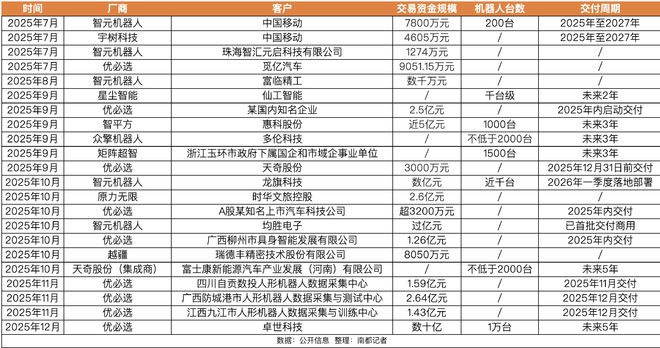
Core Viewpoint - Morgan Stanley issued a warning regarding the risks of the hype surrounding embodied intelligence, noting that while the total order value announced by Chinese robotic manufacturers has exceeded 2 billion yuan since the second half of 2025, many of these orders may not be fulfilled this year and include low-certainty framework agreements [1] Group 1: Market Orders and Delivery - Since the second half of 2025, the total order value for embodied intelligence robots announced by manufacturers in China has surpassed 2 billion yuan, primarily from industrial and commercial service sectors, as well as government-supported data collection centers [1] - A detailed table lists various orders, including a 780 million yuan order from Zhiyuan Robotics to China Mobile for 200 units, with delivery scheduled from 2025 to 2027 [2] - The orders include significant commitments, such as a 1 billion yuan order from Jiyuan Robotics for nearly 1,000 units, expected to be deployed in the first quarter of 2026 [2] Group 2: Industry Concerns and Real Demand - Industry insiders have raised concerns about whether the recent large orders from robotic manufacturers represent a genuine commercial closure and whether the created scenario value is real [3] - There is skepticism that the current mass production of robots is driven by real demand, with fears that if production is not based on actual needs, the industry may face a downturn once the initial excitement fades [3] - UBTECH has announced that its humanoid robot orders have reached 1.3 billion yuan for 2025, with a production capacity of 300 units per month and an expected delivery of over 500 units in 2025 [3] Group 3: Company Strategies and Market Dynamics - UBTECH's recent announcements of commercial orders are rooted in clear industrial needs, particularly in the context of the manufacturing sector's transformation and the pressing demand for intelligent upgrades [4] - Morgan Stanley highlighted that the limited capabilities of robots in open tasks and dexterous operations are reasons to lower short-term growth expectations, despite optimism for the long-term development of China's embodied intelligence industry due to strong government support and a well-established local supply chain [4] - The National Development and Reform Commission has also commented on the overheating issue in the embodied intelligence sector, emphasizing the need to balance speed and potential market bubbles, as the technology and commercialization models are not yet fully mature [5]
数十家机器人企业涌向港股IPO
2 1 Shi Ji Jing Ji Bao Dao· 2025-12-02 14:51
Core Viewpoint - The human-shaped robot trend is gaining momentum in the Hong Kong stock market, attracting significant capital interest as companies in the robotics industry rush to list on the Hong Kong Stock Exchange [1] Group 1: Market Activity - Several robotics companies, including Sanhua Intelligent Control and Junsheng Electronics, have successfully listed on the Hong Kong Stock Exchange this year, raising substantial capital [1] - As of now, dozens of robotics companies have either submitted listing applications or are planning to issue shares, including Top Group and leading commercial robot companies [1] - The recent approval of Youdi Robotics' IPO on December 2, with plans to issue up to 73.6 million shares, highlights the ongoing interest in the sector [1] Group 2: Performance of Listed Companies - Sanhua Intelligent Control's IPO was highly successful, with an oversubscription rate of 747 times and actual fundraising amounting to 10.7 billion HKD, making it one of the top IPOs of the year [4] - Junsheng Electronics also completed its IPO in November, raising approximately 3.4 billion HKD, indicating strong market demand for robotics companies [5] - Companies like Geek+ and Cloudwise Technology have shown stable market performance post-IPO, with Geek+ maintaining a market value around 30 billion HKD and Cloudwise's stock price rising significantly since its listing [5] Group 3: Future Prospects and Challenges - Despite the excitement surrounding new listings, the performance of robotics companies post-IPO has shown significant divergence, raising concerns about valuation and market expectations [1][8] - The Hong Kong market's international valuation system and flexible financing mechanisms are attractive to growing robotics companies, but the window for high valuations may be limited [8] - Challenges such as the lack of commercial viability in the robotics industry and long return cycles may impact future listings and company valuations [10]



数十家机器人企业涌向港股IPO
21世纪经济报道· 2025-12-02 14:45
Core Viewpoint - The human-shaped robot trend is sweeping the Hong Kong stock market, attracting significant capital interest, with numerous companies in the robotics industry racing to list on the Hong Kong Stock Exchange [1] Group 1: Market Activity - Companies such as Sanhua Intelligent Control and Junsheng Electronics have successfully listed on the Hong Kong Stock Exchange this year, raising substantial funds [1] - As of now, dozens of robotics companies have either officially submitted listing applications or are planning to issue shares, including Tesla's supply chain company Top Group and leading commercial robot firms [1] - The recent approval of Youdi Robotics' IPO on December 2, aiming to issue up to 73.6 million shares, highlights the ongoing enthusiasm for robotics companies in the market [1] Group 2: Performance of Listed Companies - Sanhua Intelligent Control's IPO was highly successful, with an oversubscription rate of 747 times and actual fundraising amounting to 10.7 billion HKD, making it one of the top four IPOs of the year [3][4] - Junsheng Electronics also completed its IPO in early November, raising approximately 3.4 billion HKD, indicating strong market interest [4] - Companies like Geek+ and Cloudwalk Technology have shown stable market performance post-IPO, with Geek+ maintaining a market value around 30 billion HKD and a revenue growth of over 60% year-on-year [4][5] Group 3: Challenges and Risks - Despite the excitement, there is a notable performance divergence among listed robotics companies, with some facing significant valuation risks due to high market expectations and lack of clear order visibility [6][7] - The international pricing logic and the complexity of the global market may lead to substantial fluctuations in stock prices post-IPO, as seen with Sanhua Intelligent Control's stock price decline from a high of 46.48 HKD to 33.78 HKD [7][8] - The long-term challenges for the robotics industry, including unresolved technology paths and commercialization bottlenecks, will impact the capital market dynamics for these companies [8]

人工智能时代,设计理念如何凸显人的价值
财富FORTUNE· 2025-12-02 14:36
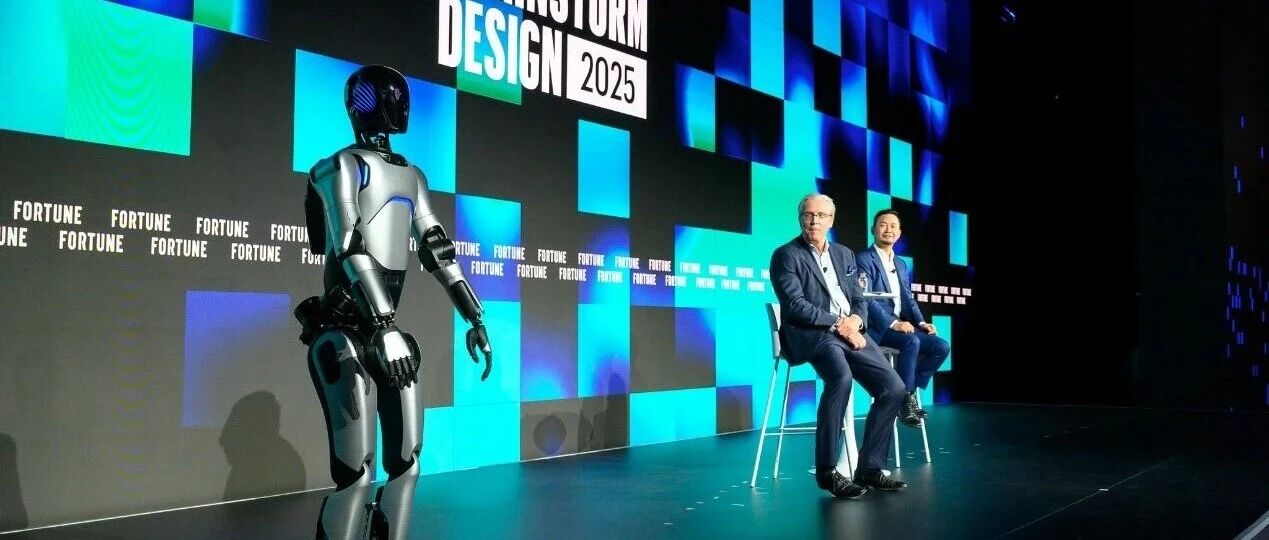
Core Insights - The article discusses the intersection of anxiety and anticipation in the current era, highlighting the transformative potential of digital technologies like artificial intelligence (AI) while also addressing the challenges posed by climate change and increased energy demands [1] Group 1: Conference Overview - The "Design Brainstorming Conference" held by Fortune on December 2 at MGM Macau focused on the theme "Future in Progress: Shaping Tomorrow's Blueprint," gathering over thirty top designers and futurists to discuss the role of design in the tech era [3] - Key discussions included new paradigms of design in the AI age, the value of human input, and the desired characteristics of future tech products [3] Group 2: Key Speakers and Their Insights - Mauro Porcini, Chief Design Officer of Samsung, emphasized that brand leadership in the new era relies on an innovation formula: "AI × (Emotional Intelligence + Human Imagination)" [3] - Ole Scheeren, a renowned architect, advocated for viewing architecture as a living organism that generates stories post-completion, enhancing user engagement [4] - André Fu, a prominent interior designer, noted a shift in hotel design from grandeur to a focus on comfort and genuine hospitality, emphasizing emotional connections over luxury materials [5] Group 3: Future Perspectives - Futurist Monika Bielskyte proposed using "story worlds" as a design approach to address real-world challenges, moving beyond traditional sci-fi concepts [6] - She criticized the binary views of technology as either utopian or dystopian, arguing for a more integrated approach that considers social, ethical, and ecological dimensions [6] - The conference also featured discussions on China's eVTOL industry and advancements in medical technology, showcasing the rapid development and commercialization of innovative solutions [9]
离开深圳:国产机器人的“精度”在长三角
3 6 Ke· 2025-12-02 07:50
Core Insights - The article discusses the contrasting developments in the robotics industry in China, highlighting the rapid production capabilities in the Pearl River Delta and the precision challenges faced in the Yangtze River Delta [1][12] - It emphasizes the importance of precision in robotics, stating that without it, robots cannot perform high-value tasks and will remain limited to basic functions [10][11] Group 1: Robotics Production and Development - The Pearl River Delta, particularly Shenzhen, has made robot manufacturing accessible, leading to a surge in production and a competitive environment [1] - The Yangtze River Delta, including Shanghai, Suzhou, and Hangzhou, focuses on refining the precision and control of robots, which is crucial for their effective operation [1][12] Group 2: Precision Challenges - Robots currently exhibit a disconnect between high intelligence and low physical capability, often resulting in delayed responses and imprecise movements [2][3] - Shanghai is identified as a key location for improving control systems, with innovations like the ViLLA architecture aimed at reducing latency in robotic movements [3][5] Group 3: Hardware and Material Science - Suzhou and Kunshan are recognized for their expertise in hardware precision, addressing issues related to wear and tear in robotic components [6][8] - The article highlights the significance of material science and precision engineering in overcoming the limitations of current robotic technologies [8][11] Group 4: Integration of AI and Lightweight Materials - Hangzhou is noted for its advancements in lightweight materials and AI integration, which enhance the agility and responsiveness of robots [9] - The combination of AI vision and reduced weight is crucial for improving the operational capabilities of robots, allowing them to navigate environments more effectively [9] Group 5: The Importance of Precision in Robotics - Precision is deemed essential for robots to gain respect and perform valuable tasks in industrial settings, with a clear distinction between low and high precision applications [10][11] - The article concludes that achieving high precision requires continuous effort in material science and engineering, emphasizing that shortcuts are not viable in this field [11][12]