泸州老窖

Search documents
华源证券:重视ROA企稳的消费板块 寻找价或量仍景气的细分赛道
智通财经网· 2025-12-24 13:01
Core Viewpoint - Different consumer sectors exhibit both differences and commonalities in recovery rhythms, with ROA being a leading indicator for operational recovery in consumer enterprises [1][2] Group 1: Recovery Rhythm Analysis - The recovery rhythm of various consumer sectors is influenced by industry supply and demand, as well as supply chain structures, with a focus on stock market competition as a mainstream phenomenon [2] - The stages of enterprise and channel adjustments are outlined, starting from oversupply to a new balance in supply and demand, with ROA serving as a key indicator throughout these stages [2] - Current recovery sequences indicate that soft drinks and snacks are leading, followed by food supply chains, condiments, dairy products, beer, and finally, liquor [2][3] Group 2: Investment Strategy - Emphasis on sectors where ROA stabilizes, indicating potential valuation recovery opportunities, with a preference for sectors that still show price or volume growth [3] - Price logic suggests that rising CPI may drive valuation recovery in traditional industries with high penetration rates, such as liquor, beer, and dairy products, which are likely to attract incremental capital [3][4] - Recommended companies in the liquor sector include Kweichow Moutai, Luzhou Laojiao, and Shanxi Fenjiu, while in dairy, focus on Yili and Mengniu [3] Group 3: Volume Logic - In the context of cost-effective consumption, companies with high supply chain efficiency are expected to gain volume, with specific recommendations for companies in the food supply chain and soft drinks [4] - Industries with low penetration rates may withstand economic cycles, with recommendations for low-alcohol beverages and functional foods that can enhance brand premium through specialization [4] - Companies benefiting from overseas market expansion include Angel Yeast and Bailong Chuangyuan [4]




扩内需:食品饮料行业投资机会
2025-12-24 12:57
Summary of Key Points from the Conference Call Industry Overview - The food and beverage industry is experiencing systemic opportunities driven by policies aimed at expanding domestic demand and increasing residents' income levels, which are expected to enhance consumption capabilities [1][2] - The liquor industry is undergoing a deep adjustment, with expectations of entering an EPS killing phase by 2025, while high-end liquor brands like Moutai and Lao Jiao are recommended for investment [1][4] - The dairy industry has completed supply-demand adjustments, with anticipated increases in demand for milk powder and liquid milk due to fertility and income policies, highlighting companies like Yili and New Dairy as potential recovery opportunities [1][5] - The snack food sector is benefiting from the "lipstick effect," new channels, and health trends, with recommendations for companies such as Salted Fish, Wei Long, Wan Chen Food, and Qiaqia Food [1][6] - The beverage sector is seeing a clear trend towards health, with non-traditional channels gaining market share, making high-growth companies like Dongpeng Beverage noteworthy [1][7] Key Insights and Arguments - The central economic work conference in 2026 will prioritize expanding domestic demand, which is expected to lead to a series of policies stimulating consumption, positively impacting the food and beverage industry [2] - The food and beverage sector has faced significant changes in volume, price, and channel structure over the past six years, with varying performances across sub-sectors [3] - The liquor sector is expected to see marginal improvements in 2026, driven by policies aimed at boosting business and government consumption [4] - The dairy sector is projected to enter a recovery phase, with increased demand anticipated due to supportive policies [5] - The snack food market is expected to gradually recover, supported by rising incomes and new retail channels [6] Additional Important Content - Cost fluctuations are a significant factor affecting the performance of consumer goods companies, with some agricultural product costs declining, providing investment opportunities [9] - The planting area for sunflower seeds is expected to recover, leading to a projected 10% decrease in the cost of sunflower seeds, which will positively impact Qiaqia Food's gross margin [10][11] - The konjac market is facing supply-demand imbalances, with high prices expected to ease in 2026, alleviating cost pressures for companies like Wei Long and Salted Fish [12] - The sugar molasses market is currently at low prices, providing strong support for Angel Yeast's profitability [13] - Innovative companies are leveraging product and channel innovations to drive growth, with notable examples including Nongfu Spring and Uni-President [14] - Efficient supply chain management is crucial for companies, with Dongpeng Beverage demonstrating strong performance in this area [15] Future Outlook - Dongpeng Beverage is expected to achieve double-digit growth in 2026 through strategic measures and product innovations [16] - Wan Chen is enhancing store quality and accelerating store openings, which is expected to improve profitability in the snack food sector [17][18] - Hai Tian Flavoring has implemented efficiency improvements under new management, resulting in revenue and profit growth exceeding industry averages [19] - The restaurant industry is expected to see a mild recovery, with companies like Yihai International and Tianhe Flavoring showing potential for improvement [20][21] - In the liquor sector, companies like Yanghe and Budweiser are expected to benefit from product and channel improvements, leading to potential breakthroughs in performance [22][23][25] - Gan Yuan Food is focusing on expanding e-commerce and high-end membership stores, with a stable development outlook [26][27] - Overall, companies in the food and beverage sector are expected to experience gradual recovery and growth, making them worthy of investor attention [28]





13只白酒股下跌 贵州茅台1400.90元/股收盘
Bei Jing Shang Bao· 2025-12-24 12:16
Core Viewpoint - The liquor industry is entering a phase of rapid performance clearing, with expectations of a weak recovery in demand as policy pressures ease and consumption expansion policies take effect [1] Industry Summary - The three major indices collectively rose, with the Shanghai Composite Index closing at 3940.95 points, up 0.53% [1] - The liquor sector closed at 2196.49 points, with a slight increase of 0.18%, although 13 liquor stocks experienced declines [1] - The current industry valuation is low, and pessimistic expectations are fully priced in, indicating a clearer direction for industry clearing and a more defined bottom [1] Company Summary - Kweichow Moutai (600519) closed at 1400.90 CNY per share, down 0.49% [1] - Wuliangye (000858) closed at 109.28 CNY per share, down 0.40% [1] - Shanxi Fenjiu (600809) closed at 175.60 CNY per share, down 0.96% [1] - Luzhou Laojiao (000568) closed at 119.94 CNY per share, down 0.38% [1] - Yanghe Brewery (002304) closed at 62.10 CNY per share, down 0.06% [1]



食品饮料2026年投资策略报告:曙光渐显,在分化中前行-20251224
Hua Yuan Zheng Quan· 2025-12-24 12:13
Group 1: Core Insights - The report emphasizes the recovery stage of consumer spending, highlighting that different sectors exhibit both commonalities and differences in their recovery rhythms, driven by supply-demand dynamics and industry structure [4][5] - ROA (Return on Assets) is identified as a leading indicator for the operational recovery of consumer companies, with a focus on analyzing various sub-sectors [4][13] Group 2: Sector Performance - The current recovery sequence indicates that soft drinks and snacks are leading, followed by the catering supply chain, condiments, dairy products, beer, and finally, liquor [5][25] - The report draws parallels with Japan's 1990s consumption differentiation, noting that sectors addressing consumer pain points and with low penetration rates are likely to succeed [5][6] Group 3: Investment Strategy - The report suggests focusing on sectors where ROA is stabilizing, indicating potential valuation recovery opportunities, particularly in traditional sectors like liquor, beer, and dairy [6][8] - It recommends identifying sub-sectors with either price or volume growth, with a preference for price-driven strategies [6][8] Group 4: Detailed Sector Analysis - The frozen food sector is showing signs of marginal improvement, with leading companies enhancing operational efficiency through product innovation and channel reforms [27][28] - The snack sector is experiencing high demand, driven by new channel developments, although competition is intensifying [33][35] - The beer industry is under pressure, with a focus on high-end products, but overall growth is slowing due to external economic factors [39][41] - The dairy sector is nearing the end of its adjustment phase, with expectations of improved performance as raw milk prices rise [41][42] - The liquor sector is currently in a phase of inventory reduction, with performance risks gradually clearing as channels stabilize [43][48]


海南封关启新程,白酒出海正当时,共赴全球飘香新纪元!
Sou Hu Cai Jing· 2025-12-24 11:26
Core Viewpoint - The recent implementation of the Hainan Free Trade Port marks a historic step in China's opening-up strategy, providing a strategic opportunity for the Chinese liquor industry to overcome international market barriers and reshape its global presence [1][3]. Group 1: Hainan's Role in Liquor Export - The "closure" of Hainan is a customs regulatory model that allows for the free flow of goods, capital, and personnel between Hainan and foreign countries, while maintaining regular supervision with the mainland, positioning Hainan as a key hub for connecting domestic and international markets [3]. - Currently, global spirits exports exceed $40 billion, but Chinese liquor accounts for only 2.4% of this market, indicating a significant mismatch between the industry's scale and its international presence [3]. - Hainan's policies, including zero tariffs on foreign goods and a low-cost platform for logistics, significantly reduce operational costs for liquor companies looking to export [5][6]. Group 2: Supply Chain and Logistics Improvements - Hainan's customs policies simplify the clearance process, significantly shortening the time required for liquor exports, while improving warehousing and logistics infrastructure [8]. - Major international liquor companies have established bonded warehouses in Hainan, allowing for rapid release of goods, which can also benefit Chinese liquor companies by enabling pre-processing activities [8]. - The development of cross-border e-commerce policies in Hainan facilitates a new model of "online ordering and bonded direct shipping," providing Chinese liquor companies with new pathways to expand overseas [8]. Group 3: Cultural and Market Challenges - One of the main challenges for Chinese liquor in international markets is the lack of understanding of its unique cultural and flavor profiles, which Hainan can help address through cultural promotion and experiential marketing [9]. - Hainan's international tourism and business attributes allow liquor companies to set up experience centers to enhance consumer understanding and appreciation of Chinese liquor [9]. - The establishment of local channels and partnerships in Hainan can help liquor companies overcome the previous "solo" approach to international expansion [9]. Group 4: Industry Upgrades and Standards - The Hainan Free Trade Port will drive the liquor industry to enhance standards, product innovation, and talent development to meet international market demands [11]. - Hainan can serve as a testing ground for establishing international standards for Chinese liquor, facilitating technical exchanges with global spirits industries [11]. - Companies need to innovate products to cater to diverse global consumer preferences, leveraging Hainan's processing advantages for targeted production [11]. Group 5: Competitive Landscape and Future Outlook - The local liquor market in Hainan is approximately $6 billion, with a high proportion of sauce-flavored liquor, and the influx of international brands post-closure will intensify competition [12]. - Talent shortages remain a critical barrier to internationalization, necessitating the recruitment and training of professionals familiar with international trade and brand management [12]. - The liquor industry must collaborate to build a cooperative mechanism in Hainan, avoiding disordered competition while promoting the global dissemination of Chinese liquor culture [12]. Group 6: Historical Context and Future Prospects - The internationalization of Chinese liquor has historically aligned with national opening strategies, and Hainan's full closure represents a significant milestone in this regard [14]. - The ongoing release of policy benefits and industry upgrades will facilitate the cultural promotion and channel development of Chinese liquor on the global stage [14]. - The expectation is that unique Chinese liquor flavors will reach global markets, enhancing the understanding of Chinese brewing techniques and cultural heritage [14].


泸州老窖(000568) - 北京康达(成都)律师事务所关于泸州老窖股份有限公司2025年第二次临时股东会的法律意见书
2025-12-24 10:45
四川省成都市锦江区东御街 18 号百扬大厦 11 楼 邮编:610011 11F, Square One, No.18 Dongyu St., Jinjiang District, Chengdu, Sichuan, P.R.China 电话/TEL:(028)87747485 传真/FAX:(028)86512848 网址/WEBSITE:www.kangdacdlawyers.com 北京康达(成都)律师事务所 关于泸州老窖股份有限公司 2025 年第二次临时股东会的 法律意见书 康达(成都)股会字【2025】第 0058 号 致:泸州老窖股份有限公司 根据北京康达(成都)律师事务所(以下简称"本所")与泸州老窖股份有 限公司(以下简称"泸州老窖"或"公司")签订的《常年法律顾问协议》,本 所指派律师参加了泸州老窖 2025 年第二次临时股东会(以下简称"本次股东会")。 本所律师根据《中华人民共和国公司法》(以下简称《公司法》)、《中华 人民共和国证券法》(以下简称《证券法》)、《上市公司股东会规则》(以下 简称《股东会规则》)等法律法规、规范性文件及《泸州老窖股份有限公司章程》 (以下简称《公司章程》 ...
泸州老窖(000568) - 2025年第二次临时股东会决议公告
2025-12-24 10:45
2.本次股东会未涉及变更前次股东会已通过的决议。 一、会议召开和出席情况 1.会议召开日期和时间: 证券代码:000568 证券简称:泸州老窖 公告编号:2025-51 泸州老窖股份有限公司 2025 年第二次临时股东会决议公告 本公司及董事会全体成员保证信息披露内容真实、准确和完整, 没有虚假记载、误导性陈述或者重大遗漏。 特别提示: 1.本次股东会未出现否决议案。 (1)现场会议召开时间:2025 年 12 月 24 日(星期三)15:30 (2)股东网络投票时间: ①通过深圳证券交易所系统进行网络投票的具体时间为 2025 年 12 月 24 日 9:15—9:25,9:30—11:30,13:00—15:00; ②通过深圳证券交易所互联网投票系统投票的具体时间为 2025 年 12 月 24 日 9:15 至 15:00 的任意时间。 2.现场会议地点:四川省泸州市龙马潭区南光路 71 号泸州老窖 指挥中心东楼一楼会议室。 3.会议召开方式:现场投票与网络投票相结合。 4.会议召集人:董事会 5.会议主持人:董事长刘淼先生 6.本次会议的召集、召开符合《中华人民共和国公司法》《深圳 证券交易所股票上市 ...
泸州老窖:2025年第二次临时股东会补选两名独立董事
Xin Lang Cai Jing· 2025-12-24 10:35
泸州老窖公告称,2025年第二次临时股东会于2025年召开,会议采用现场与网络投票结合方式。出席股 东代表股份933,645,225股,占总股份63.4295%。会议以累积投票制补选公司第十一届董事会独立董 事,益智、陈国祥分别获99.2821%、86.6672%有效表决权股份支持当选。北京康达(成都)律师事务 所认为会议合法有效。 ...
泸州老窖等在青岛新设股权投资合伙企业
Xin Lang Cai Jing· 2025-12-24 07:21
企查查APP显示,近日,青岛璞众股权投资合伙企业(有限合伙)成立,经营范围包含:以自有资金从 事投资活动。企查查股权穿透显示,该企业由泸州老窖集团有限责任公司旗下四川璞信产融投资有限责 任公司等共同出资。 ...
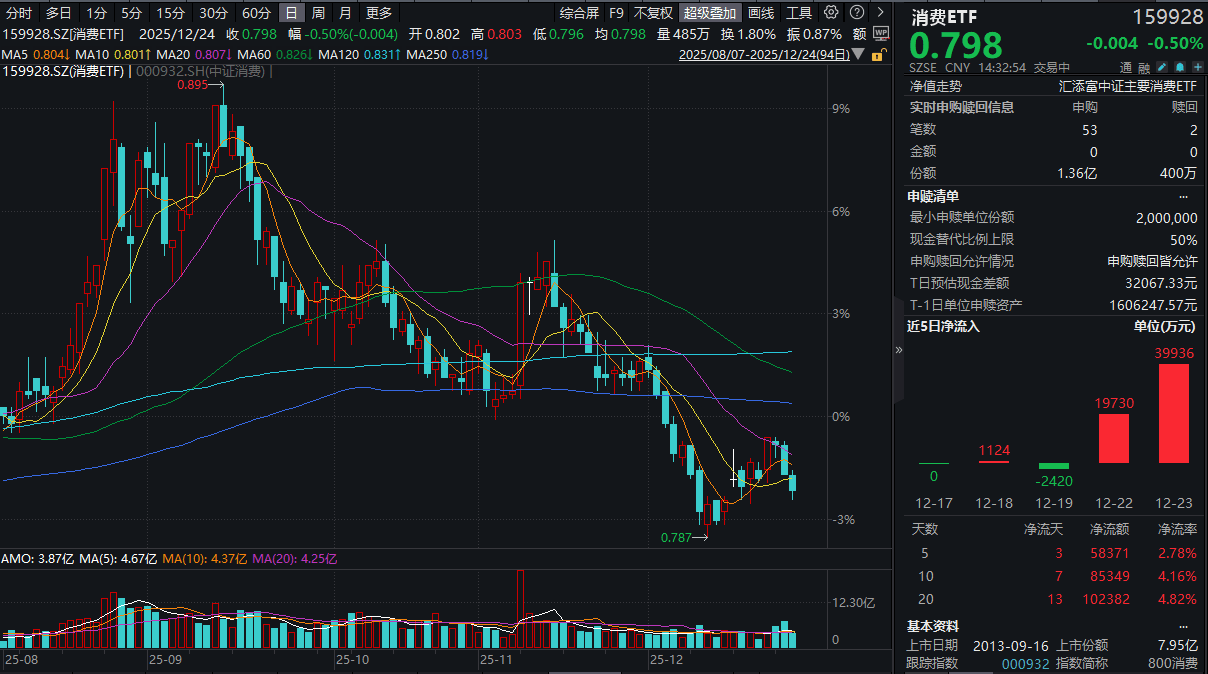
如何布局跨年攻势?科技与内需主题轮动!消费ETF(159928)三连跌走势,资金逢跌布局,3日累计巨幅净流入超7亿元!
Sou Hu Cai Jing· 2025-12-24 06:48
Market Overview - A-shares experienced a rebound, with the consumption ETF (159928) declining by 0.5% and a trading volume exceeding 380 million yuan [1] - The consumption ETF has seen a net subscription of over 130 million units during the day, accumulating a significant net inflow of over 700 million yuan over three days [1] Spring Market Expectations - As the year-end approaches, discussions about the spring market are intensifying, with analysts expecting positive policies to boost investor confidence [3] - The anticipated improvement in corporate earnings and favorable liquidity conditions are expected to contribute to a "spring rally," with technology growth and domestic consumption identified as key investment themes [3] Valuation Insights - The consumption ETF's underlying index has a TTM price-to-earnings ratio of 19.32, placing it in the 2.8% percentile over the past decade, indicating a high valuation attractiveness [5] - Seasonal trends in Q4 suggest a potential shift in market style towards undervalued sectors, particularly in December [5] Investment Themes - The rotation between domestic demand and technology themes is noted, with significant inflows into sectors like dairy, retail, and food processing [7] - External factors such as the Federal Reserve's interest rate cuts and the Bank of Japan's rate hikes are expected to stabilize market risk appetite [7] AI Applications - The domestic AI industry is entering a phase of large-scale demonstration applications, driven by advancements in computing architecture and product iterations [8] - Notable developments include the launch of new GPU architectures and AI health applications achieving significant user engagement [8] Commercial Aerospace - The upcoming launch of the Long March 12 rocket and advancements in satellite networking are highlighted as key developments in China's commercial aerospace sector [9] - The National Space Administration's action plan aims to support the development of new technologies and applications in commercial aerospace [9] Hainan Free Trade Zone - The Hainan Free Trade Port has officially launched its full island closure, with significant foreign investment projects commencing operations [9] - The first day of customs supervision saw substantial imports benefiting from zero tariffs, indicating a positive start for the free trade zone [9] Domestic Consumption - Policies aimed at boosting consumption are being implemented, with new consumption scenarios emerging in sports events, tourism, and cultural activities [10] - The expected growth in ice and snow sports consumption is projected to exceed 187.5 billion yuan, reflecting a 25% year-on-year increase [10] New Consumption Trends - The Chinese consumption market is characterized by structural highlights despite overall weak demand, with new products and channels gaining traction [11] - Health-conscious consumption trends are accelerating, particularly in sectors like health supplements and functional foods [11] ETF Composition - The consumption ETF's top ten constituent stocks account for over 68.55% of its weight, with leading liquor brands and major agricultural companies prominently featured [12]