
休闲食品

Search documents
食品饮料行业周报:两会政策红利释放,行业复苏确定性提升-20260308
KAIYUAN SECURITIES· 2026-03-08 12:15
Investment Rating - The industry investment rating is "Positive" (maintained) [1] Core Viewpoints - The dual policy support from the Two Sessions creates a window for layout in the food and beverage sector. The food and beverage index fell by 2.5% from March 2 to March 6, ranking 12th among primary sub-industries, underperforming the CSI 300 by approximately 1.4 percentage points. The meat products (+1.1%), beer (+0.9%), and dairy products (+0.1%) sectors performed relatively well. The government work report for 2026 prioritizes expanding domestic demand and boosting consumption, implementing special actions to enhance consumption recovery. The dual policy framework of "demand-side boost + supply-side expansion" is expected to drive the recovery of the food and beverage industry significantly [3][10][11]. Summary by Sections Weekly Viewpoints - The food and beverage index underperformed the market, with a decline of 2.5% and ranking 12th out of 28 industries. The meat products, beer, and dairy sectors showed relative strength [10][11]. Supply Chain Data - The report indicates a recovery in consumer spending and service consumption, with government initiatives aimed at increasing disposable income and enhancing social security. This is expected to benefit essential consumption categories such as liquor, snacks, and the catering supply chain [3][10]. Recommendations - Recommended stocks include: - Guizhou Moutai: Focused on sustainable development amidst shifting demand [4]. - Shanxi Fenjiu: Expected to grow despite short-term demand pressures [4]. - Ximai Foods: Anticipated steady growth in the oatmeal sector [4]. - Weilong: Projected to maintain growth in the konjac product line [4]. - Ganyuan Foods: Expected to benefit from a turnaround in trends [4]. Market Performance - The food and beverage sector's performance was below the market average, with specific stocks like Zhongxin Niya, New Dairy, and Chongqing Beer showing gains, while others like Jiugui Liquor and Youyou Foods faced declines [11][12]. Upstream Data - Recent data shows a decline in some upstream raw material prices, with whole milk powder prices down by 4.9% year-on-year, and fresh milk prices down by 1.9% year-on-year [16][19].




食品饮料行业关于《政府工作报告》的学习体会:政策及通胀预期有望带动估值企稳扩张
EBSCN· 2026-03-05 09:35
Investment Rating - The report maintains a "Buy" rating for the food and beverage industry, indicating an expected investment return exceeding the market benchmark by over 15% in the next 6-12 months [9]. Core Insights - The report highlights that the government's focus on economic growth, job creation, and consumer price stability is expected to stabilize and expand valuations in the food and beverage sector [2][3]. - The white liquor segment is recommended due to anticipated improvements in wealth effects from stable real estate prices and government initiatives aimed at increasing income for low-income groups [3]. - The frozen food sector is favored as the pricing logic is expected to improve under the "re-inflation" theme, with a shift towards new product-driven growth models reducing price competition [4]. - The report suggests that the dairy sector, particularly liquid milk, is expected to stabilize, with supply-side constraints and rational business goals leading to a more balanced supply-demand scenario in the latter half of 2026 [4]. Summary by Relevant Sections White Liquor - The report continues to recommend investment in the white liquor sector, with expectations of valuation stabilization and expansion driven by improved consumer wealth effects and government income initiatives [3]. - The performance during the Spring Festival showed better-than-expected sales, although pressure remains in the mid-price range [3]. Frozen Food - The frozen food segment is highlighted as a primary investment focus, with improved pricing logic and a recovery in consumer demand confirmed by positive sales feedback from leading companies [4]. - The competitive landscape has improved, with companies shifting from price competition to innovation-driven growth [4]. Snack Foods - Despite reduced channel benefits, strong individual products continue to perform well, and companies with remaining category advantages are recommended for investment [4]. Dairy Products - The report expresses optimism regarding the dairy sector, particularly in the context of the aging population, with supply-side constraints and a more rational approach to business goals expected to lead to a balanced supply-demand situation [4]. Key Company Recommendations - The report recommends high-end liquor from Guizhou Moutai, frozen food leaders like Anjijia and Sanquan Foods, and the snack food company Yanjinpuzi, as well as dairy leader Yili Group, which is expected to stabilize its liquid milk business while growing its non-liquid milk segment [5].


国内卖得很好的智能硬件产品,为什么一出海就不行了?
Founder Park· 2026-03-04 10:46
Core Insights - The article highlights the disparity between China's manufacturing prowess and the visibility of Chinese brands in the North American market, indicating a significant misalignment in brand recognition despite China's industrial capabilities [2][9]. - The next decade is identified as a critical period for transitioning from "Made in China" to "Brand from China," emphasizing the need for Chinese companies to focus on brand building rather than just manufacturing [3][11]. Group 1: Market Dynamics - North America’s retail landscape is dominated by offline channels, which account for 80% of retail share, contrasting with China's 45% [16]. - The article notes that brand recognition in North America is validated through offline repurchase rather than online algorithms, highlighting the importance of physical retail presence [17][18]. - Structural changes in consumer behavior in North America are creating opportunities for new brands, particularly in the food sector, where consumers are more open to trying products from diverse cultural backgrounds [23]. Group 2: Challenges for Chinese Brands - The main challenge for Chinese brands entering the North American market is not the product itself but gaining access to mainstream retail channels and understanding the local market dynamics [28]. - Many Chinese entrepreneurs face difficulties in navigating the North American retail landscape, often lacking knowledge about which chains to approach and what buyers prioritize [28][29]. - The article emphasizes the need for a focused approach in product categories and alignment with local consumer preferences to succeed in the North American market [29]. Group 3: Cismea's Role - Cismea is positioned as a brand incubation platform that helps Chinese brands establish a foothold in the North American market by leveraging its extensive network and understanding of local retail dynamics [31][32]. - The company has built relationships with over 30 major North American retailers, covering more than 100,000 physical stores, and operates as a vendor within these retail systems [32][35]. - Cismea offers a comprehensive methodology for brand development, including product compliance, packaging, buyer negotiations, and sales management, to facilitate the growth of Chinese brands in North America [33][36].


为一个菜系建一座“城”——成都市郫都区完善川菜产业生态
Xin Lang Cai Jing· 2026-02-24 23:26
Core Insights - The article highlights the development and globalization of the Pixian Douban industry, emphasizing its historical significance and modern transformation within the Chinese culinary landscape [1][2]. Industry Development - Pixian Douban, recognized as a "geographical indication product," has evolved into a billion-yuan industry since 2005, becoming a pillar of the local economy in Pixian District [2]. - The establishment of the China Sichuan Cuisine Industrial City has led to the gathering of 155 enterprises, aiming for an industrial output value of 11.76 billion yuan by 2025 [2]. - The industrial city promotes a model of "leading enterprises + precise investment attraction" to enhance the collaborative development of the industry chain, achieving a 15% to 20% reduction in raw material costs and a quality compliance rate of over 98% [2]. Technological Innovation - Sichuan Tianwei Food Group has implemented a fully automated and digitally controlled manufacturing process, addressing industry challenges such as food safety and product quality [3]. - The Pixian Douban Group has secured 73 independent intellectual property rights, significantly increasing production efficiency and reducing labor costs through advanced manufacturing techniques [3]. Global Expansion - The Pixian District is actively building a public service system for the "going global" strategy, assisting enterprises with customs, foreign exchange, and legal risks [5]. - Participation in international food exhibitions has led to significant contracts, with over 50 million yuan signed at the 2025 Singapore Food Expo [5]. - Companies like Pixian Douban Co. and Yang Guofu Spicy Hot Pot have successfully expanded overseas, adapting products to local tastes and achieving substantial growth in international sales [6][4]. Digital Empowerment - Many enterprises in Pixian District have embraced e-commerce, with dedicated teams for online sales and live streaming, significantly reducing promotional costs and expanding customer bases [8]. - Yang Guofu has developed a comprehensive sales system integrating stores, e-commerce, and retail, utilizing data-driven approaches for production and distribution [9]. Cultural Integration - The China Sichuan Cuisine Industrial City is developing cultural tourism resources, attracting over 40,000 visitors annually and achieving a 25% growth in factory store sales [10]. - The integration of agriculture, industry, and cultural tourism is enhancing the value chain of the Sichuan cuisine industry, promoting both local culture and economic growth [10].
为一个菜系建一座“城”
Jing Ji Ri Bao· 2026-02-24 22:07
Core Insights - The article highlights the transformation and growth of the Sichuan cuisine industry, particularly focusing on the development of Pixian Douban as a key product and the establishment of the China Sichuan Cuisine Industrial City as a hub for modernization and innovation in traditional food production [1][2]. Industry Development - Pixian Douban has become a billion-yuan industry since receiving national geographical indication product status in 2005, and it is now a pillar of the local food and beverage industry [2]. - The China Sichuan Cuisine Industrial City has attracted 155 enterprises, aiming for an industrial output value of 11.76 billion yuan by 2025 [2]. - The industrial city promotes a model of "leading enterprises + precise investment attraction" to enhance the collaboration within the supply chain, achieving a 15% to 20% reduction in raw material costs and a quality compliance rate of over 98% [2]. Technological Innovation - Sichuan Tianwei Food Group has implemented a fully automated and digitally controlled manufacturing process, addressing industry challenges such as food safety and product quality [3]. - The Pixian Douban Group has secured 73 independent intellectual property rights, significantly increasing production efficiency and reducing labor costs through advanced manufacturing techniques [3]. Global Expansion - The Sichuan cuisine industry is actively pursuing international markets, with local enterprises adapting to global food safety standards and regulations [4][5]. - The establishment of a public service system for "going global" has facilitated trade processes for local companies, leading to significant contracts at international food exhibitions [5]. - Companies like Pixian Douban and Yang Guofu have successfully expanded overseas, with Yang Guofu's store count nearly doubling in three years [6][5]. Digital Empowerment - Many enterprises in Pixian have embraced e-commerce and digital platforms, enhancing their market reach and production capabilities [8][9]. - Yang Guofu has developed a comprehensive sales system integrating stores, e-commerce, and retail, utilizing data-driven approaches for production and distribution [9]. Cultural Integration - The China Sichuan Cuisine Industrial City is also focusing on cultural tourism, integrating agricultural production, industrial standardization, and cultural promotion to enhance the overall value chain [10].
未知机构:华东食品综合大商要点20260222春节整体动销-20260224
未知机构· 2026-02-24 04:35
Summary of Conference Call Notes Industry Overview - The food industry in East China experienced positive growth across all categories during January and February, attributed to the extended sales period due to the timing of the Spring Festival and strong demand from returning consumers [1][1] - Structural characteristics indicate that essential goods saw better growth, with active sales in lower-tier markets and a recovery in gift demand, while price promotions have narrowed compared to the previous year [1][1] - There is an expectation for post-holiday inventory replenishment due to healthy sales [1][1] Category Performance - **Snacks**: Achieved approximately 10% year-on-year growth [1][1] - **Frozen Products**: Grew by about 7%, with significant contributions from brands like Anjins, which saw an 18% increase across all categories including meatballs, prepared dishes, and frozen meat [3][3] - **Beverages**: Experienced a year-on-year growth of about 5%, with larger sizes (1L) showing higher growth rates. Dongpeng Special Drink grew by over 12%, and electrolyte water increased by 20%, while Farmer's Water saw single-digit growth [3][3] - **Condiments**: Haitian achieved a 3% year-on-year growth, with brands like Qianhe and Yihai performing relatively well [4][4] - **Infant Formula**: Grew by approximately 5%, with notable differentiation; brands like Yili, Ausnutria, and Junlebao showed positive growth, while Feihe, Nestle, and Wyeth faced pressure [4][4] Notable Trends - Gift box sales showed significant differentiation, with high-priced gift boxes experiencing weak repurchase rates [3][3] - The overall market dynamics indicate a shift towards essential goods and a recovery in consumer spending patterns, particularly in lower-tier markets [1][1] Company-Specific Insights - Salted fish brands like Yanjin and Jinzhai reported double-digit growth, outperforming within their categories, while brands like Weilong and Qiaqia showed stable growth [2][2] - Yangyuan is facing relative pressure in the market [4][4]
田间到餐桌 年味“不打烊”
Xin Lang Cai Jing· 2026-02-21 20:16
Core Insights - The Tianjin Haijixing International Agricultural Products Logistics Park is actively supporting the market supply for the second half of the Spring Festival, ensuring a variety of fresh produce is available for consumers [1][2] - The park has implemented a "fresh" initiative to guarantee daily replenishment of high-quality seafood, with 11 high-end temporary storage pools capable of holding 2,000 pounds each, catering to the peak demand during the holiday season [1] - The logistics park serves as a significant agricultural product trading center in the Beijing-Tianjin-Hebei region, facilitating daily transactions of over 11,000 tons of various agricultural products, with an average daily transaction value of 78 million yuan [2] Group 1 - The logistics park is bustling with activity, with trucks delivering fresh produce and merchants busy with unloading and sorting [1] - The seafood section features various high-demand items such as Boston lobsters and king crabs, emphasizing the importance of seafood during the festive season [1] - The park offers value-added services like seafood processing to enhance the shopping experience for customers [1] Group 2 - The park sources fruits and vegetables from over 10 provinces in China and international locations like Chile and Thailand, utilizing a smart logistics system for traceability [2] - The vibrant fruit trading area showcases a variety of fruits, attracting consumers looking for gifts during the New Year celebrations [1][2] - The logistics park is not only a supply chain hub but also a reflection of Chinese customs and the economy during the festive season [2]
(新春走基层)中越边境河口:越南民众跨境采购中式年货迎新春
Xin Lang Cai Jing· 2026-02-15 08:32
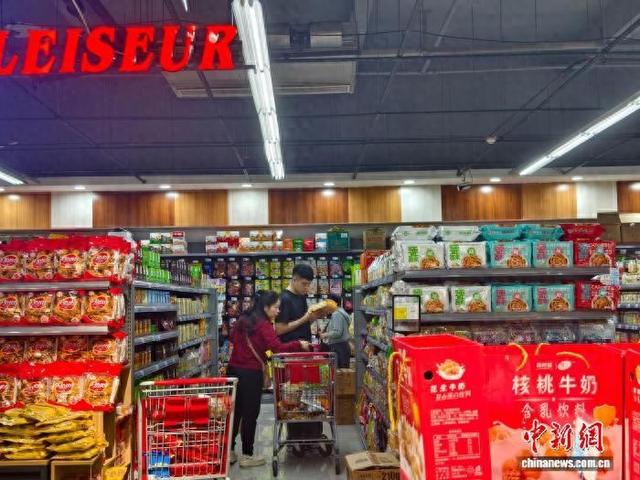
Group 1 - The article highlights the increasing cross-border shopping activity in Yunnan's Honghe Prefecture, particularly in Hekou County, as Vietnamese citizens flock to purchase traditional Chinese New Year goods, creating a unique festive atmosphere [1][3] - Hekou County's largest supermarket, Fuxin Supermarket, has increased its inventory of New Year goods by 30% compared to the previous year, showcasing a variety of products that cater to both Chinese and Vietnamese tastes [3][5] - Supermarkets in Hekou County have employed Vietnamese staff to provide dedicated shopping assistance to Vietnamese customers, enhancing the shopping experience by breaking down language barriers [5] Group 2 - The diverse range of products available in Hekou County includes local Yunnan specialties packaged as gift boxes, which are popular among Vietnamese shoppers for gifting to friends and family [3][5] - Vietnamese customers express satisfaction with the freshness of fruits and vegetables, as well as the attractive packaging of gift items, indicating a positive reception of the offerings [5] - The article emphasizes the cultural connection between China and Vietnam, particularly during the shared celebration of the Spring Festival, fostering goodwill and community ties [1][5]
货足价稳 江西省景德镇市华达超市多措施“备战”春节
Xin Lang Cai Jing· 2026-02-14 04:04
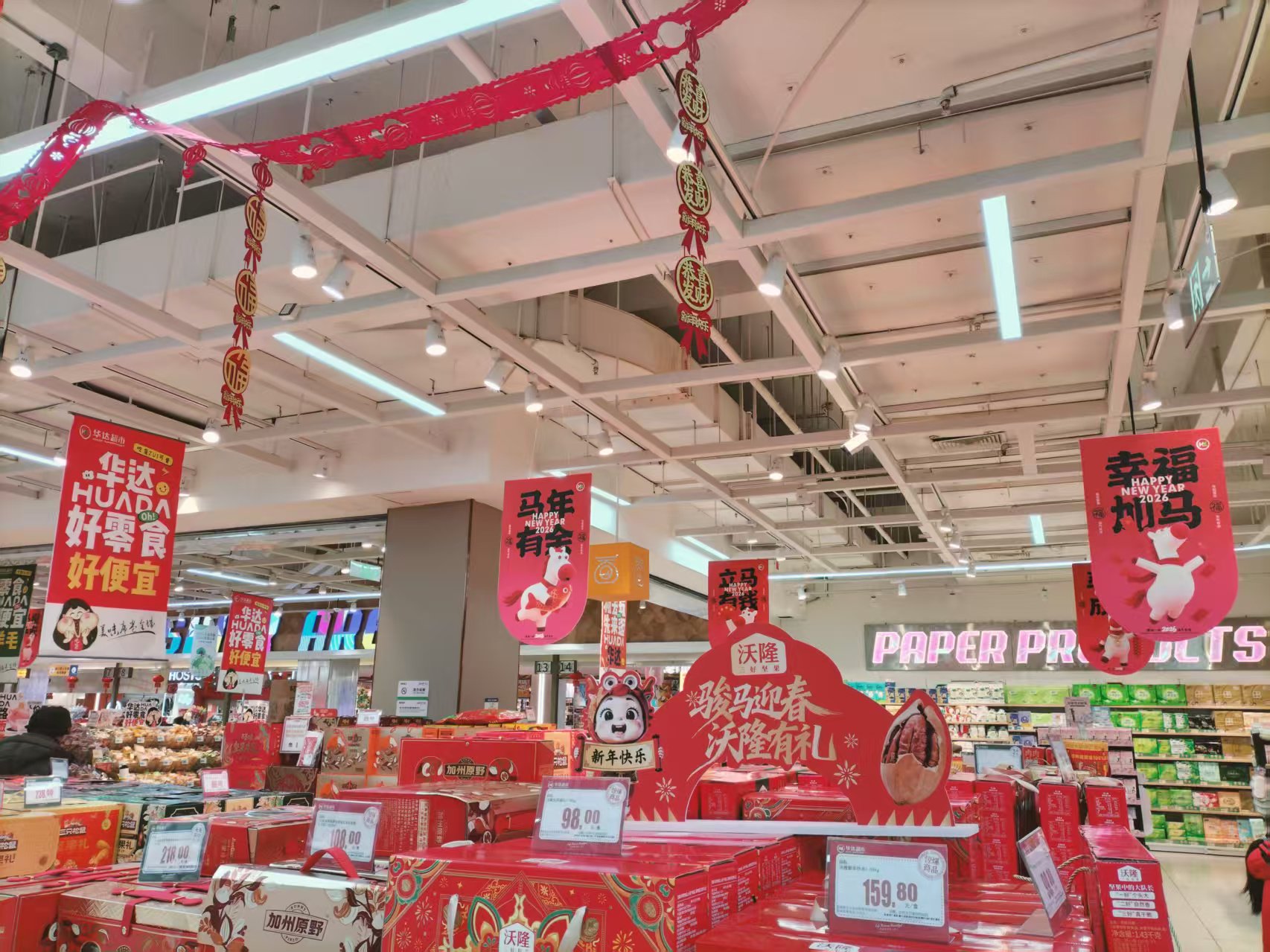
Core Viewpoint - The article highlights the preparedness of Huada Supermarket in Jingdezhen for the upcoming Spring Festival, ensuring sufficient supply, stable prices, and quality service to meet consumer demand during the peak shopping season [3][11]. Supply and Pricing - Huada Supermarket has established stable partnerships with over 1,000 quality suppliers, ensuring ample stock of essential goods such as rice, oil, fresh produce, and snacks [3]. - The supermarket has implemented direct procurement for pork by-products, resulting in an average price decrease of approximately 15% compared to the previous year [3]. - Prices for dried mushrooms have also decreased by about 12% due to a bountiful harvest, benefiting consumers directly [5]. - The supermarket has committed to price control on 30 key vegetables and 15 types of meat and grain products to ensure affordability during the festival [6]. Quality Assurance and Consumer Experience - Huada Supermarket has established a comprehensive quality management system that ensures traceability and control throughout the supply chain, with daily product inspections [7]. - Various consumer-friendly measures have been introduced, including additional cash registers, dedicated checkout lanes for the elderly and disabled, and extended operating hours during the festival [7]. - A "no-barrier return and exchange" policy is in place for all products, with extended customer service hours to facilitate consumer inquiries and complaints [7]. Digital Innovation - The supermarket has launched a "Smart New Year Goods Festival" to enhance shopping experiences through digital tools, allowing customers to check stock and promotions online and utilize smart shopping assistants in-store [8]. - Increased self-checkout machines have been implemented to reduce waiting times, and data analysis from previous years has informed accurate inventory predictions [8]. Logistics and Supply Chain - Huada Supermarket's logistics center operates with increased efficiency, delivering 30% more goods than usual during the festival period to ensure timely availability of products [9]. - Over 200 supply personnel are dedicated to maintaining product availability, price stability, and service quality during the peak season [9]. Community Impact - The supermarket's efforts reflect a broader commitment to ensuring a stable and prosperous festive market in Jingdezhen, contributing to the well-being of the community [11].
蜡笔小新食品跨界AI自救 净利润已连续多年亏损
Bei Jing Shang Bao· 2026-02-12 02:03
Core Insights - Crayon Shin-chan Foods is diversifying its business by acquiring Qucloud AI HK Limited for HKD 188 million, aiming to transform into a data-driven modern consumer goods group [1][3] Group 1: Acquisition Details - The acquisition will be financed through the issuance of consideration shares and convertible bonds, with 20.83 million shares priced at HKD 3.98 each, totaling approximately HKD 81 million, representing about 9.54% of the company's share capital before the transaction [1] - The convertible bonds will have a principal amount of HKD 106 million, with a conversion price of HKD 4.62 per share, potentially issuing 22.85 million shares, which would account for approximately 10.46% of the company's share capital before the transaction [1] - Post-acquisition, Crayon Shin-chan Foods will control Beijing Qucloud Technology Co., Ltd., which focuses on developing AI-driven software applications for businesses, including food and consumer goods manufacturers [1] Group 2: Financial Performance - Crayon Shin-chan Foods has faced continuous net profit losses since 2015, with losses amounting to CNY 338 million in 2015 and projected losses of CNY 41.45 million and CNY 20.88 million for 2024 and 2025, respectively [2] - Despite the ongoing losses, the company reported a revenue increase of 4.5% year-on-year to CNY 516 million in the last half of the previous year, with a net profit turnaround to CNY 2.52 million from a loss of CNY 43.64 million in the same period [2] Group 3: Strategic Rationale - The acquisition is seen as a strategic move to leverage Qucloud's technology and customer resources in smart marketing, aiming to enhance operational and marketing efficiency while expanding revenue sources [3][4] - The integration of AI capabilities into traditional marketing is a trend among food industry companies, with examples including Mondelez and Nestle utilizing AI to optimize marketing costs and content creation [3][4] - Analysts suggest that the acquisition reflects a "self-rescue" strategy for Crayon Shin-chan Foods, seeking high-margin opportunities through technology rather than traditional asset-heavy expansion [4]