
诺诚健华

Search documents
21对话|丹麓资本许谦:创新药“1到N”跃升,速度与质量突围
2 1 Shi Ji Jing Ji Bao Dao· 2025-08-06 01:21
21世纪经济报道记者季媛媛闫硕 对于生物医药市场而言,真正的创新宛如一场马拉松,考验的是耐力与体系的完善。 历经七八年的迅猛发展,中国创新药企已在"1到N"的马拉松中彰显了其速度与韧性。BD(商务拓展) 交易的持续井喷,不仅是这一阶段性胜利的显著标志,更是产业升级跃迁的关键动力。近期,行业报告 指出,中国创新者与美国在开发上的差距已从过去的10年缩短至3.7年。依托成本和速度优势,中国生 物科技公司在"1到N"创新领域能够维持可观的回报率。中国生物科技的全球认可度显著提升,最直观 地体现在对外授权活动的迅猛增长上。2025年上半年,中国药企达成72起海外授权交易,同比增长 38%,交易总金额高达608亿美元,已大幅超越2024年全年的519亿美元。 然而,当License-out(对外授权)的捷报频传成为常态,当资本市场对交易金额的惊叹逐渐回归理性, 中国创新药产业终将直面一个核心命题:如何在已知领域之外,开辟全新的疆域?如何从全球创新 的"优秀执行者"蜕变为"核心定义者"? 这一转变的核心标志为国内涌现出一批相关企业。百济神州和诺诚健华可作为从 "1 到 N" 创新重要贡 献主体的典型代表。 若需明确核心标 ...
汇添富医疗服务灵活配置混合D连续5个交易日下跌,区间累计跌幅1.89%
Sou Hu Cai Jing· 2025-08-05 15:52
截止2025年6月30日,汇添富医疗服务灵活配置混合D前十持仓占比合计68.66%,分别为:恒瑞医药 (9.90%)、科伦药业(9.03%)、海思科(8.99%)、百利天恒(8.94%)、新诺威(6.72%)、泽璟制 药-U(6.58%)、信立泰(5.33%)、热景生物(4.74%)、益方生物-U(4.40%)、诺诚健华-U (4.03%)。 来源:金融界 公开信息显示,现任基金经理张韡女士:中国。康奈尔大学生物医学硕士,曾任东方证券医药助理研究员, 汇添富基金医药研究员、高级医药研究员及医药行业研究组组长。2021年3月25日至今任汇添富健康生 活一年持有期混合型证券投资基金的基金经理。2021年9月29日至今任汇添富香港优势精选混合型证券 投资基金的基金经理。2022年10月21日至今任汇添富达欣灵活配置混合型证券投资基金的基金经理。 2023年11月23日至今任汇添富医疗服务灵活配置混合型证券投资基金的基金经理。2023年11月23日至今 任汇添富全球医疗保健混合型证券投资基金的基金经理。2025年4月10日至今任汇添富创新医药主题混 合型证券投资基金的基金经理。 8月5日,汇添富医疗服务灵活配置混合D ...
港股创新药板块持续冲高 7只个股市值突破千亿港元
Mei Ri Jing Ji Xin Wen· 2025-08-05 15:25
Core Viewpoint - The Hong Kong innovative drug company, Keren Biotechnology, has reached a market capitalization of HKD 101 billion, marking its entry into the exclusive club of companies valued over HKD 100 billion in the innovative drug sector [1][4]. Group 1: Market Performance - As of August 5, Keren Biotechnology's stock closed at HKD 433 per share, reflecting a sevenfold increase from its IPO price in July 2023 [4]. - The innovative drug sector in Hong Kong has seen multiple stocks reaching new highs, with seven companies now having market capitalizations exceeding HKD 100 billion, including Keren Biotechnology, Hengrui Medicine, and Innovent Biologics [1][2]. Group 2: Business Development (BD) and Collaborations - Hengrui Medicine announced a collaboration with GlaxoSmithKline (GSK) on a PDE3/4 inhibitor and up to 11 other projects, indicating a trend of active business development in the sector [2]. - The recent announcement by CSPC Pharmaceutical regarding a licensing agreement with Madrigal for a GLP-1 receptor agonist also highlights the growing BD activities among innovative drug companies [2]. Group 3: Policy and Market Sentiment - Recent policy adjustments, such as the initiation of a commercial health insurance innovative drug directory, are expected to enhance the payment landscape for innovative drugs, contributing to positive market sentiment [2]. - The overall optimistic sentiment in the Hong Kong innovative drug market is driving the continuous rise in stock prices [2]. Group 4: Company-Specific Developments - Keren Biotechnology is evolving into a comprehensive biopharmaceutical platform, with its lead product, sac-TMT, showing significant progress in clinical trials for various cancer treatments [4][5]. - The company has multiple differentiated ADC pipelines and is advancing its HER2 ADC, A166, with two applications currently under review in China [5]. - Keren Biotechnology is expected to reach operational breakeven within two years, reflecting its strategic growth trajectory [5].
智通港股解盘 | 市场大炒美联储9月降息 集采内卷强化创新药逻辑
Zhi Tong Cai Jing· 2025-08-05 12:53
Market Overview - US stock indices rebounded, influenced positively by Trump's market support, leading to a 0.68% rise in Hong Kong stocks [1] - San Francisco Fed President Daly indicated that the timing for interest rate cuts is approaching, with expectations for two 25 basis point cuts this year [1] - Goldman Sachs predicts three consecutive 25 basis point cuts starting in September, with a potential 50 basis point cut if unemployment rises further [1] Domestic Market Sentiment - A-share new account openings in July reached 1.96 million, a 71% year-on-year increase, indicating rising domestic confidence [2] - The stock of Upwind New Materials surged 20% after resuming trading, reigniting market enthusiasm [2] - The steel sector saw a significant rise, with Maanshan Iron & Steel's stock increasing over 15% due to improved loss forecasts and supportive policies [2] Industry Trends - The paper industry is experiencing a price increase, with major companies like Nine Dragons Paper and Lee & Man Paper announcing price hikes [2] - The eleventh batch of centralized drug procurement in China saw a record 45 companies applying for the same drug, intensifying competition in the generic drug market [3] - Investment is shifting towards innovative drugs, with companies like Junshi Biosciences seeing stock increases of nearly 34% due to promising clinical trials [3] Financial Support for Key Industries - A joint guideline from the central bank and seven departments aims to support financing for key manufacturing sectors, including integrated circuits and medical equipment [4] - AI-related companies like Longi Green Energy and Lenovo's server business are seeing stock increases due to new orders and market interest [4] Gaming Industry Performance - The domestic gaming market is projected to reach RMB 168 billion in sales by the first half of 2025, a 14.08% year-on-year increase [4] - Heartbeat Games anticipates a revenue increase of approximately 37% for the first half of 2025, driven by strong performance from self-developed games [4] Individual Company Highlights - Tencent's mobile game "Valorant: Source Action" is set to launch on August 19, with projected annual revenue exceeding RMB 6 billion [5] - Oriental Selection's stock surged nearly 17% ahead of its upcoming financial report, reflecting strong market performance [6] - The Macau gaming sector is experiencing a positive trend, with Morgan Stanley raising its revenue growth forecast for the year from 5% to 10% [6] Technological Advancements - Apple's breakthrough in brain-computer interface (BCI) technology allows users to control devices through thought, indicating a significant market opportunity [7] - The Chinese BCI market is expected to exceed RMB 3.8 billion by 2025, with a CAGR of approximately 20% [7] Investment Opportunities - Kelun-Bio has become a top holding in a major fund, indicating strong market confidence in its innovative drug pipeline [8] - The company has established multiple technology platforms and is expected to accelerate commercialization in 2025 [8]


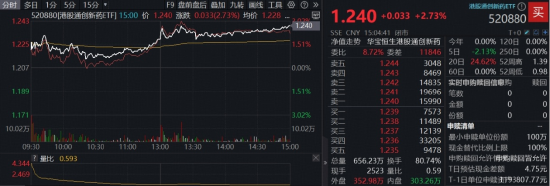
大反攻!创新药“新势力”港股通创新药ETF(520880)涨2.73%,成果多点爆发,康方生物续刷新高!
Xin Lang Ji Jin· 2025-08-05 12:15
Core Viewpoint - The Hong Kong stock market is experiencing a strong performance, particularly in the innovative pharmaceutical sector, with the Hong Kong Stock Connect Innovative Drug ETF (520880) leading the gains, reflecting a growing interest and activity in this industry [1][6]. Market Performance - The Hong Kong Stock Connect Innovative Drug ETF (520880) opened strong and rose by 2.73%, closing above the 5-day moving average with a trading volume exceeding 800 million yuan [1][2]. - Among the 30 constituent stocks in the innovative drug sector, 22 stocks increased by over 2%, with notable gains from companies like Lepu Biopharma-B, Ascentage Pharma-B, and CanSino Biologics-B, which saw double-digit increases [1][4]. Key Stocks - Kangfang Biotech surged over 7%, reaching a historical high, following the initiation of a global Phase III clinical trial for its dual-target drug, Ivosidenib [3]. - Innovent Biologics rose over 6%, benefiting from a report by JPMorgan highlighting the importance of business development (BD) in the biopharmaceutical sector this year [3]. - 3SBio Inc. increased by 5.97%, with recent announcements regarding a share placement to Pfizer, raising approximately 785 million HKD for clinical and preclinical projects [3]. Industry Growth - The National Medical Products Administration reported that 43 innovative drugs were approved in the first half of the year, a 59% increase year-on-year, nearing the total of 48 approvals expected for the entire year of 2024 [4]. - The innovative drug sector is entering a phase of significant technological advancements, with domestic companies increasingly leading innovation rather than merely following trends [5]. Policy Support - Recent favorable policies from the National Healthcare Security Administration include a price stabilization mechanism for newly launched drugs, which aims to prevent immediate price reductions upon market entry [5]. - Analysts from China International Capital Corporation express optimism about the long-term development of the innovative drug industry, supported by a favorable regulatory environment and abundant clinical resources [5]. ETF Performance - The Hong Kong Stock Connect Innovative Drug ETF (520880) is the first ETF to track the Hang Seng Hong Kong Stock Connect Innovative Drug Select Index, which focuses on the innovative drug industry chain [6]. - Year-to-date, the index has increased by 101.58%, significantly outperforming the Hang Seng Index and the Hang Seng Tech Index [8].

一则大消息,飙涨!
Zhong Guo Ji Jin Bao· 2025-08-05 10:59
Market Overview - The Hong Kong stock market showed strong performance on August 5, with the Hang Seng Index rising by 0.68% to close at 24,902.53 points, and the Hang Seng Tech Index increasing by 0.73% [2][3] - The total market turnover was 229.4 billion HKD, slightly lower than the previous trading day, with a net inflow of southbound funds amounting to 23.426 billion HKD [2] Biopharmaceutical Sector - The biopharmaceutical stocks gained significant attention, particularly Junshi Biosciences, which surged by 33.75% to 32.18 HKD per share, marking a year-to-date increase of 177.89% [4][7] - Guojin Securities reported a rising enthusiasm for global dual-antibody development, indicating a window for innovation in the domestic antibody industry, with Junshi Biosciences having extensive experience in monoclonal antibody development [7] Junshi Biosciences - Junshi Biosciences completed a placement of 41 million new shares on June 20, raising approximately 1.026 billion HKD, with 70% of the funds allocated for innovative drug research and 30% for general corporate purposes [8] - The company has developed a series of innovative dual-antibody molecules based on its experience in monoclonal antibodies, including the PD-1 monoclonal antibody, Toripalimab, which was one of the first domestically launched PD-1 inhibitors [7] Other Notable Stocks - Zhujiang Steel Pipe experienced a rise of 27.87% following an announcement regarding a proposed reduction of share premium to offset cumulative losses, which will result in a cumulative profit of approximately 92.224 million RMB by the end of 2024 [9][11] - Xindong Company, a gaming stock, saw a significant increase of 24.76% after announcing an expected revenue of at least 3.05 billion RMB for the first half of 2025, representing a growth of approximately 37% year-on-year [12][16]
中证香港300生物药品指数报1440.84点,前十大权重包含诺诚健华-B等
Jin Rong Jie· 2025-08-05 10:39
Group 1 - The core viewpoint of the news is that the CSI Hong Kong 300 Biopharmaceutical Index has shown significant growth, with a 24.33% increase over the past month, a 60.33% increase over the past three months, and a remarkable 137.42% increase year-to-date [1] - The CSI Hong Kong 300 Industry Index series is categorized according to the China Securities Index industry classification standards, reflecting the overall performance of different industries in the Hong Kong market [1] - The CSI Hong Kong 300 Biopharmaceutical Index is composed entirely of securities from the Hong Kong Stock Exchange, with 100% of its holdings in the biopharmaceutical sector [1] Group 2 - The index sample is adjusted every six months, with adjustments implemented on the next trading day following the second Friday of June and December each year [2] - Weight factors are generally fixed until the next scheduled adjustment, but can be modified in the event of temporary adjustments due to changes in the underlying index samples [2] - Special events affecting sample companies, such as delisting or mergers, will lead to corresponding adjustments in the CSI Hong Kong 300 Industry Index series [2]
诺诚健华(688428) - 证券变动月报表
2025-08-05 09:15
股份發行人及根據《上市規則》第十九B章上市的香港預託證券發行人的證券變動月報表 截至月份: 2025年7月31日 狀態: 新提交 致:香港交易及結算所有限公司 公司名稱: 諾誠健華醫藥有限公司(於開曼群島註冊成立的有限公司) 呈交日期: 2025年8月5日 I. 法定/註冊股本變動 | 1. 股份分類 | 普通股 | 股份類別 | 不適用 | | 於香港聯交所上市 (註1) | | | 是 | | | --- | --- | --- | --- | --- | --- | --- | --- | --- | --- | | 證券代號 (如上市) | 09969 | 說明 | | | | | | | | | | | 法定/註冊股份數目 | | | 面值 | | | 法定/註冊股本 | | | 上月底結存 | | | 25,000,000,000 | USD | | 0.000002 | USD | | 50,000 | | 增加 / 減少 (-) | | | | | | | USD | | | | 本月底結存 | | | 25,000,000,000 | USD | | 0.000002 | USD | | 5 ...
诺诚健华(688428) - 董事会召开日期
2025-08-05 09:15
諾誠健華醫藥有限公司 ( 於 開 曼 群 島 註 冊 成 立 的 有 限 公 司 ) (股份代號:9969) InnoCare Pharma Limited 香港交易及結算所有限公司及香港聯合交易所有限公司對本公告的內容概不負責,對其準確 性或完整性亦不發表任何聲明,並明確表示,概不就因本公告全部或任何部分內容而產生或 因依賴該等內容而引致的任何損失承擔任何責任。 承董事會命 於本公告日期,董事會包括主席兼執行董事崔霽松博士;執行董事趙仁濱博士;非執行董事 施一公博士及謝榕剛先生;以及獨立非執行董事胡蘭女士、董丹丹博士及及管坤良教授。 諾誠健華醫藥有限公司(「本公司」)董事會(「董事會」)謹此宣佈,本公司將於 2025年8月19日(星期二)舉行董事會會議,藉以(其中包括)考慮並批准本公司 及其附屬公司截至2025年6月30日止六個月中期業績及其發佈。 諾誠健華醫藥有限公司 主席兼執行董事 崔霽松博士 香港,2025年8月5日 董事會召開日期 ...
港股收评:三大指数齐涨,科技股分化,生物医药股强势!君实生物大涨34%,晨鸣纸业涨15%,腾讯涨1.64%,快手涨3%
Ge Long Hui· 2025-08-05 08:48
Core Viewpoint - The Hong Kong stock market continued its rebound, with significant net inflows from mainland investors exceeding HKD 22 billion, leading to gains in major indices [1] Group 1: Market Performance - The Hang Seng Index rose by 0.68%, the Hang Seng China Enterprises Index increased by 0.65%, and the Hang Seng Tech Index gained 0.73% [1] - Large technology stocks showed mixed performance, with Kuaishou up nearly 3%, Tencent rising by 1.64%, and Netease increasing by 1.55%, while Xiaomi, Alibaba, Baidu, and Meituan remained in the red [1] Group 2: Sector Highlights - Biopharmaceutical stocks experienced a significant surge, with Junshi Biosciences soaring nearly 34% at the close, and other companies like CanSino Biologics, Innovent Biologics, and WuXi AppTec also showing strong performance [1] - Leading paper companies initiated a new round of price increases, resulting in a notable rise in paper stocks, with Chenming Paper up nearly 15% reaching a new high [1] - The brain-computer interface concept stocks generally rose, with Nanjing Panda Electronics hitting an intraday high of 8% [1] Group 3: Other Sector Movements - The automotive sector showed mixed results following the release of July's new energy vehicle sales data, with NIO, Leapmotor, and BYD underperforming [1] - Semiconductor stocks declined in the afternoon, with SMIC falling nearly 1%, while lithium battery stocks, education stocks, and oil stocks saw slight declines [1]
