
华人影业

Search documents
春节档,已破40亿!《飞驰人生3》领跑 背后上市公司曝光
Shang Hai Zheng Quan Bao· 2026-02-22 00:52
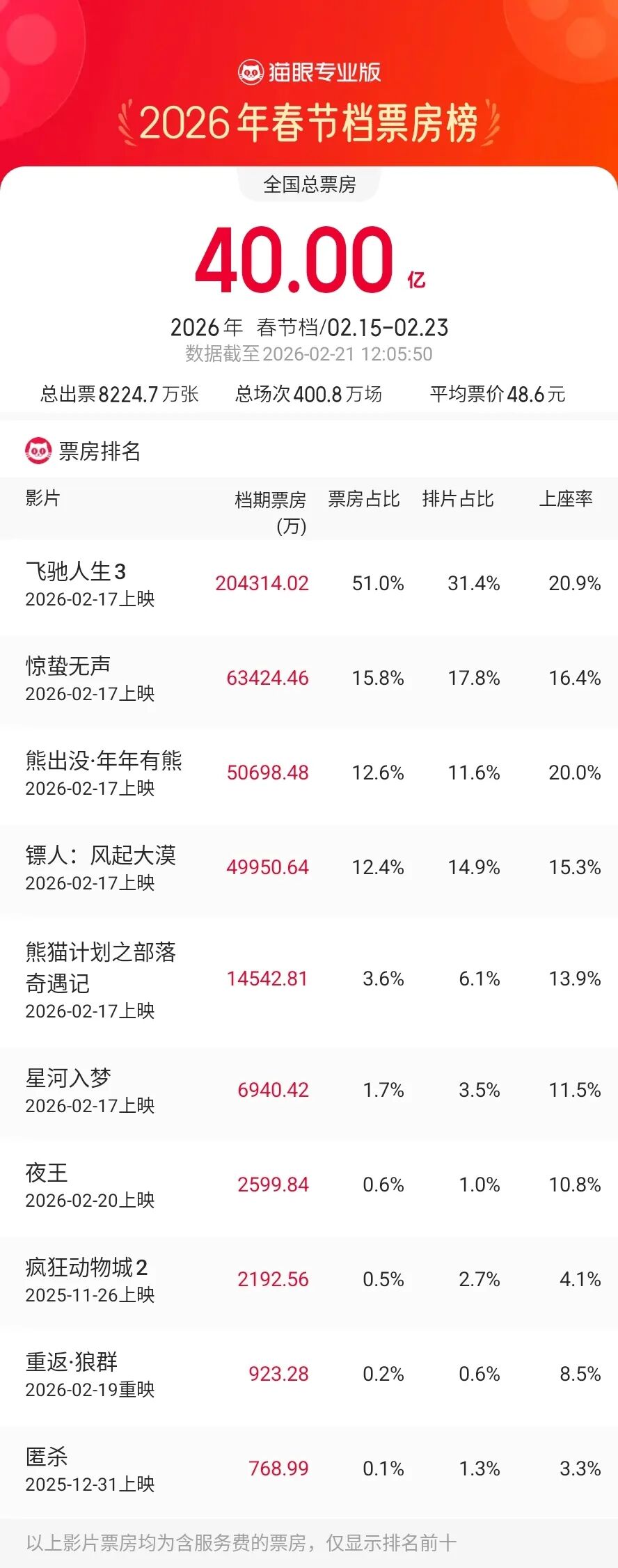
Core Insights - The total box office for the 2026 Spring Festival period has exceeded 4 billion yuan, with "Flying Life 3," "Silent Awakening," and "Boon Year" leading the charts [1][4] - The total number of screenings has surpassed 4 million, setting a new record for the Spring Festival in Chinese film history [1] Box Office Performance - "Flying Life 3" has achieved a box office of 2.04 billion yuan, accounting for 51.0% of the total box office, with a screening ratio of 31.4% and an attendance rate of 20.9% [4] - "Silent Awakening" ranks second with a box office of 634.24 million yuan, representing 15.8% of the total, with a screening ratio of 17.8% and an attendance rate of 16.4% [4] - "Boon Year" is in third place with a box office of 506.98 million yuan, making up 12.6% of the total, with a screening ratio of 11.6% and an attendance rate of 20.0% [4] Notable Films - "Flying Life 3," directed by Han Han and featuring actors such as Shen Teng and Yin Zheng, has broken the record for the highest opening day box office for a domestic film in China, reaching 641 million yuan on its premiere day [6] - "Silent Awakening," directed by Zhang Yimou, focuses on contemporary national security themes and includes elements of espionage and action [6] - "Boon Year," part of the Huasheng Fantawild series, has accumulated over 5 billion yuan in box office revenue across its previous 11 films, maintaining its status as a family-friendly choice during the Spring Festival [7] Emerging Films - "The Courier: Wind Rises in the Desert" has seen a positive reception, with its box office nearing 500 million yuan and a forecasted total box office of 1.24 billion yuan [10] - "Night King," the only Cantonese comedy in this Spring Festival lineup, has surpassed 25 million yuan in box office revenue within two days of its release [12]


突破10亿元,春节档票房爆了!“最长电影春节档”谁能胜出?
Mei Ri Jing Ji Xin Wen· 2026-02-17 08:25
Core Insights - The total box office for the 2026 Spring Festival period has surpassed 1 billion yuan as of February 17, 2026, indicating strong market performance [1] - The film "Flying Life 3," directed by Han Han and starring Shen Teng, has grossed over 480 million yuan, with AI predictions estimating a total box office of 4.367 billion yuan [3] - Other notable films include "Silent Awakening" and "Boonie Bears: Year of the Bear," with box office earnings of 180 million yuan and nearly 140 million yuan, respectively, and AI predictions of 2.1 billion yuan and 1.36 billion yuan [3] - The film "Bounty Hunter: Wind Rises in the Desert," directed by Yuen Woo-ping and starring Wu Jing, has crossed 100 million yuan, with an AI forecast of 840 million yuan [3] - The film industry is increasingly influenced by a few major players, with several listed companies involved in the production of these films, including Maoyan Entertainment, Bona Film Group, China Film, Wanda Film, and Hengdian Film [12] - The Spring Festival holiday in 2026 lasts for 9 days, providing a favorable window for box office performance, with a high acceptance rate for quality films among audiences [12]

中国电影出海!塑造中国风格,展现中国气派
Xin Lang Cai Jing· 2026-01-17 23:55
Core Insights - The article highlights the significant achievements of Chinese cinema in expanding its presence internationally, with notable box office successes and a systematic approach to "going global" [1][2]. Group 1: Box Office Performance - The film "Ne Zha" achieved an overseas box office of $69 million, setting a new record for Chinese films [1]. - The total overseas box office for Chinese films exceeded 1 billion RMB in the past year, showing an increase compared to the previous year [1]. - Among the top 20 domestic films, 15 were released overseas, indicating a growing trend in international distribution [1]. Group 2: Trends in International Collaboration - Co-productions and international collaborations are becoming key trends, exemplified by the "Meg" series, which utilizes a "Chinese control + international resources" model [2]. - New-generation Chinese directors are expanding their narratives beyond traditional contexts, allowing Chinese characters to resonate with global audiences [2]. - The distribution of Chinese films is evolving from festival screenings to a more commercial and systematic approach, including simultaneous global releases and a dual distribution model of theaters and streaming [2]. Group 3: Technological Advancements - China leads in the global LED cinema screen market, with 13 out of 22 certified manufacturers and over 200 installations worldwide [3]. - Chinese companies are establishing virtual filming studios in North America and Europe, showcasing advancements in virtual production technology [3]. - Chinese sound technology has reached international standards, with immersive sound systems being applied in award-winning films [3]. Group 4: Systematic Development - The "mode going out" phase reflects a comprehensive management system, a robust market framework, and a focus on innovation in the Chinese film industry [4]. - The transition from a "learner" to a "leader" in the global film industry is marked by China's unique film management and cultural governance experiences [4]. Group 5: Challenges Ahead - Language and cultural barriers remain significant challenges for Chinese filmmakers, necessitating a balance between cultural identity and universal appeal [6]. - The marketing and promotion systems for overseas markets are still underdeveloped, which can hinder the success of high-quality films [6]. - The need for professionals familiar with international laws and market dynamics highlights gaps in the talent pool necessary for successful international collaborations [6]. Group 6: Future Outlook - By 2035, China aims to become a major player in the global film industry, influencing the international film ecosystem and expanding its market share [8]. - China is expected to establish a complete international standard system in areas like LED optics and sound, contributing to global film technology [9]. - The transition from being a "learner" to a "contributor" and "leader" in the global film landscape is anticipated, with Chinese films gaining more attention in mainstream international markets [10].
塑造中国风格 展现中国气派(人文对话)
Ren Min Ri Bao· 2026-01-17 23:16
Core Viewpoint - The article discusses the significant progress and trends in the international expansion of Chinese cinema, highlighting the systematic approach and the increasing global presence of Chinese films, with a focus on both content and technology [6][10]. Group 1: Achievements in International Expansion - In 2025, Chinese films achieved remarkable overseas box office success, with "Ne Zha" grossing $69 million, marking a new high for domestic films [6]. - The total overseas box office for Chinese films exceeded 1 billion RMB, showing an increase from the previous year [6]. - 15 out of the top 20 domestic films were released internationally, indicating a growing trend of Chinese films "going global" [6]. Group 2: Trends in Film Production and Distribution - Co-productions and international collaborations are becoming key trends, exemplified by the "Meg" series, which utilizes a "Chinese control + international resources" model [7]. - The narrative scope of new-generation Chinese directors has expanded, allowing for stories that resonate with global audiences [7]. - The distribution of Chinese films has evolved from festival screenings to a more commercial and systematic approach, including simultaneous global releases and a dual distribution model of theaters and streaming [7]. Group 3: Technological Advancements - China leads in the global LED cinema screen market, with 13 out of 22 certified manufacturers and over 200 installations worldwide [8]. - Chinese virtual filming technology is being adopted in North America and Europe, with several companies establishing virtual studios abroad [8]. - Chinese sound technology has reached international standards, with immersive sound systems being applied in award-winning films [8]. Group 4: Systematic Approach to Globalization - The "mode of going global" reflects a comprehensive management system, a robust market framework, and a public service system that supports the film industry [9]. - The transition from "cultural output" to "industry participation" signifies a shift in China's role in the global film landscape [9]. Group 5: Challenges and Future Outlook - Language and cultural barriers remain significant challenges for Chinese films in international markets [12]. - The need for a more robust marketing and promotion system is critical for the success of high-quality films abroad [12]. - By 2035, China aims to become a major player in the global film industry, with expectations of significant contributions to international projects and the establishment of global standards in film technology [14][15].

120亿元+64个项目!饶曙光:成都成影视产业新热土 企业“西进”布局忙
Mei Ri Jing Ji Xin Wen· 2025-09-11 16:00
Core Insights - The second Panda Award event in Chengdu resulted in the signing of 64 film industry-related projects with a total investment exceeding 12 billion yuan, showcasing Chengdu's growing appeal as a new hub for the film industry [1][2]. Group 1: Project Overview - The signed projects include 24 major projects focusing on digital cultural creation and film bases, indicating a vibrant multi-faceted development in the industry [2]. - Notable projects include the establishment of a digital technology cultural park, a short drama base linked to cultural heritage, and a high-tech digital photography studio, which will enhance Chengdu's capabilities in film production [2][3]. Group 2: Film Productions - A total of 23 significant works were signed, covering genres such as AI science fiction and realistic themes, with projects like "Emei," a new martial arts aesthetic, and "The Prosecution," which focuses on the role of prosecutors [3][4]. - The projects aim to reflect local culture and stories, with a strong emphasis on community engagement and storytelling [5][6]. Group 3: Investment and Financial Support - The signing included 17 strategic investment and overseas cooperation projects, aimed at injecting financial resources into the film industry [5]. - The establishment of a film investment service platform will create a dual mechanism of "fund pool + project pool" to connect quality projects with funding, enhancing the overall industry ecosystem [5][6]. Group 4: Policy Support and Industry Growth - Chengdu has introduced policies to promote the film industry, offering substantial financial support for high-quality projects, with maximum funding exceeding 21 million yuan for premium projects [6]. - The local government aims to position Chengdu as a national hub for film and animation creation, fostering a competitive environment for over 1,000 film enterprises in the region [5][6].

120亿元+64个项目!饶曙光:成都成影视产业新热土,企业“西进”布局忙
Mei Ri Jing Ji Xin Wen· 2025-09-11 15:29
Core Insights - The second "Panda Awards" event in Chengdu resulted in the signing of 64 film industry-related projects with a total investment exceeding 12 billion yuan [1][3] - The projects are categorized into major projects, important works, and strategic investments/outbound cooperation, indicating a focus on both industry upgrades and cultural exports [1][3] Group 1: Project Overview - The signed projects include 24 major projects focusing on digital cultural creation and film bases, showcasing a vibrant multi-faceted development [3] - Notable projects include the "Cultural and Artistic Technology City Digital Creative Park" and the "All-domain Short Drama Base Construction and Operation Project," which aim to leverage local resources and enhance service offerings [3][4] - 23 significant works were also signed, covering genres such as AI science fiction and realistic themes, contributing to the vitality of Chengdu's digital cultural and film production sectors [4][6] Group 2: Strategic Investments and Support - A total of 17 strategic investment/outbound cooperation projects were signed, aimed at injecting financial resources into the film industry [7] - The "China (Chengdu) Film Investment and Financing Service Platform" was established to create a dual empowerment mechanism, connecting funds with quality projects [7] - Chengdu's film industry development fund is progressing steadily, with plans to invest over 500 million yuan in 10 reserved projects, enhancing the industry's growth potential [7][9] Group 3: Industry Environment and Policy Support - Chengdu is recognized as a fertile ground for the film industry, attracting filmmakers and artists to create impactful stories that resonate with the public [9] - The city has implemented policies to promote the film industry, offering substantial financial support for high-quality projects, with maximum subsidies exceeding 21 million yuan [9][10] - The supportive environment in Chengdu is highlighted by its openness and respect for creators, facilitating project completion through effective policy backing [9][10]

吒儿再出海!英文版《哪吒2》8月登陆北美澳新,杨紫琼加盟配音
第一财经· 2025-07-09 14:23
Core Viewpoint - The article highlights the international release of the English dubbed version of the animated film "Nezha: The Devil's Child" (referred to as "Nezha 2"), which is set to premiere in the US, Canada, Australia, and New Zealand starting August 22. The film has achieved significant box office success and critical acclaim, becoming the highest-grossing animated film globally with a total box office of $2.193 billion [1][2]. Group 1 - The English dubbed version of "Nezha 2" will be released in multiple countries, including the US, Canada, Australia, and New Zealand, starting August 22, and will be available in IMAX and 3D formats [1]. - The film is directed and written by Jiaozi and has received positive reviews and box office performance, making it the highest-grossing animated film and non-English film globally [1]. - The collaboration between A24 and CMC Pictures aims to explore new distribution models for Chinese animation in international markets, leveraging A24's expertise in promoting multicultural stories [1][2]. Group 2 - CMC Pictures has established a mature distribution network covering over 100 countries and 500 cities since launching its overseas distribution business in 2016, successfully promoting major Chinese IPs like "The Wandering Earth" and "Detective Chinatown" [2]. - The partnership with A24 is expected to enhance the international presence and influence of Chinese culture and the "Nezha" IP, allowing the film to reach diverse audiences with different viewing habits [2].

《哪吒》踏浪越重洋 东方神话与世界表达同频共振
Shang Hai Zheng Quan Bao· 2025-06-22 17:20
Core Insights - The animated film "Nezha: The Devil's Child" (referred to as "Nezha 2") has topped the global animated film box office chart and ranks 5th in the all-time global box office, breaking Hollywood's monopoly on animated films and the global top 10 box office list [3][4] - The film showcases the innovative expression of traditional Chinese culture, gaining significant international attention and popularity [3][4] International Release Strategy - "Nezha 2" adopted a staggered release strategy starting from February 14, covering five continents and becoming the first Chinese animated film to be widely released in mainstream theaters in Europe and North America [4][5] - The film's North American theater count increased from 135 for the first installment to over 1,000 for "Nezha 2," setting new records for Chinese-language films in terms of both screening volume and box office [4][5] Audience Reception - The film attracted a diverse audience, including not only overseas Chinese but also a significant number of Western viewers, with 30% of the audience being non-Chinese speakers, up from a previous high of 20% [5][6] - Positive reviews highlighted the film's ability to resonate with audiences of all ages, with many viewers expressing a desire for more content of this quality [5][6] Distribution and Marketing - The success of "Nezha 2" is attributed to effective distribution strategies by Huayi Brothers, which focused on reaching overseas audiences through original sound versions and localized marketing efforts [6][7] - An English version of "Nezha 2" is set to be released, aiming to further expand its audience reach and enhance its global impact [7][8] Cultural Impact - The film has sparked increased interest in Chinese culture and language, with a 37% surge in users of Chinese learning apps and a 20-fold increase in searches for specific terms related to the film [7][8] - "Nezha 2" is seen as a cultural phenomenon that connects global audiences and enhances their understanding of Chinese culture [8] Future Prospects - The film industry is exploring new technologies such as virtual reality, which may reshape the competitive landscape of the film market [8] - The success of "Nezha 2" indicates a shift in the international perception of Chinese films, moving from niche to mainstream distribution [8]

中国影视出海新常态:东南亚成“桥头堡”
Zhong Guo Jing Ying Bao· 2025-06-19 16:55
Core Insights - The structure of the box office composition in China's film market has significantly changed since 2020, with the proportion of imported films dropping from over 36% to a projected 21% by 2024 [1] - The Shanghai International Film Festival has introduced forums and promotional activities for various countries, indicating a trend towards more diverse international cooperation in the film industry, particularly with Southeast Asia [1] Box Office Trends - The share of Hollywood films in the Chinese market has also decreased, with projections showing a decline from 13.5% in 2020 to 15.1% in 2024 [1] - The Southeast Asian market is increasingly recognized as a potential growth area for Chinese films, with significant box office contributions from countries like Malaysia [3] International Collaboration - Chinese film companies are looking to collaborate with Southeast Asian and Japanese firms for mid-budget films, as opportunities for large-scale productions are limited [3] - The potential for collaboration has been highlighted by successful projects like the "Detective Chinatown" series, which have utilized Southeast Asia as a filming location [3] Market Growth - The Southeast Asian film market has recovered to pre-pandemic box office levels and is growing at an annual rate of 5%-6%, with a predominantly young audience [3] - The region has a significant Chinese-speaking population, providing a solid audience base for Chinese-language films [3] Tax Incentives - Many Southeast Asian countries offer attractive tax incentives for film production, with some providing rebates of 20%-30%, encouraging Chinese companies to film and establish branches in the region [4] Distribution Challenges - Chinese films often do not consider overseas distribution until after production, which can lead to cultural mismatches and lower acceptance in foreign markets [6] - The high costs of marketing and distribution in China pose challenges for smaller films from Southeast Asia, limiting their box office potential [7] Cultural Exchange - There is a call for greater cultural exchange and understanding between Chinese and Southeast Asian filmmakers to enhance the appeal of films in both markets [8]
文化赋能 创新驱动:中国电影业探索高质量发展破题之道
Xin Hua Wang· 2025-05-28 07:57
Core Insights - The forum emphasized the importance of high-quality development in the Chinese film industry, highlighting the audience's strong desire for good films despite rapid societal changes [1] - The success of films like "Ne Zha" and "Detective Chinatown 1900" during the Spring Festival has boosted market confidence and showcased the modern expression of traditional Chinese culture [1][2] - The concept of "new mainstream films" is gaining traction, focusing on historical narratives and national sentiments to resonate with audiences [2] Group 1 - The deputy director of the Film Bureau stressed that the creativity and imagination of filmmakers are crucial for producing appealing films [1] - Filmmakers are encouraged to draw inspiration from real life and the people, aiming to tell more compelling stories [1] - The film industry is urged to create a supportive environment for talent development and maintain a healthy market [1] Group 2 - The success of "Ne Zha 2" as the highest-grossing animated film globally demonstrates the power of Chinese culture and storytelling [1][2] - Audience engagement through "secondary creation" has enhanced the longevity of the "Ne Zha" IP, indicating a reciprocal relationship between creators and viewers [2] - The recognition of mainstream values in new mainstream films is essential for fostering social consensus and emotional resonance among audiences [2]