金故

Search documents
国庆假期,它去哪儿?
3 6 Ke· 2025-09-30 10:13
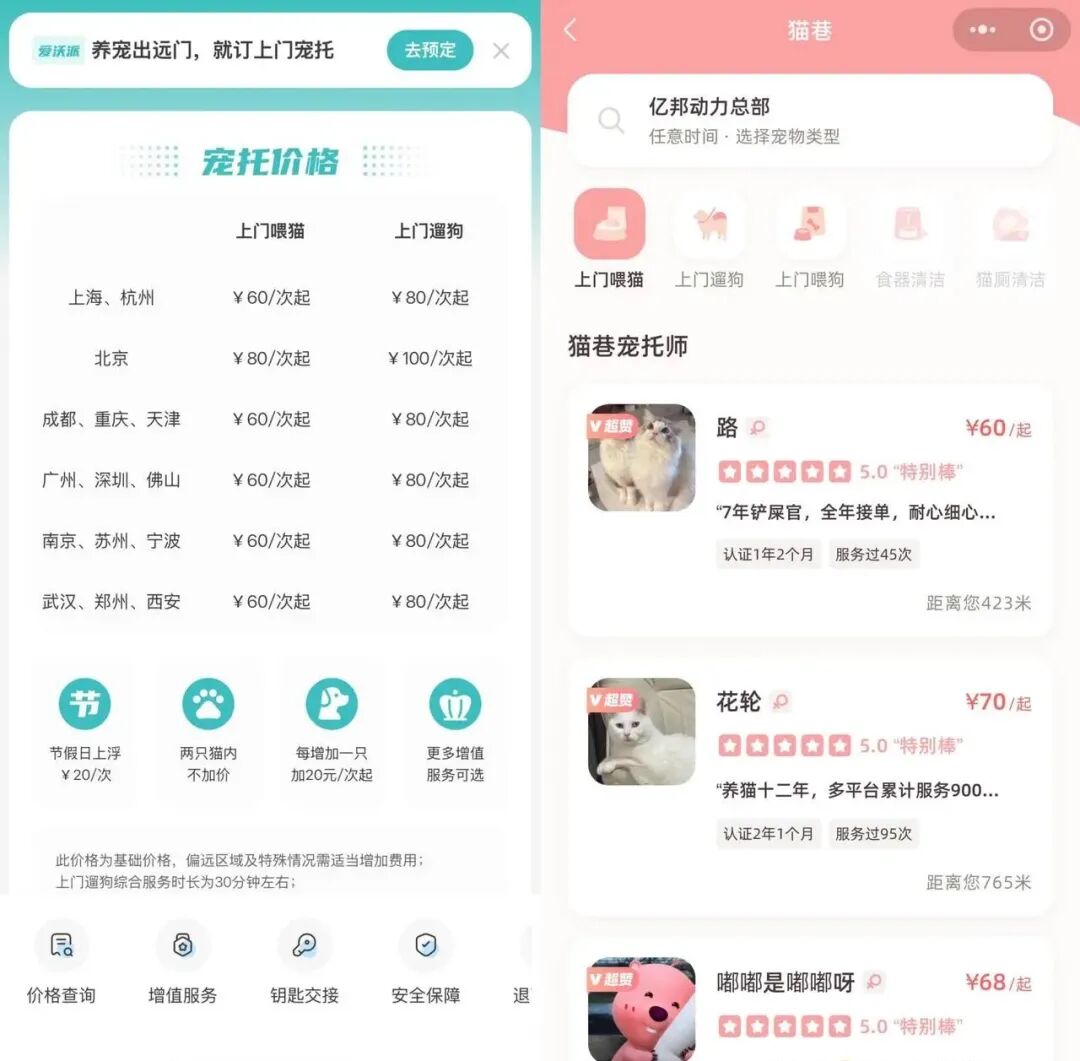
Core Insights - The traditional pet boarding model is being challenged as pet owners increasingly view their pets as family members, leading to a demand for higher-quality pet care services [1][3][4] - The rise of on-demand pet care services, such as home feeding and pet-friendly travel options, reflects a shift in consumer preferences towards personalized and quality services [1][5][8] Pet Care Services - Many pet owners are opting for home feeding services instead of traditional boarding due to concerns about the quality of care and the environment in boarding facilities [3][4] - The market for home pet care services is growing, with platforms like Aiwopai and Cat Alley offering various packages during peak seasons like National Day [5][7] - The pricing for home feeding services varies, with costs ranging from 40 to 100 yuan per visit depending on the service and location [5] Pet-Friendly Trends - The concept of "pet-friendly" is becoming a new consumer trend, with more businesses catering to pet owners by allowing pets in their establishments [8][9] - Pet-friendly hotels are increasingly popular, with a nearly 20% year-on-year increase in the number of such hotels listed on major booking platforms [8][9] - Travel agencies are also creating pet-friendly travel packages, allowing pet owners to travel with their pets while ensuring their care and safety [11] Market Growth and Dynamics - The Chinese pet industry is experiencing rapid growth, with the number of pet-related businesses increasing from 380,000 in 2019 to nearly 4 million in 2025 [14] - The market for pet products and services is projected to exceed 400 billion yuan by 2027, with pet food accounting for over 40% of the market share [14] - The demand for quality and personalized pet care is driving innovation and competition within the industry, leading to a diversification of services offered [14][17] Challenges and Issues - The pet care industry faces challenges such as product standardization, quality control, and consumer trust due to issues like misleading marketing and inconsistent product quality [17][19] - There is a growing need for regulatory frameworks and quality standards to address these challenges and rebuild consumer confidence in pet products and services [19]

华创证券:国产宠粮高端化突破迎来重要契机 市场核心竞争已转向供应链自控力
智通财经网· 2025-09-29 07:30
Core Insights - The pet food market is experiencing a shift towards high-end products, driven by changing consumer behavior and preferences, with users transitioning from "passive buyers" to "active selectors" [1][2][6] - The focus in the high-end pet food market is moving from single nutritional indicators to comprehensive performance and functional segmentation, with the introduction of baking technology and localization being key opportunities for domestic pet food brands [1][2][6] - The core competition in the pet food market has shifted from price competition to "trust premium" and "supply chain control," indicating a need for brands to build consumer trust and loyalty [1][2][6] Demand and Supply Dynamics - The new generation of consumers emphasizes self-expression and information equality, leading to new business models that prioritize emotional and psychological compensation [2][6] - The high-endization of pet food is a result of both demand upgrades and supply improvements, with consumers willing to pay a premium for emotional value and scientifically formulated products [6] Brand Strategies - Brands like Xianlang are redefining high-end positioning through systematic approaches that include technological breakthroughs, content-driven user engagement, and standardization to enhance brand perception [3][4] - The pricing strategy of Xianlang, such as 186 RMB for 2kg, targets consumers willing to pay for quality and scientific pet care [4] - Content capability is identified as a core competitive advantage for brands in the crowded online market, enabling effective user engagement and loyalty [5][6] Market Recommendations - Recommended leading companies in the pet food industry include Zhongchong Co., Ltd. (002891.SZ), Petty Co., Ltd. (300673.SZ), Guibao Pet (301498.SZ), and Yuanfei Pet (001222.SZ) [7]
“618”大促宠物消费增长势头强劲 机构看好宠物板块投资机会
Zheng Quan Shi Bao Wang· 2025-06-11 11:31
Group 1 - The "618" shopping festival has shown strong growth in pet consumption, with live e-commerce playing a significant role in driving sales [1][2] - In the Li Jiaqi live stream, pet product sales increased by 73% year-on-year, with cat and dog food accounting for 92% of total pet product sales [1] - Traditional e-commerce platforms also reported impressive pet category performance, with JD's pet business user transactions up 23% and high-value user activity increasing by 78% [1] Group 2 - Tmall's "618" event saw pet brand transactions double within the first hour, with over 1,000 new brands participating [2] - The pet economy is rapidly expanding, with the market size expected to reach 5,928 billion yuan in 2023, growing by 20.1% year-on-year, and projected to reach 11,500 billion yuan by 2028 [2] - Investment firms are optimistic about the pet sector, with East China Securities forecasting a 7.5% growth in the urban pet market to reach 3,002 billion yuan by 2024 [3] Group 3 - The pet industry is experiencing a trend towards product premiumization and differentiation, benefiting companies with first-mover advantages [3] - The emotional connection of pets as family members is driving younger generations to become pet owners, leading to increased pet ownership and spending [3] - The pet sector's growth potential remains significant compared to overseas markets, indicating further opportunities for expansion [3]

大促简化,是电商进入新阶段的标志
Sou Hu Cai Jing· 2025-06-06 06:35
Core Insights - The ongoing Tmall 618 event is shifting towards simpler promotional strategies, moving from "full reduction" to "instant discount" methods, which allows consumers to enjoy discounts without needing to meet minimum purchase requirements [3][4][16] - Brands are diversifying their goals during promotions, focusing on launching new products and enhancing member engagement rather than solely relying on price reductions [4][11] Group 1: New Opportunities in Promotions - The new promotional strategies are creating opportunities for brands that offer genuine discounts and have strong overall capabilities, with major brands like Apple, Midea, and Huawei quickly achieving over 100 million in sales [11][12] - Certain trending categories, such as pet products and toys, are experiencing significant growth, with pet industry sales exceeding last year's first-day totals within just 100 minutes [12][15] - The simplification of promotional methods is expected to reduce return rates and improve the quality of growth during the 618 event [7][16] Group 2: Brand Growth and Platform Requirements - The shift in promotional strategies reflects a change in brand growth logic, requiring platforms to provide an environment that supports multi-dimensional brand development [5][23] - Tmall's 618 event has shown effective encouragement of long-term brand growth, with significant sales increases in categories like home appliances and digital products, with some categories seeing a 283% increase compared to last year's Double 11 [6][11] - The new promotional framework emphasizes true discounts and diverse participation methods, allowing brands to better meet consumer needs and enhance their market presence [16][19] Group 3: E-commerce Platform Strategy - E-commerce platforms are transitioning their competitive focus from price wars to enhancing supply quality and service experience, as evidenced by the changes in Tmall's promotional strategies [18][19] - Tmall's 2025 strategy aims to support brand growth through substantial subsidies and improved product innovation capabilities, reflecting a commitment to long-term brand development [26][27] - The integration of AI technology is aimed at improving transaction efficiency and matching consumers with products, further optimizing the platform for new brand growth [28][29]