雷鸟创新

Search documents
阿里Qwen深夜地震,核心团队或集体出走;马斯克确认SpaceX的IPO目标估值超1.75万亿美元;微信加大对“AI魔改”视频的治理力度丨邦早报
创业邦· 2026-03-04 00:36
完整早报音频,请点击标题下方小耳机收听 【阿里Qwen深夜地震,林俊旸官宣离职】 深夜,Qwen负责人林俊旸突然发布推文,宣布自己将离开Qwen团队。 几乎在同一时间,Qwen另一位核心负 责人Binyuan Hui、核心贡献者Kaixin Li等多位骨干也相继发布告别帖。 截至目前,林俊旸尚未透露自己的去向和接任者,目前外界尚不知道他是否也会离开阿里巴巴。从一位内部知情人士我们了解到,目前还没直接接替林俊旸 的人,因为「事发比较突然」。但这位知情人士透露:「主要感觉就是他的一部分的职能会被空降的同事架空,但有没有人能完全替代林老师的位子目前还 不清楚。」 (搜狐) 【马斯克确认 SpaceX 的 IPO 目标估值超 1.75 万亿美元】 马斯克在社交平台 X 上与网友交流时,似乎确认了有关这家商业航天公司计划以 1.75 万亿 美元估值进行 IPO 的报道。当地时间周一,企业家彼得 ·戴曼迪斯( Peter Diamandis )在 X 上发帖,分享了他对这起报道中的 IPO 的看法: "估值 1.75 万亿美元,于 3 月份提交。为星舰、月球、火星殖民和地球的戴森云筹集资金。这不仅仅是一家公司的上市 —— ...





雷鸟创新携手德国电信亮相MWC 2026,推出首款代理式AI智能眼镜
IPO早知道· 2026-03-03 05:51
全球运营商加码押注。 无论是探索独立终端,还是拥抱"服务找人"的代理式AI,亦或是与潮流文化的跨界融合,雷鸟创新 在MWC上展现的所有努力,最终都指向同一个目标:让科技更无形,让生活更从容。当全球顶尖运 营商以前所未有的资本与合作力度共同加持同一家AR企业时,已不仅是在加速布局抢占后手机时代 关键入口,更是对AR+AI未来生活图景的投票,而这一刻,以雷鸟创新为代表的中国智造已走在了最 前沿。 本文由公众号IPO早知道(ID:ipozaozhidao)原创撰写,如需转载请联系C叔↓↓↓ 本文为IPO早知道原创 作者| Stone Jin 微信公众号|ipozaozhidao 据IPO早知道消息,雷鸟创新(RayNeo)与欧洲电信巨头德国电信(Deutsche Telekom)合作在 2026年世界移动通信大会(MWC)上联合展示了基于雷鸟X3 Pro的代理式AI应用"Magenta AI"。 值得一提的是,这也是继中国移动、中国联通后,雷鸟创新又一次与全球头部运营商建立合作,展现 出中国AR企业在全球市场的强劲拓展势头。 雷鸟X3 Pro作为全球最小可量产的双目全彩MicroLED光波导AR眼镜,其技术成熟度与 ...

中国智能眼镜行业发展状况与用户行为调查数据-艾媒智库
Sou Hu Cai Jing· 2026-02-28 01:25
今天分享的是:中国智能眼镜行业发展状况与用户行为调查数据-艾媒智库 报告共计:51页 艾媒智库2025年发布的中国智能眼镜行业发展与用户行为调查数据显示,全球及中国智能眼镜市场均呈高速增长态势,同时国内消费者 对该产品的认知、购买及使用行为呈现出鲜明特征,行业发展兼具机遇与待解问题。 市场规模方面,2022-2029年全球智能眼镜市场销量从10.3亿美元攀升至预测的1387.3亿美元,中国市场则从4.5亿元增长至1191.1亿元, 二者同比增长率均在近年保持高位,后续虽有回落但仍维持增长,行业发展潜力显著。 消费者认知与购买层面,国内消费者对智能眼镜认知度全覆盖,评测文章、亲友推荐是主要了解渠道,小米、大疆、雷鸟创新为消费者 重点关注品牌,超八成消费者认为品牌对购买有重要性,且更认可品牌以提升产品质量、推出创新产品的方式塑造形象。目前仅34.21% 消费者购买过智能眼镜,未来购买意愿为46.15%,价格过高、担心视力健康和隐私泄露是消费者不愿购买的核心原因,而满足日常功 能、追求科技感则驱动购买意愿,综合电商平台是主要购买渠道。 产品使用与偏好上,AR眼镜、视频眼镜是消费者购买主流类型,续航、舒适度、功能为购 ...

华为、字节、Meta同台竞技,AI眼镜势必记住2026这一年
3 6 Ke· 2026-02-26 11:06
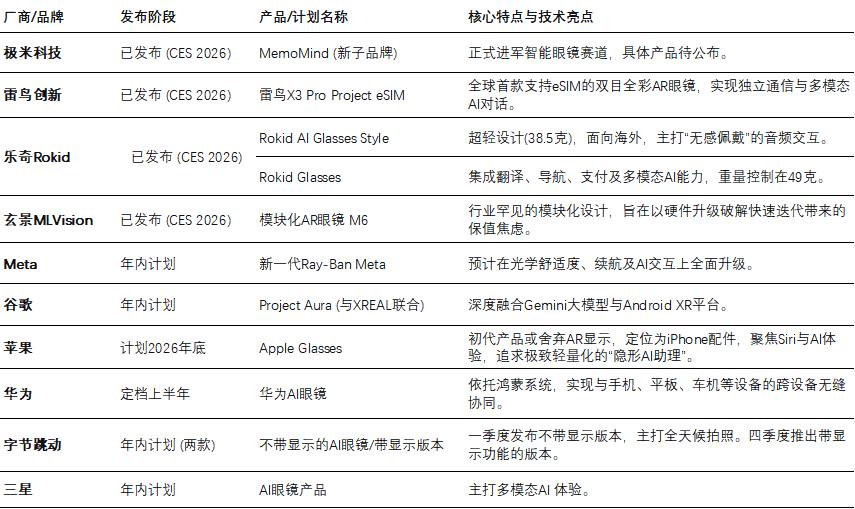
Core Insights - The AI glasses market in 2026 is characterized by intense competition, with numerous companies, including major tech giants and startups, launching new products and strategies, marking a shift from niche gadgets to essential tools for various applications [1][2][4] Group 1: Market Dynamics - The AI glasses market is witnessing a "full-scale war" with major players like Meta, Google, Apple, and domestic companies like Huawei and ByteDance all actively participating [1][2] - The CES 2026 event served as a platform for companies to showcase their innovations, with significant product announcements from various manufacturers [2][4] - The trend of "lightweight" and "independence" is evident, as companies prioritize user comfort and reduce reliance on smartphones through features like eSIM and independent processing capabilities [9][10] Group 2: Product Launches and Innovations - Key product launches include: - XGIMI's MemoMind brand entering the smart glasses market [8] - Thunderbird's X3 Pro Project eSIM, the first dual-lens AR glasses with independent connectivity [8] - Rokid's ultra-light AI glasses weighing only 38.5 grams, emphasizing comfort and audio interaction [8] - Modular AR glasses M6 from Xuanjing, designed for hardware upgrades [3][8] - Meta plans to enhance its Ray-Ban Meta glasses, aiming for improved optical comfort and AI interaction [4][8] - Google's three-step strategy includes launching audio smart glasses and collaborating on Project Aura with XREAL [4][8] - Apple is expected to release Apple Glasses by the end of 2026, focusing on a lightweight design and AI integration [4][8] Group 3: Industry Trends and Drivers - The industry is driven by three main factors: cost reduction in the supply chain, advancements in AI interaction, and growing market demand [10][11] - The rapid decrease in component costs, particularly in chips and optical displays, has made AI glasses more affordable for consumers, with prices now in the 2000-3000 yuan range [11] - The introduction of national subsidies for smart glasses is expected to boost market penetration and consumer adoption [14][15] Group 4: Future Competition Landscape - The competition is shifting from hardware specifications to user experience, ecosystem integration, and technological innovation [16][17] - Companies are focusing on creating compelling reasons for daily use, with examples like Rokid's integration of AI glasses into automotive systems and educational tools [17][18] - The future of the industry will depend on ecosystem development, with companies like Google and Huawei aiming to create comprehensive platforms that integrate AI capabilities and user data [20][21]



博士眼镜:公司致力于智能眼镜“最后一公里”的验配服务
Zheng Quan Ri Bao Wang· 2026-02-25 09:39
证券日报网讯2月25日,博士眼镜(300622)在互动平台回答投资者提问时表示,公司致力于智能眼 镜"最后一公里"的验配服务,目前,公司已与业内头部智能眼镜厂商阿里夸克、雷鸟创新、星纪魅族、 XREAL、界环、李未可、小米mijia等品牌开展合作。目前公司智能眼镜业务的相关营收占比极小,请 注意投资风险。 ...

华强北“新风口”,AI眼镜卖爆了
Shen Zhen Shang Bao· 2026-02-24 14:17
Core Viewpoint - AI glasses are emerging as a new trend in the consumer electronics market, particularly in Shenzhen's Huaqiangbei, with significant sales growth and consumer interest noted during the recent Spring Festival [1][6]. Group 1: Market Trends - AI glasses have become a popular item among young consumers, with prices ranging from over 100 yuan to 5000 yuan, and features such as music playback, phone calls, and real-time translation being highly favored [2][4]. - The sales of AI glasses have surged, with a reported increase of 70% to 80% during the Spring Festival period, making it one of the fastest-growing product categories [6][7]. - The overall revenue in Huaqiangbei increased by 35% year-on-year during the Spring Festival, with technology products seeing a sales increase of over 30% compared to regular periods [6]. Group 2: Product Features and Innovations - AI glasses are being designed with various camera placements to cater to different usage scenarios, such as side-mounted cameras for casual wear and central cameras for first-person Vlog recording [3]. - Higher-end models, priced above 2000 yuan, feature MicroLED transparent displays and support multi-language AI translation, while models above 5000 yuan can connect with drones for first-person flight experiences [3][4]. - The integration of AI functionalities into glasses is expected to create a significant market opportunity, potentially becoming a major personal mobile interface following smartphones [6][7]. Group 3: Industry Dynamics - Since July of the previous year, numerous specialized AI glasses retail stores have emerged in Huaqiangbei, indicating a rapid industry expansion [3][4]. - Major tech companies, including smartphone and internet giants, are entering the AI glasses market, with notable product launches from Xiaomi and Alibaba planned for 2025 [4]. - The global smart glasses market is projected to see substantial growth, with an expected shipment of 2,368.7 million units by 2026, and Chinese manufacturers capturing a significant market share [7].
现在是入手智能眼镜的好时候吗?
Xin Hua Wang· 2026-02-21 02:30
Core Insights - The smart glasses market in China is experiencing significant growth, with projected sales reaching 1.454 million units in 2025, representing a year-on-year increase of 211% [1] - Major tech companies such as Alibaba, Baidu, ByteDance, Huawei, and Xiaomi are entering the smart glasses sector, indicating a competitive landscape for the next generation of mobile devices [1][2] - The demand for smart glasses is driven by the need for a new mobile terminal as smartphone innovation reaches physical limits, with smart glasses offering immersive interaction and hands-free capabilities [2] Market Dynamics - The smart glasses market is characterized by a wide variety of brands, styles, and functionalities, leading to increased consumer interest [1] - The global traditional eyewear market is substantial, and capturing just 10% of it could yield over $10 billion in revenue for smart glasses [2] - The competition is shifting from hardware specifications to ecosystem development, user habit cultivation, and commercial value extraction [3] Consumer Experience - Current smart glasses are available in a price range from 1,000 to nearly 10,000 yuan, with two main categories: non-display models and those with display capabilities [3] - Consumer feedback highlights issues with weight and comfort, as mainstream smart glasses weigh between 40-80 grams compared to regular glasses at around 20 grams [4] - Battery life is a concern, with advertised durations of 4-8 hours often dropping to 2-3 hours under heavy usage [5] Industry Challenges - The "impossible triangle" of balancing weight, battery life, and display quality presents a significant challenge for the smart glasses industry [5] - Many current models rely on smartphones for processing, limiting their independence and functionality [5] - The industry is expected to transition from novelty to regular use within the next three years, with advancements in chip technology and design [6] Future Directions - The development of AI operating systems (AIOS) is seen as a key factor for enhancing user experience and interaction [7] - There is a push for full-color displays to meet consumer expectations for richer visual experiences [7] - Addressing comfort and usability will be crucial for widespread adoption, as consumers seek more than just a display but a comprehensive smart assistant experience [7]
科技好物快速迭代 创新生态高速运转
Nan Fang Du Shi Bao· 2026-02-09 23:17
Core Insights - Shenzhen is emerging as a global leader in the consumer electronics sector, particularly in innovative products like robotic vacuum cleaners and AR glasses, driven by technological advancements and a robust industrial ecosystem [5][9][10]. Group 1: Market Performance and Growth - In the first three quarters of 2025, global shipments of robotic vacuum cleaners reached 17.424 million units, marking an 18.7% year-on-year increase, with Chinese brands dominating the top five positions [6]. - Shenzhen's exports of robotic vacuum cleaners reached 11.12 billion yuan in the first eleven months of 2025, reflecting a significant 71.8% year-on-year growth, with exports to the EU increasing by 121% [7]. - The strategic partnership between Shenzhen's Yunji Technology and European Cyber Group resulted in over 600 million yuan in new overseas orders, indicating strong international demand [6]. Group 2: Industrial Ecosystem and Innovation - Shenzhen has established a comprehensive industrial system that supports rapid product development and market entry, allowing for quick iterations and innovations in technology [11][12]. - The city is home to a vast number of market entities and a complete supply chain, which are crucial for producing high-quality products that gain market recognition [9]. - Shenzhen's strategic focus on 20 emerging industrial clusters has led to a GDP contribution of 43% from these sectors, showcasing the city's commitment to advancing its technological capabilities [10]. Group 3: Entrepreneurial Environment - The entrepreneurial ecosystem in Shenzhen is characterized by a high degree of collaboration between technology companies and educational institutions, facilitating rapid product development and market readiness [13]. - Shenzhen's R&D investment intensity stands at 6.67%, the highest among Chinese cities, with 93% of this funding coming from enterprises, enhancing its competitive edge [12]. - The city has seen a significant increase in specialized and innovative small and medium-sized enterprises, with 347 new "little giant" companies established in 2025, leading the nation [12].

AI眼镜进“国补”,从“尝鲜”到“常用”还有几步?
Xin Lang Cai Jing· 2026-02-09 05:11
Core Insights - The article highlights the rising popularity of AI glasses as a new consumer trend during the upcoming Spring Festival, alongside traditional goods, driven by technological advancements and government subsidies [1][3]. Group 1: Market Dynamics - The new "national subsidy" policy, effective January 2026, includes smart glasses in the trade-in subsidy list, offering a 15% subsidy with a maximum of 500 yuan per item, which is expected to stimulate demand [3][5]. - The initial month of the subsidy saw a significant increase in inquiries and sales for AI glasses, with prices dropping to around 85% of the original price, making them more affordable [5][7]. - Despite the growing interest, the AI glasses market remains small, with approximately 1.78 million units shipped in the first three quarters of 2025, compared to smartphones which see shipments in the hundreds of millions [7][9]. Group 2: Product Features and Categories - AI glasses integrate various technologies, including chips, audio units, sensors, and AI capabilities, offering functionalities like audio playback, voice calls, and real-time translation [7][9]. - The market features three main categories of AI glasses: AI audio glasses for auditory enhancement, AI camera glasses for first-person recording, and AI+AR glasses for immersive experiences [10][12]. Group 3: Industry Trends and Innovations - The global AI glasses market is expected to grow significantly, with shipments projected to rise from 340,000 units in 2023 to 26 million units by 2028, particularly in China [12][14]. - Chinese companies dominate the AI glasses exhibition space, accounting for over 60% of participants, showcasing a full industry chain from components to finished products [12][14]. - Recent investments from Chinese telecom operators into the AI glasses sector indicate a shift towards independent AI devices, enhancing the market's potential [14][16]. Group 4: Challenges and Recommendations - The industry faces challenges in achieving mass adoption, requiring a breakthrough product that combines innovative technology with practical applications [16][19]. - Key recommendations for the industry include enhancing technological innovation, improving user experience, and fostering collaboration across the supply chain [20][22].
雷鸟创新智能眼镜亮相米兰冬奥,奥委会主席称赞中国智造遥遥领先
IPO早知道· 2026-02-09 05:08
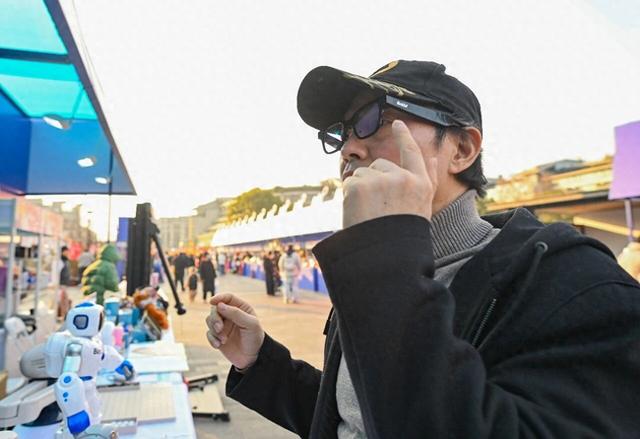
Group 1 - The core viewpoint of the article highlights RayNeo's AI + AR smart glasses as a significant representation of Chinese technology on the international stage, particularly at the 2026 Milan-Cortina Winter Olympics [1][5] - RayNeo has been recognized as the leading consumer-grade AR glasses brand in China for four consecutive years and showcased its first eSIM smart glasses at CES 2026, attracting significant attention [1][5] - The flagship smart glasses, RayNeo X3 Pro, have been selected as one of Time magazine's "Best Inventions of 2025" and are popular among athletes from various countries for their advanced features [3][5] Group 2 - The smart glasses market is currently a hot sector within the AI hardware industry, valued in the hundreds of billions, with RayNeo leading both the global and Chinese AR smart glasses markets [5] - RayNeo has successfully secured over 1 billion yuan in strategic financing from investment institutions such as China Mobile and China Unicom at the beginning of 2026, indicating strong investor confidence [5] - The company aims to deepen its global presence and continue to leverage its technological strengths to lead innovation in the industry [5]