Eoptolink

Search documents
光互联的市场图谱
傅里叶的猫· 2026-02-21 14:13
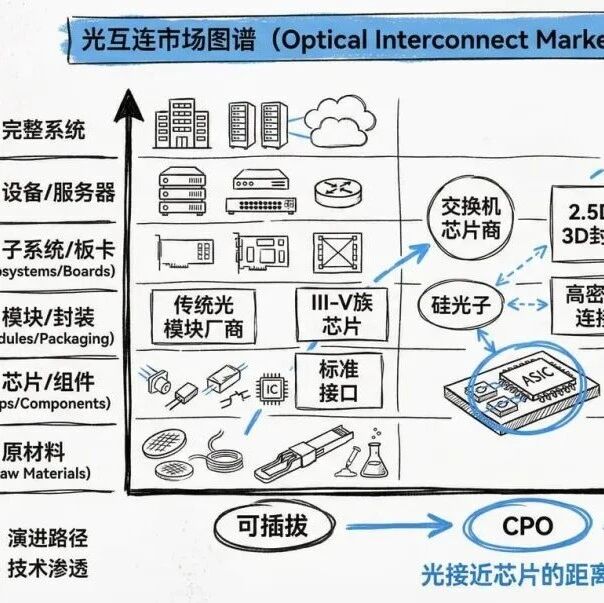
Core Insights - The article discusses the evolution of optical interconnect technology, highlighting three key structural patterns in the market: vertical integration vs. specialization, the scarcity of light generation, and the rise of SiPho foundries [5][6][10]. Group 1: Market Structure - Vertical integration offers structural advantages during technological transitions, as companies that can design across multiple layers can optimize the entire tech stack [9]. - Companies like Broadcom exemplify vertical integration, appearing across multiple layers of the value chain, while most others focus on specific segments [8]. - The semiconductor industry has historically shown that such advantages may not be permanent, as standardization can lead to the emergence of fabless models [9]. Group 2: Scarcity of Light Generation - The difficulty of producing light sources (Layer 1 and Layer 0) is highlighted, with InP and GaAs materials requiring specialized technology and equipment [12][13]. - Companies capable of mass-producing high-performance InP lasers are few, creating a concentrated market [13][14]. Group 3: Rise of SiPho Foundries - Layer 2, which focuses on SiPho foundries, is gaining attention as traditional semiconductor manufacturers like TSMC and GlobalFoundries enter the photonics space [17]. - TSMC's potential to optimize both AI chips and optical interconnects within the same ecosystem could disrupt existing vertical integration advantages [17]. Group 4: Layer Analysis - Layer 0 involves substrate supply, with companies like AXT benefiting from increased demand for III-V substrates, although geopolitical risks exist due to production in China [21][22]. - Layer 1 is dominated by Coherent and Lumentum, both of which manufacture InP lasers and are expanding production amid high demand [24][25]. - Layer 2 focuses on SiPho foundries, with companies like GlobalFoundries and TSMC leading in manufacturing photonic integrated circuits [27][29]. - Layer 3, represented by DSPs, faces potential obsolescence as CPO technology advances, with companies like Broadcom and Marvell adapting to this shift [33][36]. - Layer 4 sees companies like Innolight and Eoptolink currently leading in the pluggable module market, but their positions may be challenged as the industry shifts towards CPO [40][42]. Group 5: Future Signals - Key indicators to watch include pJ/bit energy consumption metrics, which reflect technological advancements and efficiency [56]. - The ongoing standardization efforts, such as OIF and UCIe, will shape the future market landscape and influence competitive dynamics [57][59]. - Recent mergers and acquisitions signal strategic directions in the industry, with notable deals like Marvell's acquisition of Celestial AI [60][62]. - The choices made by major cloud service providers like Google and AWS regarding their technology partnerships will ultimately determine market trajectories [63][64].




中国科技通信-26 年第一季度亚洲市场反馈-China Technology Communications 1Q26 Asia marketing feedback
2026-02-10 03:24
Summary of Key Points from the Conference Call Industry Overview - **Sector Focus**: The conference call primarily discussed the **semiconductor**, **consumer electronics**, and **optical transceiver** industries, with a specific emphasis on the **China Technology & Communications** sector [1][4][5][6]. Semiconductor Industry Insights - **Increased Interest**: Investor interest in the **China semiconductor** sector has risen due to the country's push for AI localization and new IPO listings [5][6]. - **Growth Projections**: China's AI accelerator units (GPUs/ASICs) are expected to grow from **2.2 million units in 2025 to 3.5 million units in 2026**, with domestic supply increasing from **45% to 60%** [5]. - **Key Players**: Notable companies include **CXMT** and **YMTC**, which are expanding their production capacity [5]. - **Investment Recommendations**: Top stock picks include **Montage Technology** and **ASMPT**, with Montage seen as a unique investment opportunity benefiting from global AI infrastructure investments [5]. Consumer Electronics Sector - **Investor Sentiment**: Interest in the consumer electronics sector is low, particularly in the **Android supply chain**, which is heavily shorted [6]. - **Key Concerns**: Discussions revolved around potential declines in smartphone shipments, memory chip availability, and the impact of memory price trends on companies like **Xiaomi** and **Luxshare** [6]. - **Resilient Names**: **Conant** is highlighted as a resilient player in the AI glasses market, with potential growth from partnerships with major tech companies [6]. Optical Transceiver Market - **Shipment Expectations**: The optical transceiver market anticipates shipments of **60-70 million units**, but achieving higher numbers may be challenging due to supply constraints [4]. - **Market Volatility**: Pair trading and rotation are expected to continue driving volatility in optical transceiver stocks [4]. - **Future Catalysts**: The upcoming **GTC/OFC** events are seen as potential catalysts for updates on CPO and 2027 optical transceiver demand [4]. Investment Risks and Opportunities - **Valuation Concerns**: High expectations in the AI supply chain are met with downside risks, leading to a cautious outlook on certain stocks like **VGT** and **FII**, which are viewed as having more downside than upside potential for 2026 earnings [1][4]. - **Preferred Stocks**: Investors favor stocks with exposure to substrate and CPU boards, as well as tier-2 names gaining market share in AI accelerator PCBs [1][4]. Conclusion - The conference call provided a comprehensive overview of the current state and future outlook of the semiconductor, consumer electronics, and optical transceiver industries, highlighting key players, investment opportunities, and potential risks associated with market volatility and valuation concerns.
剑桥科技-管理层调研:切片业务扩张;2026 年连续波激光器供应落定;LPO、NPO 项目进展顺利
2026-02-10 03:24
9 February 2026 | 9:19AM HKT Equity Research GC Tech: CIG (603083.SS) Mgmt. visit: SiPh in expansion; CW laser supply secured for 2026; LPO, NPO progress on track We visited CIG (603083.SS, NC) management in Hong Kong on Jan 22. Management's positive tone echoes our positive view on SiPh optical modules: (1) AI servers ramp up with growing ASIC driving high-speed networking demand: As we highlighted in Jan (report link), we expect global AI servers shipment implied AI chips to increase by 49% / 31% YoY in 2 ...
源杰科技:管理层调研:连续波激光器产能扩张;800G、1.6T 硅光模块渗透率提升
2026-01-20 03:19
Summary of YJ Semi (688498.SS) Management Call Company Overview - **Company**: YJ Semi (688498.SS) - **Industry**: Semiconductor, specifically focusing on optical modules and lasers - **Revenue Growth**: Revenues increased by 71% year-over-year in 1H25, driven by strong growth in the data center business [2] Key Industry Insights - **AI Infrastructure Demand**: There is a significant ramp-up in AI infrastructure across both the US and China cloud markets. The projected demand for AI chips is expected to reach 11 million, 16 million, and 21 million units in 2025, 2026, and 2027 respectively, with ASICs making up 38%, 40%, and 50% of these chips in the same years [1] - **Optical Module Specifications**: The specifications for optical modules are being upgraded, particularly towards 1.6T in the US Cloud, with a notable increase in 800G modules in the China Cloud. Global shipments for 800G and 1.6T optical modules are expected to reach 38 million and 14 million units by 2026 [1] Company Strategy and Product Development - **Product Focus**: YJ Semi is focusing on CW lasers, particularly 70mW and 100mW models, with plans to develop 300mW CW lasers. The company aims to become a major supplier of CW lasers globally by 2026 [3] - **Silicon Photonics Adoption**: The adoption rate of silicon photonics is expected to grow faster than EML technology, with increasing optical connections in AI data centers. This shift is anticipated to provide larger bandwidth and reduced loss compared to traditional copper cables [3] Market Position and Competitive Landscape - **Supplier Diversification**: YJ Semi has diversified its InP substrate suppliers across mainland China and Japan, enhancing its supply chain resilience [3] - **Investment Recommendations**: Analysts recommend buying stocks of companies such as Landmark, VPEC for Epiwafer/CW lasers, and Innolight, Eoptolink, TFC Optical for optical modules, as well as Ruijie for ODM [1] Financial Outlook - **Confidence in Pricing**: Management expresses confidence in the pricing of CW lasers for 2026-27, supported by the anticipated upcycle in AI infrastructure and the rising adoption of silicon photonics and CW lasers [3] Additional Notes - **Client Verification**: YJ Semi has successfully passed client verification for its 100mW CW lasers, indicating strong product validation and market readiness [2] - **Growth Projections**: The company is positioned to benefit from the growing local ecosystem in China, particularly following the launch of leading foundation models in generative AI [1] This summary encapsulates the key points from the management call, highlighting the company's growth trajectory, market dynamics, and strategic initiatives within the semiconductor industry.

华工科技-管理层调研-光模块出货量增长,向 800G、1.6T 迈进,客户渗透持续深化
2026-01-19 02:29
Summary of HG Tech (000988.SZ) Management Visit Company Overview - **Company Name**: HG Tech - **Ticker**: 000988.SZ - **Location**: Wuhan, China - **Specialization**: Laser equipment, optoelectronic devices, sensors - **Market Exposure**: AI data centers, consumer electronics, industrial, automotive - **Ranking**: Global top 9 in optical modules in 2024 [2] Key Industry Insights 1. **AI Infrastructure Growth**: - Positive outlook on AI infrastructure ramp-up in both US and China Cloud markets - Projected demand for AI chips: 11 million in 2025, 16 million in 2026, and 21 million in 2027 - ASICs expected to account for 38%, 40%, and 50% of AI chips in 2025, 2026, and 2027 respectively [1][3] 2. **Optical Modules Demand**: - Anticipated specification upgrades towards 1.6T in US Cloud and rising 800G in China Cloud - Expected global shipment of optical modules: 38 million units for 800G and 14 million units for 1.6T in 2026 - 1.6T optical modules projected to be sourced 60% from GPU AI servers and 40% from ASIC AI servers [1][3] 3. **Market Dynamics**: - Despite GPU restrictions, demand for generative AI is increasing in China, supported by local ecosystem growth post-launch of leading foundation models [1] - The company is expanding its market reach from China Cloud to US Cloud, enhancing competitiveness in high-end modules [3] Business Growth Drivers 1. **Optical Modules**: - Solid demand driven by AI infrastructure and continuous specification upgrades - Anticipated double-digit growth in optical module shipments in China for 2026, particularly in 800G and silicon photonics [3] 2. **Laser Equipment**: - Expected recovery in 2026, driven by sectors such as 3D printing, wearables, shipbuilding, precision agriculture, and PCB industry [3] Investment Recommendations - **Buy Recommendations**: - Epiwafer / CW laser: Landmark, VPEC - Optical module: Innolight, Eoptolink, TFC Optical - ODM: Ruijie [1] Additional Insights - Management maintains a positive outlook on business growth for 2026, emphasizing the importance of high-end optical modules and laser equipment recovery [3]

全球光模块 - 2026-27 年 800G 提升市场规模 43%;AI 趋势下 2026 年 1.6T 光模块出货量达 3800 万 - 1.4 亿只-Global Optical transceivers_ Raising value TAM by 43 in 2026-27E with 800G _ 1.6T at 38m _ 14m units in 2026E on AI trend
2026-01-08 02:43
Summary of Global Optical Transceivers Conference Call Industry Overview - The focus is on the **Global Optical Transceiver market**, with significant updates on the **TAM (Total Addressable Market)** forecast for 2026-2028, driven by the increasing demand for AI servers and advancements in optical transceiver technology [1][26]. Key Insights - The **Global Optical Transceiver value TAM** is raised by **43%** and **46%** for 2026 and 2027, respectively, with projected shipments of **800G** and **1.6T** units reaching **38 million** and **14 million** in 2026 [1][28]. - The **CAGR (Compound Annual Growth Rate)** for shipments of **800G and above optical transceivers** is expected to be **34%** from 2026 to 2028, reaching **94 million** units by 2028 [1][21]. - The **ASIC penetration rate** for AI chips is projected to increase to **50%** by 2027, up from **45%**, indicating a shift towards more efficient AI server architectures [1][26]. Market Dynamics - **Upstream supply constraints** such as EML and CW lasers are critical factors affecting delivery timelines for optical transceiver manufacturers [1][29]. - The transition from **pluggable optical transceivers** to **on-board optics (NPO)** and eventually to **co-packaged optics (CPO)** is anticipated to influence market dynamics significantly [1][30]. Shipment and Revenue Estimates - The **Global Optical module market** is projected to grow from **$33.7 billion** in 2025 to **$49.5 billion** in 2028, with a notable shift in product mix towards higher-speed modules [1][28]. - Shipments of **400G or lower** are expected to decline from **94%** of total shipments in 2025 to **80%** by 2028, indicating a market shift towards higher-speed optical transceivers [21][22]. Competitive Landscape - Companies rated as **Buy** include: - **Optical transceiver makers**: Innolight, Eoptolink, TFC Optical - **CW lasers/Epiwafer suppliers**: Landmark, VPEC - **Data center switch**: Ruijie [2]. Potential Risks - **Geopolitical tensions** may impact the supply and demand dynamics of AI chip platforms, particularly in the Chinese market [29]. - The **size of AI server clusters** could affect the number of optical modules used, with smaller clusters potentially leading to lower attach rates [29]. Technology Trends - The **adoption of Silicon Photonics (SiPh)** is expected to increase, with projections indicating that SiPh will account for **15%** of the market by 2028, particularly in high-speed applications [9][25]. - The **migration to higher-speed connections** (800G and above) is becoming mainstream for large-scale data centers, with significant growth expected in the **1.6T** and **3.2T** segments starting from 2026 [22][23]. Conclusion - The Global Optical Transceiver market is poised for substantial growth driven by advancements in AI server technology and increasing demand for high-speed connectivity solutions. The ongoing shifts in technology and market dynamics present both opportunities and challenges for industry players.
罗博特科-电话会_ 硅光驱动增长;光电子元件自动化组装与测试
2025-12-31 16:02
Summary of RoboTechnik Management Call Company Overview - **Company Name**: RoboTechnik (300757.SZ) - **Established**: 2011 - **Initial Focus**: Photovoltaic cell manufacturing equipment - **Acquisition**: Entered the CPO market by acquiring FiconTEC, a leader in automated assembly and testing systems for integrated photonic devices and high-end opto-electronic components in 2020, with FiconTEC becoming a subsidiary in 2025 [3][9] Industry Insights - **Market Segment**: Co-Packaged Optics (CPO) and Silicon Photonics (SiPh) - **Growth Drivers**: Increased demand for SiPh solutions due to rising data volumes for AI model training and the need for higher computing efficiency [5][9] - **Technological Advancements**: SiPh optical modules are expected to contribute significantly to 800G and 1.6T optical modules due to their compact structure and production efficiency [2] Key Takeaways from Management Call 1. **Automated Assembly and Testing Systems**: - RoboTechnik utilizes advanced AI and machine learning algorithms for high-precision alignments, meeting customer requirements for 800G+ SiPh or CPO products [4] - The company has developed auto align technology capable of detecting defects as small as 0.5μm [4] 2. **Business Expansion Plans**: - Equipment revenues related to optical modules and engines increased by 229% year-over-year in the first half of 2025 [9] - Plans to establish production lines in mainland China and expand sales and technical support teams to provide localized services [9] 3. **Positive Market Outlook**: - Management maintains a positive outlook on the demand for high-precision automated equipment for assembly and testing, aiming to expand capacity to meet rising end demand [1][5] 4. **Technological Capabilities**: - RoboTechnik's experience in image processing and alignment algorithms enhances the precision of their equipment, which is crucial for the evolving demands of the SiPh and CPO markets [4][8] Additional Insights - **Strategic Positioning**: The acquisition of FiconTEC positions RoboTechnik favorably within the AI infrastructure cycle, aligning with industry trends towards automation and efficiency in optical components [1][3] - **Investment Recommendations**: Analysts recommend buying stocks of companies like Innolight, Eoptolink, Landmark, VPEC, and TFC Optical, which are expected to benefit from the growth in SiPh optical modules [2] This summary encapsulates the key points discussed during the management call, highlighting RoboTechnik's strategic initiatives, market opportunities, and technological advancements within the opto-electronic components industry.

全球光模块:总体潜在市场解析;AI 服务器基础设施扩张推动 800G1.6T 需求增长Global Optical transceivers_ TAM introduced; rising 800G _ 1.6T driven by growing AI servers infrastructure
2025-12-15 01:55
Summary of Global Optical Transceivers Conference Call Industry Overview - The global optical transceiver market is projected to grow significantly, driven by the increasing demand for AI server infrastructure and the transition from copper to fiber optics [1][2] - The market is expected to reach US$24 billion in 2025, US$30 billion in 2026, and US$37 billion in 2027, with the 800G+ segment growing at an impressive 87% CAGR [2] Key Insights - **Adoption Trends**: - 1.6T optical transceivers are expected to ramp up adoption in 2026-2027, while 3.2T will start adoption in 2027 [1] - The penetration of silicon photonics (SiPh) solutions is anticipated to increase, reaching 60% for 800G, 80% for 1.6T, and 100% for 3.2T optical transceivers by 2028 [2] - **Market Demand**: - The demand for optical transceivers is expected to be driven by the AI server infrastructure cycle, with ASIC chips projected to account for 40% of total AI chips by 2025 and 45% by 2026 [1] - Shipment volumes for 800G and 1.6T are expected to grow from 36 million and 5 million units in 2026 to 56 million and 12 million units in 2027, respectively [2][17] - **Supply Chain Insights**: - Companies rated as "Buy" include optical transceiver module leaders Innolight and Eoptolink, CW laser manufacturers Landmark and VPEC, and data center switch provider Ruijie [3] Financial Projections - The global optical module total addressable market (TAM) is projected to grow from US$24.1 billion in 2025 to US$36.8 billion in 2027, with significant contributions from the 800G+ segment [2][8] - The average selling price (ASP) for optical transceivers is expected to decline year-over-year, with a notable drop for 800G and 1.6T products [14][15] Additional Considerations - The transition to high-speed connections is expected to accelerate the adoption of SiPh solutions due to their cost advantages over traditional EML modules [18] - The overall demand for optical transceivers is projected to reach 392 million units in 2025, increasing to 437 million units by 2028, with traditional applications declining from 89% to 66% of total shipments [16] - The market is witnessing a shift towards higher-speed products, with 800G becoming the mainstream specification for large-scale data centers [17] Conclusion - The optical transceiver market is poised for rapid growth, driven by advancements in AI infrastructure and the increasing adoption of high-speed optical solutions. Key players in the supply chain are well-positioned to benefit from these trends, making it a promising area for investment.
Astera Labs Showcases Rack-Scale AI Ecosystem Momentum at OCP Global Summit
Globenewswire· 2025-10-13 13:00
Core Insights - Astera Labs is leading the development of semiconductor-based connectivity solutions for rack-scale AI infrastructure, emphasizing the shift towards unified computing platforms rather than individual servers [1][2] - The company is showcasing its ecosystem collaborations at the 2025 OCP Global Summit, highlighting the importance of open standards for AI Infrastructure 2.0 [1][2] Industry Trends - The AI infrastructure landscape is transitioning from server-level architectures to rack-scale systems, driven by significant investments from hyperscalers [2] - Open standards are essential for integrating diverse accelerators, interconnects, and management tools, enabling optimized solutions for specialized AI workloads [2] Ecosystem Collaborations - Astera Labs is collaborating with various industry leaders, including AMD, Arm, and Molex, to enhance AI infrastructure through high-performance connectivity solutions [3][4][9] - These partnerships focus on delivering reliable, high-speed cable solutions and ensuring robust signal integrity across rack-scale distances [3][9] Technical Innovations - The company is presenting technical sessions on UALink deployment strategies and PCIe 6 security considerations at the OCP Global Summit [2] - Astera Labs' Intelligent Connectivity Platform integrates multiple semiconductor-based technologies, including CXL, Ethernet, PCIe, and UALink, to create cohesive systems [13] Market Position - Astera Labs positions itself as a key player in the AI infrastructure market by providing purpose-built connectivity solutions grounded in open standards [13] - The company's collaborations aim to accelerate the adoption of open rack architectures, enhancing performance, interoperability, and scalability for customers [10][12]


硅光和CPO,下一件大事
半导体行业观察· 2025-09-03 01:17
Core Viewpoint - The article emphasizes the critical role of silicon photonics in meeting the increasing demands of data centers, particularly for artificial intelligence and machine learning applications, highlighting the advancements in high-speed communication and the growing bandwidth requirements driving the development of silicon photonics and lithium niobate technologies [2][5]. Group 1: Industry Landscape - The silicon photonics industry is characterized by a diverse range of participants, including major vertically integrated players like Innolight, Cisco, and Marvell, as well as startups, research institutions, foundries, and equipment suppliers, all contributing to significant growth and diversification [5]. - China is making notable progress in the silicon photonics sector, aiming to establish global leadership by narrowing the gap with Western companies through government support and a focus on domestic innovation [5]. Group 2: Technological Advancements - Higher single-channel rates can achieve Ethernet speeds of 3.2 Tbps or more, while also reducing power consumption and the number of lasers required, leading to lower capital expenditures and simplified supply chains [8]. - The demand for scalable, energy-efficient optical solutions in data centers and networks is intensifying competition among SOI, LNOI, and InP platforms, each with unique advantages and challenges shaping the future of optical communication [8]. Group 3: Co-Packaged Optics (CPO) Development - The explosive growth of artificial intelligence, particularly large language models, is driving the adoption of co-packaged optical modules (CPO), which are essential for high bandwidth, low latency, and energy-efficient connections in large-scale data centers [12][20]. - NVIDIA's introduction of Spectrum-X and Quantum-X silicon photonic switches at GTC 2025 marks a significant milestone for CPO in AI infrastructure, with the CPO market projected to grow from $46 million in 2024 to $8.1 billion by 2030, reflecting a compound annual growth rate of 137% [13][20]. Group 4: Supply Chain Dynamics - The CPO supply chain encompasses semiconductor foundries, photonics manufacturers, packaging suppliers, and fiber experts, with key players like Nvidia, TSMC, and Broadcom driving demand in response to AI workloads [16][20]. - The supply chain includes materials such as silicon wafers, SOI, indium phosphide, and glass, supporting the integration of ASICs and photonic circuits for both horizontal and vertical scaling networks [17].