
Hoya

Search documents
全球半导体及半导体资本设备:2025 年 12 月 WSTS 追踪-销售额环比 + 4.8%,高于典型值(2.2%);同比 + 41.3%;2025 财年增长 26% 至 7920 亿美元
2026-02-11 15:40
Summary of Semiconductor Industry Conference Call Industry Overview - The conference call focused on the global semiconductor industry, specifically discussing the WSTS report for December 2025, which tracks sales, units, and average selling prices (ASPs) across the semiconductor sector [2][27]. Key Financial Metrics - **2025 Semiconductor Sales**: Grew by 26% year-over-year, reaching approximately $792 billion, following a 20% increase in 2024 [3][28]. - **December 2025 Sales Growth**: Total semiconductor sales increased by 41.3% year-over-year, with memory sales growing by 67.6% year-over-year [3][29]. - **Monthly Sales Performance**: December sales rose by 4.8% month-over-month, significantly above the historical average of 2.2% [4][38]. Product Category Performance - **Logic Sales**: Increased by 40% year-over-year, leading the growth among product categories [28][32]. - **Memory Sales**: Grew by 35% year-over-year, with a notable 67.6% increase in December alone [3][29]. - **Analog Standard Linear**: Sales rose by 17%, while Discretes and Microcontroller Units (MCUs) saw declines of 1% each [28][32]. - **Monthly Performance by Product Group**: - Discretes: 18.3% growth vs. typical 14.5% - Optoelectronics: 14.2% vs. typical -0.1% - Logic: 3.7% vs. typical -1.1% - MCU: 13.8% vs. typical 11.6% [5][40]. Geographic Sales Insights - **Year-over-Year Sales Growth by Region**: - Americas: Up 32.5% - Europe: Up 23.3% - China: Up 40.3% - Asia Pacific/All Other: Up 77.6% - Japan: Down 11.3% [45]. - **Month-over-Month Sales Growth**: - Americas: Up 10.5% - China: Up 5.8% - Europe: Up 4.7% - Japan: Flattish at -0.7% - Asia Pacific/All Other: Down 1.2% [46]. Unit Shipments and ASPs - **Total Unit Shipments**: Increased by 9.6% month-over-month, with ASPs down by 4.4% [52]. - **Year-over-Year Shipment Growth**: Increased by 4.1%, with notable increases in Discretes, Optoelectronics, and Logic [53]. - **ASP Changes**: - ASPs increased for Discretes (6.3%), Optoelectronics (7.3%), and NAND (11.5%). - ASPs decreased for Sensors & Actuators (-4.6%) and Logic (-3.6%) [55][56]. Investment Implications - **ADI (Analog Devices)**: Rated Market-Perform with a target price of $270.00, executing well but shares considered expensive [11]. - **AMD (Advanced Micro Devices)**: Rated Market-Perform with a target price of $235.00, driven by high AI expectations and a new deal with OpenAI [11]. - **AVGO (Broadcom)**: Rated Outperform with a target price of $475.00, benefiting from a strong AI trajectory [11]. - **NVDA (NVIDIA)**: Rated Outperform with a target price of $275.00, with significant opportunities in the datacenter market [13]. - **QCOM (Qualcomm)**: Rated Outperform with a target price of $175.00, despite memory headwinds, shares are considered cheap [14]. Additional Insights - The semiconductor industry is experiencing robust growth driven by various product categories, particularly logic and memory, with significant regional disparities in performance. - The overall market sentiment remains positive, with several companies positioned for growth amid ongoing technological advancements and demand for semiconductors.


QYResearch 半导体耗材-探针卡&掩膜版介绍
QYResearch· 2025-12-13 00:06
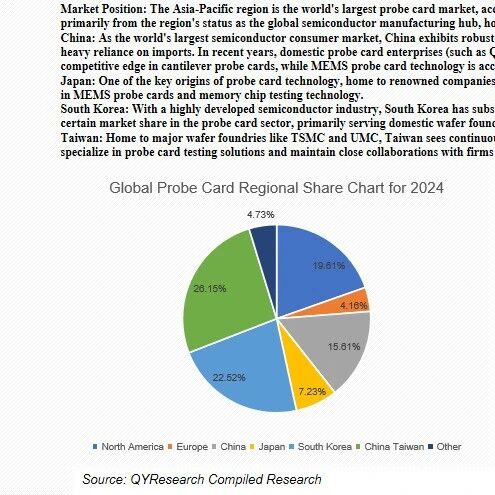
Group 1: Core Insights - The probe card is a crucial hardware component in the semiconductor manufacturing process, used during the wafer testing phase to detect defects and test functionality, directly impacting chip yield and manufacturing costs [5][6] - The global probe card market is projected to reach $2.656 billion in 2024, with a compound annual growth rate (CAGR) of 7.45% from 2025 to 2031 [9] - The MEMS probe card dominates the market, accounting for approximately 74.8% of the total revenue in 2024, with a projected revenue of $1.987 billion [12] Group 2: Market Structure - Probe cards are categorized into MEMS, vertical, and cantilever types, with MEMS cards being the leading product due to their high precision, efficiency, and durability [6] - The market shares for vertical and cantilever probe cards are expected to be 11.61% and 9.64% respectively in 2024, indicating a lower market presence compared to MEMS cards [6] Group 3: Competitive Landscape - According to QYResearch, the top companies in the probe card market for 2024 include FormFactor, Technoprobe S.p.A., and Micronics Japan, with FormFactor leading with a market share of 23.57% [15] - FormFactor's revenue is projected to increase from $497.90 million in 2023 to $625.96 million in 2024, reflecting a year-over-year growth of 25.72% [15] Group 4: Regional Insights - The Asia-Pacific region is the largest market for probe cards, accounting for approximately 74% of the global market share, driven by a high concentration of semiconductor manufacturing facilities [16] - China, as the largest semiconductor consumer market, shows strong demand for probe cards but has a low domestic production rate, heavily relying on imports [16][17]

Semiconductor Consumables Probe Cards and Photomask
QYResearch· 2025-12-13 00:06
Semiconductor Industry Overview - The global probe card market is projected to reach $2.656 billion in revenue in 2024, with a CAGR of 7.45% from 2025 to 2031 [5] - The global MEMS probe card market is expected to reach $1.987 billion in revenue in 2024, accounting for 74.8% of the total probe card market [8] - The global photomask market is anticipated to reach $6.238 billion in revenue in 2024, with a CAGR of 4.63% from 2025 to 2031 [15] Probe Card Market Rankings - FormFactor leads the global semiconductor probe card market with a revenue of $625.96 million in 2024, representing a 25.72% year-over-year growth and a market share of 23.57% [11] - Technoprobe S.p.A. follows closely with a revenue of $613.51 million in 2024, showing a year-over-year growth of 20.89% and a market share of 23.10% [11] - MPI Corporation experienced significant growth of 54.55%, reaching $223.18 million in revenue in 2024, with a market share of 8.40% [11] Photomask Market Rankings - Photronics is the leading company in the photomask market with a revenue of $866.95 million in 2024, although it shows a decline of 2.82% year-over-year [18] - Toppan ranks second with a revenue of $752.09 million, reflecting a growth of 3.15% [18] - The "Other" category in the photomask market accounts for a significant share, with revenues increasing from $2,526.23 million in 2023 to $2,709.28 million in 2024, a growth of 7.25% [18] Market Growth Projections - The semiconductor industry is expected to see continued growth, with the probe card market and photomask market both showing positive trends in revenue and market share [5][15] - The overall semiconductor consumables market is projected to expand, driven by advancements in technology and increasing demand across various applications [20]
行业聚焦:全球AR/MR光波导玻璃晶片行业 Top 5生产商市场份额及排名调查
QYResearch· 2025-11-03 09:25
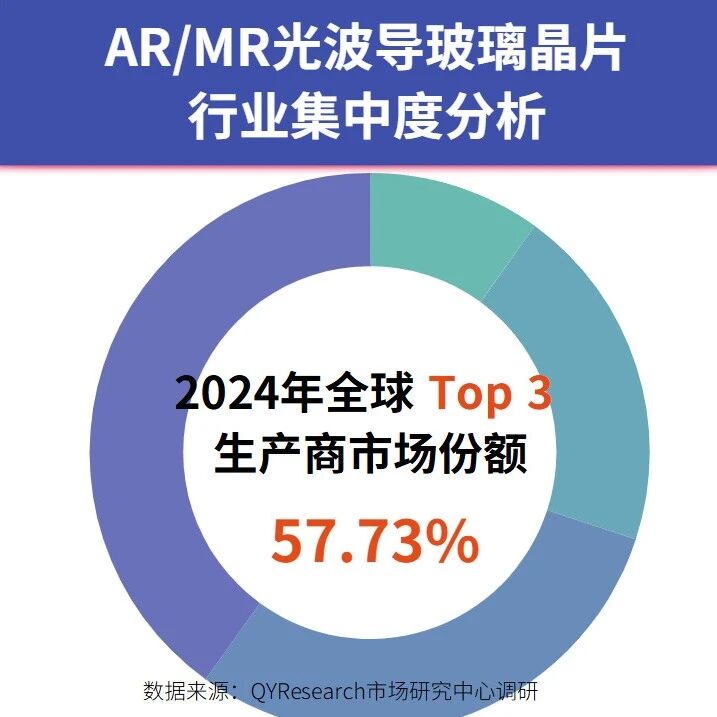
Core Viewpoint - The AR/MR waveguide glass chip market is projected to reach $426 million by 2031, with a compound annual growth rate (CAGR) of 5.1% in the coming years [2][10]. Market Overview - Major manufacturers in the global AR/MR waveguide glass chip market include Hoya, Corning, and Schott, with the top three companies holding approximately 57.73% of the market share in 2024 [7]. - The market is primarily driven by advancements in optical display and spatial computing technologies, as well as the acceleration of AR ecosystem development by global tech giants [10]. Industry Chain Analysis - The production of AR/MR waveguide glass chips involves multiple processes including precision cutting, ion exchange, polishing, coating, and optical testing [8]. - The upstream segment focuses on the production of high-purity optical glass materials, with leading companies like DISCO and Hoya excelling in material purity and flatness [8]. - The midstream segment is critical for determining product yield and optical performance, requiring high cleanliness and precision in manufacturing processes [8]. Applications - The downstream applications of AR/MR waveguide glass chips include head-mounted displays, spatial computing glasses, and mixed reality visualization systems, with key manufacturers like Apple and Microsoft leading the market [9]. - North America and Asia are the primary markets, with North America focusing on high-end immersive experiences and Asia rapidly expanding in consumer-grade AR glasses and industrial applications [9]. Industry Development Trends - Future trends indicate a shift towards high integration, lightweight, and low-energy consumption in AR/MR waveguide glass chips [12]. - The industry is moving towards automation and digitalization, with AI quality control and smart manufacturing becoming essential for efficiency and reliability [12]. - Green manufacturing and recyclable materials are expected to become competitive focal points in the new phase of industry development [12].
大摩:硬盘驱动器目标价格和预测大幅上调 - 前景更加乐观
2025-10-09 02:00
Summary of Conference Call Notes Industry Overview - The conference call focuses on the hard disk drive (HDD) industry, particularly the companies Seagate and Western Digital (WD) [1][2]. Key Insights and Arguments - **Nearline Storage Demand**: There is a significant increase in nearline storage demand, with a projected growth rate of 25% over the next three years. HDD supply shortages are expected to persist until 2026, granting pricing power to Seagate and WD, which will drive the adoption of high-capacity HDDs and the application of Hammer technology [1][3]. - **Cloud Computing Capital Expenditure**: There is a strong correlation (R-squared of 0.9) between cloud computing capital expenditure and HDD revenue growth. Continuous upward adjustments in cloud capital spending indicate robust growth potential for HDD revenues, benefiting related companies [1][4]. - **Impact of Artificial Intelligence (AI)**: The shift in AI towards multimodal reasoning is leading to an exponential increase in data storage needs, as the volume of generated data (images, videos) far exceeds that of text files. This trend is expected to significantly drive HDD demand [1][5]. - **Supply Shortages and Pricing Power**: The ongoing HDD supply shortage is providing Seagate and WD with pricing power, encouraging customers to adopt higher-capacity HDDs. This situation is also promoting the use of profit-generating technologies like Hammer, with Seagate's gross margin expected to reach 40% by the end of fiscal year 2026 [1][6]. - **Valuation of WD and Seagate**: The valuation methods for WD and Seagate involve comparing them with semiconductor hardware and networking companies related to data centers. Despite leading in revenue growth and cloud service revenue share, their price-to-earnings ratios are relatively low. Regression analysis suggests that their current enterprise value/sales ratio of 4-4.5 should rise to around 8, indicating significant upside potential. Target prices are set at $171 for WD and $265 for Seagate [1][7][8]. Other Important Insights - **Beneficiaries of the HDD Cycle**: The long-term strong HDD cycle not only benefits WD and Seagate but also positively impacts TDK (a key supplier of HDD heads and arms), Hoya (the sole supplier of glass substrates for HDD heads), and storage companies like SanDisk and Micron, which are also rated as buy due to the current strong NAND flash cycle driven by HDD shortages [2][9].


ClearBridge International Growth EAFE Strategy Q3 2025 Commentary
Seeking Alpha· 2025-10-07 00:40
Market Overview - International equities showed mixed results in Q3 2025, with the MSCI EAFE Index rising 4.8%, driven by Asian markets and Canada, while Europe Ex U.K. underperformed [3] - The MSCI Emerging Markets Index advanced 10.6%, supported by a 20.7% rally in China, which constitutes 30% of that benchmark [3] - European markets experienced a slowdown in momentum due to inflation remaining above the European Central Bank's target, with a September reading of 2.2% [4] Economic Conditions - Japan's GDP grew modestly in Q2, aided by tourism, while manufacturing activity remained restrained [5] - The People's Bank of China cut key lending rates in July to address weaknesses in the real estate sector and sluggish consumer demand, with Q2 GDP growth at 5.2% year over year [5] Investment Strategy - The MSCI EAFE Value Index outperformed the MSCI EAFE Growth Index by over 500 basis points in Q3, with value stocks leading growth by more than 1,300 basis points year to date [6] - The ClearBridge International Growth Strategy maintained pace with its core MSCI EAFE benchmark, with sector positioning in IT and financials creating headwinds [12] Company Performance - London Stock Exchange faced a decline due to AI concerns impacting its desktop and data business, while Adyen's revenue missed expectations [13] - Banco Santander was acquired for its streamlined operations and cost-cutting measures, expected to improve profitability [14] - HSBC is well-positioned for growth in Asian wealth management, benefiting from inflows of mainland Chinese money [15] - KBC Group's strong capital position allows for capital distributions or acquisitions, with growing assets under management [16] Sector Contributions - Health care sector saw solid contributions, particularly from European biotechs Argenx and UCB, driven by strong sales and positive clinical trial results [20] - The strategy expanded into the Chinese biotechnology sector with the purchase of WuXi AppTec, known for efficient drug development [21] Portfolio Adjustments - The strategy added 10 positions while exiting 13, with significant purchases in financials and health care, including Prysmian, which is poised for growth in the power cables industry [22] - Softbank trades at a discount to its NAV, holding stakes in key technology companies [23] - Celestica is positioned for growth in AI infrastructure, with expected annual revenue growth of over 20% [24] Outlook - The regions of investment are making progress on growth and equity-friendly policies, with forecasts for double-digit EPS growth in the pan-European Stoxx 600 [27] - Emerging markets are outperforming developed markets, with a focus on China’s growth potential in AI and biotechnology [28][32]

电力设备与新能源行业专题报告:空白掩模有望国产化 聚和材料版图扩展
Xin Lang Cai Jing· 2025-09-25 00:30
Core Insights - The company, Juhe Materials, announced the acquisition of SKE's Blank Mask business segment for approximately 350 million RMB, aiming to expand its footprint in the semiconductor core materials sector [1] Group 1: Blank Mask Overview - Blank Mask is a core material in semiconductor photolithography, used to manufacture photomasks that transfer circuit designs onto substrates or wafers [2] - The global semiconductor materials revenue is projected to be around 67.5 billion USD in 2024, with China's share estimated at 13.5 billion USD, accounting for about 20% [2] - The domestic market for photomasks is expected to reach approximately 7.2 billion RMB in 2024, with the Blank Mask segment projected to generate revenue between 1.4 to 1.5 billion RMB [2] Group 2: Market Dynamics - The domestic market for both photomasks and Blank Masks has a low localization rate, with major players in the Blank Mask market being dominated by Japanese and Korean companies [3] - The semiconductor photomask market is primarily occupied by wafer fabs and IDM manufacturers, with significant shares held by companies like Toppan, Photronic, and DNP [3] Group 3: Strategic Implications for Juhe Materials - The acquisition is expected to enhance Juhe Materials' capabilities in semiconductor self-sufficiency, with plans to stabilize existing technology and operations by retaining key personnel from SKE [4] - The company aims to promote both localization and globalization, including appointing a senior management team to oversee overseas operations and expanding production capacity in mainland China to meet market demand [4] - SKE's Blank Mask division focuses on producing substrates for DUV-ArF and DUV-KrF lithography technologies, which have already been validated by multiple semiconductor wafer fabs [4] Group 4: Financial Position - Juhe Materials holds a strong market position in silver paste and has demonstrated excellent performance in copper paste reliability tests, with plans to accelerate copper paste promotion with the launch of a second-generation product [5] - The company has substantial financial reserves, with cash and trading financial assets amounting to around 2 billion RMB as of the first half of 2025, supporting its strategic acquisition in the semiconductor core materials sector [5]

空白掩模有望国产化,聚和材料版图扩展
Changjiang Securities· 2025-09-24 23:30
Investment Rating - The industry investment rating is "Positive" and maintained [10] Core Insights - The report highlights that the acquisition of SKE's blank mask business by the company is a strategic move to enter a market with low domestic production rates, especially in the context of increasing trade tensions and macroeconomic uncertainties [2][4][6] - The blank mask is identified as a core material in semiconductor photolithography, crucial for transferring circuit designs onto substrates or wafers, with a significant opportunity for domestic production [5][31] - The report emphasizes the importance of achieving self-sufficiency in blank masks for the development of the domestic semiconductor industry, as current production is heavily dominated by Japanese and Korean companies [6][21] Summary by Sections Acquisition Details - The company announced the acquisition of SKE's blank mask business for approximately 350 million RMB, which includes land, facilities, inventory, equipment, patents, and personnel [4][18] - The acquisition aims to enhance the company's capabilities in high-end DUV blank masks, which have already been validated by several semiconductor wafer manufacturers [7][38] Market Opportunity - The global semiconductor materials revenue is projected to be around 67.5 billion USD in 2024, with China's share estimated at 13.5 billion USD, representing about 20% of the total market [5][27] - The domestic market for photomasks is expected to reach approximately 7.2 billion RMB, while the revenue for blank masks is projected to be between 1.4 to 1.5 billion RMB in 2024 [31][35] Strategic Plans - The company plans to solidify its technological and operational foundation by retaining key personnel from SKE and enhancing R&D capabilities [7][37] - Future strategies include expanding production capacity in mainland China to meet market demand and increasing brand influence through a dedicated sales team [7][37]
晨星:AI的采用料将结构性降低多个行业长期运营成本 哪些行业受益最多?
Zhi Tong Cai Jing· 2025-09-04 06:21
Group 1 - The core viewpoint of the report is that artificial intelligence (AI) is transitioning from hype to delivering substantial cost savings, which has significant implications for investors [1] - The report highlights that AI adoption is expected to structurally reduce long-term operating costs across multiple industries, enhance profitability, and create re-evaluation opportunities for undervalued companies [1] - The report identifies that the current earnings season for Chinese companies shows mixed performance, with cyclical consumer sectors experiencing weak growth and profit margins falling short of expectations [1] Group 2 - The communications services sector has shown outstanding performance due to AI applications, with growth or cost-driven profit expansion exceeding expectations [1] - Key companies to watch in the consumer cyclical and defensive sectors include Budweiser, Kao, and Trip.com, which are expected to achieve better-than-expected profit improvements [1] - In the communications services sector, companies such as Naver, Baidu, Tencent, and NetEase are highlighted for their cost improvements driven by AI [1] Group 3 - In the semiconductor industry, AI is optimizing chip production processes, which will lower R&D costs, with major companies like TSMC and SK Hynix leading this trend [2] - In the financial services sector, AI is automating customer service processes and loan approvals, reducing costs for banks and insurance companies, with companies like HSBC, MUFG, and DBS being noteworthy [2] - The healthcare industry is leveraging AI for clinical trials and drug development data management, improving operations and outcomes, with companies like Hoya and Yidu Tech being of interest [2] Group 4 - The report suggests that AI is enhancing operational leverage by replacing labor and R&D, indicating that even slight positive growth rebounds in undervalued consumer sectors could lead to better-than-expected profit improvements [2] - Investors are advised to closely monitor the progress of AI applications in these sectors, particularly those companies with cost-cutting potential, to seize investment opportunities arising from market re-evaluations [2]
全球半导体及半导体设备_如果英特尔放弃…… 会怎样-Global Semiconductors and Semicap Equipment_ What happens if Intel gives up_
2025-08-05 03:20
Summary of Key Points from the Conference Call Industry Overview - The discussion centers around the **semiconductor industry**, particularly focusing on **Intel** and its potential shift towards becoming a **fabless company** if it fails to secure a major external customer for its 14A and subsequent nodes [2][9]. Core Insights and Arguments 1. **Intel's Strategic Shift**: Intel may cease pursuing its 14A node and subsequent nodes, which could lead to it becoming a fabless company. This shift would have significant implications for the semiconductor supply chain [2][9]. 2. **Impact on Wafer Fabrication Equipment (WFE)**: Intel is a major player in semiconductor capital expenditure, contributing **20-25%** of logic foundry capex and **10-15%** of total semiconductor capex. A shift to fabless would negatively impact the WFE market, particularly for EUV supply chain companies like **Lasertec** and **ASML** [3][14]. 3. **EUV Supply Chain Exposure**: Companies like Lasertec and ASML are significantly exposed to Intel, with Lasertec deriving approximately **40%** of its backlog from Intel. ASML, while having a lower revenue contribution, still relies on Intel for **15-20%** of its EUV revenue [3][4][19]. 4. **Beneficiaries of Intel's Potential Fabless Model**: If Intel becomes fabless, companies such as **TSMC**, **Samsung Foundry**, and **Hoya** are expected to benefit. Hoya, in particular, could see its market share in EUV mask blanks grow from **70% to 100%** if Intel stops internal manufacturing [4][5][9]. 5. **Long-term Market Dynamics**: The transition may create a time lag for TSMC and Samsung to redesign chips and build capacity, but TSMC is well-positioned to benefit from Intel's potential fabless status. Samsung Foundry is also expected to gain from this shift [5][9]. 6. **Intel's Challenges**: The potential move to fabless raises concerns about Intel's competitiveness against AMD and could disrupt its product roadmap. The uncertainty surrounding this transition may deter major customers from partnering with Intel [6][7][9]. Additional Important Insights - **Market Performance Ratings**: The report includes performance ratings for various companies, with **TSMC** rated as Outperform with a price target of **NT$1,260.00**, and **Samsung** also rated as Outperform with a price target of **KRW 78,000**. Intel is rated as Market-Perform with a target price of **$21.00**, reflecting a significant decline of **51.8%** [10][11][12]. - **Investment Implications**: The report suggests avoiding Intel due to the substantial disruption and uncertainty surrounding its business model and stock performance. Conversely, TSMC, Samsung Foundry, and Hoya are seen as potential investment opportunities [9]. This summary encapsulates the critical points discussed in the conference call, highlighting the implications of Intel's strategic decisions on the semiconductor industry and related companies.
