
RayNeo

Search documents
MeetBrands 出海向新 | 当“带电”成为共识:中国消费电子的全球突围路径
3 6 Ke· 2026-02-05 10:00
从CES看,中国消电品牌正站上全球舞台 如果说过去 CES 更像"未来技术的展示橱窗",那 CES 2026 更像一张全球消费电子竞争的实时地图。 今年有4500+ 展商、138,000+ 参会者参加这一消电盛宴。CES期间,飞书点跃BeyondClick也于拉斯维加斯举办了"活力全开——激发全球品牌增长力"主题活 动,覆盖硬科技和前沿赛道,近100+客户前来参展。 会上,飞书点跃BeyondClick负责人廖敏航预告了《2025 MeetBrands中国出海新锐消费品牌榜单报告》的发布,他指出,中国品牌出海正经历从"规模扩 张"向"质量筛选"的结构性转变,而消费电子品类将成为中国企业出海版图不可忽视的一部分。 1月,《2025 MeetBrands中国出海新锐消费品牌榜单报告》正式发布,正如廖敏航判断,消费电子品类成为出海品牌的高度确定性赛道。它们既是出海浪潮 中最早一批"走出去"的实践者,也持续成为新技术、新模式率先验证的载体,消费电子不只是一个成熟赛道,更是一个仍在不断释放增长与进化信号的关键 板块。 消费电子品类成为确定性赛道 消费电子霸榜两届榜单最大品类 在 2025MeetBrands榜单中,消费 ...


MoonFox Data | Li Auto’s Performance Plunges, BEV Transition Faces Formidable Headwinds
Globenewswire· 2026-01-09 10:00
Core Viewpoint - Li Auto has reported a significant net loss in Q3 2025, marking a shift from its previous profitability and indicating challenges in its transition to battery electric vehicles (BEVs) amid increasing competition in the new energy vehicle market [1][4][6]. Financial Performance - In Q3 2025, Li Auto recorded a net loss of RMB 625 million (approximately USD 89.286 million), ending a streak of 11 profitable quarters [1][4]. - Vehicle sales revenue fell to RMB 25.9 billion (approximately USD 3.7 billion), a decrease of 37.4% from RMB 41.3 billion (approximately USD 5.9 billion) in Q3 2024 [3]. - Total revenue for Q3 2025 was RMB 27.4 billion (approximately USD 3.914 billion), down 36.2% from RMB 42.9 billion (approximately USD 6.129 billion) in Q3 2024, and down 9.5% quarter-over-quarter from RMB 30.2 billion (approximately USD 4.314 billion) in Q2 2025 [4]. - Total deliveries were 93,211 units, reflecting a 39.0% year-over-year decline [3]. Market Challenges - Li Auto is facing intensified competition in the new energy vehicle market, particularly from brands like AITO and Deepal in the extended-range electric vehicle (EREV) segment, and Tesla and NIO in the BEV segment [7][8]. - The company is experiencing a late transition to BEVs and insufficient production capacity, which are critical issues that need to be addressed to enhance competitiveness [7][10]. Production Capacity and Supply Chain - Despite positive market response to newly launched BEV models i6 and i8, supply chain challenges have limited their deliveries to only 18% of total deliveries in Q3 [11]. - Li Auto is attempting to increase production capacity through a dual-supplier system but faces urgent supply chain stability issues [11]. Strategic Expansion and New Ventures - Li Auto has begun expanding into new business lines, including "Space Robotics" and "Wearable Robotics," and launched AI smart glasses, but the market response has been lukewarm [12][13]. - The AI smart glasses market is highly competitive, with established brands dominating, making it difficult for Li Auto to gain traction [13]. Consumer Engagement - Despite declining deliveries, Li Auto maintains a relatively stable consumer base with high app user engagement, indicating strong customer loyalty [14]. Q4 Outlook - For Q4 2025, Li Auto is projected to continue facing challenges, with revenue expected to decline to RMB 26.5 billion (approximately USD 3.786 billion), a 40% year-over-year decrease [18].



SeeYA Technology Clears IPO Review, Poised to Become China’s First Silicon-Based OLED Listing
Pandaily· 2025-12-26 03:37
Core Viewpoint - SeeYA Technology Co., Ltd. is set to become China's first publicly listed company focused on silicon-based OLED display chips following the approval of its IPO application by the Shanghai Stock Exchange's Listing Review Committee on December 24, 2025 [1] Company Overview - SeeYA is a micro-display solutions provider that ranked second globally in silicon-based OLED shipments for XR devices in 2024, holding a 35.2% market share, behind Sony's 50.8% [2] - The company's products have been shipped to notable clients including ByteDance, Insta360, RayNeo, and Lenovo [2] IPO Details - The IPO aims to raise approximately RMB 2.015 billion (about USD 278 million), primarily for the expansion of production lines [3] - Revenue increased from RMB 190 million (about USD 26.2 million) in 2022 to RMB 280 million (about USD 38.6 million) in 2024 [3] - The company anticipates achieving profitability by 2026 [3]

每周观察 |3Q25DRAM产业营收;十大科技市场趋势预测;ASICs有望转向EMIB技术;3Q25新能源车销量;LEDoS技术
TrendForce集邦· 2025-11-28 10:05
Group 1: DRAM Industry Insights - The DRAM industry revenue for Q3 2025 increased by 30.9% quarter-over-quarter, reaching $41.4 billion, driven by rising contract prices and increased shipment volumes of conventional DRAM and HBM [2][3] Group 2: Company Performance - SK hynix led the market with a revenue of $13.75 billion in Q3 2025, marking a 12.4% increase from Q2 2025, capturing a market share of 33.2% [3] - Samsung followed closely with a revenue of $13.5 billion, a 30.4% increase from the previous quarter, holding a market share of 32.6% [3] - Micron experienced the highest growth rate of 53.2%, with revenue reaching $10.65 billion and a market share of 25.7% [3] - Nanya and Winbond also showed significant growth, with Nanya's revenue increasing by 84% and Winbond's by 21.4% [3] Group 3: Electric Vehicle Market - Global sales of new energy vehicles (NEVs) reached 5.39 million units in Q3 2025, representing a year-on-year increase of 31%, with battery electric vehicles (BEVs) accounting for 3.71 million units sold, up 48% [8] - BYD led the BEV market with a 15.4% market share, while Tesla held 13.4% [9] Group 4: AR Display Technology Trends - The competition in AR display technology is intensifying, with projections indicating that the penetration rate of LEDoS technology will reach 65% by 2030, up from 37% in 2025 [12]

AR显示技术竞争加剧,2030年LEDoS技术渗透率或达65%
WitsView睿智显示· 2025-11-27 08:25
Core Insights - The report by TrendForce highlights the competitive landscape of AR glasses display technologies, particularly focusing on the growth opportunities for LEDoS (Micro LED on silicon) and LCoS technologies, with projected penetration rates of 37% and 7% by 2025, respectively, and further growth to 65% and 11% by 2030 [2][3]. Group 1: AR Glasses Market Dynamics - Major brands like Meta, Apple, Amazon, and RayNeo are intensifying their investments in AR glasses, leading to increased competition in display technology [2]. - Chinese brands dominate the AR glasses shipment market, initially focusing on viewing applications where brightness specifications are less critical, making the mature and cost-effective OLEDoS solution the mainstream display technology [2]. - As the industry evolves, the demand for brightness and light transmittance in AR glasses is rising, prompting brands to shift resources away from viewing products, with OLEDoS technology expected to reach a 53% penetration rate by 2025 before declining [2]. Group 2: Technology Penetration and Development - The short-term market for AI-assisted information display glasses is heating up, with various players, including Chinese cloud service providers and traditional consumer electronics brands, entering the AR terminal market and investing in LEDoS technology [3]. - The penetration rate of LEDoS technology is anticipated to rise to 37% by 2025, driven by rapid product development and supply chain collaboration [3]. - International brands are focusing on full-color LEDoS development, which may result in longer development timelines, but once products from Apple, Meta, and Google are mass-produced, they are expected to boost LEDoS penetration to 65% by 2030 [4]. Group 3: LCoS Technology Outlook - LCoS technology is favored by Meta due to its mature technology and cost-effectiveness, with expected penetration reaching 7% by 2025, although it faces challenges in high brightness and contrast performance [4]. - Chinese brands are less competitive in establishing LCoS technology barriers and have heavily invested in LEDoS, leading to a slowdown in LCoS growth, projected to reach 11% by 2030 [4].

研报 | AR显示技术竞争随品牌布局加剧,预估2030年LEDoS技术渗透率达65%
TrendForce集邦· 2025-11-26 06:59
Core Insights - The report from TrendForce indicates that the competition in AR glasses display technologies is intensifying, with significant growth opportunities for LEDoS and LCoS technologies, projected to reach penetration rates of 37% and 7% respectively by 2025, and further increasing to 65% and 11% by 2030 [2][3][4] Group 1: AR Glasses Market Dynamics - Major brands like Meta, Apple, Amazon, and RayNeo are actively investing in AR glasses, leading to a competitive landscape in display technology [2] - Chinese brands dominate the AR glasses shipment market, initially focusing on viewing applications, which has made OLEDoS the mainstream display technology due to its cost-effectiveness and mature processing technology [2] - As the industry evolves, the demand for brightness and transparency in AR glasses is increasing, leading to a decline in OLEDoS's market share after reaching a 53% penetration rate by 2025 [2] Group 2: LEDoS Technology Development - The market for AI-assisted information glasses is heating up, prompting various players, including Chinese cloud service providers and traditional consumer electronics brands, to enter the AR terminal market and invest in LEDoS technology [3] - The penetration rate of LEDoS technology is expected to rise to 37% by 2025, driven by rapid product development and collaboration with supply chains [3] - International brands are focusing on full-color LEDoS, which may result in longer development timelines, but once products from major players like Apple and Meta are mass-produced, the penetration rate is expected to reach 65% by 2030 [3] Group 3: LCoS Technology Outlook - LCoS technology is favored by Meta due to its mature technology and cost-effectiveness, with an expected penetration rate of 7% by 2025, although it faces challenges in high brightness and contrast [4] - Chinese brands are less competitive in establishing LCoS technology barriers and have heavily invested in LEDoS, which may slow LCoS's growth, projected to reach 11% by 2030 [4]
Counterpoint:2025上半年全球VR头显出货量同比下滑14% AR智能眼镜有望迎来强劲增长
智通财经网· 2025-09-26 01:20
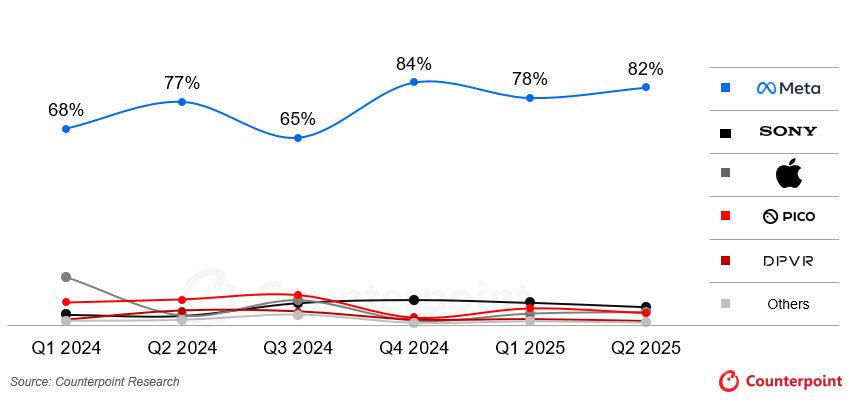
Core Insights - The global VR headset shipments are expected to decline by 14% year-on-year in the first half of 2025 due to continued weak demand in the consumer market [1] - Meta maintains a dominant position in the VR market, holding approximately 80% market share in the first half of 2025 [1] - The AR smart glasses market is projected to experience significant growth, with a compound annual growth rate (CAGR) of 69% from 2024 to 2027, driven by increased investments from major tech companies [1] VR Headset Market - The overall competitive landscape in the VR market remains stable, with few new product launches from major OEMs [1] - Meta continues to lead the market significantly, indicating a strong brand presence and product acceptance [1] AR Smart Glasses Market - Global AR smart glasses shipments increased by 50% year-on-year in the first half of 2025, signaling a recovery in market sentiment [3] - Birdbath technology-based AR smart glasses dominate the market with a 78% share, while waveguide technology-based glasses account for about 17% [3] - The average selling price of waveguide AR glasses is approximately 27% higher than that of more mature Birdbath products [3] Key Products and Innovations - Xreal One is the best-selling model among Birdbath technology products in the first half of 2025, followed by RayNeo Air 3s and RayNeo Air 3 [7] - RayNeo Air 3s features a competitive price of approximately $269 and significant improvements in optical systems [7] - Even Realities G1, a waveguide technology product, has shown strong sales despite its higher price point of $599 due to its lightweight and stylish design [7] Competitive Landscape - Xreal and RayNeo together hold over 60% of the global AR smart glasses market share in the first half of 2025 [8] - RayNeo surpassed competitors in Q2 2025 with multiple new product launches, including the RayNeo Air 3s and RayNeo X3 Pro [8] - Upcoming products like Xreal One Pro and Rokid Glasses are expected to enhance competition in the AR market [9] Future Outlook - The AR smart glasses market is anticipated to become more competitive in the second half of 2025, with new product launches expected to reshape market dynamics [9] - Notable upcoming products include Meta Ray-Ban Display and Alibaba's Quark "AR+AI" glasses, which are expected to increase the market share of waveguide products [9]
最新报告 | 近眼显示将迎来市场成长新纪元
TrendForce集邦· 2025-08-29 03:44
Core Insights - The near-eye display device market is expected to show a lackluster performance in the short term, with global shipments projected to reach 6.2 million units by 2025 [2] - The VR/MR market, particularly Meta Quest 3s, is anticipated to see a decline in shipments to 5.6 million units by 2025, while AR devices are expected to perform more steadily, with shipments reaching 600,000 units driven by new AI+AR products and decreasing OLEDoS prices [2] - Long-term growth is expected, with global near-eye display shipments projected to rise to 46.5 million units by 2030, supported by ongoing product development from major companies like Meta and Apple, and strong growth in the AR market [2] AR Display Technology Market Development - OLEDoS remains the mainstream technology in China due to its cost advantages, but other technologies pose a threat to its dominance [6] - LCoS technology is expected to gain traction in the market due to Meta's adoption, while the growth of single green LEDoS AR glasses will enhance the penetration of LEDoS technology [6] - The demand for AR devices is increasing, with expectations for shipments using high-spec full-color LEDoS technology to reach 20.9 million units by 2030, achieving a penetration rate of 65% [7] Optical Waveguide Technology and SiC Supply Alliance Analysis - The choice of optical waveguide technology is critical for AR engine modules, with diffraction waveguides currently being the mainstream but needing efficiency improvements [9] - NIL and PL are the two main processing methods for waveguides, with NIL suitable for small-scale development and PL better for mass production [9] - The trend towards larger SiC substrates is expected to enhance cost-effectiveness, with projections indicating that 8-inch SiC substrate shipments could exceed 20% by 2030, moving towards 12-inch substrates in the long term [9] AR Product Development Trends - The specifications of AR devices are becoming standardized to control costs, with mainstream panel sizes for LEDoS and LCoS ranging from 0.13 to 0.18 inches and pixel densities exceeding 5,500 PPI [10] - Chinese brands like Xreal, RayNeo, and INMO are focusing on different strategies, such as enhancing display technology and integrating AI capabilities, reflecting a shift from hardware competition to a more complex software-hardware ecosystem [10]

国内首台28纳米关键尺寸电子束量测量产设备出机,科创半导体ETF(588170)盘中交易活跃
Mei Ri Jing Ji Xin Wen· 2025-08-21 12:31
Group 1 - The core viewpoint of the news highlights the significant growth in the global smart glasses market, which saw a year-on-year increase of 110% in the first half of 2025, with expectations of maintaining a compound annual growth rate (CAGR) of over 60% from 2024 to 2029 [2] - Meta dominates the smart glasses market with a 73% share, while emerging companies like Xiaomi and RayNeo are accelerating their presence, contributing to the sustained interest in AI glasses [2] - Domestic semiconductor equipment has made breakthroughs in 28nm electron beam measurement equipment and electron beam lithography machines, which are crucial for enhancing China's semiconductor industry chain autonomy [2] Group 2 - The current demand in the electronics industry is experiencing a mild recovery, prompting recommendations to focus on the AI server supply chain, AIOT, equipment materials, and the localization of automotive electronics [2] - The Sci-Tech Innovation Board Semiconductor Materials and Equipment Theme Index has seen a decline of 1.11%, with significant drops in constituent stocks such as Xinyichang and Shanghai Hejing [1] - The Sci-Tech Semiconductor ETF (588170) has shown a weekly increase of 5.51% as of August 20, 2025, with a notable trading volume and liquidity, indicating active market participation [1]
出货量倍增,智能眼镜市场需求强劲
Xuan Gu Bao· 2025-08-14 15:19
Group 1 - The global smart glasses market is expected to see a 110% year-on-year increase in shipment volume in the first half of 2025, with AI smart glasses accounting for 78% of this growth [1] - Strong demand for Ray-Ban Meta smart glasses, along with the entry of new brands like Xiaomi and RayNeo, has driven this growth, particularly in the AI glasses segment, which has experienced over 250% year-on-year growth [1] - Continuous technological advancements, price reductions, and expanding application scenarios position smart glasses as the next significant personal tech device after smartphones and smartwatches [1] Group 2 - The global AI glasses shipment volume is predicted to reach 140 million units by 2030, with the market size expected to exceed one trillion [2] - Relevant A-share concept stocks include companies like Jiahe Intelligent and Zhongjing Electronics [3]