Rokid

Search documents
华强北“新风口”,AI眼镜卖爆了
Shen Zhen Shang Bao· 2026-02-24 14:17
正月初八,深圳华强北众多商户迎来马年春节后首个营业日。记者走访发现,AI眼镜已成为2026年新 风口。记者走访发现,在今年春节出现的"科技年货"新消费热潮中,AI眼镜异军突起,成为继无人机、 机器人之后的新晋"爆款"。 年轻人用压岁钱"扫货"AI眼镜 拍照和视频高端功能最受青睐 从华强电子世界到赛格电子市场,各式各样的AI眼镜被摆在了最显眼的位置。AI眼镜价格从100元多至 5000元不等。一位正在试戴的消费者对着镜子左右打量着新"装备",对记者笑道:"这玩意儿比想象中 轻,戴着不像是科技产品,倒像是个时髦的配饰。" 记者走访市场发现,AI眼镜功能日益丰富,百元级基础款已具备耳机播放、音乐播放、电话接听与实 时翻译等功能。"这款150元的,能当蓝牙耳机用,听歌、接电话、实时翻译都没问题。"在华强电子世 界,一个档口老板正向几位外国客商演示一款基础款AI眼镜。 而在相隔不远的一家AI眼镜专营店,店主则向记者展示了售价400多元的"升级款":"贵一点的主要差别 在拍摄头,这款贵一点的AI眼镜新增拍照、录像与录音等功能,是春节前刚刚上市的,目前技术已经 很成熟。" 记者看到,下载一个手机APP后,眼镜拍摄的画面可以 ...
腾讯研究院AI速递 20260213
腾讯研究院· 2026-02-12 16:13
Group 1 - Zhipu released the open-source GLM-5 model with a parameter scale expanded to 744 billion (activated 40 billion), ranking fourth globally in the Artificial Analysis leaderboard and first in open-source, with coding and agent capabilities approaching Claude Opus 4.5 [1] - The model achieved scores of 77.8 and 56.2 in SWE-bench-Verified and Terminal Bench 2.0, respectively, setting new open-source SOTA records, excelling in complex systems engineering and long-range agent tasks [1] - GLM-5 has been adapted to domestic chips such as Huawei Ascend, Cambricon, and Kunlun, and introduced Z Code full-process programming tools and AutoGLM universal agent assistant [1] Group 2 - MiniMax launched the M2.5 model with only 10 billion activated parameters, achieving flagship-level reasoning speed three times faster than Opus [2] - The model completed a full-stack learning website in 9 minutes and can independently perform physical simulations and enterprise-level CMS system setups, supporting cross-platform development for PC/App/React Native [2] - It utilizes a native agent RL training framework and CISPO algorithm, achieving approximately 40 times training acceleration and is compatible with mainstream development tools like Claude Code and OpenClaw [2] Group 3 - Xiaohongshu's foundational model team released the open-source FireRed-Image-Edit, achieving SOTA in multiple authoritative rankings such as ImgEdit and GEdit, with code and technical reports now available [3] - The model employs a three-stage training process to enhance capabilities and innovatively introduces Layout-Aware OCR-based Reward, significantly improving text editing accuracy and style retention [3] - It supports various complex editing scenarios, including instruction-following consistency, text editing, style transfer, multi-image fusion, and old photo restoration, with model weights set to be open-sourced [3] Group 4 - Xiaomi released the open-source VLA model Xiaomi-Robotics-0 with 4.7 billion parameters, excelling in visual language understanding and real-time execution capabilities, achieving optimal results in comparisons across 30 models including LIBERO, CALVIN, and SimplerEnv [4] - The model uses a Mixture-of-Transformers architecture, where the VLM brain understands instructions and the Diffusion Transformer generates high-frequency smooth actions [4] - It addresses action discontinuity issues through asynchronous reasoning and Λ-shape attention masks, enabling real-time inference on consumer-grade graphics cards, and has been open-sourced on GitHub and HuggingFace [4] Group 5 - Gaode launched the ABot series of embodied base models, with ABot-M0 responsible for operations and ABot-N0 for navigation, achieving comprehensive SOTA across 10 global authoritative evaluations [5][6] - ABot-M0 integrates 6 million cross-platform trajectory data through action language and proposes an action manifold learning algorithm, achieving an 80.5% success rate on Libero-Plus, surpassing pi0 by nearly 30% [6] - ABot-N0 unifies five core navigation tasks within a single VLA architecture, constructing 8,000 high-fidelity 3D scenes and 17 million expert examples, with a 40.5% improvement in SocNav success rate [6] Group 6 - Rokid Glasses launched the "customizable agent" feature on the Lingzhu platform, allowing integration with OpenClaw or privately deployed models like DeepSeek R1 and Qwen3 through a standard SSE interface [7] - Users can achieve local closed-loop processing of private data and switch model bases with one click, leveraging the ClawHub skill ecosystem to execute capabilities like file systems, browsers, and IM messaging [7] - The platform empowers users by allowing them to summon private agents via voice commands or shortcuts, creating a 24/7 intelligent assistant [7] Group 7 - Google DeepMind released the AI mathematician Aletheia based on Gemini Deep Think, achieving a score of 91.9% on IMO-ProofBench, setting a new SOTA and capable of independently writing and publishing academic papers [8] - Aletheia systematically evaluated 700 open problems in the Erdős conjecture database and autonomously solved 4 unsolved mysteries, demonstrating self-correction and acknowledgment of limitations [8] - Gemini Deep Think collaborated with experts to tackle 18 long-stagnant research challenges, resolving a decade-long submodel optimization conjecture, with one paper accepted by ICLR 2026 [8] Group 8 - HyperWrite's CEO published an article that garnered 70 million views, stating that the release of GPT-5.3-Codex and Claude Opus 4.6 marks a qualitative change in AI [9] - AI can now independently complete the workload of human experts in 5 hours, with this capability doubling every 4-7 months, and GPT-5.3 plays a crucial role in its self-training process, initiating a recursive self-improvement cycle [9] - Almost all cognitive work performed in front of screens will be affected, and it is advised to spend one hour daily experimenting with AI, as the current cognitive window period will not last long [9] Group 9 - Anthropic released a 53-page report warning that the risks associated with Claude Opus 4.6 are approaching ASL-4 levels, outlining 8 potential risk pathways that could lead to catastrophic harm, including autonomous escape and autonomous operation [10][11] - The report concludes that current models do not exhibit "sustained consistent malicious intent," and the risk of catastrophic damage is "very low but not zero," entering a "gray area" of capability assessment [10] - The head of Anthropic's safety research team resigned, stating that "the world is in crisis," and xAI co-founder predicts that recursive self-improvement cycles may be launched within 12 months [11]




东北证券:AI+AR眼镜有望成为市场主流 镜片制造企业迎来发展新机遇
智通财经网· 2026-02-11 02:21
Group 1 - The core viewpoint is that AI+AR glasses are expected to surpass AI shooting glasses in market share by 2028, capturing nearly two-thirds of the market due to continuous technological updates and decreasing costs [1] - The current mainstream product is AI shooting glasses, with projected sales increasing from 5.5 million units in 2025 to 7 million units, and from 11 million units in 2026 to 18 million units [1] - The AI glasses market is anticipated to reach a scale of 149.996 billion yuan by 2030, with AI+AR glasses expected to meet both vision correction and display needs [1] Group 2 - Major tech companies like Meta and Alibaba are actively developing AI+AR glasses, with Meta's RayBan Display receiving positive market feedback, leading to a focus on fulfilling U.S. orders first [2] - Quark's AI glasses S1 have been well-received, prompting the addition of an assembly line to meet production demands [2] - Leading tech firms including Google, Amazon, Apple, and ByteDance plan to launch multiple AI glasses by 2026-2027, further validating the trend towards AI+AR glasses becoming mainstream [2] Group 3 - The potential user base for AI glasses is expanding from traditional glasses users to those with normal vision, with a focus on meeting both vision correction and display functionalities [3] - Companies like Quark, Rokid, and XREAL have established numerous offline experience stores, emphasizing the importance of traditional glasses users in their strategies [3] Group 4 - The integration challenges of waveguide and refractive lenses need to be addressed, with Rokid and Quark employing different solutions to tackle structural inconsistencies [4] - The one-piece bonding solution is expected to become the mainstream choice for integrating waveguide and refractive lenses, although it presents optical and customization challenges [4]

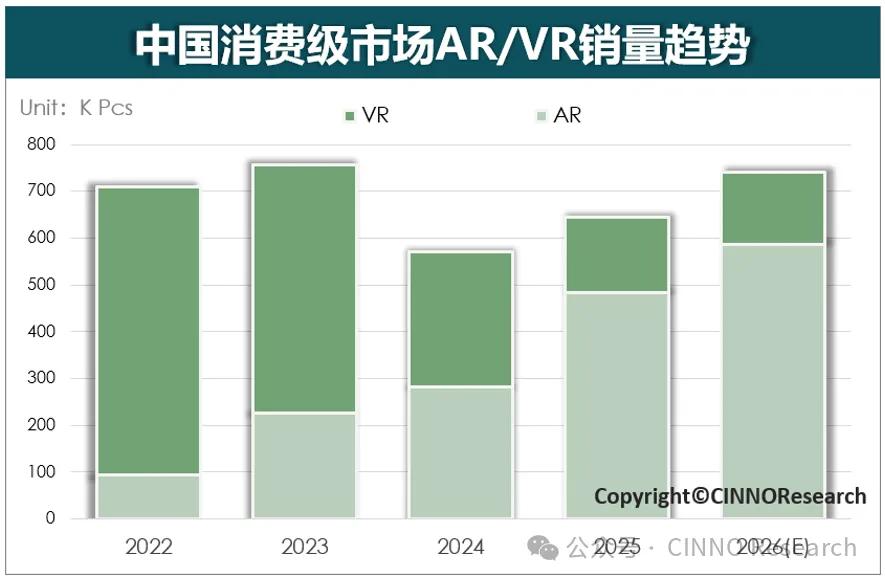
AR销量首超VR !2025年国内消费级XR销量64.5万台,同比增长13%
Xin Lang Cai Jing· 2026-02-09 10:10
Core Insights - The Chinese consumer-grade XR market is expected to achieve a structural leap by 2025, driven by domestic supply chain breakthroughs and deep restructuring of consumption scenarios, with total sales reaching 645,000 units, a year-on-year increase of 13%, and AR sales surpassing VR for the first time with 480,000 units sold [1][11]. Market Dynamics - The domestic consumer-grade market is undergoing a restructuring, with AR devices achieving historic breakthroughs, benefiting from upstream supply chain support and investment focus, leading to a 71% year-on-year increase in AR terminal sales to 484,000 units in 2025. By 2030, AR is expected to dominate the market with over 5 million units shipped [3][15]. - The VR market is experiencing a contraction, with 2025 sales projected at only 161,000 units, marking a historical low. Challenges include declining consumer enthusiasm and limited application scenarios, with predictions of continued market decline due to rising memory costs affecting high-end VR devices [4][15]. Technological Trends - AR display and optical solutions are evolving, with Micro OLED holding a 78% market share, and Sony leading with 60%. The partnership between Visionary and Thunderbird has increased their market share to 39%. The sales of green Micro LED in AR glasses have surged by 203% [5][16]. - In the VR segment, Fast LCD dominates with a 90% market share, while Micro OLED penetration in the above 5,000 yuan price segment has risen to 62%. Pancake technology accounts for 52% of sales, although its market share is expected to slightly decline due to high manufacturing costs [5][16]. Pricing and Consumer Behavior - AR is driving down prices through mass production, leading to the emergence of affordable products, while high-end AR headsets are also being developed [6][17]. - In the VR market, 33% of sales are in the 4,000 to 5,000 yuan price range, primarily driven by the PICO 4 Ultra. Despite overall sales decline, core users are willing to pay a premium for immersive technology, indicating a structural upgrade in the high-end market [6][17]. Brand Landscape - In the AR market, Thunderbird leads with a 32% market share and a 60% year-on-year growth, supported by a comprehensive product matrix. XREAL follows with an 18% share, focusing on advancements in field of view and computational power [7][18]. - In the VR market, PICO maintains a leading position with over 40% market share, while Meta's share has rapidly increased to over 30%, indicating a competitive landscape [7][18]. Investment and Ecosystem Development - In 2025, global VR/AR industry financing reached 54.9 billion yuan, with domestic financing at 5.08 billion yuan, an increase of 610 million yuan from the previous year. AR hardware and terminal manufacturers are the focus of this financing [8][18]. - The Chinese consumer-grade XR market is undergoing a structural transformation driven by policy guidance, technological breakthroughs, and ecosystem reconstruction, with AR achieving market dominance through portability and adaptability, while VR deepens its application value in professional fields [8][19].
AI眼镜进“国补”,从“尝鲜”到“常用”还有几步?
Xin Lang Cai Jing· 2026-02-09 05:11
Core Insights - The article highlights the rising popularity of AI glasses as a new consumer trend during the upcoming Spring Festival, alongside traditional goods, driven by technological advancements and government subsidies [1][3]. Group 1: Market Dynamics - The new "national subsidy" policy, effective January 2026, includes smart glasses in the trade-in subsidy list, offering a 15% subsidy with a maximum of 500 yuan per item, which is expected to stimulate demand [3][5]. - The initial month of the subsidy saw a significant increase in inquiries and sales for AI glasses, with prices dropping to around 85% of the original price, making them more affordable [5][7]. - Despite the growing interest, the AI glasses market remains small, with approximately 1.78 million units shipped in the first three quarters of 2025, compared to smartphones which see shipments in the hundreds of millions [7][9]. Group 2: Product Features and Categories - AI glasses integrate various technologies, including chips, audio units, sensors, and AI capabilities, offering functionalities like audio playback, voice calls, and real-time translation [7][9]. - The market features three main categories of AI glasses: AI audio glasses for auditory enhancement, AI camera glasses for first-person recording, and AI+AR glasses for immersive experiences [10][12]. Group 3: Industry Trends and Innovations - The global AI glasses market is expected to grow significantly, with shipments projected to rise from 340,000 units in 2023 to 26 million units by 2028, particularly in China [12][14]. - Chinese companies dominate the AI glasses exhibition space, accounting for over 60% of participants, showcasing a full industry chain from components to finished products [12][14]. - Recent investments from Chinese telecom operators into the AI glasses sector indicate a shift towards independent AI devices, enhancing the market's potential [14][16]. Group 4: Challenges and Recommendations - The industry faces challenges in achieving mass adoption, requiring a breakthrough product that combines innovative technology with practical applications [16][19]. - Key recommendations for the industry include enhancing technological innovation, improving user experience, and fostering collaboration across the supply chain [20][22].

AI眼镜进“国补” 从“尝鲜”到“常用”还有几步?
Yang Shi Xin Wen· 2026-02-09 05:07
Core Insights - The article highlights the growing popularity of AI glasses as a new consumer product during the upcoming Spring Festival, driven by government subsidies and technological advancements [2][4] - The market for AI glasses is still in its infancy, with a shipment volume of approximately 1.78 million units in the first three quarters of 2025, compared to billions for smartphones [3][10] - The global AI glasses market is expected to see significant growth, with shipments projected to rise from 340,000 units in 2023 to 26 million units by 2028 [5] Policy and Market Dynamics - A new round of national subsidies for AI glasses will begin in January 2026, offering a 15% subsidy with a maximum of 500 yuan per unit, which is expected to stimulate consumer interest [2][4] - The CES 2026 showcased a strong presence of Chinese companies in the AI glasses sector, accounting for over 60% of exhibitors, indicating a robust domestic industry [4][5] Product Features and Consumer Interest - AI glasses are categorized into three main types: audio glasses, camera glasses, and AI+AR glasses, each serving different functions and use cases [8][9] - Consumer interest in AI glasses has increased, with many expressing curiosity and a willingness to purchase due to improved functionality and lower price points after subsidies [2][3] Industry Challenges and Future Outlook - Despite the growing interest, AI glasses remain a niche product, facing challenges such as consumer unfamiliarity and privacy concerns [3][10] - The industry is awaiting a breakthrough product that could drive mass adoption, akin to the "iPhone moment" for smartphones [10][12] - Recommendations for the industry include enhancing technological innovation, optimizing user experience, and fostering collaboration across the supply chain [12]
AI眼镜进入验证期;潮玩IP工业化加速
Huafu Securities· 2026-02-08 13:41
Investment Rating - The industry rating is "Outperform the Market" [7] Core Insights - The AI glasses have entered the delivery verification phase, with Rokid achieving a significant milestone by surpassing 15,000 units shipped globally, marking a rare case of substantial delivery in the domestic AI glasses market [2][13] - The smart glasses industry has transitioned from an engineering verification phase dominated by AR/MR headsets to a consumer exploration phase driven by lightweight designs and AI capabilities, focusing on everyday wearability and comfort [3][15] - The trend in the collectible toy industry has shifted from niche art toys to mainstream cultural consumption, with IP industrialization accelerating, indicating a structural upgrade in the market [4][21] Summary by Sections AI Glasses - Rokid AI Glasses Style has officially launched globally, with over 15,000 units shipped as of February 2, indicating a successful entry into the consumer market [13] - The product is designed for daily wear, weighing only 38.5g, and features AI capabilities such as real-time translation and information queries, emphasizing its role as a primary eyewear option [13][15] - The industry focus has shifted from the feasibility of technology to whether products can support real consumer demand, with key performance indicators now including sales volume, return rates, and customer retention [15] Collectible Toys - Recent collaborations, such as the partnership between Miniso and CCTV for Spring Festival IP derivatives, highlight the cultural significance of collectible toys, moving them into broader consumer markets [4][24] - The SPACE MOLLY toy, which completed a space round trip, represents a new cultural narrative, transforming collectible toys into symbols of exploration and future imagination [21][23] - The collectible toy industry has evolved from a focus on individual IP to a model of industrialized production and cultural output, with a shift towards high turnover and multi-IP strategies [29][30]
MeetBrands 出海向新 | 当“带电”成为共识:中国消费电子的全球突围路径
3 6 Ke· 2026-02-05 10:00
Core Insights - The CES 2026 event highlights the global competitiveness of Chinese consumer electronics brands, marking a shift from "scale expansion" to "quality selection" in overseas markets [1][2] - The consumer electronics category is identified as a key area for Chinese brands to expand internationally, with a significant presence in the 2025 MeetBrands list [2][3] Group 1: Consumer Electronics as a Key Category - Consumer electronics remains the largest category in the 2025 MeetBrands list, reflecting its rapid iteration and ability to quickly validate products in various markets [2] - A mature and centralized supply chain in China provides a competitive advantage in cost, efficiency, and delivery stability, facilitating large-scale international expansion [3] - Nearly one-third of the new brands on the 2025 MeetBrands list are from the consumer electronics category, indicating a significant turnover and renewal within this sector [4] Group 2: Trends in Consumer Electronics - "Portability" is emerging as a dominant trend among new brands, with products like portable projectors and energy storage devices designed for on-the-go use [7] - The rise of personal manufacturing, including laser engraving machines and 3D printers, is becoming mainstream as these devices evolve to meet the needs of ordinary users [9] Group 3: Challenges in International Expansion - Despite the popularity of consumer electronics, companies face challenges in establishing a foothold in overseas markets, including intense competition and the need for clear product differentiation [11][12] - Increasing compliance requirements across different countries add complexity to market entry, necessitating ongoing adaptation to local regulations [13] - Localization challenges extend beyond language translation, requiring a deep understanding of local consumer behavior and preferences [15] Group 4: Case Study of AR Glasses - The AR glasses market is highly competitive, with both international giants and emerging Chinese brands vying for market share [16] - BeyondClick's strategies for assisting brands like Rokid include restructuring their online presence to focus on user scenarios rather than technical specifications, significantly improving conversion rates [17][18] - The use of AI to enhance creative production and optimize marketing strategies has led to increased efficiency and higher conversion rates for brands entering international markets [19][21]

集福、停车、当导游……一副眼镜,正在打开AI的「生活副本」
3 6 Ke· 2026-02-05 02:18
Core Viewpoint - The integration of AI glasses into daily life is transforming traditional practices, such as the collection of blessings during the Chinese New Year, into a seamless and interactive experience, showcasing the potential of AI technology in enhancing user engagement and convenience [1][3][5]. Group 1: AI Glasses and User Experience - The use of AI glasses for collecting blessings allows users to effortlessly scan for "福" characters and receive rewards, indicating a shift towards a more intuitive and engaging interaction with technology [1][3]. - The collaboration with popular cultural IPs, such as "王者荣耀" and "乡村爱情," enhances the experience by turning the real world into a large-scale interactive game, further integrating AI technology into everyday activities [5]. - The GPASS technology framework supports this new experience by enabling seamless interactions and connections between users and the AI system, marking a significant advancement in the application of AI glasses [5][13]. Group 2: Practical Applications of AI Glasses - AI glasses can simplify everyday tasks, such as parking fee payments, by allowing users to interact with the system through voice commands, thus streamlining the payment process and reducing hassle [8][10]. - The integration of health management features into AI glasses allows users to receive real-time health advice and information, enhancing the utility of the device in daily life [10][12]. - In the tourism sector, AI glasses can serve as personal guides, providing information and navigation assistance, which exemplifies their potential to transform user experiences in various contexts [12][18]. Group 3: Market Trends and Future Outlook - The AI glasses market is on the verge of significant growth, with projections indicating a 370% year-over-year increase in sales for AI smart glasses, highlighting the rapid acceleration of this technology [19]. - By 2026, AI glasses are expected to reach a critical point of widespread adoption, driven by advancements in hardware and the development of a robust software ecosystem that enhances user experience [21]. - Companies like Rokid and others are preparing for this market shift by optimizing their hardware and leveraging GPASS technology to create a comprehensive service framework, positioning themselves for success in the emerging AI glasses landscape [21].

特斯拉最新人形机器人2026年底前启动量产;三星SDI2025年第四季度持续亏损丨智能制造日报
创业邦· 2026-02-03 03:09
Group 1 - Tesla's third-generation humanoid robot is set to be unveiled, with an expected annual production capacity of 1 million units by the end of 2026, as the Fremont factory's Model S/X production line will be converted for this purpose [2] - Rokid is collaborating with a leading domestic large model company to develop a new generation of AI glasses driven by generative AI and AI agents, with current daily sales of approximately 1,200 units [2] - Samsung SDI reported a continued loss in Q4 2025, with a net profit of 207.8 billion KRW (approximately 142.4 million USD) for Q4 2024, and an operating loss of 299.2 billion KRW, which is an increase from the previous year's loss [2][3] Group 2 - VinFast plans to accelerate its expansion into Southeast Asia, targeting markets such as the Philippines, Indonesia, India, Thailand, and Malaysia, with plans to establish hundreds of retail outlets by 2027 [2]