《国际紧急经济权力法》(IEEPA)

Search documents
特朗普关税“B计划”遭质疑,专家:美国经济现状并不符合“122条款”
Hua Er Jie Jian Wen· 2026-02-24 06:44
Core Viewpoint - The Trump administration has initiated a "Plan B" to impose tariffs of up to 15% on global imports after the U.S. Supreme Court rejected the use of the International Emergency Economic Powers Act (IEEPA) for this purpose, raising legal and economic concerns regarding the legitimacy of this action [1][2] Group 1: Legal and Economic Context - The new tariff measure allows the president to bypass investigation procedures but is constrained by a 15% tax rate cap and a 150-day validity period, leading to anticipated legal challenges from businesses seeking refunds for tariffs already paid [2] - The Trump administration's invocation of Section 122 of the Trade Act of 1974 is based on claims of a "huge and serious" trade and international balance of payments deficit, including a net international investment position (NIIP) of negative $26 trillion [1][3] - Legal experts argue that the current economic conditions do not exhibit typical symptoms of a balance of payments crisis, such as currency collapse or capital flight, which raises questions about the applicability of Section 122 [1][4] Group 2: Historical and Regulatory Framework - Section 122 of the Trade Act of 1974 was designed to allow the president to act without waiting for federal agency investigations in response to significant balance of payments deficits or imminent currency devaluation, with a historical context dating back to the Nixon Shock [6] - The limitations of this section include a maximum tariff rate of 15% and a maximum implementation period of 150 days, requiring congressional approval for any extension, which poses challenges for the sustainability of the new tariffs [6] Group 3: Economic Implications - Economists challenge the rationale behind the tariffs, arguing that the negative NIIP is largely due to foreign holdings of U.S. assets being significantly higher than U.S. holdings of foreign assets, and that a successful tariff implementation could paradoxically worsen the NIIP [4] - The absence of evidence indicating that the U.S. cannot meet its international obligations suggests that there is no actual "crisis," as a genuine crisis would typically lead to a sell-off of U.S. assets and a significant depreciation of the dollar [4]
特朗普全球关税被推翻!他放话加征10%
Sou Hu Cai Jing· 2026-02-22 10:18
Core Viewpoint - The U.S. Supreme Court ruled that the International Emergency Economic Powers Act (IEEPA) does not grant the president the authority to impose tariffs without congressional approval, marking a significant legal defeat for former President Trump [1] Group 1: Legal Implications - The Supreme Court's decision, with a 6-3 vote, confirmed that the IEEPA does not authorize the president to levy tariffs without Congress's explicit consent [1] - The ruling upholds a previous lower court's decision that Trump's tariff policies exceeded the powers granted by the IEEPA [1] - The court's ruling leaves unresolved whether importers can seek refunds for tariffs already paid, delegating this issue to lower courts [1] Group 2: Economic Impact - Economists estimate that tariffs related to this ruling exceed $175 billion, and if refunded or reduced, it could significantly impact the U.S. economy [1] - The average effective tariff rate in the U.S. is projected to drop from 13.6% to 6.5%, a reduction of over 50% [1] - The ruling may lead to a potential refund of tariffs that could surpass the budgets of the U.S. Department of Transportation and the Department of Justice for the fiscal year 2025 [1] Group 3: Market Reactions - Following the ruling, the U.S. dollar index fell, U.S. Treasury prices dropped, major U.S. stock indices gained, and gold and silver prices surged [1] - Market reactions were relatively calm, attributed to prior expectations of the ruling and Trump's indication of alternative plans [1] - Analysts suggest that the market's positive response may be temporary, as the government retains the ability to implement tariffs through other legal frameworks, albeit requiring more time [3]

一图读懂|最高法院判特朗普关税违宪,剩余五张“关税牌”
Di Yi Cai Jing· 2026-02-21 02:44
Group 1 - The U.S. Supreme Court ruled 6-3 that former President Trump's large-scale tariffs were illegal, emphasizing that the term "regulation" in the International Emergency Economic Powers Act (IEEPA) does not include taxation [5][7][8] - The ruling indicates that the government must address the process of refunding approximately $170 billion in tariffs collected from over 300,000 importers, although the court did not provide specific guidance on how this should be done [9][10] - The Supreme Court's decision is expected to create significant administrative challenges in managing the refund process, as acknowledged by Justice Kavanaugh during oral arguments [10][11] Group 2 - The ruling has implications for the authority of Congress regarding regulatory and taxation powers, highlighting the need for clear delineation in legislation [5][6] - The decision may lead to a reevaluation of existing tariffs and their legal basis, particularly those implemented under emergency powers [16] - The court's majority opinion was written by Chief Justice John Roberts, with dissenting opinions from Justices Clarence Thomas and Samuel Alito, who argued for broader presidential powers in emergencies [7][8]

被判违法后 特朗普为何能宣布额外征收10%全球关税?还有牌?
Di Yi Cai Jing· 2026-02-21 00:51
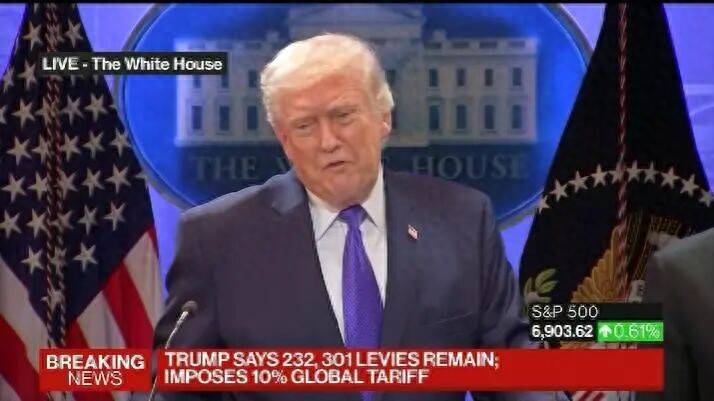
Group 1 - The U.S. government plans to impose an additional 10% tariff on global goods based on Section 122 of the Trade Act of 1974, following a Supreme Court ruling that deemed previous tariff policies illegal [1][2] - The tariffs under Section 122 can be implemented immediately and are temporary, lasting up to 150 days unless extended with Congressional approval [3][4] - Experts suggest that the Trump administration is in a difficult position regarding tariffs, as failing to impose additional tariffs could undermine existing trade agreements [3][4] Group 2 - The administration has several options for imposing tariffs, including Sections 232, 301, and 201 of various trade laws, with Section 232 being expected to be used more broadly [5][6] - Section 301 investigations are currently underway against countries like Brazil, but these investigations are time-consuming and may not be used immediately [7] - Section 338 of the Tariff Act of 1930 allows for immediate tariffs of up to 50% against discriminatory trade practices, while Section 201 provides a mechanism for emergency import relief with flexible tariff limits [5][7]
特朗普关税案判决,美国最高法院再度爽约
Di Yi Cai Jing· 2026-01-15 12:29
Core Viewpoint - The U.S. Supreme Court has delayed its ruling on the Trump administration's tariff case, causing uncertainty in the market, particularly affecting consumer stocks. Analysts suggest that the longer the delay, the more favorable it may be for the Trump administration, although some legal experts disagree on this perspective [1][2]. Group 1: Court Proceedings and Market Reactions - The Supreme Court has not yet announced a decision on the tariff case, with potential rulings expected around January 21 or 22 [1]. - The delay in the ruling has led to declines in consumer stocks, reflecting market concerns over policy uncertainty [1]. - Analysts from JPMorgan indicate that the longer the court takes to decide, the higher the likelihood that the ruling will favor the Trump administration [2]. Group 2: Financial Implications of Tariffs - The potential amount for tariff refunds in the case is estimated at $135 billion [3]. - Trump has warned that a ruling against his tariffs could lead to refunds amounting to "hundreds of billions" or even "trillions" of dollars, which he claims would be disastrous for the country [4]. - The actual tariff revenue collected has increased by $206 billion over the past eight months, but only about $130 billion is attributed to tariffs under the International Emergency Economic Powers Act (IEEPA) [5]. Group 3: Economic Perspectives - The current pace of tariff revenue generation is approximately $30.4 billion per month, translating to an annualized revenue of $364.5 billion, although this figure is expected to decline as companies seek ways to avoid tariffs [5]. - The Trump administration has indicated that tariffs are a means to address the national debt, but experts argue that the revenue generated is insufficient to have a significant economic impact [5].
特朗普政府关税案未裁决,B计划还有这些
第一财经· 2026-01-10 03:24
Core Viewpoint - The article discusses the potential implications of the U.S. Supreme Court's upcoming decision on tariffs imposed by the Trump administration, highlighting the administration's contingency plans if the court rules against them [3][4]. Group 1: Supreme Court Decision - The U.S. Supreme Court will not make a ruling on the Trump administration's tariff case on January 9, with the next hearing scheduled for January 14 [3]. - The court is expected to announce its decision on the case by February 3, 2026, with indications that the Trump administration may lose [7][11]. Group 2: Contingency Plans - Trump administration officials have indicated they are prepared with a "Plan B" if the Supreme Court rules against the tariffs, suggesting the use of alternative legal frameworks [4][10]. - The administration has identified several legal tools, including the 1974 Trade Act Section 122, the "232 investigation," and the "301 investigation," to potentially impose tariffs without relying on the International Emergency Economic Powers Act (IEEPA) [13][14]. Group 3: Financial Implications - If the Supreme Court rules the tariffs illegal, the Trump administration could face a refund obligation ranging from $133.5 billion to $150 billion [10][11]. - The administration's statements suggest that even if they lose the case, they will find ways to continue imposing tariffs through different legal mechanisms [11][12]. Group 4: Legal Frameworks - The article outlines various legal frameworks available to the Trump administration for imposing tariffs, including: - IEEPA: Immediate effect under national emergency [14] - Section 301: Takes 9-12 months to implement [14] - Section 232: Related to national security, takes about 9 months [14] - Section 122: Allows for quick imposition of tariffs within 150 days [14] - Section 338: Can impose tariffs up to 50% for discriminatory practices [14][16].
事关特朗普政府关税案!美最高法院:暂缓裁决
Zheng Quan Shi Bao· 2026-01-09 23:12
Core Viewpoint - The U.S. Supreme Court will not make a ruling on the Trump administration's tariff case on January 9, focusing on the legality of tariffs imposed under the International Emergency Economic Powers Act (IEEPA) and potential refunds to importers if deemed illegal [1] Group 1: Legal and Policy Implications - The Supreme Court's review centers on whether the Trump administration had the authority to impose tariffs under IEEPA and if the government must refund tariffs paid by importers if the tariffs are found illegal [1] - U.S. Treasury Secretary Scott Bansen emphasized the importance of maintaining tariff revenue levels, noting that an unfavorable ruling would limit the President's flexibility in using tariffs as negotiation tools, which could be detrimental to the American public [1] Group 2: Economic Impact - The actual effects of the tariff policy have diverged from initial analyst predictions, with limited impact on U.S. inflation but a significant reduction in trade deficits, which fell to the lowest level since the 2009 financial crisis by October 2025 [2] - The upcoming tariff ruling is expected to gradually reveal its effects on U.S. trade dynamics, fiscal health, and global economic interactions, warranting ongoing monitoring of policy adjustments and market responses [2]
市场等待美最高法院对特朗普关税案裁决
Guo Ji Jin Rong Bao· 2026-01-09 14:37
Group 1 - The U.S. Supreme Court is set to announce several rulings on January 9, with the most notable being the legality of President Trump's "reciprocal tariffs" [1] - This ruling could have significant implications for U.S. trade policy, presidential power boundaries, and market expectations [1] - The Supreme Court has expedited the handling of related cases, leading to a strong belief in the legal community that the tariff case will likely be included in the announcements [1] Group 2 - Trump's tariff measures announced in April caused the S&P 500 index to drop nearly 5%, and U.S. Treasury yields fell significantly as investors sought safe-haven assets [2] - Analysts indicate that uncertainty in the market is rising, and if the court rules against Trump's use of emergency powers for tariffs, it could lead to a decrease in government tariff revenue and impact investor confidence in U.S. trade policy stability [2] - There is a prediction that if tariffs are ruled to be refunded, importers could see an influx of approximately $150 billion to $200 billion, which may support certain industries and improve corporate profitability [2]
最高法院周五或裁定特朗普关税合法性,美国经济面临关键抉择
Jin Rong Jie· 2026-01-09 05:48
Core Viewpoint - The U.S. Supreme Court is expected to make a ruling on the legality of tariffs implemented during Trump's administration, which could have significant implications for trade policy and the U.S. fiscal situation [1] Group 1: Legal and Policy Implications - The ruling will address whether the government has the authority to impose tariffs under the International Emergency Economic Powers Act (IEEPA) and whether the government must refund tariffs paid by importers if the tariffs are deemed illegal [1] - The court may issue a mixed ruling, granting limited authority under IEEPA while requiring limited refunds, or it may explore various other options [1] - Even if the White House loses the case, it retains other policy tools to implement tariffs without invoking emergency powers [1] Group 2: Economic Impact - Losing the tariff tool could have multiple repercussions, including negative effects on the ambition for industrial relocation to the U.S. and potential increases in interest rates, although it may benefit corporate profits by lowering input costs and facilitating trade [2] - The government has identified several alternative strategies to maintain most tariffs if the court ruling is unfavorable, with a 28% probability that the court will support the current tariff implementation [2] - Tariffs are projected to generate approximately $195 billion in revenue for the fiscal year 2025, with an additional $62 billion expected in 2026 [2] Group 3: Analyst Perspectives - Analysts from Morgan Stanley believe there is significant leeway in the Supreme Court's ruling, which could result in a narrowing of existing tariffs without a complete repeal or limitations on future tariff applications [3] - The focus on affordability issues may allow the government to adopt a more moderate approach to the overall tariff system [3] Group 4: Trade Deficit and Inflation - The impact of tariffs has exceeded analysts' expectations, showing limited effects on inflation while significantly reducing the trade deficit, countering views that tariffs could isolate the U.S. in global trade [4] - The U.S. trade deficit reached its lowest level since the end of the 2009 financial crisis in October last year, indicating a substantial decrease in imports [4]
美最高法院周五将裁决特朗普关税案,输了要退1335亿美元?
第一财经· 2026-01-07 15:56
Core Viewpoint - The U.S. Supreme Court is set to make a ruling on tariffs on January 9, which could significantly impact the Trump administration's economic policies and potentially require the return of over $133.5 billion in tariffs if deemed illegal [3][12]. Group 1: Tariff Policy and Legal Context - The Trump administration implemented a series of tariffs using the International Emergency Economic Powers Act (IEEPA) without Congressional approval [5]. - Previous rulings by the U.S. Court of Appeals and the U.S. International Trade Court deemed these tariffs illegal, prompting the Trump administration to appeal to the Supreme Court [6]. - The tariffs in question include "reciprocal tariffs" and those related to fentanyl [7]. Group 2: Potential Financial Implications - If the Supreme Court rules against the Trump administration, it may face the obligation to refund over $133.5 billion in tariffs collected since February 2025 [12]. - The U.S. Customs and Border Protection reported that the net revenue from tariffs reached a record $195 billion for the fiscal year 2025, with monthly revenues around $30 billion [12]. Group 3: Future Actions and Legal Challenges - In anticipation of a potential unfavorable ruling, the Trump administration is considering using other legal provisions, such as the Trade Expansion Act of 1962 and the Trade Act of 1974, to impose new tariffs [8][9]. - Numerous companies, including Costco and Revlon, have initiated lawsuits to reclaim tariffs paid, with around 40 legal briefs submitted to the Supreme Court opposing the tariff policies [14].