先进制造业集群

Search documents
政府工作报告点题先进制造
21世纪经济报道· 2026-03-05 12:14
当前,广东已培育出8个国家级先进制造业集群,总产值规模近10万亿元,各集群在标志性产 品、标准、工艺等方面达到世界级水平。新一代信息通信集群孵化的无人机、3D打印等新兴 领域90多种产品,市场规模已占全国第一,广东先发优势明显。 站在全球产业链重构的关键窗口期,广东如何加快发展先进制造业集群?南方财经记者观察 到,广东的解法是,通过先进制造业与服务业的协同融合发展,为先进制造业集群带来赋能效 应、模式创新和生态重构。 随着人工智能赋能千行百业,广东的先进制造业集群开始迈入下半场——以数据、AI大模型和 应用场景为核心,重塑制造生产方式、重构服务模式,助力新一轮制造业重点产业链高质量发 展。 以科技创新推进智能制造 记者丨 郑康喜 编辑丨蒋韵 3月5日,十四届全国人大四次会议开幕。2026年政府工作报告提出,实施新一轮制造业重点产 业链高质量发展行动,强化产业基础再造和重大技术装备攻关,打造一批国家先进制造业集 群。 作为"十五五"开局之年,政府工作报告为中国制造高质量发展擘画蓝图,制造业大省广东又该 如何作答? "到今年年底,广汽希望在海外建成超千家销售店,加快铺设全球重点市场销售与服务网 络。"3月4日,全 ...

京津冀公共服务资源将共建共享
Jin Rong Jie· 2026-02-12 03:58
Core Viewpoint - The recent announcement of the "Modern Capital Metropolitan Area Spatial Coordination Plan" emphasizes the need for deeper collaboration in the Beijing-Tianjin-Hebei region, focusing on high-quality integrated development [1] Group 1: Key Tasks for Collaboration - The Beijing-Tianjin-Hebei region will leverage inter-provincial neighboring areas as "breakthrough points" to enhance integration, particularly through the demonstration effects of areas like Beijing's Tongzhou District and Hebei's Langfang City [1] - The plan aims to promote the deep integration of innovation and industrial chains, fostering the development of new productive forces tailored to local conditions [1] - The establishment of advanced manufacturing clusters in the Beijing-Tianjin-Hebei region is a priority, aiming for a collaborative industrial ecosystem [1] Group 2: Expanding Collaborative Development - The initiative seeks to broaden the scope of collaborative development by strengthening integrated protection and systematic governance of natural resources, including mountains, rivers, forests, fields, lakes, and grasslands [1] - There is a focus on constructing a resilient spatial layout that supports shared public services such as education, healthcare, elderly care, and childcare [1]
跃马扬鞭“十五五”|“订单稳、产线流畅、岗位踏实,是对‘稳’最实在的贡献”
Xin Lang Cai Jing· 2026-02-07 13:33
Core Viewpoint - The Jiangsu provincial government emphasizes the tasks of "stabilizing employment, enterprises, markets, and expectations," which are crucial for companies to integrate their development into the broader provincial growth strategy [1][3]. Group 1: Stabilizing Enterprises - The concept of "stabilizing enterprises" is closely linked to technological innovation, as highlighted by the company’s focus on carbon fiber and its equipment, addressing critical challenges in the industry [3][4]. - The company has maintained stable production capacity, with over 300 employees working during the Spring Festival, demonstrating its role as a stabilizer in the industrial ecosystem [3]. Group 2: Employment and Economic Impact - Employment is viewed as a significant aspect of public welfare, with the company recognizing that "stabilizing employment" should be rooted in healthy industrial development [4]. - The company has fostered over twenty supporting enterprises in the local area, creating a small industrial cluster that enhances job creation and stabilizes public sentiment [4]. - The company provides diverse job opportunities across various sectors, including technology research and development, smart manufacturing, and marketing, while also focusing on skill training and career development for local talents [4].
湖南公布今年389个省重点建设项目名单,总投资2万亿元
Xin Lang Cai Jing· 2026-02-05 00:00
Core Viewpoint - Hunan Province has announced a total of 430 key construction and preliminary work projects for 2026, with a total investment of 2 trillion yuan, focusing on infrastructure, ecological protection, social welfare, and industrial development [1] Group 1: Key Construction Projects - The list includes 389 key construction projects and 41 key preliminary work projects [1] - The infrastructure projects consist of 152 projects, including major initiatives in energy, urban infrastructure, and transportation [1] - Significant infrastructure projects include the "source-network-load-storage" integration project, "four-network integration" computing power project, and urban infrastructure renovation [1] Group 2: Transportation Development - The plan includes the acceleration of six high-speed rail lines and the expansion of 17 expressways [1] - Major water conservancy projects such as the Meishan Irrigation District and Jintangchong Reservoir are also part of the construction agenda [1] Group 3: Industrial Development - The focus is on a "4×4" modern industrial system, enhancing 13 key industrial chains and "5+5" advanced manufacturing clusters [1] - Key industrial projects include the development of next-generation lithium batteries, 3D glass production, and new energy drive systems [1]
首都都市圈擘画世界级城市群蓝图
Xin Lang Cai Jing· 2026-02-03 19:46
Core Viewpoint - The release of the "Modern Capital Urban Circle Spatial Coordination Plan (2023-2035)" marks a significant step in the coordinated development of the Beijing-Tianjin-Hebei region, aiming to establish a world-class urban circle centered around the capital by 2050 [1] Group 1: Planning and Structure - The plan delineates a spatial framework covering approximately 42,000 square kilometers, proposing a structure of "one core, two wings, dual cities, multiple points, and dual corridors" [1] - The "one core, two wings" model aims to facilitate the orderly decongestion of non-capital functions from Beijing while enhancing the region's capacity to support capital functions [2] Group 2: Urban Coordination and Development - The urban circle encompasses the entirety of Beijing, parts of Tianjin, and 11 cities in Hebei, focusing on enhancing the functions of Tianjin and the construction of the Xiong'an New Area [2] - The plan emphasizes the need for differentiated development across commuting, functional, and industrial collaboration circles to avoid homogenization [2][3] Group 3: Industrial and Economic Development - The plan aims to cultivate a "Beijing-Tianjin-Xiong'an Innovation Triangle" to enhance innovation capabilities and industrial leadership within the urban circle [3] - Key industries targeted for development include life and health, power and new energy equipment, integrated circuits, and artificial intelligence [5] Group 4: Infrastructure and Corridor Development - The plan outlines the construction of two high-quality development corridors: the Beijing-Tianjin Corridor and the Beijing-Xiong'an Corridor, focusing on innovation and resource integration [4] - The Beijing-Tianjin Corridor will span approximately 220 kilometers, while the Beijing-Xiong'an Corridor will cover about 240 kilometers, both aimed at fostering high-level openness and innovation [4] Group 5: Implementation and Future Outlook - The plan emphasizes the need for collaborative development among the three regions to optimize resource allocation and maximize efficiency [5] - As the plan's initiatives are implemented, it is expected to significantly contribute to the construction of a world-class urban cluster and support China's modernization efforts [5]
浙江为96家“科技新小龙”授牌
Xin Lang Cai Jing· 2026-01-28 10:31
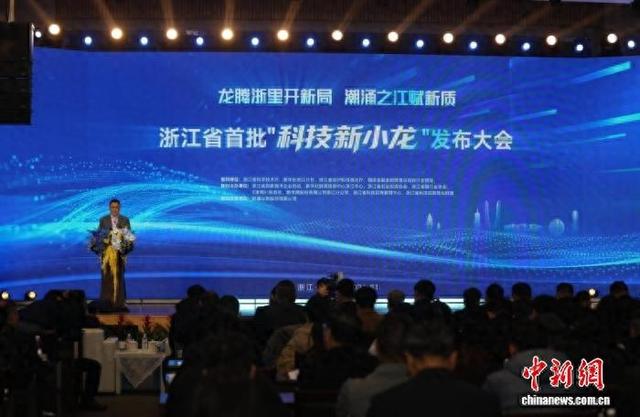
Core Insights - The first batch of "Technology New Dragons" in Zhejiang Province was announced, consisting of 96 companies selected from nearly 400 candidates across 11 cities, with Hangzhou having the highest representation [1][3] - The selected companies span multiple strategic fields, including new generation information technology, biotechnology, new materials, new energy, and bionic robotics, showcasing a strong focus on high-tech industries [3][4] - The selection criteria for these companies included being established for more than 3 years but less than 10 years, having a high-level talent R&D team, and meeting specific R&D investment thresholds [3][4] Industry Distribution - Among the selected companies, 43 are in the new generation information technology sector, making it the core strength of the "New Dragons" group, while 18 are in biotechnology and 12 in new materials, indicating a robust presence in advanced industries [3][4] - The initiative reflects Zhejiang's commitment to fostering innovation and high-tech industries, aligning with its "315" technology innovation system and "415X" advanced manufacturing cluster development goals [4][5] Support Measures - A "Technology New Dragon Enterprise Support Action" was launched to empower the growth of these companies, featuring ten measures focused on resource support, ecosystem integration, and service assurance [3][4] - The province aims to establish a "service consortium" to address operational challenges and innovation needs by involving experts from various fields [4]
瞄准世界级创新集群 多地部署整合区域优势资源
Xin Lang Cai Jing· 2026-01-27 21:04
Core Insights - The construction of international technology innovation centers in Beijing-Tianjin-Hebei, Yangtze River Delta, and Guangdong-Hong Kong-Macau Greater Bay Area is a key focus during the local Two Sessions, aimed at enhancing regional innovation resources and collaboration to foster world-class innovation clusters and support the construction of a technology-driven strong nation [1][4] Group 1: Strategic Goals and Developments - The central government emphasizes the expansion of Beijing's and Shanghai's international innovation centers to their respective regions, providing clear direction for regional technology innovation efforts [1][3] - Beijing aims to enhance its role as the core engine of the Beijing-Tianjin-Hebei innovation center by focusing on innovation sources and improving the efficiency of technology transfer within the region [1][3] - Guangdong targets the establishment of a globally influential industrial technology innovation center, emphasizing the development of new productive forces and high-level self-reliance in technology [2][5] Group 2: Regional Collaboration and Specialization - Regions like Tianjin, Hebei, and Zhejiang are focusing on precise integration and collaboration with core innovation resources, aiming to enhance their unique strengths and contribute to the overall innovation ecosystem [2][3] - Tianjin is actively engaging in the co-construction of the Beijing-Tianjin-Hebei international technology innovation center, focusing on key areas such as artificial intelligence and synthetic biology [2][3] - Hebei is working to attract innovation resources from Beijing and is implementing collaborative innovation projects to enhance its role in the regional innovation landscape [3] Group 3: Advanced Manufacturing and Innovation Clusters - China has established 80 national advanced manufacturing clusters, with the three major innovation center regions being the core areas for these clusters [3] - In the 2025 global ranking of innovation clusters, Shenzhen-Hong Kong-Guangzhou, Beijing, and Shanghai-Suzhou are projected to rank first, fourth, and sixth respectively, highlighting the competitive strength of China's innovation clusters [3]
广西全力打造制造业十大支柱产业
Guang Xi Ri Bao· 2026-01-22 02:59
Group 1 - The core focus of Guangxi's industrial strategy for 2026 is to develop ten modern pillar industries, including non-ferrous metals, advanced steel materials, modern green chemicals, artificial intelligence, new generation information technology, high-end equipment manufacturing, new energy vehicles and batteries, food processing, forest products and paper industry, and biomedicine and health [1] - Guangxi plans to implement a robust "Five Ones" work promotion mechanism to ensure effective development of these industries, which includes appointing a responsible leader, establishing a working team, formulating an action plan, empowering with an industrial fund, and driving with leading enterprises [1] - The region aims to enhance investment and transformation in traditional industries through actions such as manufacturing technology upgrades, developing industry-specific implementation plans, and providing enterprise diagnostic services [1] Group 2 - Guangxi will deepen the implementation of industrial project construction actions by establishing a comprehensive project lifecycle management mechanism and creating quarterly key project lists [2] - The region will enhance the construction of advanced manufacturing industry clusters through actions aimed at strengthening and extending supply chains, as well as cultivating new advanced manufacturing clusters in areas like new energy and environmental protection [2] - The establishment of a key metal national advanced manufacturing cluster is part of the strategy to accelerate the high-quality development of critical metals in Nandan [2]
杭州“十五五”规划建议:积极推进人工智能创新发展第一城建设
Xin Hua Cai Jing· 2026-01-16 05:40
Group 1: Artificial Intelligence Development - The proposal emphasizes the construction of Hangzhou as a leading city in artificial intelligence innovation, focusing on advanced technologies such as large models, high-end chips, foundational software, model algorithms, and data engineering [1] - It aims to establish a new computing power system and promote key areas like embodied intelligent robots, brain-like intelligence, and intelligent driving, fostering a collaborative development pattern across the entire industry chain [1] - The initiative includes the implementation of the "Artificial Intelligence +" action plan to integrate AI with various sectors, enhancing research paradigms and societal governance [1] Group 2: Advanced Manufacturing Industry - The proposal aims to strengthen and optimize the "296X" advanced manufacturing clusters, targeting the creation of trillion-level industry clusters in artificial intelligence and visual intelligence [2] - It focuses on nine key sectors, including intelligent robots, integrated circuits, biomedicine, and new energy equipment, to develop billion-level industry clusters [2] - The plan includes establishing future industry investment growth mechanisms and exploring various technological routes and market regulations for emerging sectors like quantum technology and brain-like intelligence [2] Group 3: State-Owned Enterprises Reform - The proposal seeks to enhance the core functions and competitiveness of state-owned enterprises (SOEs) through deepening reforms and optimizing the layout of state capital [3] - It emphasizes the importance of strategic collaboration between SOEs and private enterprises, supporting joint efforts on major projects [3] - The initiative includes improving the evaluation system for SOEs and enhancing their technological innovation investment mechanisms [3]
制造业高质量发展重点任务扎实推进
中汽协会数据· 2026-01-12 07:05
Core Viewpoint - The article emphasizes the significant progress in the digital transformation of the manufacturing industry in China, highlighting the government's strategic initiatives and the establishment of a comprehensive framework to support this transformation by 2025 [4][18]. Group 1: Digital Transformation Framework - The State Council issued a digital transformation action plan for the manufacturing industry, aiming for full coverage of digital upgrades in key industrial enterprises by 2027 and completion of a round of digital transformation by 2030 [4]. - A universal evaluation index system for the digital transformation of the manufacturing industry has been established, categorizing transformation levels into five grades (L1-L5) [6]. - A comprehensive information service platform for manufacturing digital transformation has been launched, providing assessment diagnostics, policy documents, and industry evaluations, with connectivity established across 15 provinces [9]. Group 2: Industry-Specific Policies - Implementation plans for digital transformation have been issued for 14 key industries, specifying transformation goals, typical scenarios, and solutions [12]. - The establishment of 62 digital transformation promotion centers has been initiated, covering 25 provinces and 14 key industries, focusing on specialized services [15]. Group 3: Progress and Achievements - As of December 31, 2025, 248,000 industrial enterprises have registered on the digital transformation platform, representing 47.1% of all industrial enterprises, with 89.6% of these enterprises having initiated digital upgrades [18]. - The penetration rate of digital production equipment among industrial enterprises reached 57.7% [18]. - Industrial technology renovation investments in 26 cities averaged a growth rate of 7.3%, exceeding the national average by 6.8 percentage points, with total investments surpassing 760 billion [21]. Group 4: Green and Intelligent Manufacturing - The average penetration rate of digital R&D design tools among industrial enterprises reached 86.7%, with the CNC rate for key production processes averaging 71.1% [23]. - The energy consumption per unit of industrial added value has decreased to 1.4 tons of standard coal per 10,000 yuan [23]. Group 5: Collaborative Innovation and New Models - The article highlights the establishment of 1,724 national-level technology innovation carriers and nearly 3,000 public service platforms, with an average R&D investment intensity of 4.64% within clusters [43]. - The integration of new technologies such as 5G, AI, and big data into manufacturing processes has led to the establishment of 238 leading and excellent smart factories [47][48]. Group 6: High-tech Industry Development - By 2025, national high-tech zones are expected to maintain a positive growth trend, with industrial output value reaching 27.4 trillion yuan, a year-on-year increase of 2.8% [72]. - High-tech zones have gathered 70% of national manufacturing innovation centers and 80% of key laboratories, contributing significantly to original innovations and high-tech industry clusters [76][78].