
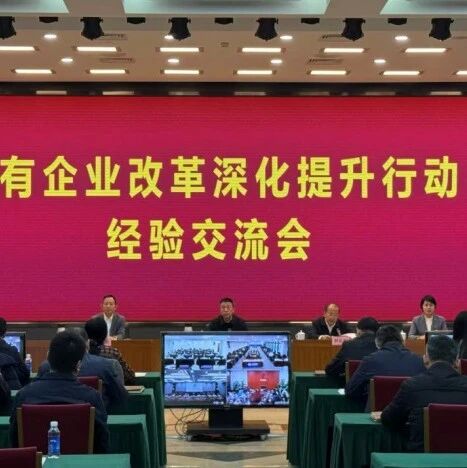
国有企业改革深化提升行动

Search documents
滨州市国资委国企改革案例入选国务院国资委微案例集
Xin Lang Cai Jing· 2026-02-28 01:40
Core Insights - The State-owned Assets Supervision and Administration Commission (SASAC) has officially released the 2023-2025 action plan for deepening and enhancing state-owned enterprise (SOE) reform, with a case study from Binzhou City recognized in the national micro-case collection [1] - Binzhou City is among four cities in the province to have its case selected, indicating that its SOE reform efforts are leading in the province and have received national recognition [1] Summary by Categories SOE Reform Initiatives - Binzhou City has implemented comprehensive measures in 2023 to align with the reform directives from SASAC and the provincial government, focusing on enhancing core functions and competitiveness [1] - Key tasks include improving the modern enterprise system, establishing market-oriented operational mechanisms, optimizing the structure of state-owned capital, strengthening technological innovation, and enhancing the effectiveness of state asset supervision [1] Challenges and Solutions - The city aims to address significant issues such as insufficient coordination between municipal and county-level state assets, resource fragmentation, and low efficiency [1] - A reform path has been explored that promotes collaboration between city and county levels, as well as horizontal and vertical integration, resulting in replicable and promotable practical outcomes [1] Future Directions - The recognition in the national micro-case collection serves as both an acknowledgment and motivation for further efforts [1] - The Binzhou State-owned Assets Supervision and Administration Commission plans to leverage this recognition to consolidate the achievements of SOE reform, promote typical experiences, and ensure effective implementation of reform measures [1]
深化提升行动收官 国企改革三方面成效明显
Xin Hua She· 2026-02-15 03:03
Group 1 - The core viewpoint of the news is that the reform of state-owned enterprises (SOEs) in China is showing positive results, with enhanced functions and core competitiveness, particularly in areas such as layout structure, technological innovation, corporate governance, and regulatory mechanisms [1][2] Group 2 - Strategic functions of SOEs have been further strengthened, with over 70% of revenue from central enterprises coming from sectors related to national security, the economy, and people's livelihoods. There has been an orderly advancement in strategic professional restructuring, with four new central enterprises established since 2023 [1] - The governance level of SOEs has improved, with the modernization of the corporate system accelerating. The evaluation of boards and directors has become more scientific, and rules for the executive layer's performance have been continuously refined. Reforms in three systems are deepening, with ongoing adjustments for underperforming management personnel and a proposal to link variable pay to performance [1] Group 3 - Regulatory effectiveness has been enhanced through the implementation of personalized assessments for enterprises, with 76% of individual indicators for the 2025 assessment and 79% for the 2025-2027 term. The separation of government and enterprise, as well as government and capital, is being deepened, and a centralized regulatory system for operational state-owned assets is being accelerated [2] - A national state-owned assets system property information database has been established, and efforts are underway to create an intelligent, real-time, and automated regulatory system that enhances the scientific, targeted, and effective nature of state-owned asset supervision [2]
央企2025“成绩单”发布:资产超95万亿元、利润2.5万亿元
Yang Guang Wang· 2026-01-29 01:26
Group 1 - The core viewpoint of the news is that by the end of 2025, the total assets of central enterprises are expected to exceed 95 trillion yuan, with a profit target of 2.5 trillion yuan, supporting China's economic and social development goals [1] - During the "14th Five-Year Plan" period, the total assets of central enterprises have crossed three major thresholds: 70 trillion yuan, 80 trillion yuan, and 90 trillion yuan, indicating continuous growth in scale and strength [1] - As of the end of last year, the average annual growth rate of total assets reached 6.9%, with an added value of 51.3 trillion yuan, representing a 44.6% increase compared to the "13th Five-Year Plan" period [1] - The total profit achieved was 12.7 trillion yuan, which is a 56.2% increase compared to the "13th Five-Year Plan" period [1] - Key product outputs have shown stable growth, with crude oil production increasing by 24.7%, and electricity generation and sales rising by 38.2% and 40.7% respectively compared to the "13th Five-Year Plan" period [1] Group 2 - Central enterprises account for over 70% of revenue in areas related to national security, the lifeblood of the national economy, and people's livelihoods [2] - There is an orderly advancement of strategic professional restructuring and integration, with improvements in governance and regulatory effectiveness [2] - The implementation of "one enterprise, one policy" assessments is ongoing, alongside continuous deepening of the separation between government and enterprises, as well as between government and assets [2]
国资央企交出五“新”成绩单
Xin Lang Cai Jing· 2026-01-28 13:39
Group 1 - The core achievement of state-owned enterprises (SOEs) includes total assets exceeding 95 trillion yuan by 2025, with R&D investment surpassing 1 trillion yuan for four consecutive years, and strategic emerging industries accounting for 41.8% of total investments [1][6] - The total profit is projected to reach 2.5 trillion yuan, with fixed asset investments of 5.1 trillion yuan and tax contributions of 2.5 trillion yuan by 2025 [3][5] - SOEs have made significant breakthroughs in high-level technological self-reliance, with the addition of 22 academicians and the establishment of 23 innovation alliances involving over 100 entities [5][4] Group 2 - The reform of state-owned enterprises has progressed, enhancing the effectiveness of state asset supervision and accelerating the establishment of a modern enterprise system with world-class enterprise cultivation [8][7] - A digital and intelligent regulatory system has achieved important milestones, contributing to the overall improvement of regulatory efficiency [8]


本市国企资产总额达到32.5万亿元
Xin Lang Cai Jing· 2026-01-24 07:16
Group 1 - The total assets of local state-owned enterprises in Shanghai reached 32.5 trillion yuan in 2025, marking a historical high, with total profit and net profit attributable to shareholders growing by 12.3% and 11.2% year-on-year, respectively, both achieving a five-year high [1] - In 2025, the comparable growth rates for industrial output value, weighted average growth rate of financial industry indicators, and total foreign trade import and export growth in Shanghai were 10.5%, 20.7%, and 7.9% respectively [1] - The total market value of listed companies controlled by local state-owned enterprises in Shanghai reached 3.2 trillion yuan, also a historical high [1] - Over the past three years of deepening state-owned enterprise reform, the total assets, total profit, and net profit attributable to shareholders of local state-owned enterprises in Shanghai increased by 16%, 24%, and 23% compared to 2022, with the market value of listed companies rising by over 42% [1] Group 2 - In 2026, Shanghai's state-owned assets and enterprises will continue to promote quality improvement, efficiency enhancement, and stable growth, aiming for a strong start in the first quarter [2] - The optimization of state asset layout will focus on concentrating resources on advantageous enterprises and key sectors, enhancing the development level of the productive service industry [2] - The implementation of the "AI+" initiative will strengthen the technological innovation role of state-owned enterprises, promoting the application of vertical models and intelligent agents across industries [2] - The operational level of state capital will be enhanced, with reforms in state capital fund management systems and the establishment of a complementary development pattern for municipal and district-level state capital funds [2] - A reasonable distribution of assessment results for enterprise leadership will be implemented, along with the establishment of an unconventional talent introduction system [2] - The construction of a comprehensive regulatory evaluation system will focus on fulfilling strategic missions and enhancing core competitiveness through enhanced collaborative supervision [2] - The responsibility system for party building will be improved with a refined assessment and evaluation index system [2]
国有企业改革深化提升行动重点领域将持续加力
Xin Lang Cai Jing· 2026-01-14 18:39
Core Insights - The State-owned Assets Supervision and Administration Commission (SASAC) has indicated that the main tasks of the deepening reform of state-owned enterprises (SOEs) have been largely completed, but the reform process will continue to evolve and deepen [1][2] Group 1: Reform Progress - Various local SASACs and central enterprises have effectively implemented reform tasks, achieving new progress in areas such as structural layout, technological innovation, corporate governance, and regulatory mechanisms [1] - A total of 116 strategic reorganizations have been conducted across various regions, focusing on strengthening and specializing key industries [1] - Revenue from central enterprises in strategic emerging industries is projected to exceed 11 trillion yuan from January to November 2025 [1] Group 2: Investment in Innovation - Since the 14th Five-Year Plan, the average annual growth rate of R&D expenditure for central enterprises has been 6.5%, with basic research investment growing at an average annual rate of 19% [1] - Central enterprises have established 134 pilot platforms for external openness and have created over 800 application scenarios in 16 key industries [1] Group 3: Management and Oversight - There has been a widespread implementation of management personnel adjustments and exits for underperforming individuals, with a 6% adjustment and exit rate among central enterprises [1] - The penetration-based regulatory approach has been effectively advanced, with 89 central enterprises piloting treasury management platforms that are directly linked to online procurement [1]
从深化提升行动“成绩单”看国企改革攻坚新成效
Xin Lang Cai Jing· 2026-01-10 02:59
Group 1 - The core viewpoint of the news is that the latest round of state-owned enterprise (SOE) reforms has significantly enhanced the core functions and competitiveness of these enterprises, with the main tasks of the reform action being largely completed [1] - The average annual growth of R&D expenditure for central enterprises has been 6.5% since the 14th Five-Year Plan, with R&D spending exceeding 1 trillion yuan for three consecutive years from 2022 to 2024, and basic research investment growing at an average rate of 19% [2] - The establishment of a modern enterprise system with Chinese characteristics is being continuously improved, with a more scientific and efficient operation of boards of directors and a deepening of market-oriented management mechanisms [3] Group 2 - The optimization of the state-owned asset structure is a key focus of the reform, aimed at accelerating the transformation of momentum and enhancing the strategic support role of the state-owned economy [4] - New central enterprises such as China Chang'an Automobile Group have been established, and 116 strategic reorganizations have been carried out to support pillar industries [4] - The China National Offshore Oil Corporation is advancing the development of strategic emerging industries, with revenue from these industries expected to exceed 15% by 2025 [4] Group 3 - The effectiveness of state-owned asset supervision is being continuously improved, with a focus on a matrix-style regulatory model that balances object and behavior supervision [6] - The integration of smart technology and penetrating supervision has become a trend in regulatory reforms, with platforms being developed to enhance oversight capabilities [7] - Despite the completion of the reform action, there is a commitment to continue deepening reforms and solidifying their outcomes [7]
国务院国资委,最新部署!
证券时报· 2026-01-10 00:40
Core Viewpoint - The State-owned Assets Supervision and Administration Commission (SASAC) has completed the main tasks of the deepening reform action, but emphasizes that reform efforts must continue to address existing gaps and prepare for the next round of reforms [1][4]. Group 1: Reform Progress and Achievements - By November 2025, central enterprises' revenue in strategic emerging industries surpassed 11 trillion yuan [6][7]. - A total of 116 strategic reorganizations involving 229 first-level enterprises have been conducted across various regions to enhance core competitiveness [5][4]. - New central enterprises such as China Yajiang Group and China Zihuan Group have been established, focusing on specialization and efficiency [4][5]. Group 2: Technological Innovation and Industry Development - Central enterprises' R&D expenditure has increased by an average of 6.5% annually, with total spending exceeding 1 trillion yuan for three consecutive years from 2022 to 2024 [7][9]. - The focus on technological innovation has intensified, with a 19% annual growth rate in basic research investment [7]. Group 3: Management and Performance Evaluation - Performance evaluation is now closely linked to compensation and promotion, with over 20,000 managerial members experiencing salary changes of more than 20% due to performance evaluations [9]. - The adjustment and exit of underperforming management personnel have become common, with a 6% adjustment exit rate in central enterprises [9].
增动能、调结构、优监管
Xin Lang Cai Jing· 2026-01-09 17:39
Core Insights - The latest round of state-owned enterprise (SOE) reforms has shown significant progress, with core functions and competitiveness of SOEs being enhanced [1] - The focus on innovation and R&D has led to a continuous increase in funding, with central enterprises' R&D expenditure averaging a growth of 6.5% annually since the 14th Five-Year Plan, and basic research investment growing by 19% annually [2] - The restructuring of state-owned assets is a key focus, with strategic mergers and the establishment of new central enterprises aimed at enhancing the role of state-owned economy in modern industrial systems [4] Group 1: Innovation and R&D - Central enterprises have seen R&D funding exceed 1 trillion yuan for three consecutive years from 2022 to 2024, indicating a strong commitment to innovation [2] - The establishment of 134 pilot platforms for external testing and verification across 16 key industries demonstrates a proactive approach to bridging technology and product development [2] - The continuous improvement of R&D expenditure accounting and evaluation systems reflects a commitment to optimizing R&D investment efficiency [2] Group 2: Corporate Governance and Management - The integration of party leadership into corporate governance has been enhanced, leading to more scientific and efficient board operations [3] - The implementation of performance-based management practices has become common, with 6% of central enterprise management personnel being adjusted or removed due to performance issues [3] - The market-oriented operational mechanisms have been strengthened, improving resource utilization and management efficiency within SOEs [3] Group 3: Structural Adjustment - The restructuring of state-owned assets is crucial for accelerating the transformation of growth drivers and supporting the development of a modern industrial system [4] - New central enterprises, such as China Chang'an Automobile Group, have been established, and 116 strategic mergers have been initiated to bolster key industries [4] - By 2025, central enterprises are expected to generate over 1.1 trillion yuan in revenue from strategic emerging industries, highlighting a shift towards new productive forces [4] Group 4: Regulatory Enhancements - The effectiveness of state asset supervision has been improved through the establishment of a matrix-style regulatory model that balances object and behavior supervision [6] - The implementation of smart regulatory platforms in regions like Zhejiang has enhanced oversight capabilities, integrating AI for risk identification and management [7] - The ongoing reforms aim to deepen and solidify the achievements made, with a focus on continuous improvement in regulatory practices [7]
重庆国资2026年版授权放权清单出炉 赋予国企更充分经营自主权
Zhong Guo Xin Wen Wang· 2026-01-09 17:16
Core Viewpoint - The Chongqing State-owned Assets Supervision and Administration Commission (SASAC) has released the "Chongqing SASAC Authorization and Delegation List (2026 Edition)" to enhance the operational autonomy of key state-owned enterprises in Chongqing [1]. Group 1: Authorization and Delegation Adjustments - The new list focuses on core areas of concern for enterprises, including property management, investment decisions, financial management, and equity incentives, with targeted adjustments made [1]. - Compared to the 2019 version, the new list adds 9 new authorization items, modifies 7, and removes 5, ensuring that the necessary powers are effectively delegated [1]. Group 2: Specific Adjustments - In property management, state-owned enterprises are now allowed to independently decide on the public transfer, capital increase, and asset evaluation filing through the property market, except for significant subsidiaries [1]. - Key state-owned enterprises in Chongqing can autonomously decide on investment projects, with exceptions for negative lists and special regulatory projects [1]. - Enterprises have gained more autonomy in bond issuance, guarantee management, and handling financial matters [1]. Group 3: Regulatory Measures - The SASAC emphasizes that granting greater operational autonomy does not equate to loosening regulation, and will implement three measures to strengthen oversight [1]. - The first measure involves enhancing corporate governance by guiding enterprises to improve their legal governance structure and clarify responsibilities between parent and subsidiary companies [1]. - The second measure focuses on strengthening digital oversight through the application of "State-owned Assets Intelligent Management" and the establishment of an AI-based regulatory framework [1]. - The third measure aims to enhance daily supervision and accountability by integrating internal and external oversight forces [1]. Group 4: Support for Investment and Operation Companies - The SASAC will continue to implement separate authorizations based on the "one enterprise, one policy" principle for state capital investment and operation companies to better fulfill their roles [2].