基金降费

Search documents
Vanguard对旗下多只基金启动新一轮降费 进一步升级行业价格战
Xin Lang Cai Jing· 2026-02-02 17:17
Core Viewpoint - Vanguard Group has initiated a new round of fee reductions for its mutual funds and ETFs, intensifying price competition in an already low-cost industry [1][2]. Group 1: Fee Reductions - Vanguard announced a reduction in fees for 53 funds across 84 share classes, lowering its asset-weighted average fee to 0.06%, a further decrease of 1 basis point from last year's record cuts [1][2]. - Over the past two years, Vanguard's fee reductions have totaled more than $500 million, reflecting the company's commitment to its investors [1][2]. Group 2: Industry Impact - Vanguard has reshaped the asset management industry over the past 50 years with its low-cost index funds, compelling competitors to lower their fees significantly [1][2]. - Despite the competitive landscape reaching a potential limit, with average fees for newly launched funds beginning to rise, Vanguard continues its strategy of steady fee reductions [1][2]. Group 3: Company Philosophy - The CEO of Vanguard, Salim Ramji, emphasized that the company is owned by its investors, with no external shareholders profiting from clients, reinforcing its commitment to reducing costs for its "owner" clients [1][2]. - Vanguard estimates that its investors have collectively saved approximately $600 million when considering the fee reductions from the previous year and this year [1][2].
又一只ETF官宣降费,今起生效!(附31只低费率ETF大全)
Sou Hu Cai Jing· 2026-01-22 10:32
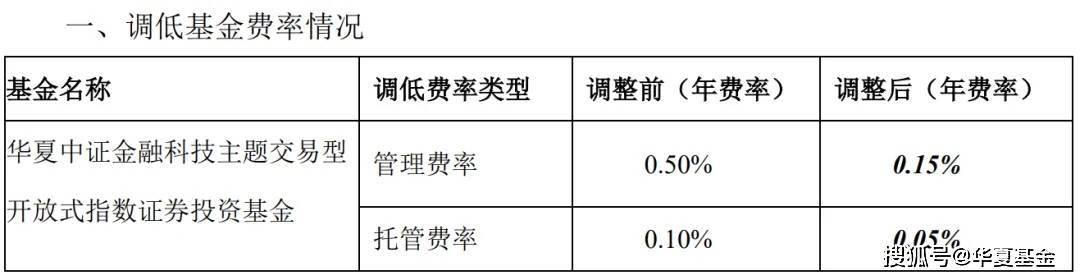
Core Viewpoint - Starting from January 22, 2026, the management fee rate and custody fee rate for the Financial Technology ETF Huaxia (516100) will be reduced, aiming to lower investment costs for investors and enhance their return experience [1][2]. Fee Rate Adjustments - The management fee rate will decrease from 0.50% to 0.15% (annual rate) [2] - The custody fee rate will decrease from 0.10% to 0.05% (annual rate) [2] - After this adjustment, the combined management and custody fees for the Financial Technology ETF Huaxia will be 0.20%, the lowest in its category [5][6]. Market Position - The fee reduction positions the Financial Technology ETF Huaxia and its linked fund at the lowest fee level among similar products in the market [2][5]. - Following this fee reduction, the number of low-fee ETFs managed by Huaxia Fund will reach 31, demonstrating a strong commitment to benefiting investors [7].

基金销售新规三大变化,如何影响竞争格局?
券商中国· 2026-01-05 01:48
Core Viewpoint - The new public fund sales regulations, effective from January 1, 2026, aim to benefit investors and encourage long-term holding, featuring significant changes in fee structures and redemption policies [1][2]. Summary by Sections Changes in Fee Structures - The maximum subscription and redemption fee rates for actively managed equity funds are reduced from 1.2% and 1.5% to 0.8%. For other mixed funds, the rates drop from 1.2% and 1.5% to 0.5%. Bond funds see a reduction from 0.6% and 0.8% to 0.3%. Index funds have a maximum fee rate of 0.3% [2]. - The annual sales service fee for equity and mixed funds decreases from 0.6% to 0.4%, while for index and bond funds, it drops from 0.4% to 0.2%. Money market funds see a reduction from 0.25% to 0.15% [2]. - The maintenance fee for individual clients remains at 50%, while for institutional clients, it is 30% for equity and drops from 30% to 15% for non-equity [2]. Redemption Policy Adjustments - The redemption policy for bond funds is relaxed, allowing individual investors to redeem without fees after holding for 7 days, while institutional investors can do so after 30 days [3]. - The rectification period for existing funds not compliant with the new fee structures is set to 12 months, providing more time compared to the previous 6-month or 12-month adjustments [3]. Impact on Distribution Channels - The new regulations significantly affect distribution channels, particularly for agents, as fee reductions will impact their income. Subscription and redemption fees for equity funds are reduced by one-third to one-half, and similar reductions apply to bond funds [4]. - Direct sales channels benefit from the elimination of subscription and sales service fees, potentially reducing the market share of distribution agencies [4]. Influence on Bond Fund Demand - The demand for bond funds may be more adversely affected than for equity funds due to the larger fee reductions and the nature of institutional investors. However, the risk of concentrated redemptions is considered manageable [6]. - The flexibility and cost-effectiveness of bond funds may diminish, leading to a slight decrease in demand, particularly from institutions with high liquidity requirements [6].
基民省钱攻略来了!这些基金手续费要降了
Di Yi Cai Jing Zi Xun· 2025-12-31 14:53
Core Viewpoint - The recent adjustment in public fund fee rates aims to lower the maximum sales fee rates for various types of funds, benefiting investors through reduced costs [1] Group 1: Fee Rate Adjustments - The maximum subscription fee rate for actively managed equity funds is reduced to 0.8% [1] - The maximum subscription fee rate for other mixed funds is lowered to 0.5% [1] - The maximum subscription fee rate for index funds and bond funds is capped at 0.3% [1] Group 2: Service Fee Rate Adjustments - The maximum service fee rate for equity and mixed funds is decreased to 0.4% per year [1] - The maximum service fee rate for index funds and bond funds is reduced to 0.2% per year [1] - The service fee rate for money market funds is lowered to 0.15% per year [1]
基金降费的涟漪,正波及整个生态链
Sou Hu Cai Jing· 2025-12-21 04:08
Core Viewpoint - The recent trend of fund fee reductions is causing significant disruptions across the entire ecosystem that relies on "management fee redistribution" [2] Group 1: Industry Dynamics - The departure of mid-to-back office personnel from an ETF indicates a shift in the competitive landscape of active equity public funds [2] - A head public fund recently received bids from over ten suppliers, highlighting increased competition in the market [2] - The internal conflict among chief analysts at a brokerage over coverage rights for a listed company reflects the intense competition and pressure within the industry [4][8] Group 2: Resource Competition - The term "coverage" refers to the territorial rights of analysts, and the dispute over it illustrates the underlying resource competition driven by financial incentives [8] - The phenomenon of "九子抢迪" (Nine Sons Competing for the Heir) symbolizes the resource competition across various industries, particularly in the context of year-end bonuses and income [9] - The analysis of the media industry reveals similar resource contention among financial journalists, drawing parallels to the struggles faced by analysts in brokerage firms [9] Group 3: Industry Trends and Challenges - The brokerage research sector is under pressure to transform due to declining fee rates, prompting a shift from traditional research to services for government and enterprises [8] - The historical phenomenon of high transfer fees for analysts in the New Fortune rankings indicates a competitive market for talent within the industry [8]


易方达丰华债券(A/C:000189/006867)公告降费
Mei Ri Jing Ji Xin Wen· 2025-12-16 02:12
Core Viewpoint - E Fund announced a reduction in management and custody fees for its E Fund Fenghua Bond Fund to better meet investor needs and lower investment costs, effective December 17 [1] Group 1: Fee Adjustments - The management fee will decrease from 0.8% per year to 0.6% per year [1] - The custody fee will decrease from 0.2% per year to 0.15% per year [1] - E Fund has already reduced management fees for nearly 10 products and custody fees for around 20 products this year, covering various asset types including multi-asset, fixed income, money market, index, and QDII [1] Group 2: Fund Performance - E Fund Fenghua Bond Fund (A/C: 000189/006867) is a medium-duration secondary bond fund aimed at achieving stable returns with lower drawdowns [1] - As of December 12, the fund's year-to-date return was 5.49% and 5.1%, outperforming its benchmark [1] - The maximum drawdown for the year was 2.19% and 2.25%, indicating a relatively stable overall performance [1]
中金:财富管理收入进入上行通道 明年需关注基金第三阶段降费影响
智通财经网· 2025-10-17 02:53
Group 1 - The core viewpoint is that wealth management institutions are expected to see rapid growth in large wealth income in the first half of 2025, driven by an increase in AUM growth rate and fee rate optimization [1] - In 1H25, large wealth income for sample banks, brokerages, and platform institutions grew by 11.4%, 21.4%, and 27.7% year-on-year, with revenue contribution ratios increasing for the first time in two years [1] - The growth in large wealth income is primarily attributed to wealth management business, contributing 98% of the incremental growth, driven by a recovering capital market, low interest rates prompting asset reallocation, and increased marketing of wealth products by institutions [1] Group 2 - As of the end of 1H25, retail AUM and wealth AUM for sample banks grew by 11.2% and 10.7% year-on-year, with growth rates accelerating compared to 2024 [2] - The average wealth management fee rate for five sample banks in 1H25 was 0.27%, an increase of 2 basis points from 2024, indicating a potential turning point in fee rates [2] Group 3 - The number and AUM of high-net-worth clients and brokerage clients are growing faster than the overall retail client base, indicating greater growth potential [3] - As of the end of 1H25, the number of retail clients for sample banks grew by 2.6% year-on-year, while the number of high-income private banking clients and brokerage clients grew by 14% and 11% respectively [3]
降费!余额宝,官宣!
Zheng Quan Shi Bao Wang· 2025-09-23 11:04
Core Points - Tianhong Fund announced a reduction in the custody fee for its Tianhong Yu'ebao money market fund from 0.08% to 0.07% effective September 23, 2023, alongside other funds reducing their management fees [1][2] - The public fund industry is experiencing a trend of fee reductions across various fund types, including money market funds, driven by declining yields and regulatory changes [3][4] - The average 7-day annualized yield for money market funds is currently 1.12%, with 22% of funds yielding below 1%, primarily due to pressure on underlying assets [5][6] Fee Reductions - Tianhong Yu'ebao's fee reduction is expected to save investors approximately 80 million yuan [2] - Other funds, such as E Fund's Margin Income and Guoxin Guozheng's Cash Increase, have also announced fee reductions, with management fees decreasing from 0.20% to 0.15% and from 0.30% to 0.20%, respectively [2] - The China Securities Regulatory Commission has proposed that the sales service fee for money market funds should not exceed 0.15% per year, prompting further fee reductions across the industry [3] Market Trends - Despite declining yields, money market funds have seen stable growth in scale, attributed to low entry barriers, low risk, and high liquidity, appealing to younger investors [6] - The asset allocation of money market funds is heavily weighted towards bonds (54%) and bank deposits (27%), making their yields closely tied to monetary policy and market interest rates [5]
降费!余额宝,官宣!
券商中国· 2025-09-23 10:57
Core Viewpoint - The public fund industry is experiencing a trend of fee reductions, with various funds announcing lower management and custody fees to enhance investor returns amid declining yields [2][5][6]. Fee Reductions - Tianhong Fund announced a reduction in the custody fee for its Tianhong Yu'ebao money market fund from 0.08% to 0.07% effective September 23 [1][3]. - Other funds, such as E Fund and Guoxin Guozheng, also reduced their management and custody fees, with E Fund lowering its management fee from 0.20% to 0.15% and custody fee from 0.08% to 0.05% [5]. - The overall trend in the public fund industry is towards lowering various fees, including management, sales service, and custody fees, to improve investor returns [2][5]. Market Context - Despite the fee reductions, a significant number of money market funds still maintain sales service fees at 0.25%, which could erode investor returns as yields decline [2][7]. - As of September 23, 271 out of 356 money market funds had sales service fees exceeding the regulatory cap of 0.15% [7]. - The average 7-day annualized yield for these funds is 1.12%, with 22% of the funds yielding below 1% [7]. Asset Allocation and Yield Trends - The decline in yields is attributed to the pressure on the underlying assets of money market funds, which primarily invest in bank deposits, bonds, and repurchase agreements [7]. - As of Q2 2025, the asset allocation of money market funds was 54% in bonds, 27% in bank deposits, and 18.6% in repurchase agreements, indicating a strong correlation between fund yields and market interest rates [7]. Growth in Money Market Funds - Despite declining yields, money market funds have seen consistent growth in scale, becoming a major contributor to the rise in public fund assets [8]. - Factors contributing to this growth include low entry barriers, low risk, high liquidity, and the integration of money market funds with shopping scenarios, appealing to younger investors [8].

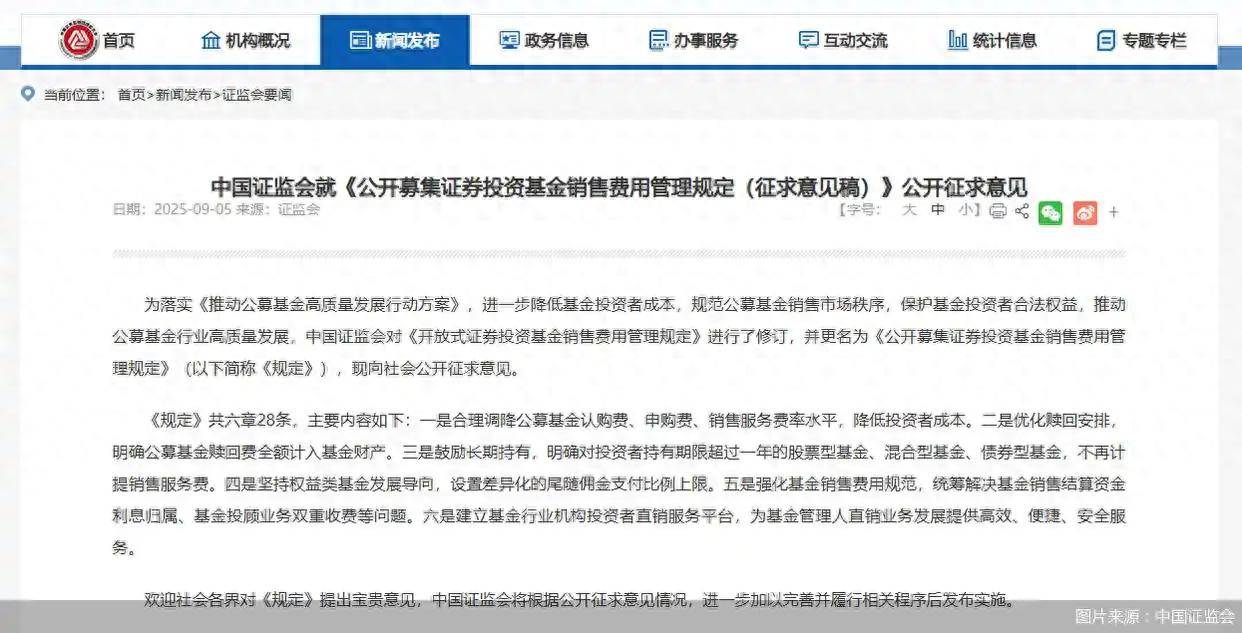
每年多赚500亿!证监会重磅新规落地,7亿基民迎来"降费大红包"
Sou Hu Cai Jing· 2025-09-10 11:44
Core Points - The China Securities Regulatory Commission (CSRC) has issued a significant document aimed at reducing various sales fees for public funds, which is expected to increase annual earnings for investors by over 50 billion yuan [1] Group 1: Impact on Fund Fees - The new regulations will lower sales service fees for public funds, with a specific example being the reduction of the sales service fee for money market funds like Yu'ebao from 0.25% to a maximum of 0.15%, potentially saving nearly 1.2 billion yuan annually for investors [2] - The new rule mandates a minimum redemption fee of 0.5% for any fund type if held for less than six months, which encourages long-term holding and reduces frequent trading [3][5] Group 2: Changes in Fund Investment Strategy - Investors are encouraged to choose A-share funds and hold them for over six months, as the new rules diminish the advantages of C-share funds for short-term investors [5] - Bond fund investors should be cautious, as the new regulations also apply to bond funds, which will now require a minimum holding period of six months to avoid redemption fees [5] Group 3: Market Dynamics and Competition - The new regulations are likely to exacerbate the trend of consolidation among public funds, as funds with shorter holding periods will see a shift towards A-share funds or ETFs, benefiting larger fund companies [5] - Sales service fee reductions may negatively impact fund distribution platforms that rely heavily on fund sales for revenue, prompting them to pivot towards providing advisory services instead [7]