
汽车电动化与智能化

Search documents
东芯股份预计2025年亏损扩大 存储盈利、GPU赛道投资亏损
Zheng Quan Shi Bao Wang· 2026-01-23 12:57
Core Insights - The company expects to expand its losses in 2025, with projected revenue of approximately 921 million yuan, a year-on-year increase of about 43.75% [1] - The storage segment has achieved profitability, while the company continues to invest heavily in the high-performance GPU sector, reporting an investment loss of 166 million yuan last year [1] Financial Performance - The company anticipates a net profit loss ranging from 214 million yuan to 174 million yuan in 2025, representing an increase in losses of 4.1% to 280.3 million yuan compared to the previous year [1] - The net profit loss after deducting non-recurring items was between 241 million yuan and 201 million yuan last year, with a slight increase in losses of 0.15% to 200.9 million yuan [1] Market Dynamics - The small-capacity storage chip market has benefited from an AI-driven industry upcycle, with improved supply-demand dynamics and steady product price recovery [1] - The company’s products are experiencing a structural growth in demand due to ongoing 5G base station construction, smart city upgrades, innovations in wearable devices, and the electrification and intelligence trends in the automotive industry [1] Technological Advancements - The company is focusing on the integration of storage, computing, and networking, maintaining high levels of R&D investment, with significant expenditures reported during the period [2] - In the storage segment, the company is solidifying its technological leadership in SLC NAND Flash, with 1xnm flash products achieving mass production and sales [2] - The company is also enhancing the reliability of its storage products, advancing the development and industrialization of automotive-grade storage products [2] Investment Strategy - In 2024, the company made a strategic investment of 200 million yuan in Lishuan Technology (Shanghai) Co., Ltd., which specializes in GPU chip design [3] - The first self-developed GPU chip, "7G100," successfully completed its first tape-out in 2025, with initial graphics cards delivered to customers [3] - The company plans to invest an additional 211 million yuan in 2025 to deepen its engagement in the high-performance GPU sector, with an expected investment loss of approximately 166 million yuan for the year [3] Market Performance - Since the press conference held by Lishuan Technology in July last year, the company's stock price has surged, with a cumulative increase of over 200%, and the latest market capitalization stands at 53.2 billion yuan [3]

趋势研判!2026年中国汽车雨刮器总成行业发展背景、产业链、销量、重点企业及未来趋势:汽车产量增长带动汽车雨刮器总成销量扩大[图]
Chan Ye Xin Xi Wang· 2026-01-23 01:20
Core Insights - The automotive wiper assembly market in China is directly linked to the automotive production volume, with a stable growth potential driven by the ongoing expansion of the automotive industry [1][9] - The sales volume of automotive wiper assemblies is projected to reach 46.33 million sets by 2027, reflecting a compound annual growth rate (CAGR) of 3.24% from 2024 [9] Industry Overview - The automotive wiper assembly is a critical component for removing rain, snow, and debris from vehicle windshields, ensuring driver visibility and safety [3][4] - The assembly can be categorized based on installation position (front and rear), motor control type (mechanical and electronic), blade type (with or without bones), and vehicle type (commercial and passenger vehicles) [3][4] Market Demand and Trends - In 2020, the sales volume of automotive wiper assemblies in China was 37.07 million sets, a decrease of 2.56% year-on-year due to the pandemic [9] - The market rebounded in 2021 with sales reaching 38.55 million sets, a 4% increase, and is expected to grow to 42.63 million sets in 2024 [9] - The automotive industry's steady development, along with trends in electrification and intelligence, is expected to drive product upgrades and replacement demand [9] Industry Chain - The upstream of the automotive wiper assembly industry includes raw materials and components such as steel, aluminum, and electronic components, which significantly impact production costs [6] - The midstream involves the manufacturing of wiper assemblies, while the downstream is focused on vehicle manufacturing and end consumers [6] Competitive Landscape - The Chinese automotive parts industry has historically lagged behind foreign competitors, but domestic suppliers are improving in technology and market share [11] - Key players in the automotive wiper assembly market include Zhejiang Shenghua Bo Electric Co., Ltd., Bosch, Valeo, Denso, and others [11][12] Challenges and Opportunities - The industry faces challenges such as technological gaps with foreign firms, increased competition from foreign entrants, and the need for improved automation in production [15] - However, the growth of the automotive market and supportive government policies present significant opportunities for the wiper assembly sector [15] Future Development Trends - Lightweight materials and structural optimization are expected to reduce the weight of wiper assemblies, enhancing vehicle efficiency [16] - The integration of smart technologies will allow wiper systems to autonomously adjust based on environmental conditions, improving safety and user experience [16] - High-performance requirements will focus on reliability and noise reduction under extreme conditions, with advancements in materials and design [17]


徕木股份:2025年预亏1亿元至1.5亿元
Ge Long Hui· 2026-01-19 08:51
Core Viewpoint - The company, Lai Mu Co., Ltd. (603633.SH), is expected to report a significant net loss for the fiscal year 2025, with projected losses ranging from 150 million to 100 million yuan, indicating a downturn compared to the previous year [1] Financial Performance - The anticipated net profit attributable to the parent company for 2025 is projected to be between -150 million and -100 million yuan, reflecting a loss compared to the previous year's statutory disclosure [1] - The expected operating loss for the company in 2025 is estimated to be between -50 million and -30 million yuan [1] Reasons for Performance Decline - The primary reasons for the expected loss include: 1. The global automotive industry is undergoing a deep transformation towards electrification and intelligence, leading to tightened pricing strategies by manufacturers, which has resulted in price reductions for some products [1] 2. The prices of key raw materials, particularly copper, have reached historical highs during the reporting period, further increasing production costs [1] - Additionally, the rapid changes in market conditions and product updates have led to signs of impairment in certain inventories and fixed assets, prompting the company to make impairment provisions, which are expected to impact profits by approximately -100 million to -70 million yuan [1]

香港汽车ETF(520720)涨超0.6%,政策与转型前景引市场关注
Mei Ri Jing Ji Xin Wen· 2026-01-09 07:01
Group 1 - The Hong Kong Automotive ETF (520720) rose over 0.6% on January 9, driven by market attention on policies and transformation prospects [1] - Guohai Securities noted that the "Two New" policy will continue to implement subsidies for vehicle scrapping and replacement updates in 2026, adjusting fixed subsidies to be proportional to vehicle prices, with new energy passenger vehicle scrapping subsidies reaching 12% of the vehicle price (up to 20,000 yuan) and replacement subsidies at 8% (up to 15,000 yuan) [1] - The Ministry of Industry and Information Technology and three other departments jointly issued the "Implementation Plan for Digital Transformation of the Automotive Industry," aiming for deep application of digital technologies by 2027 and a high level of overall digitalization in the industry by 2030 [1] Group 2 - The year-on-year growth rate of passenger vehicles may decline by the end of 2025, but the high-end market is expected to perform relatively better in 2026 amid expectations of policy tapering, with a positive outlook on the high-end breakthrough of independent brands [1] - The Hong Kong Automotive ETF (520720) tracks the Hong Kong Stock Connect Automotive Index (931239), which selects listed companies involved in vehicle manufacturing and related industries within the Stock Connect scope, covering electric passenger vehicles and intelligent driving [1] - This index focuses on the automotive sector, reflecting the development trends of electrification and intelligence in the industry, thereby representing the overall performance of listed companies related to the automotive industry [1]
天龙股份拟2.32亿控股苏州豪米波 业绩稳健跨界布局智能驾驶赛道
Chang Jiang Shang Bao· 2026-01-06 23:51
Core Viewpoint - Tianlong Co., Ltd. is making a significant strategic shift from a traditional automotive parts supplier to an intelligent perception integrator by acquiring a controlling stake in Suzhou Haomibo Technology Co., Ltd. for 232 million yuan [1][2]. Group 1: Acquisition Details - Tianlong plans to acquire 54.87% of Suzhou Haomibo through a combination of equity transfer and capital increase, with a total investment of 232 million yuan [1][2]. - The acquisition consists of two parts: 131.84 million yuan for acquiring 32.2998% equity from seven shareholders and 100 million yuan for capital increase to subscribe to the new registered capital of 7.608 million yuan [2]. - The deal includes performance-based clauses, requiring Suzhou Haomibo to achieve a cumulative revenue of 1.2 billion yuan and a net profit of 48 million yuan from 2026 to 2029 [2]. Group 2: Company Performance - Tianlong's financial performance remains robust, with a revenue of 947 million yuan and a net profit of 82.7036 million yuan for the first three quarters of 2025 [4]. - In Q3 2025, the company reported a revenue of 333 million yuan, a year-on-year increase of 2.03%, and a net profit of 26.1814 million yuan, up 6.31% [4]. - The company's net profit excluding non-recurring items grew by 21.56%, indicating strong resilience in its core business [4]. Group 3: Suzhou Haomibo's Growth - Suzhou Haomibo, established in 2016, focuses on R&D in intelligent perception devices, including 4D millimeter-wave radar and UWB sensors [2]. - The company has shown rapid revenue growth, achieving 33.7945 million yuan in revenue for the first three quarters of 2025, a staggering increase of 288.64% compared to the entire year of 2024 [3]. - With the increasing penetration of intelligent driving technology and the gradual mass production of projects, Suzhou Haomibo's operational performance is expected to continue improving [3]. Group 4: Market Outlook - The acquisition positions Tianlong to leverage Suzhou Haomibo's technological expertise in intelligent perception to enter high-growth sectors such as intelligent driving, low-altitude flight, smart transportation, and robotics [5]. - The market for 4D millimeter-wave radar is projected to experience explosive growth, with the Chinese market expected to reach 12.8 billion yuan in 2024 and 37 billion yuan by 2030, reflecting a compound annual growth rate of 20% [5].

飞度月销“归零” 新款车型如何力挽狂澜?
Xi Niu Cai Jing· 2025-12-24 02:23
Core Insights - The sales of Honda Fit (飞度) have dropped to zero in November, highlighting a significant decline in the small car market [2][3] - The Fit was once a market leader in Japan and China, known for its innovative design and affordability, but has struggled in recent years due to market changes and competition from electric vehicles [2][3] Historical Performance - The Honda Fit was launched in 2001 and quickly gained popularity, selling 200,000 units within a year and winning the "2001 Japan Car of the Year" award [2] - The third generation, launched in 2014, was particularly successful, with sales reaching 26,098 units in just three months and becoming the best-selling A0 class hatchback in July 2015 with a year-on-year increase of 177.5% [2] Market Trends - The A0 class sedan market has been shrinking, with sales dropping to 439,000 units in 2020, a 33.9% decline year-on-year, and market share falling to 2.3% [3] - The fourth generation Fit, launched in 2020, saw sales decline to 62,600 units, further impacted by chip shortages and competition from electric vehicles like BYD Dolphin and Geely Starwish [3] Future Outlook - Despite the challenges, GAC Honda has plans to launch a new version of the Fit in Q1 2026, featuring a new design and retaining the 1.5L naturally aspirated engine with CVT [3] - The new Fit will have increased dimensions and updated interior features, including a 10.1-inch central control screen with support for various smartphone connectivity options [3] Industry Context - The decline of the Fit reflects broader changes in the automotive industry, where traditional fuel-efficient small cars are losing ground to electric and smart vehicles [4] - The upcoming model will need to enhance its smart features to remain competitive in the evolving market landscape dominated by electric vehicles [4]

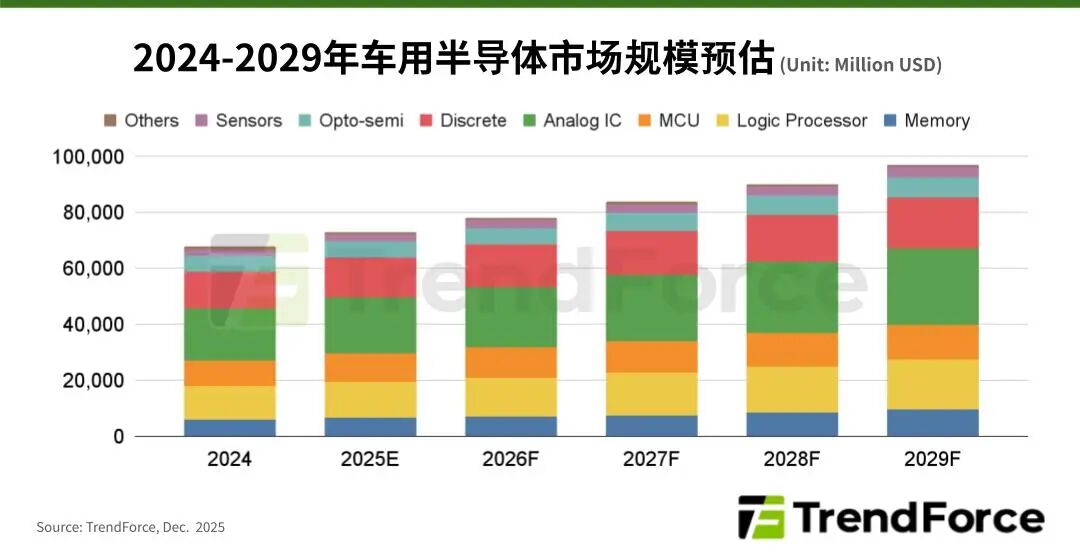
每周观察 | 预估2029年车用半导体市场规模达近千亿美元;HBM3e和DDR5的平均销售价格;全球Micro LED AR眼镜
TrendForce集邦· 2025-12-20 02:05
Group 1 - The core viewpoint of the article highlights the acceleration of electric and intelligent vehicle development, predicting that the global automotive semiconductor market will grow from approximately $67.7 billion in 2024 to nearly $96.9 billion by 2029, with a compound annual growth rate (CAGR) of 7.4% from 2024 to 2029 [2] Group 2 - The article discusses the recent surge in demand for conventional DRAM, leading to a rapid increase in prices, while also noting that the average selling price (ASP) gap between HBM3e and DDR5 is expected to narrow in the coming year [5] - It mentions that PlayNitride will acquire 100% of Lumiode Inc. for $2 million, which will enhance its technology and patent portfolio, as well as expand its customer base and sales channels in North America, thereby increasing its international competitiveness in near-eye displays and medical applications [6]

集邦咨询:汽车电动化与智能化加速 预估2029年车用半导体市场规模达近千亿美元
Zhi Tong Cai Jing· 2025-12-17 09:28
Group 1 - The growth in the automotive chip market is uneven, with high-performance computing (HPC) chips like logic processors and high-end memory significantly outpacing traditional components like microcontrollers (MCUs), indicating a market shift towards core technologies that support smart and electric vehicles [2] - TrendForce forecasts that by 2025, the penetration rate of electric vehicles (including BEV, PHEV, FCV, HEV) in the new car market will rise to 29.5%, necessitating advancements in electronic and electrical architecture (E/E Architecture) from decentralized to centralized systems, driven by the increasing demand for computational power from multi-sensor configurations and AI models [2] - The integration of various functions such as body control, remote processing, smart driving, and smart cockpit by automakers is crucial, with chip manufacturers playing a significant role in this process [3] Group 2 - The competition among chip manufacturers is intensifying, with companies like NVIDIA and Qualcomm leveraging their high-performance chips and extensive software-hardware ecosystems to penetrate the automotive smart technology sector [4] - Chinese companies like Horizon Robotics are rapidly emerging due to technological advancements, domestic policies, and high demand for intelligent solutions, posing challenges to traditional automotive chip manufacturers [4] - Traditional automotive chip manufacturers still hold advantages due to their broad product portfolios, reliability, and strong customer relationships, which are essential for competing against new entrants [4]
天龙股份前三季度业绩稳定 积极培育增长新动力
Zheng Quan Ri Bao Wang· 2025-10-31 13:09
Core Viewpoint - Ningbo Tianlong Electronics Co., Ltd. reported stable performance in the first three quarters of 2025, with a revenue of 947 million yuan and a net profit of 82.7036 million yuan, indicating a positive growth trajectory in the automotive electronics sector [1][2] Financial Performance - The company achieved a revenue of 333 million yuan in the third quarter, representing a year-on-year growth of 2.03% [1] - The net profit attributable to shareholders in the third quarter was 26.1814 million yuan, showing a year-on-year increase of 6.31% [1] - The net profit excluding non-recurring gains and losses was 27.3671 million yuan, reflecting a year-on-year growth of 21.56% [1] Business Focus and Development - Tianlong focuses on precision manufacturing, providing integrated solutions in precision molds, injection molding, stamping, and assembly [1] - The company is actively enhancing its market development and R&D investment, aiming to improve management practices [1] - The strategic focus is on automotive electronics and lightweight business, driven by the rapid development of electric and intelligent vehicles [1] Product Development and Market Expansion - The company has successfully developed multiple specifications of fisheye terminal connectors and is expanding into precision automotive electronics and other emerging markets [2] - Tianlong has secured important project designations from leading international clients for next-generation IGBT modules, headlight assemblies, front-end modules, and integrated liquid cooling plates [2] - New products such as fisheye terminal connectors, battery distribution units (BDUs), front-end modules, and integrated liquid cooling plates have achieved significant business breakthroughs [2]
战略性并购开启新纪元:新莱福整合金南磁材,构筑功能材料产业新高地
Quan Jing Wang· 2025-10-15 09:23
Core Viewpoint - Guangzhou Xinlaifu New Materials Co., Ltd. is strategically expanding from the consumer functional materials sector into the broader industrial magnetic materials and precision components market through the acquisition of 100% equity in Guangzhou Jinnan Magnetic Materials Co., Ltd. for a total consideration of 1.054 billion yuan, marking its first major asset restructuring since going public [1] Group 1: Strategic Value and Synergy - The acquisition is expected to create significant synergies between Xinlaifu and Jinnan Magnetic, enhancing Xinlaifu's core competitiveness through deep collaboration in technology and research platforms [2] - Xinlaifu's research focuses on micro-nano functional powders, while Jinnan Magnetic specializes in industrial component production processes, allowing for a complete research chain from basic research to product application post-merger [2] Group 2: Product and Market Complementarity - The merger will enable Xinlaifu to transition from consumer markets to industrial markets, creating a dual-engine drive model that enhances resilience against market fluctuations and smooths performance volatility [3] - Both companies will share customer resources and sales channels, with Xinlaifu leveraging Jinnan Magnetic's industrial technology to enter high-end markets, while Jinnan Magnetic benefits from Xinlaifu's established global distribution network [3] Group 3: Industry Outlook and Market Expansion - The global magnetic materials industry is rapidly evolving towards high performance, lightweight, miniaturization, and low loss, driven by increasing demands from sectors like renewable energy and AI [4] - The demand for high-performance products, such as those produced by Jinnan Magnetic, is surging, particularly in the electric vehicle sector, where performance and reliability are critical [4][5] Group 4: Policy Support and Strategic Alignment - Current national policies are creating a favorable environment for the development of new materials and high-end manufacturing, aligning with Xinlaifu's strategic acquisition [7] - The acquisition is seen as a well-considered move that goes beyond mere scale, aiming for value reconstruction based on deep industry logic, thereby establishing a comprehensive competitive advantage [7]