
油运大时代

Search documents
—交通运输行业周报(2026年3月23日-2026年3月29日):地缘对油运影响深化,快递全面提价开启-20260330
Hua Yuan Zheng Quan· 2026-03-30 06:41
Investment Rating - The investment rating for the transportation industry is "Positive" (maintained) [4] Core Views - The current demand in the e-commerce express delivery sector remains resilient, and the "anti-involution" trend is driving up express prices, which releases profit elasticity for companies, indicating a favorable long-term competitive opportunity for the e-commerce express delivery sector [15] - The shipping sector is expected to benefit from the continuous increase in crude oil production and tight capacity, with geopolitical changes potentially catalyzing market sentiment and fundamentals [15] - The aviation sector may see significant elasticity in performance if passenger turnover and ticket price growth continue, providing a buffer against high oil prices [15] Industry Dynamics Tracking Shipping and Ports - The Iranian Revolutionary Guard announced the closure of the Strait of Hormuz, impacting shipping routes and increasing operational requirements for vessels passing through [4] - The SCFI composite freight index increased by 7.0% week-on-week, reaching 1827 points, with notable increases in Shanghai to the US West Coast and East Coast [6] - The BDTI index for VLCC freight rates rose by 23.07% week-on-week, indicating a strong upward trend in oil transportation rates [7] Express Logistics - Express companies in Hunan have announced price increases due to rising operational costs from fuel price hikes [10] - The Guangdong Provincial Express Delivery Regulations were passed to promote high-quality development in the express delivery industry [10] - The express delivery sector's business volume reached 30.49 billion pieces in January-February 2026, a year-on-year increase of 7.1% [26] Aviation and Airports - China Eastern Airlines announced the purchase of 101 Airbus A320neo series aircraft, with deliveries planned from 2028 to 2032 [12][13] - The aviation sector is facing potential flight reductions due to fuel shortages caused by Middle Eastern conflicts [13] Road and Rail - National logistics operations are running smoothly, with rail freight volume at 80.31 million tons, a week-on-week decrease of 1.66% [14] - Deep Highway reported a slight increase in net profit for 2025, with total revenue of 9.264 billion yuan, a year-on-year increase of 0.20% [14] Port Performance - China's port cargo throughput reached 25.824 million tons from March 16 to March 22, 2026, a week-on-week increase of 0.81% [9][78]
中远海能(600026):25年报点评:Q4业绩验证周期上行,看好油运大时代:中远海能(600026.SH)
Hua Yuan Zheng Quan· 2026-03-29 12:02
Investment Rating - The investment rating for the company is "Buy" (maintained) [5] Core Views - The report highlights that the company's Q4 performance validates an upward cycle, with optimism surrounding the "oil transportation era" [5] - The VLCC (Very Large Crude Carrier) freight rates have been rising since August, driven by increased demand due to OPEC+ lifting voluntary production cuts and a tight supply-demand balance in the oil transportation market [7] - The report anticipates a significant improvement in the oil transportation market in 2026, with VLCC TCE (Time Charter Equivalent) rates expected to reach an average of $102,000 per day in the first two months of 2026, a year-on-year increase of 150.8% [7] Financial Performance Summary - For the year 2025, the company achieved operating revenue of 238.92 billion yuan, a year-on-year increase of 2.68%, and a net profit attributable to shareholders of 4.037 billion yuan, a slight decline of 0.11% [7] - The report projects the company's net profit for 2026-2028 to be 10.947 billion yuan, 13.899 billion yuan, and 16.592 billion yuan respectively, with growth rates of 171.15%, 26.96%, and 19.37% [7] - The company's P/E ratios for the years 2026, 2027, and 2028 are projected to be 11.83, 9.32, and 7.80 respectively, indicating a favorable valuation outlook [7][8]
交通运输行业周报(2026年3月16日-2026年3月22日):重申油运战略价值,快递反内卷再深化-20260323
Hua Yuan Zheng Quan· 2026-03-23 08:25
Investment Rating - The investment rating for the transportation industry is "Positive" (maintained) [4] Core Views - The current demand in the e-commerce express delivery industry remains resilient, with a top-down "anti-involution" policy driving up express prices, thereby releasing profit elasticity for companies. The long-term outlook for e-commerce express delivery is favorable due to healthy competition opportunities [16] - The oil transportation sector is expected to benefit from sustained crude oil production and tight capacity, with the "Changjin factor" reshaping pricing logic. Geopolitical changes may continue to catalyze sentiment or fundamentals, leading to a significant improvement in the oil transportation market in 2026 [16] - The bulk shipping market is anticipated to recover, driven by environmental regulations limiting the operation of aging fleets and increased production of iron ore from Australia, Brazil, and West Africa. The market is expected to enter a "new cycle" [16] - The shipping industry is experiencing a green renewal cycle, with demand driven by shipping market recovery and progress in green updates. The new shipbuilding market is expected to improve as constraints ease [16] Summary by Sections Shipping and Ports - Iran may establish a "safe passage" in the Strait of Hormuz, with multiple countries negotiating with Tehran for ship passage. However, security experts warn of potential delays or seizures by Iranian forces [4] - MSC Group has acquired a 50% stake in Changjin Shipping, supporting aggressive expansion of its VLCC fleet, which is estimated to control 150 VLCCs, significantly impacting market concentration and pricing [5] - The SCFI composite freight index decreased by 0.2% to 1707 points, with varying changes in freight rates across different routes [6] - The BDTI index for VLCC freight rates increased by 0.26% to 2821 points, while TCE rates for VLCCs decreased by 5.9% [7] - The BDI index for bulk carriers increased by 3.2% to 2046 points, indicating a rise in bulk shipping rates [8] - China's port cargo throughput increased by 9.52% to 25.617 million tons, with container throughput rising by 9.27% to 6.6 million TEU [10] Express Logistics - In January-February 2026, the express delivery industry volume grew by 7.1% year-on-year, with significant differentiation in market share among major players [9] - Zhongtong Express reported a stable net profit per ticket and committed to a shareholder return rate of no less than 50% [10] - Shentong plans to issue 3 billion yuan in convertible bonds for logistics network upgrades, with a commitment to distribute at least 30% of profits in cash over the next three years [11] - Price adjustments have been made in Yunnan and Jiangxi provinces, reflecting rising operational costs [12] Aviation and Airports - China and Thailand have suspended aviation fuel exports, potentially leading to fuel shortages for airlines [14] - The Ministry of Commerce has announced measures to promote travel service exports and expand inbound consumption [14] Road and Rail - From March 9 to March 15, 2026, national freight logistics operated smoothly, with rail freight increasing by 6.7% and highway truck traffic rising by 14.75% [15]


交通运输行业周报(2026年3月9日-2026年3月15日):地缘支撑油运运价高位,多地上调快递价格-20260316
Hua Yuan Zheng Quan· 2026-03-16 12:30
Investment Rating - The investment rating for the transportation industry is "Positive" (maintained) [4] Core Views - The current demand in the e-commerce express delivery industry remains resilient, with a top-down "anti-involution" approach driving up express prices, which releases profit elasticity for companies, indicating a favorable competitive opportunity in the medium to long term [13] - The oil transportation sector is expected to benefit from sustained crude oil production and tight capacity, with geopolitical changes potentially continuing to catalyze sentiment or fundamentals, leading to a significant improvement in the oil transportation market in 2026 [13] - The shipping market is anticipated to recover, driven by environmental regulations limiting the operation of older fleets and the continuous increase in iron ore production from Australia, Brazil, and West Africa [13] Summary by Sections Shipping and Ports - The Middle East oil transportation channels are disrupted, leading to the use of alternative pipelines by Saudi Arabia and the UAE, which could provide substantial long-distance cargo volumes for oil transportation [4] - The SCFI composite freight index increased by 14.9% week-on-week, with significant increases in freight rates for various routes [4] - The BDI index decreased by 8.8% week-on-week, indicating a decline in bulk shipping rates [6][12] Express Logistics - Major express companies in Sichuan province have raised shipping prices to cope with rising operational costs and to respond to the industry's call for rational pricing [8] - The national express delivery volume is expected to grow by approximately 7.5% year-on-year for January and February, with a steady increase in business volume and revenue [9] Aviation - During the 2026 Spring Festival travel season, civil aviation transported 94.39 million passengers, a year-on-year increase of 4.6% [10] - The ongoing geopolitical situation has led to rising fuel costs for airlines, prompting several companies to increase passenger fuel surcharges and ticket prices [11] Road and Rail - National railway freight volume increased by 6.16% week-on-week, while highway freight traffic saw a significant rise of 40.64% [12] - The revenue from the Gansu-Guangdong Expressway in February 2026 was 348 million yuan, reflecting a year-on-year growth of 10.2% [12] Port Operations - The total cargo throughput at Chinese ports decreased by 0.42% week-on-week, while container throughput increased by 1.44% [10][12]
运力紧张推升油轮运费 全球油轮费率续创六年新高丨A股明日线索
2 1 Shi Ji Jing Ji Bao Dao· 2026-02-26 11:22
Group 1: Oil Shipping Industry - The recent tensions between the US and Iran have led to a significant increase in daily rental rates for Very Large Crude Carriers (VLCC), surpassing $200,000 per day, marking a new high since 2020 [1] - The increase in oil shipping costs is attributed to a rise in crude oil exports from the Middle East as traders seek to secure shipping capacity before potential conflicts [1] - Huayuan Securities predicts that the strong performance of VLCC rates in Q1 2026 will be driven by favorable trends in fundamentals, supply-side restructuring, and geopolitical changes, suggesting a prolonged "oil shipping boom" [1] Group 2: Smartphone Industry - The Chinese smartphone market is expected to experience a comprehensive price increase starting in March 2026, marking the first time multiple brands and categories will raise prices simultaneously [2] - New smartphone models released after March are anticipated to see price hikes of over 1,000 yuan, with high-end flagship models potentially increasing by 2,000 to 3,000 yuan compared to previous generations [2] - The price increases are driven by a sustained rise in upstream component costs, particularly storage chips, which have seen an over 80% increase in procurement costs compared to the previous year [2] Group 3: Semiconductor Industry - The demand for storage components is being driven by AI, with TrendForce forecasting a 144% increase in DRAM market value to $404.3 billion and a 112% increase in NAND Flash value to $147.3 billion by 2026 [3] - The semiconductor sector is experiencing a broader price increase for passive components, with major manufacturers like Murata discussing price hikes for MLCCs due to rising raw material costs and increased demand from AI and automotive sectors [4] Group 4: AI and Cooling Technology - Akash Systems has delivered the first commercial AI servers utilizing Diamond Cooling technology to NxtGen AI, marking a significant innovation in the AI chip market [6] - The potential market for diamond cooling solutions in AI chips is estimated to range from 7.5 billion to 150 billion yuan by 2030, depending on the penetration rates of this technology [6] Group 5: Commercial Space Industry - The commercial space sector is seeing renewed interest with the upcoming launch of the recoverable liquid rocket "Li Jian No. 2" by China Aerospace, scheduled for late March [7] - The company plans multiple launches throughout the year, including satellite internet deployment and significant national missions, reinforcing its position in the commercial launch market [7][9]

中远海能股价持续上扬,油轮现货运价飙升至近六年新高,机构:本轮“油运大时代”的高度与持续性有望超预期
Zhi Tong Cai Jing· 2026-02-25 02:30
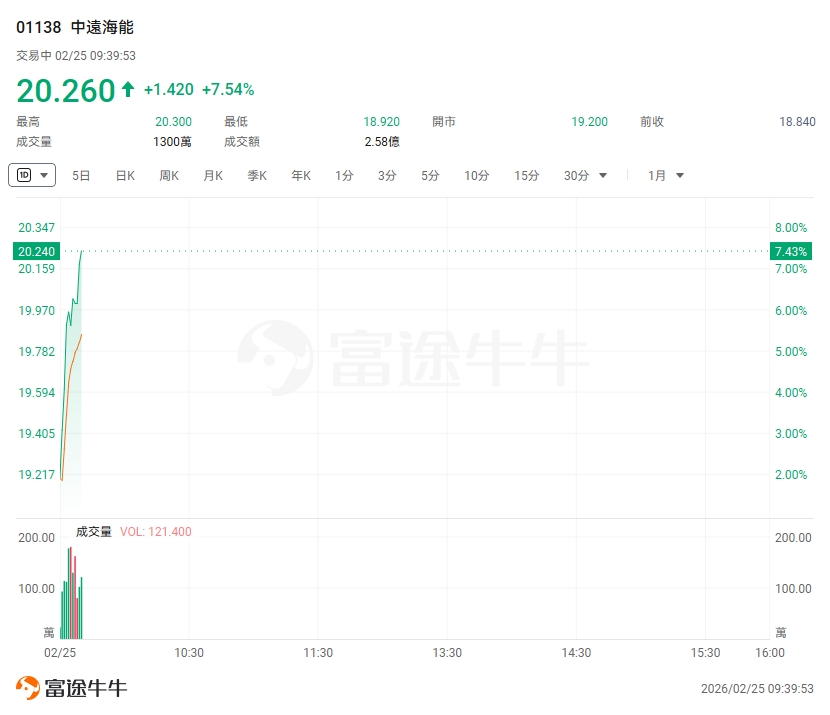
Group 1 - The stock price has surged over 7%, reaching a new high for the year at 20.26 HKD, with a trading volume of 258 million HKD [1] - A-share market has hit the daily limit up [1] Group 2 - The spot freight rates for oil tankers have soared to a nearly six-year high, with the cost of chartering a Very Large Crude Carrier (VLCC) from the Middle East to China exceeding 170,000 USD per day, a threefold increase since the beginning of the year [4] - Factors contributing to the price surge include the ongoing US-Iran tensions, changes in global oil supply trends, and significant ship orders from South Korean shipping companies [4] - Huayuan Securities indicates that the fundamentals of oil transportation are continuously improving, and with the "Changjin factor" and geopolitical changes, an "oil transportation boom era" is expected to emerge [4] - The strong performance of VLCC rates in Q1 2026 is anticipated to be driven by favorable trends in fundamentals, supply-side restructuring, and geopolitical changes, with the potential for this "oil transportation boom era" to exceed expectations in terms of height and sustainability [4]
港股异动 | 中远海能(01138)涨超6% 油轮现货运价飙升至近六年新高
智通财经网· 2026-02-25 01:40
Core Viewpoint - The surge in spot freight rates for oil tankers has reached a nearly six-year high, significantly benefiting companies like China Cosco Shipping Energy Transportation Co., Ltd. (中远海能) [1] Group 1: Market Performance - China Cosco Shipping Energy's stock rose over 6%, specifically by 6.16%, reaching HKD 20, with a trading volume of HKD 1.89 billion [1] Group 2: Freight Rate Trends - The latest data indicates that the cost of chartering a Very Large Crude Carrier (VLCC) to transport Middle Eastern crude oil to China has exceeded USD 170,000 per day, tripling since the beginning of the year [1] - Factors contributing to the price surge include geopolitical tensions, particularly between the U.S. and Iran, changes in global crude oil supply trends, and significant ship orders from South Korean shipping companies [1] Group 3: Industry Outlook - Huayuan Securities suggests that the fundamentals of oil transportation are improving, and with the "Long Jin factor" and geopolitical changes, a "big era of oil transportation" is anticipated [1] - The strong performance of VLCC rates in Q1 2026 is expected to be driven by favorable trends in fundamentals, supply-side restructuring, and geopolitical changes, with the potential for this "big era" to exceed expectations [1]
VLCC运价春节大涨,期租租金创历史新高
Zhong Guo Neng Yuan Wang· 2026-02-24 11:13
Group 1 - VLCC freight rates surged during the 2026 Spring Festival, with rates for the Middle East, West Africa/Latin America, and the Gulf of Mexico reaching $157,000, $137,000, and $101,000 per day respectively, marking increases of 28.5%, 28.7%, and 8.7% compared to February 13, and surpassing the highest levels seen in November 2025, reaching the highest since April 2020 [1][2] - The one-year time charter rate for VLCCs rose to $93,000 per day on February 20, a 28.5% increase from February 13, setting a historical high since 1988 [1][2] - The influence of "Changjin factors" is becoming evident in the market pricing, with VLCC rates experiencing significant increases, particularly noted on February 17 when the West Africa/Middle East route exceeded $120,000 per day, with two of the three transactions involving Changjin-operated vessels [2] Group 2 - The ongoing strengthening of VLCC freight rates is expected to lead to a historical high average for Q1 2026, with the Middle East route's average projected to reach $131,000 per day, significantly exceeding the previous best Q1 performance of $92,000 per day in 2008 [3] - The oil shipping fundamentals are improving, driven by the "Changjin factors" and geopolitical changes, suggesting the onset of a "great era of oil shipping" [4] - Companies such as China Merchants Energy Shipping Company, COSCO Shipping Energy Transportation, and China Merchants Jinling Shipyard are recommended for attention due to the favorable market conditions [4]
VLCC运价春节大涨,期租租金创历史新高 | 投研报告
Zhong Guo Neng Yuan Wang· 2026-02-24 02:09
Group 1 - VLCC freight rates surged during the 2026 Spring Festival, with rates for the Middle East, West Africa/Latin America, and the US Gulf routes reaching $157,000, $137,000, and $101,000 per day respectively, marking increases of 28.5%, 28.7%, and 8.7% compared to February 13, and surpassing the highest levels seen in November 2025, reaching the highest since April 2020 [1] - The one-year time charter rate for VLCCs rose to $93,000 per day, a 28.5% increase from February 13, achieving the highest level since 1988 [1] - The "Changjin factor" is significantly influencing VLCC pricing, with the company controlling 120-130 VLCCs impacting market pricing through effective supply-side management [2] Group 2 - VLCC freight futures (FFA) have also strengthened, with the Middle East route priced at an average of $147,000 per day for February and $169,000 for March, indicating a potential average of $131,000 per day for Q1 2026, which would exceed the historical best Q1 performance of $92,000 per day in 2008 [3] - The oil shipping sector is expected to enter a "big era" driven by favorable fundamentals, the "Changjin factor," and geopolitical changes, with VLCC rates in Q1 2026 likely to perform strongly due to these three positive trends [3] - Companies such as China Merchants Energy Shipping, COSCO Shipping Energy Transportation, and China Merchants Jinling Shipyard are recommended for attention in this evolving market [3]
华源证券:长锦商船重金押注VLCC 有望重塑定价逻辑
智通财经网· 2026-02-09 07:50
Core Viewpoint - Sinokor (长锦商船) plans to sell all its container ships to Mediterranean Shipping Company (MSC) for approximately $2.5 billion to $3 billion, reallocating funds to the VLCC sector to rapidly expand capacity through "second-hand acquisitions and long-term leases" [1][2] Group 1: Company Strategy - Sinokor aims to exit the container shipping market and heavily invest in VLCC, which is expected to support asset prices and time-charter rates [2] - The company is acquiring second-hand VLCCs at prices 10%-15% above mainstream valuations, with plans to purchase at least 39 second-hand VLCCs by January 2026 [2] - Sinokor is also extending existing charter agreements and entering new leasing contracts with major shipowners [2] Group 2: Market Impact - Sinokor's aggressive expansion is likely to increase industry concentration and reshape pricing logic in the VLCC market [3] - By early 2025, Sinokor and Trafigura may control over 100 VLCCs, representing about 12% of the market share, with actual control potentially reaching 120-130 VLCCs, accounting for 25% of the compliant spot market fleet [3] - The VLCC market is highly sensitive to supply-side disruptions, as evidenced by a significant price spike following sanctions on a major oil transport company [4] Group 3: Long-term Outlook - The VLCC supply side is expected to face challenges, with a significant portion of the fleet aging and new deliveries insufficient to meet replacement needs, which may support market conditions in the long term [5] - The current VLCC fleet has 33.8% of its capacity delivered between 2006-2012, which will start reaching 20 years of age in 2026, leading to potential supply shortages [5] Group 4: Investment Recommendations - The fundamentals of oil transportation are improving, and geopolitical changes may catalyze a "big era" for oil shipping [6] - Sinokor's focus on VLCC is expected to stabilize and elevate VLCC freight rates, with recommendations to pay attention to companies like China Merchants Energy Shipping (601872.SH), COSCO Shipping Energy Transportation (600026.SH, 01138), and China Merchants Jinling Shipyard (601975.SH) [6]