生产指数

Search documents
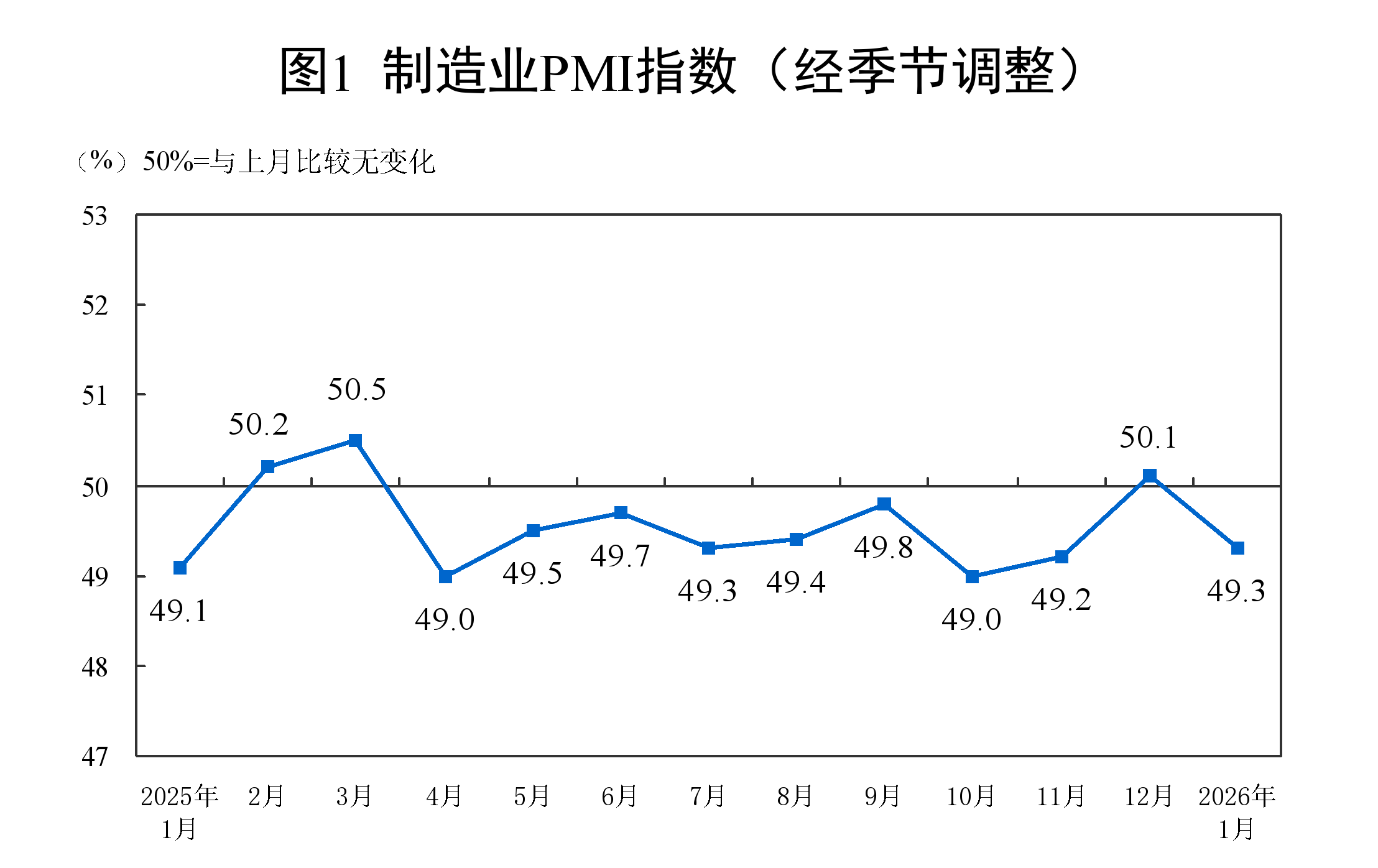
1月份制造业PMI为49.3%
Ren Min Ri Bao Hai Wai Ban· 2026-02-02 01:48
Group 1 - The manufacturing Purchasing Managers' Index (PMI) for January is 49.3%, a decrease of 0.8 percentage points from the previous month, indicating a decline in manufacturing activity due to seasonal factors and insufficient market demand [2] - The production index stands at 50.6%, indicating continued expansion in manufacturing production, while the new orders index is at 49.2%, reflecting a drop in market demand [2] - Certain industries such as agricultural processing and aerospace have production and new orders indices above 56.0%, indicating strong demand, while sectors like petroleum and automotive show indices below the critical point, suggesting a slowdown in market demand [2] Group 2 - The main raw materials purchasing price index and the factory price index are at 56.1% and 50.6%, respectively, both showing increases from the previous month, with the factory price index rising above the critical point for the first time in nearly 20 months [3] - Large enterprises maintain a PMI of 50.3%, indicating continued expansion, while medium and small enterprises show PMIs of 48.7% and 47.4%, reflecting a decline in their economic performance [3] - High-tech manufacturing leads with a PMI of 52.0%, remaining above 52.0% for two consecutive months, while consumer goods and high-energy industries show lower PMIs of 48.3% and 47.9%, indicating a decrease in their economic conditions [3] Group 3 - The production and business activity expectation index is at 52.6%, indicating optimism among enterprises, particularly in agricultural processing and food industries, which have indices above 56.0% [4] - The non-manufacturing business activity index for January is 49.4%, a decrease of 0.8 percentage points from the previous month, indicating a decline in overall non-manufacturing activity [4] - The service industry business activity index is at 49.5%, down 0.2 percentage points, with sectors like financial services showing high activity indices above 65.0%, while the real estate sector drops below 40.0%, indicating weak performance [4]

1月制造业PMI49.3%,制造业市场价格总体改善
2 1 Shi Ji Jing Ji Bao Dao· 2026-02-01 02:29
21世纪经济报道记者冉黎黎 北京报道 1月31日,国家统计局服务业调查中心和中国物流与采购联合会发布了中国采购经理指数。1月份,制造业采购经理指 数(PMI)为49.3%,比上月下降0.8个百分点,制造业景气水平有所回落。 对于制造业PMI回落的原因,国家统计局服务业调查中心首席统计师霍丽慧解读时提到,1月份,部分制造业行业进入传统淡季,加之市场有效需求仍显不 足。 中信证券首席经济学家明明对21世纪经济报道记者表示,2025年12月制造业PMI超预期回升至50.1%,产需全面改善下,春节备货情况有所前置,导致本月 数据回落。 从供需来看,生产指数为50.6%,高于临界点,制造业生产保持扩张;新订单指数为49.2%,市场需求有所回落。从行业看,农副食品加工、铁路船舶航空 航天设备等行业生产指数和新订单指数均高于56.0%,产需释放较快。 需要注意的是,高技术制造业PMI为52.0%,连续两个月位于52.0%及以上较高水平,相关行业发展态势持续向好。装备制造业PMI为50.1%,保持在扩张区 间。 另外,制造业市场价格总体水平改善。受近期部分大宗商品价格上涨等因素影响,主要原材料购进价格指数和出厂价格指数分别为 ...
1月份我国制造业生产保持扩张
Xin Lang Cai Jing· 2026-01-31 20:32
价格指数双双回升。受近期部分大宗商品价格上涨等因素影响,主要原材料购进价格指数和出厂价格指 数分别为56.1%和50.6%,比上月上升3.0个和1.7个百分点,其中出厂价格指数近20个月来首次升至临界 点以上,制造业市场价格总体水平改善。有色金属冶炼及压延加工、电气机械器材等行业主要原材料购 进价格指数和出厂价格指数均升至55.0%以上,相关行业原材料采购和产品销售价格总体水平上涨。 大型企业PMI继续高于临界点。大型企业PMI为50.3%,仍位于扩张区间,大型企业支撑作用持续显 现;中、小型企业PMI分别为48.7%和47.4%,比上月下降1.1个和1.2个百分点,景气水平有所回落。 光明日报北京1月31日电(记者董蓓)国家统计局服务业调查中心和中国物流与采购联合会31日发布的 数据显示,1月份,制造业采购经理指数(PMI)、非制造业商务活动指数和综合PMI产出指数分别为 49.3%、49.4%和49.8%。生产指数为50.6%,高于临界点,制造业生产保持扩张。 《光明日报》(2026年02月01日 02版) 国家统计局服务业调查中心首席统计师霍丽慧解读数据时说,从行业看,农副食品加工、铁路船舶航空 航天设 ...
2025年12月制造业采购经理指数升至扩张区间
Ren Min Ri Bao· 2026-01-02 22:09
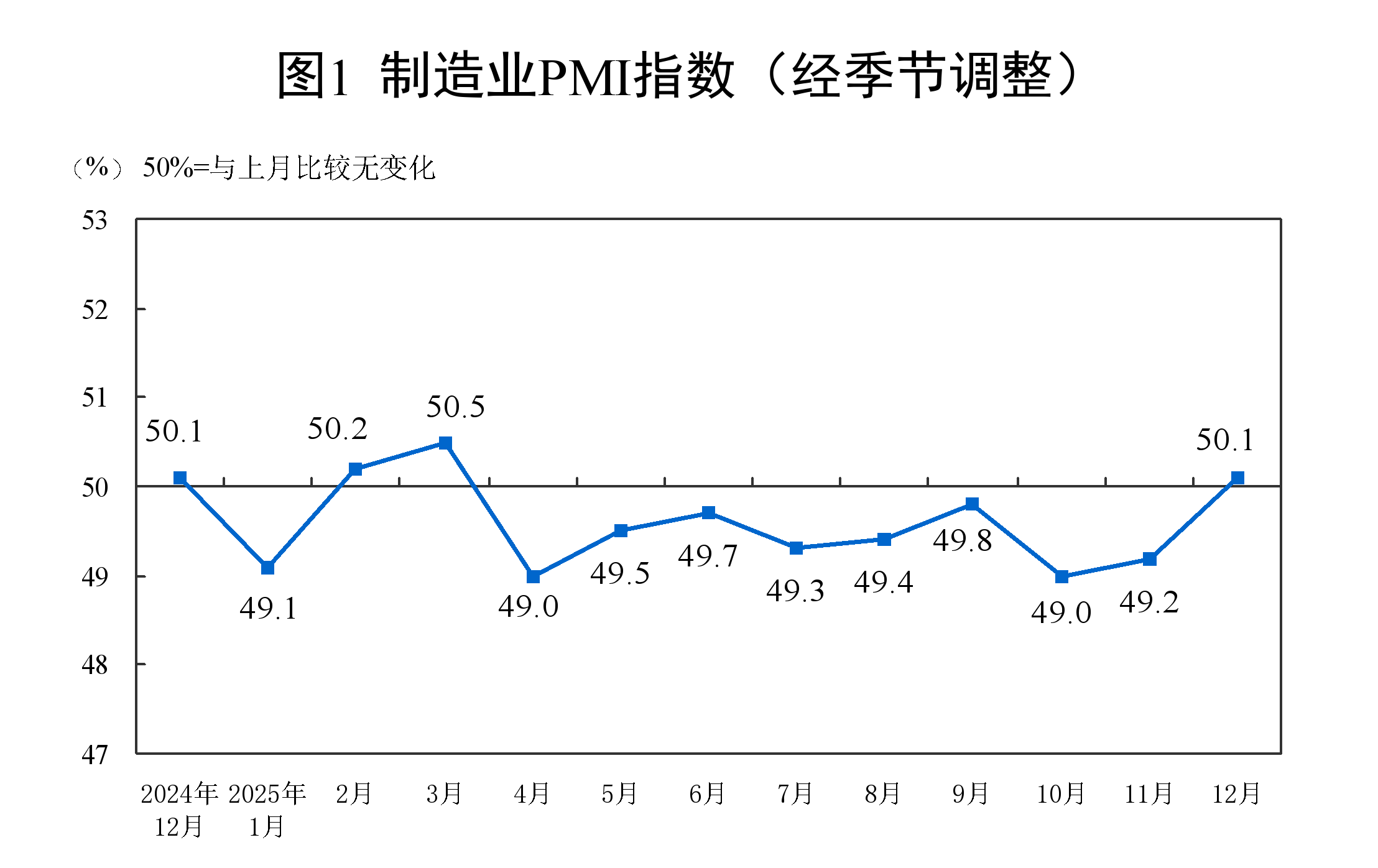
Group 1 - The manufacturing Purchasing Managers' Index (PMI) for December 2025 is reported at 50.1%, an increase of 0.9 percentage points from the previous month, marking a return to the expansion zone after eight consecutive months below 50% [1] - The production and business activity expectation index for December is at 55.5%, up 2.4 percentage points, the highest since April 2024 [1] - The new orders index for December is at 50.8%, rising 1.6 percentage points, indicating a return to the expansion zone after five months below 50% [1] Group 2 - The new export orders index for December is at 49%, an increase of 1.4 percentage points, indicating stable development in manufacturing exports [1] - The production index for December is at 51.7%, up 1.7 percentage points, showing significant growth in manufacturing activity [1] - The high-tech manufacturing PMI is reported at 52.5%, an increase of 2.4 percentage points, indicating a notable acceleration in expansion [1] Group 3 - The consumer goods industry PMI is at 50.4%, up 1 percentage point, with the production index exceeding 52% and the new orders index exceeding 51%, reflecting good expansion in the consumer goods manufacturing market [1] - The non-manufacturing business activity index for December is at 50.2%, an increase of 0.7 percentage points from the previous month [2] - The composite PMI output index for December is at 50.7%, up 1 percentage point from the previous month [2]
关键指标现积极信号!50.1%重返扩张区,12月PMI暖了
2 1 Shi Ji Jing Ji Bao Dao· 2025-12-31 06:56
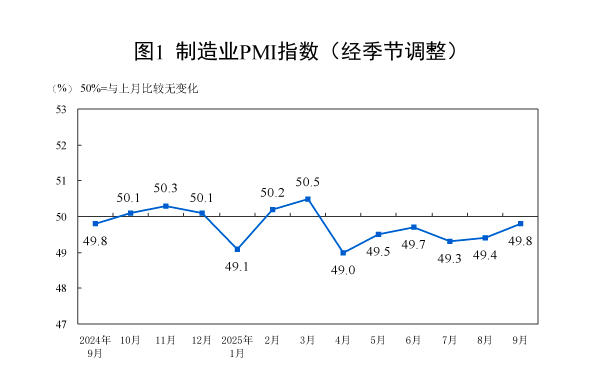
Core Viewpoint - The manufacturing Purchasing Managers' Index (PMI) in China rose to 50.1% in December 2025, marking the first expansion since April 2025, indicating a recovery in both production and demand [1][5]. Group 1: Manufacturing PMI Overview - The manufacturing PMI increased by 0.9 percentage points from the previous month, reaching the expansion zone [5]. - The production index and new orders index were reported at 51.7% and 50.8%, respectively, both showing significant month-on-month increases [6][7]. - In 2025, the monthly manufacturing PMI figures were 49.1%, 50.2%, 50.5%, 49%, 49.5%, 49.7%, 49.3%, 49.4%, 49.8%, 49.0%, 49.2%, and 50.1% [5]. Group 2: Sector Performance - Among the 21 surveyed industries, 16 showed an increase in PMI compared to the previous month, indicating improved business conditions [2][8]. - High-tech manufacturing, equipment manufacturing, and consumer goods sectors reported PMIs of 52.5%, 50.4%, and 50.4%, respectively, all above the expansion threshold [2][8]. - The new export orders index rose to 49.0%, up 1.4 percentage points, although it remains below the expansion threshold [7][9]. Group 3: Economic Indicators - The production activity expectation index reached 55.5%, indicating increased confidence among manufacturing enterprises regarding market development [10]. - The supplier delivery time index was reported at 50.2%, suggesting that the delivery times for raw materials are improving [9]. - The inventory indices for finished products and raw materials showed signs of recovery, with finished product inventory rising to 48.2% and raw materials inventory at 47.8% [9].
制造业景气水平改善 新出口订单指数升幅明显
Zheng Quan Shi Bao· 2025-11-30 18:17
Core Insights - The manufacturing Purchasing Managers' Index (PMI) for November increased to 49.2%, reflecting a slight improvement in economic conditions compared to the previous month [1] - The new export orders index rose significantly by 1.7 percentage points, indicating a positive shift in the external trade environment, particularly benefiting small enterprises [1][2] - Most of the 13 sub-indices for manufacturing showed an upward trend, with production, new orders, and purchasing volume indices all improving [1][2] Manufacturing PMI Details - The manufacturing PMI for November stands at 49.2%, up by 0.2 percentage points from the previous month, indicating a recovery in manufacturing activity [1] - The new orders index increased by 0.4 percentage points to 49.2%, while the production index returned to the neutral level of 50% after a brief contraction [2] - The equipment manufacturing, high-tech manufacturing, and consumer goods manufacturing sectors all maintained production indices in the expansion zone [2] Price Trends - The purchasing price index for manufacturing rose to 53.6%, up by 1.1 percentage points, indicating a general increase in raw material prices across major manufacturing sectors [2] - The decline in finished product prices has slowed, influenced by rising raw material costs and stable market demand [2] Future Outlook - Analysts suggest that the manufacturing market demand may continue to stabilize and recover in December, driven by year-end activities, policy implementation, and expected demand increases from the upcoming "15th Five-Year Plan" [2] - Despite the improvements, the manufacturing PMI remains at historically low levels, indicating a growing necessity for macroeconomic policy support [3]
10月份制造业采购经理指数有所回落 非制造业商务活动指数略有回升
Guo Jia Tong Ji Ju· 2025-10-31 02:32
Group 1: Manufacturing PMI Insights - In October, the manufacturing PMI decreased to 49.0%, down 0.8 percentage points from the previous month, indicating a slowdown in production activities [1][2] - Both production index and new orders index fell to 49.7% and 48.8%, respectively, reflecting a decline in manufacturing production and market demand [2] - Large enterprises maintained a PMI above the critical point, with indices at 50.9% for production and 50.1% for new orders, indicating sustained demand in this segment [2][3] Group 2: Non-Manufacturing PMI Insights - The non-manufacturing business activity index rose to 50.1%, up 0.1 percentage points from the previous month, indicating a slight expansion in the sector [4] - The service industry business activity index increased to 50.2%, with significant growth in sectors closely related to consumer travel, such as rail and air transport, which saw indices above 60.0% [4] - The construction industry business activity index slightly decreased to 49.1%, but the business activity expectation index improved to 56.0%, suggesting a positive outlook for future market conditions [4] Group 3: Composite PMI Insights - The composite PMI output index stood at 50.0%, indicating overall stability in production and business activities across sectors [5] - The manufacturing production index and non-manufacturing business activity index were recorded at 49.7% and 50.1%, respectively, contributing to the composite index's position at the critical point [5]
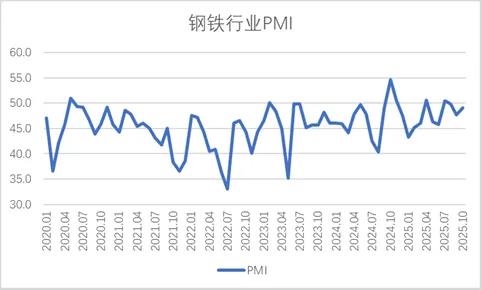
2025年10月钢铁PMI显示:钢铁行业有所恢复 供需两端回稳运行
Xin Hua Cai Jing· 2025-10-31 02:26
Core Viewpoint - The steel industry is showing signs of recovery in October 2025, with the PMI rising to 49.2%, ending a two-month decline, although challenges such as high raw material prices and inventory pressures remain [1][2]. Demand Recovery - October saw a recovery in steel demand due to the resumption of outdoor construction post-holidays and a lack of adverse weather in northern regions, but the real estate sector remains in deep adjustment, limiting overall market demand [2][3]. - The new orders index increased to 47.6%, up 2.4 percentage points, indicating some improvement in demand, but still within a contraction zone [3]. - Export orders showed significant improvement, with the new export orders index rising to 54.3%, the highest in nearly 20 months, driven by price differentials and overseas demand [3]. Production Trends - Steel production stabilized in October, with the production index rising to 49.8%, up 4.1 percentage points, indicating a recovery in production activities [5]. - Despite improvements in both supply and demand, the recovery in demand is weaker than the increase in supply, leading to continued inventory pressures for steel mills [5]. Raw Material Prices - Raw material prices remain high, with the purchasing price index exceeding 70%, indicating increased cost pressures for steel manufacturers [8]. - Prices for different raw materials are showing divergence, with iron ore prices stabilizing, scrap steel prices declining, and coke prices rising due to supply constraints [8]. Price and Profitability - Steel prices have shown a downward trend, with the Shanghai rebar price index dropping from 3176 CNY/ton to 3122 CNY/ton during October, leading to further compression of profit margins for steel mills [11]. - The overall cost pressure on steel manufacturers has increased compared to September, despite some recovery in demand [11]. Future Outlook - In November, steel demand is expected to show a "first rise then fall" trend, supported by construction activities and export resilience, but constrained by ongoing weakness in the real estate sector and seasonal factors [12]. - Steel production is anticipated to contract due to environmental restrictions in northern regions and a shift from peak to off-peak demand [15].
国家统计局发布9月重要数据
21世纪经济报道· 2025-09-30 10:13
Core Viewpoint - The manufacturing Purchasing Managers' Index (PMI) in September rose to 49.8%, indicating a continued improvement in the manufacturing sector's economic conditions [1][4]. Group 1: Manufacturing PMI Overview - The manufacturing PMI increased by 0.4 percentage points from the previous month, reflecting a recovery in manufacturing activity [1][4]. - The production index reached 51.9%, up 1.1 percentage points, marking a six-month high, while the new orders index rose to 49.7%, indicating a slight improvement in market demand [1][5]. Group 2: Sector Performance - Key sectors such as equipment manufacturing, high-tech manufacturing, and consumer goods showed strong expansion, with PMIs of 51.9%, 51.6%, and 50.6% respectively, all above the manufacturing average [6]. - The consumer goods sector has returned above the threshold line, achieving its highest level this year [2][6]. Group 3: Employment and Inventory Trends - The employment index improved to 48.5%, indicating a better employment situation in manufacturing, while the raw materials inventory index rose to 48.5%, suggesting a slowdown in inventory reduction [4][7]. - The production expectations index increased by 0.4 percentage points to 54.1%, showing a positive outlook among manufacturers for upcoming market conditions [7]. Group 4: Price Dynamics - The purchasing price index for raw materials was at 53.2%, indicating a slight decrease but still in the expansion zone, while the factory price index fell to 48.2%, suggesting a contraction in output prices [6]. - The gap between raw material purchasing prices and factory prices widened to 5.0 percentage points, indicating a shrinking profit margin for manufacturers [6].
制造业PMI连续两月回升 下阶段走势如何
Di Yi Cai Jing· 2025-09-30 02:57
Core Insights - The manufacturing PMI in China rose to 49.8% in September, indicating a slight recovery but still below the expansion threshold [1] - The non-manufacturing business activity index decreased to 50.0%, reflecting a slight slowdown in non-manufacturing activities [1] Manufacturing Sector - The manufacturing production index increased to 51.9%, marking a continuous expansion for five months [4] - The purchasing volume index rose to 51.6%, indicating improved procurement activities [4] - New orders index reached 49.7%, showing a stabilization in market demand [4] - The export new orders index improved to 47.8%, suggesting a narrowing decline in export demand [4] - The manufacturing purchase price index was 53.2%, while the factory price index fell to 48.2%, indicating mixed price trends across sectors [5] Non-Manufacturing Sector - The non-manufacturing business activity index remained stable at 50.0%, with the construction index at 49.3% and the services index at 50.1% [8] - The business activity expectation index for non-manufacturing remained above 55%, indicating stable optimism among enterprises [8] - The postal industry showed significant growth, with indices above 60%, reflecting active online shopping [8][9] Future Outlook - The manufacturing sector is expected to see continued growth in Q4, driven by macro policies and seasonal demand [5] - Non-manufacturing activities are anticipated to stabilize and recover, supported by year-end effects and holiday demand [10]