
粮食生产

Search documents
我国农业农村发展稳中有进、稳中向好 顺利完成2025年全年和“十四五”各项目标任务
Yang Guang Wang· 2026-01-23 01:49
Group 1 - The core viewpoint of the articles emphasizes the stable progress and positive trends in agricultural and rural development in China, with a focus on achieving food security and high-quality economic growth by 2025 [1][2] - By 2025, China's grain production is projected to reach 14,298 billion jin, an increase of 168 billion jin, maintaining a historical high for two consecutive years above 14 trillion jin [1] - The Ministry of Agriculture and Rural Affairs plans to enhance grain production through measures such as stabilizing acreage, increasing yield, optimizing structure, improving efficiency, and disaster reduction [1] Group 2 - The Ministry is accelerating the legislative process for farmland protection and quality improvement, aiming to maintain 1.865 billion acres of farmland and 1.546 billion acres of permanent basic farmland protection [1] - A supplementary method for farmland quality acceptance has been issued to ensure compliance with balance standards in land use [2] - The second round of land contract extensions is being piloted across seven provinces, covering 2.5 million farming households, ensuring stability in land tenure for farmers [2]
西宁2025年民生答卷亮点纷呈
Xin Lang Cai Jing· 2026-01-21 18:32
Group 1: Agricultural Production - In 2025, Xining's total grain production reached 241,000 tons, an increase of 6,000 tons or 2.6% compared to the previous year [1] - The grain planting area was 915,000 mu, a slight decrease of 1,000 mu or 0.1% from the previous year [1] - The comprehensive yield per mu for grain was 263.2 kg, which is an increase of 6.9 kg or 2.7%, surpassing the provincial average by 1.3 percentage points [1] - Notable increases in yield per mu were observed in wheat (253.4 kg, up 1.1%), barley (154.3 kg, up 16.8%), while miscellaneous grains saw a decrease (151.5 kg, down 4.5%) [1] - The total output of major livestock and poultry was 67,000 tons, with pork production at 14,000 tons (up 3.3%), beef at 38,000 tons (up 19.5%), mutton at 14,000 tons (up 9.4%), and poultry at 1,000 tons (up 12.2%) [1] Group 2: Resident Income and Consumption - In 2025, the per capita disposable income for all residents in Xining was 38,727 yuan, reflecting a year-on-year growth of 4.8%, which is 0.3 percentage points lower than the provincial average [2] - Rural residents had a per capita disposable income of 19,369 yuan, growing by 6.0%, matching the provincial average [2] - Urban residents' per capita disposable income was 45,605 yuan, with a growth of 4.1%, slightly higher than the provincial average by 0.1 percentage points [2] - The per capita consumption expenditure for all residents was 25,951 yuan, an increase of 3.8% year-on-year [2] - Rural residents' per capita consumption expenditure was 16,193 yuan (up 7.3%), while urban residents' was 29,418 yuan (up 2.8%) [2] - The Consumer Price Index (CPI) in Xining decreased by 0.2% compared to the previous year, with a "six increases and two decreases" trend observed in the prices of eight major categories of goods and services [2]
我国最大垦区北大荒集团粮食总产463.14亿斤实现“二十二连丰”
Xin Hua She· 2025-12-14 01:39
Group 1 - The core viewpoint of the article highlights that the Beidahuang Agricultural Reclamation Group is set to achieve a record grain production of 46.314 billion jin in 2025, marking a year-on-year increase of 550 million jin, thus achieving "22 consecutive years of abundance" in agricultural production [1] - In 2025, the total sown area for grain crops will reach 46.4465 million mu, with a comprehensive grain yield of 997.15 jin per mu, an increase of 10.61 jin or 1.07% compared to the previous year [2] - The total grain output will account for 28.24% of Heilongjiang Province and 3.24% of the national total, surpassing the historical best year of 2021 by 400,000 jin, maintaining a stable output above 40 billion jin for 15 consecutive years [2] Group 2 - During the "14th Five-Year Plan" period, the grain production capacity of Beidahuang Agricultural Reclamation Group has steadily increased, with the sown area expanding from 43.4011 million mu in 2020 to 46.4465 million mu, a net increase of 3.0455 million mu [5] - The comprehensive grain yield per mu has improved by 13.75 jin compared to 2020, with a cumulative grain production of 2,291.12 billion jin, an increase of 172.33 billion jin compared to the "13th Five-Year Plan" period [5] - The company, located in Heilongjiang Province, has a total operational land area of 53,600 square kilometers and stable arable land of 48.744 million mu, making it the largest reclamation area in China [5]


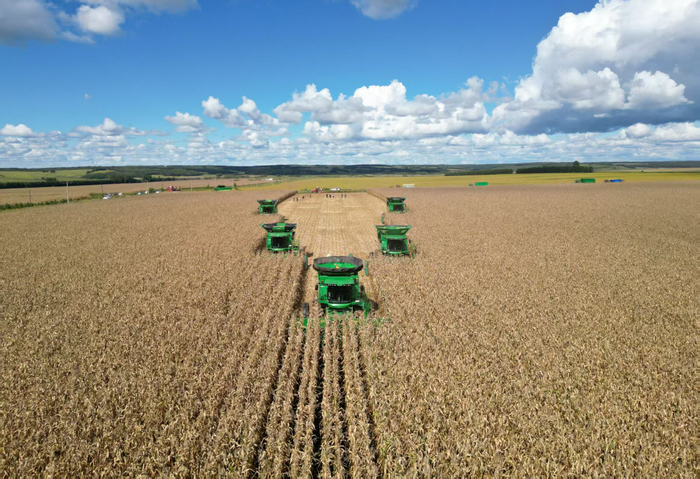
今冬不放松,来年“丰”可期
Ren Min Ri Bao Hai Wai Ban· 2025-11-27 21:57
Core Insights - The article highlights the urgency of winter wheat planting in China due to delayed autumn harvests caused by prolonged rainfall, with farmers across various regions accelerating their planting efforts to ensure a successful summer grain harvest next year [1][2][4]. Group 1: Current Agricultural Conditions - In Shaanxi province, the autumn harvest has been delayed by over 15 days, with farmers now transitioning from autumn to winter wheat planting [2]. - The planting of winter wheat is critical, with farmers like Liu Lululu increasing seed and fertilizer usage due to the delayed planting period, with seed usage rising to 47 pounds per acre and fertilizer to 140 pounds [2][5]. Group 2: Technological Advancements in Farming - The article emphasizes the integration of technology in winter wheat planting, with farmers utilizing advanced machinery for efficient sowing and fertilization processes [5]. - Agricultural experts are providing technical guidance to farmers, focusing on optimal planting conditions and crop varieties that are resilient to adverse weather [5][7]. Group 3: Farmers' Perspectives and Future Outlook - Farmers express optimism about future yields, citing government support and the adoption of scientific farming techniques as key factors for potential success [7]. - There is a collective effort among farmers to share best practices and improve overall grain production capacity, with some planning to expand their planting areas [7].
今冬不放松,来年“丰”可期——多地冬种及田间管护见闻
Xin Hua She· 2025-11-24 14:26
Core Viewpoint - The article highlights the urgency and efforts of farmers across various regions in China to complete winter wheat sowing, which has been delayed due to prolonged rainfall, ensuring a solid foundation for next year's summer grain harvest [1][2]. Group 1: Current Agricultural Practices - Farmers in Shaanxi province are actively working to complete winter wheat sowing, which has been postponed by over 15 days due to late autumn harvests [2]. - The sowing process has seen increased seed and fertilizer usage, with seed usage rising from 35 pounds to 47 pounds per acre, and fertilizer from 120 pounds to 140 pounds [2]. - In Shandong province, over 100 agricultural service teams are providing technical guidance for wheat sowing during this critical period [3]. Group 2: Technological Advancements - The article notes a rise in the technological content of winter wheat sowing, with large machinery being utilized for efficient operations, including precise fertilization and sowing processes [5]. - Farmers are advised to select drought-resistant and high-yield wheat varieties, emphasizing the importance of proper sowing techniques to ensure successful winter survival of the crops [5]. Group 3: Future Expectations - Farmers express optimism for next year's harvest, driven by government support for grain production and the sharing of successful farming techniques among peers [7]. - There is a collective effort among farming cooperatives to expand planting areas and improve agricultural practices to enhance grain production and contribute to national food security [7].
省委常委会召开扩大会议学习习近平总书记重要讲话重要指示精神 部署文物保护粮食生产和信访等工作
Shan Xi Ri Bao· 2025-11-02 01:00
Group 1 - The meeting emphasized the importance of studying and implementing Xi Jinping's important speeches and directives, particularly regarding cultural heritage protection, grain production, and resolving issues related to real estate registration [1][2] - The focus on cultural heritage includes optimizing museum system layout and enhancing the overall protection and utilization of cultural relics [2] - The meeting highlighted the need to strengthen food security strategies, protect arable land, and improve agricultural productivity through technological advancements and international cooperation [2] Group 2 - The resolution of real estate registration issues is to be integrated with efforts to combat corruption and improve governance, ensuring a comprehensive approach to policy implementation [2] - A long-term mechanism is to be established to prevent future registration difficulties, emphasizing the importance of regulatory oversight across the entire real estate process [2]
全国秋粮收获已过八成半 主产区冬小麦播种加快推进
Ren Min Wang· 2025-10-30 05:41
Core Insights - The national autumn grain harvest has surpassed 85%, with significant progress in major production areas [1] - The planting of winter wheat is accelerating, with a 15% progress rate in major production regions [1] Harvest Progress - In Northeast China, over 90% of autumn grain has been harvested; Northwest nearly 90%; Southwest and Huang-Huai-Hai over 85.5%; Yangtze River middle and lower reaches nearly 80% [1] - As of October 27, 23,235.1 million acres of crops have been harvested, accounting for 99.2% of the expected harvest [1] - Soybeans and rice were harvested 3 to 5 days earlier than last year, while corn was harvested 3 days earlier [1] Planting Conditions - In Henan, continuous rainy weather since September has posed challenges for timely harvesting and sowing of winter wheat [1] - The provincial agricultural department has issued guidelines for late sowing of wheat to optimize seed selection and management [1] - In Anhui, the planned area for autumn wheat is 43.44 million acres, with 2.44 million acres sown, achieving a progress rate of 5.62% [1] Winter Wheat Initiatives - In Shandong, emergency funding has been allocated to accelerate the "Three Autumns" work, with nearly 30 million acres of land prepared and over 1.1 million acres of winter wheat sown [2] - The Ministry of Agriculture has launched a 60-day action plan to ensure winter wheat planting and management, focusing on adapting to wet conditions and promoting seedling growth [2] - Meteorological forecasts indicate that soil moisture levels in northern winter wheat areas will decrease, improving conditions for planting [2]
二〇二五年我国早稻产量增长
Ren Min Ri Bao· 2025-08-23 22:20
Core Insights - The early rice planting area in China for 2025 is projected to be 71.143 million acres, a slight decrease of 0.3% from the previous year, while the early rice yield is expected to increase to 570.3 billion pounds, marking a growth of 1.2% compared to 2024 [1][2] - The average yield per acre for early rice is anticipated to reach 400.8 kg, an increase of 1.5% from the previous year, with nine out of ten major early rice-producing provinces showing yield improvements [2] Group 1 - The early rice planting area is expected to remain stable around 71 million acres for six consecutive years despite a slight decrease in 2025 [1] - The government has increased support for grain production, including raising the minimum purchase price for early indica rice to stabilize farmers' expectations and encourage planting [1] - Local governments are implementing policies and funding to ensure early rice production, despite some areas facing drought conditions that affected timely planting [1] Group 2 - The favorable weather conditions in major rice-producing regions have contributed to the increase in yield, with minimal natural disasters reported during the growing season [2] - Key agricultural techniques such as machine transplanting and increased seed density are being promoted to enhance early rice yield [2] - The successful early rice harvest is seen as a foundation for stable grain production throughout the year, supporting economic recovery amid complex international challenges [2]
以安全高水平促发展高质量——从发展与安全看江苏经济稳健基石
Xin Hua Ri Bao· 2025-07-26 23:55
Group 1: Safety Production and Risk Management - Jiangsu has published 796 safety risk items across 77 sectors, prompting 28.6 million production units to complete risk reports and identify 943,000 risks [2] - A total of 53,800 hidden dangers were reported by companies, with rewards amounting to over 41.8 million yuan for employees who identified these risks [2] - The province has implemented a special governance action targeting illegal activities in chemical and pharmaceutical production, resulting in 108 illegal actions being addressed [3] Group 2: Energy Supply and Infrastructure - Jiangsu's highest electricity load reached 152.8 million kilowatts, marking the third record-breaking peak this year, with an increase of 5.75 million kilowatts from the previous highest value [5] - The province has invested approximately 136.6 billion yuan in the energy sector in the first half of the year, reflecting a year-on-year growth of 29.8% [7] - The new coal power project in Jiangsu, with two 1 million kilowatt units, is expected to generate 10 billion kilowatt-hours annually, meeting the electricity needs of over 7 million residents in East China [6] Group 3: Agricultural Production and Resilience - Despite facing rare drought conditions, Jiangsu's summer grain production remained stable at 14.213 million tons, with a yield of 379.4 kg per mu [8] - The province has implemented various measures to enhance agricultural resilience, including the construction of high-standard farmland, which now totals 44.01 million mu, accounting for 82% of the permanent basic farmland [10] - Water management strategies have been enhanced, with 20.4 billion cubic meters of water being diverted to support summer crops [9]
农业农村部“点赞”山东乡村振兴新路子
Da Zhong Ri Bao· 2025-07-18 00:59
Group 1 - The national summer grain production reached 299.48 billion jin, marking the second highest production year in history, following last year [2] - The production of pork, beef, mutton, and poultry meat in the first half of the year was 48.43 million tons, a year-on-year increase of 2.8%, while milk production grew by 0.5% [2] - The per capita disposable income of rural residents in the first half of the year was 11,936 yuan, reflecting a real growth of 6.2% after accounting for price factors [2] Group 2 - Summer grain production has been stable and abundant, benefiting from timely and effective drought response measures and increased agricultural disaster resilience [3] - The central government allocated 1.6 billion yuan early to support wheat production and 376 million yuan for drought relief [3] - Major grain-producing provinces such as Shandong, Hebei, and Sichuan saw increases in production by 410 million jin, 360 million jin, and 220 million jin respectively [3] Group 3 - Autumn grain production, which accounts for three-quarters of the annual grain output, is crucial for achieving the target of approximately 1.4 trillion jin for this year [4] - The area for autumn grain is expected to increase slightly compared to last year, particularly for high-yield crops like corn [4] - The implementation of the rural revitalization strategy has significantly improved agricultural production and enhanced the sense of gain, happiness, and security among farmers [4] Group 4 - The value added of the agricultural and sideline food processing industry above designated size grew by 7.5% year-on-year in the first half of the year [5] - Over 300,000 new projects were added to the rural construction project library in the first half of the year, with project funding exceeding 100 billion yuan [5] - Continuous improvement in rural living conditions and governance effectiveness has been observed [5]