
股息收益

Search documents
How To Earn $500 A Month From Toll Brothers Stock Ahead Of Q1 Earnings
Benzinga· 2026-02-17 12:48
Core Insights - Toll Brothers, Inc. (NYSE:TOL) is set to release its first-quarter earnings on February 17, which may attract investor interest due to its dividend potential [1] - The company currently offers an annual dividend yield of 0.60%, translating to a quarterly dividend of $0.25 per share, or $1.00 annually [1] Dividend Calculation - To achieve a monthly income of $500 from Toll Brothers, an investor would need to own approximately 6,000 shares, equating to a total investment of about $996,720 [2][3] - For a more conservative monthly income target of $100, an investor would require 1,200 shares, amounting to an investment of approximately $199,344 [3] Dividend Yield Dynamics - The dividend yield is determined by dividing the annual dividend payment by the current stock price, which can fluctuate based on market conditions [4] - For instance, if the annual dividend is $2 and the stock price is $50, the yield is 4%. If the stock price rises to $60, the yield drops to 3.33%, and if it falls to $40, the yield increases to 5% [4] - Changes in the dividend payment itself can also affect the yield; an increase in dividends raises the yield if the stock price remains constant, while a decrease lowers it [5] Recent Stock Performance - Shares of Toll Brothers increased by 2.2%, closing at $166.12 on the previous Friday [5]



How To Earn $500 A Month From Expedia Stock Ahead Of Q4 Earnings
Benzinga· 2026-02-12 13:06
Expedia Group, Inc. (NASDAQ:EXPE) will release earnings for its fourth quarter after the closing bell on Thursday, Feb. 12.Expedia investors may be eyeing potential gains from the company's dividends. Currently, the company has an annual dividend yield of 0.68%, which is a quarterly dividend amount of 40 cents per share ($1.60 a year). So, how can investors exploit its dividend yield to pocket a regular $500 monthly?To earn $500 per month or $6,000 annually from dividends alone, you would need an investmen ...


Spectrum Brands Holdings Inc. (NYSE: SPB) Sees Positive Outlook from Oppenheimer with Price Target Increase
Financial Modeling Prep· 2026-02-06 18:02
Core Viewpoint - Spectrum Brands Holdings Inc. has shown strong quarterly earnings, leading to an upgrade in its stock rating and price target by Oppenheimer, enhancing its attractiveness to investors [1][6]. Financial Performance - The company reported earnings per share (EPS) of $1.40, exceeding the consensus estimate of $0.77 by $0.63 [2][6]. - Revenue for the quarter was $677 million, surpassing the consensus estimate of $667.59 million, although it represented a 3.3% decrease compared to the same quarter last year [3]. - The return on equity was 7.29% and the net margin was 3.56% [3]. Stock Performance - Following the earnings announcement, the stock price increased significantly from a closing price of $68.44 to a last traded price of $73.50, reflecting a notable rise [2]. - The stock symbol SPB is currently priced at $75.43, showing an increase of 10.21% with a trading volume of 887,617 shares [4]. Dividend Announcement - Spectrum Brands announced a quarterly dividend of $0.47 per share, payable on March 10th, which adds to the stock's appeal by providing a steady income stream for investors [5][6].


Is the AFIC (ASX:AFI) share price a buy after the HY26 result?
Rask Media· 2026-01-21 04:54
Core Viewpoint - Australian Foundation Investment Co Ltd (AFIC) has reported its HY26 results, highlighting a special dividend and underperformance in its investment portfolio [1][10]. HY26 Result - The half-year net profit for AFIC was $147 million, reflecting a 5% decrease [10]. - The portfolio return for the half-year was negative 2%, compared to a positive 4.2% for the benchmark [10]. - The interim dividend per share was maintained at $0.12, with a special dividend of $0.025 per share [10]. Investment Performance - Several long-term holdings, including CSL Ltd, ARB Corporation Ltd, James Hardie Industries plc, Reece Ltd, and CAR Group Ltd, underperformed the market [3]. - Sectors that AFIC typically avoids, such as small and medium-sized resource shares, saw significant gains, with one-year returns of 73% and 104.3%, and gold up 127% [4]. Portfolio Management - AFIC has been reducing its positions in Wesfarmers Ltd and Commonwealth Bank of Australia, citing them as "extremely over-valued" [5]. - The company sold shares in Westpac Banking Corp, National Australia Bank Ltd, Netwealth Group Ltd, WiseTech Global Ltd, and James Hardie [5]. - AFIC focused its buying on Woolworths Group Ltd and Telstra Group Ltd, which it views as having attractive dividend yields and valuations [6]. International Portfolio - AFIC's international portfolio has grown to $170 million from an initial investment of $103.5 million in May 2021, with plans to maintain a concentrated portfolio rather than listing a separate fund [7]. Market Outlook - AFIC perceives the market as expensive, particularly regarding long-term averages for price-to-earnings ratios and dividend yields [8]. - The company believes it can capitalize on buying opportunities in selected high-quality companies with promising long-term growth prospects [8]. Investment Stability - AFIC is considered one of the most stable ASX dividend shares due to its diversified portfolio [11].
3 reasons it’s a good time to buy Vanguard Australian Shares Index ETF (ASX:VAS)
Rask Media· 2026-01-19 00:58
Core Viewpoint - The Vanguard Australian Shares Index ETF (ASX: VAS) is considered an attractive investment option for the year due to its low management fees and other favorable factors [1] Group 1: Global Uncertainty - The unpredictable nature of US President Donald Trump has created market surprises over the past year [2] - The VAS ETF's portfolio is primarily focused on Australian and New Zealand shares, which may provide a safe haven amid global tensions, particularly between the US and Europe [2][3] Group 2: Diversification - The VAS ETF offers good diversification with approximately 300 businesses across various sectors, including financials, resources, healthcare, and more [4] - Diversification is highlighted as a beneficial strategy in the face of potential market volatility [5] Group 3: Dividend Income - Many companies within the VAS ETF portfolio are known for providing substantial dividends, including BHP Group Ltd, Westpac Banking Corp, and others [6] - The fund boasts a dividend yield of 3.1%, with franking credits adding additional value, making passive income returns particularly significant in a year where capital growth may be challenging [7]

纽曼思:对联想财务表现及未来前景持正面看法 斥3,410万人币购股
Ge Long Hui· 2026-01-13 08:09
Group 1 - Newman (02530.HK) announced the acquisition of 4 million shares of Lenovo Group (00992.HK) at a total cost of approximately 34.098 million RMB, with an average purchase price of about 8.524 RMB per share [1] - The company's board believes that Lenovo Group has a track record of regular dividend payments, which can generate stable and recurring income streams [1] - The acquisition is expected to provide potential capital appreciation from any future increase in Lenovo Group's stock price, thereby enhancing the overall investment return for Newman [1] Group 2 - Newman primarily engages in the marketing, sales, and distribution of health and wellness products in China [1] - The company's products are sold under its own brands "Nemans" and "Numans," categorized into four main types: DHA, probiotics, vitamins, and multivitamins [1] - As a pioneer in the Chinese maternal and infant DHA (algal oil) industry since 2007, Newman positions its products as high-end, premium, and safe health supplements, particularly suitable for pregnant women, postpartum women, infants, and children [1]
BARINGTON Loads Up Bath and Body Works With 125,000 Shares Bought
The Motley Fool· 2025-12-05 17:58
Core Insights - Barington Companies Management, LLC initiated a new position in Bath & Body Works, acquiring 125,000 shares valued at $3.22 million, representing 2.42% of its total reportable assets of $133.17 million as of September 30, 2025 [2][3] Company Overview - Bath & Body Works, Inc. operates 1,755 company-owned retail stores and has a significant online presence, focusing on strong brand recognition and a robust product pipeline to maintain customer loyalty [5] - The company generates revenue primarily from direct retail sales in the U.S. and Canada, supplemented by international licensing and wholesale arrangements [8] - As of November 12, 2025, Bath & Body Works reported a revenue of $7.37 billion and a net income of $699 million, with a dividend yield of 3.57% [3] Investment Position - Barington's investment in Bath & Body Works is relatively small at 2.42% of its assets under management, which is notable given the fund's concentrated portfolio of only 12 stocks [9][10] - The stock has experienced a one-year total return of -27.15%, significantly underperforming the S&P 500 by 41.22 percentage points [7] - The P/E ratio of Bath & Body Works was 7 at the time of the filing, which may have attracted Barington to this investment [11] Market Performance - As of November 12, 2025, Bath & Body Works shares were priced at $22.40, with a market cap of $4 billion [12] - The stock has been on a downward trajectory since February, and it may take time for Barington to see positive returns on this investment [10][13]


Does UPS's 7% Dividend Yield Make the Stock a No-Brainer Buy?
The Motley Fool· 2025-11-12 02:14
Core Viewpoint - United Parcel Service (UPS) is a leading logistics company with a high dividend yield, but it faces challenges due to economic slowdown fears and trade issues, leading to a 24% stock decline in 2025 despite a recent earnings boost [2][10]. Financial Performance - UPS has a current dividend payout of $1.64 per share quarterly, with a diluted EPS of $1.55 in the most recent quarter, which is below the dividend amount, raising concerns about sustainability [4][5]. - The adjusted EPS was $1.74, indicating some profitability, but the company is undergoing cost-cutting measures to enhance overall profitability [5]. - Over the past nine months, UPS generated $2.7 billion in free cash flow, translating to an annual rate of approximately $3.7 billion, which is insufficient to cover the expected $5.5 billion in annual dividends [6]. Dividend Safety - The safety of UPS's dividend can be assessed through payout ratios and cash flows, with current figures suggesting potential risks but also opportunities for improvement [3][6]. - Management expressed confidence in generating significantly more free cash flow over time and hinted at a possible dividend increase in the near future [8]. Market Position - UPS shares are trading at a price-to-earnings multiple of 13, significantly lower than the S&P 500 average of 26, indicating a potentially undervalued stock [9]. - The company is in a turnaround phase, implementing significant restructuring measures, including job cuts, to adapt to demand changes [7][10]. Investment Outlook - While there are risks associated with the current restructuring, UPS's strong fundamentals and strategic moves suggest a positive direction for the company, with potential for improved valuation and modest dividend increases in the future [10][11].


4000点拉锯战下,上证综指ETF(510760)带你提前站上5100点
Mei Ri Jing Ji Xin Wen· 2025-11-03 06:33
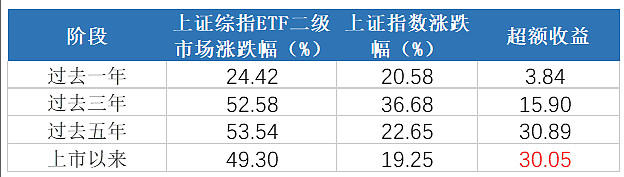
Core Insights - The Shanghai Composite Index ETF (510760) has achieved significant excess returns, leading investors to a level above 5100 points, while the A-share market is around the 4000 points mark [1][5]. Performance Summary - The Shanghai Composite Index ETF has outperformed the Shanghai Composite Index by over 30% since its inception, with a total return of 49.30% compared to the index's 19.25% [2][3]. - The ETF's performance over various time frames shows consistent excess returns: 24.42% in the past year, 52.58% in the past three years, and 53.54% in the past five years, with excess returns of 3.84%, 15.90%, and 30.89% respectively [3]. Dividend Yield and Strategy - The ETF benefits from a dividend yield exceeding 2%, which enhances its return base. The index's total market capitalization weighting, particularly with a high allocation to state-owned enterprises, contributes to this yield [4]. - The ETF's performance is further supported by its strategy of tracking the index while controlling tracking error, allowing for enhanced returns through sampling replication [2][4]. Market Outlook - The outlook for the A-share market remains positive, with expectations of a slow bull market driven by ongoing growth policies, active market sentiment, and easing monetary policy [5]. - The Shanghai Composite Index ETF is positioned as a key channel for investing in quality Chinese assets, with notable excess returns compared to the CSI 300 Index, reaching 50.45% since inception [5][6]. Cost Efficiency - The ETF is noted for its low management fees of 0.15% per year and custody fees of 0.05% per year, making it an attractive investment vehicle for those looking to track the market [6].
海峡股份:致力于保证公司可持续发展的前提下,为股东创造稳定的股息收益
Zheng Quan Ri Bao Wang· 2025-10-29 07:40
Core Viewpoint - The company emphasizes its commitment to providing stable dividend returns to shareholders while ensuring sustainable development [1] Summary by Relevant Categories Dividend Policy - The company's dividend policy will take into account factors such as profitability, cash flow, future investment plans, and reasonable return expectations from shareholders [1]
