软件生态

Search documents
关于手机业务停摆传闻,魅族回应!
Nan Fang Du Shi Bao· 2026-02-27 04:30
Core Viewpoint - Meizu Technology officially announced a strategic transformation, responding to rumors of "business suspension" and "bankruptcy restructuring," confirming the suspension of domestic smartphone hardware projects while shifting focus to AI-driven software products and the Flyme open ecosystem [1][8][9]. Group 1: Strategic Shift - The company will pause the development of new domestic smartphone hardware projects and actively seek third-party hardware partners, while existing business operations will remain unaffected [3][9]. - This decision is driven by intense competition in the domestic smartphone market and a significant increase in memory prices, making the commercialization of new products unfeasible [9][10]. Group 2: Focus on Software Ecosystem - Meizu will transition from a hardware-centric model to one that prioritizes AI-driven software products, aiming to create a resilient enterprise based on the Flyme open ecosystem [10]. - The Flyme Auto system has achieved over 2.26 million units in 2025, making it the leading smart cockpit system in China, with a target of 3 million units in collaboration with Geely Group by 2026 [5][10]. Group 3: Market Operations and User Assurance - Overseas smartphone business, AI glasses, and the PANDAER technology brand will operate independently in the market [10]. - The company assures that existing users will continue to receive support, with normal sales of Meizu smartphones, AI glasses, and other products, as well as ongoing after-sales and system security updates [6][10].

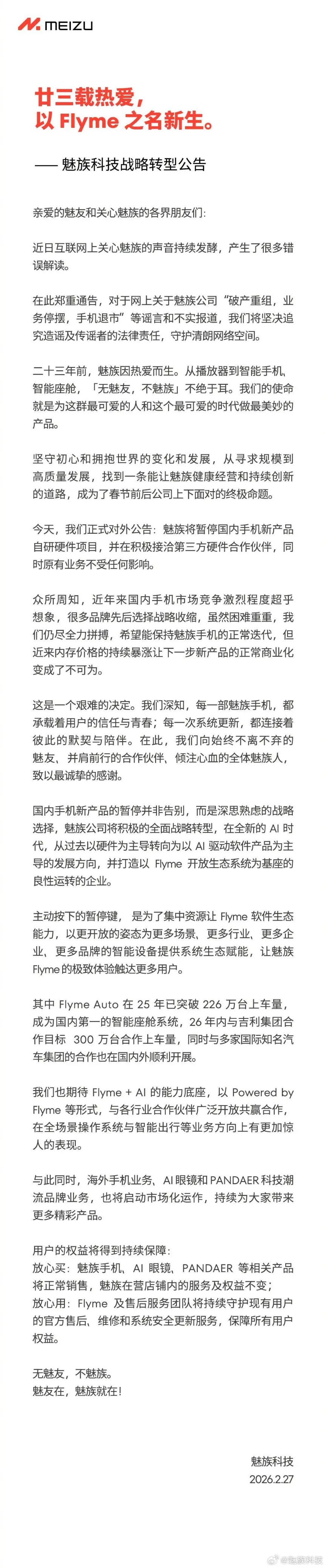
魅族宣布将暂停国内手机自研硬件项目,全面转型AI及软件生态
Feng Huang Wang· 2026-02-27 02:20
Core Viewpoint - Meizu Technology announced a strategic transformation, shifting focus from self-developed hardware for domestic mobile phones to AI-driven software products, aiming to create a business model based on the Flyme open ecosystem [1] Group 1: Strategic Shift - The company will suspend new self-developed hardware projects for domestic mobile phones due to intense competition and rising memory prices, which have made commercialization of new products challenging [1] - Meizu aims to transition from pursuing scale to focusing on high-quality development, seeking a sustainable path for healthy operations and continuous innovation [1] Group 2: Business Operations - Existing business operations, including mobile system updates and services, will remain unaffected during this transition [1] - The company plans to actively engage with third-party hardware partners to explore new collaboration models [1] Group 3: Software Ecosystem Development - Meizu will concentrate resources on enhancing the Flyme software ecosystem, adopting a more open approach to empower various smart devices across different scenarios, industries, and brands [1] - FlymeAuto has achieved over 2.26 million units in vehicle installations by 2025, becoming the leading smart cockpit system in China [1] - The collaboration target with Geely Group for 2026 is set at 3 million units, with ongoing partnerships with internationally renowned automotive groups [1] Group 4: Market Operations - The overseas mobile business, AI glasses, and PANDAER tech trend brand will initiate market operations, continuing to launch new products [2]

智能眼镜产业需构建软硬件生态
Zhong Guo Zheng Quan Bao· 2026-02-13 20:23
Core Insights - The smart glasses market is experiencing significant growth, with Rokid emerging as a leading player in China, particularly with its Rokid Glasses product expected to receive 300,000 orders by 2025 [1][2] Market Trends - Smart glasses have become a popular item for the upcoming Chinese New Year, with IDC predicting that the shipment volume in China will exceed 4.915 million units by 2026, marking a new phase of scaled growth [1] - The user demographic for smart glasses has expanded beyond tech professionals, now including business people, civil servants, media personnel, teachers, lawyers, and designers, with the proportion of tech workers as users dropping from 50% to about 16% [2] Application Expansion - The application scenarios for smart glasses are diversifying, with significant market share in the cultural tourism sector, where Rokid's AR glasses hold over 90% of the market [3] - Smart glasses are being utilized for various functions such as teleprompting, translation, and information retrieval, as well as in industrial, medical, and educational fields [3] Supply Chain Challenges - Rokid faced production capacity challenges due to a surge in demand, with actual orders for Rokid Glasses reaching 300,000, significantly higher than the anticipated 100,000, leading to delays in fulfilling 30-40% of orders until 2026 [3] - The company is addressing these challenges by collaborating with upstream suppliers to increase production capacity and ensure timely delivery [3] Competitive Landscape - The entry of major companies like Xiaomi, Alibaba, and Li Auto into the smart glasses market is expected to intensify competition, with players categorized into three types: simple audio glasses, non-display smart glasses, and full-featured smart glasses [4] - Rokid positions its products as full-featured smart glasses, emphasizing the importance of system integration, yield rates, production processes, supply chain management, and ecosystem development for future competitiveness [4] Software Ecosystem Development - Rokid is developing a software ecosystem to enhance the functionality of smart glasses, with over 20,000 developers and 4,000 companies already participating in its platform [4] - The company plans to upgrade its products in three phases: solidifying the tool attributes, integrating entertainment and social features, and ultimately expanding to full functionality over the next three to five years [4] Future Outlook - The company believes that smart glasses will not replace smartphones but will transform human-computer interaction, positioning itself as a core platform for interaction in the AI era [5] - With a large base of eyeglass wearers in China and a high acceptance rate for wearing glasses, the market for smart glasses is expected to grow, with Chinese manufacturers projected to account for 45% of global shipments by 2026 [5]
黄仁勋:AI不会取代软件 现有软件生态是发展基础
Huan Qiu Wang· 2026-02-05 03:17
Core Viewpoint - Nvidia CEO Jensen Huang refuted concerns that "artificial intelligence will replace software and related tools," stating that this view is "illogical" and that time will prove it [1] Group 1: AI and Software Industry - Huang emphasized that the belief AI will render software companies obsolete is a misunderstanding, asserting that the future development of AI relies on the existing software ecosystem rather than reinventing foundational tools from scratch [1] - He pointed out that both humans and robots prefer "using existing tools" over "reinventing tools," indicating a clear preference for leveraging current software capabilities [1] - Huang explained that the latest breakthroughs in AI are focused on the "use of tools," with the existing software tools designed with clear characteristics providing solid support for AI applications [1] Group 2: Market Reactions - The launch of a new chatbot by AI company Anthropic has raised concerns about the rapid advancement of AI capabilities potentially impacting the data industry and professional services, leading to a notable sell-off in global software stocks [1] - The sentiment surrounding these developments has continued to spread across the market, reflecting heightened anxiety among investors regarding the implications of AI advancements [1]


黄仁勋:AI不会取代软件,现有软件生态是发展基础
Huan Qiu Wang Zi Xun· 2026-02-05 02:24
Group 1 - The core viewpoint of the article is that concerns about AI replacing software and related tools are unfounded, as emphasized by NVIDIA CEO Jensen Huang [1][2] - Huang argues that the future development of AI relies on the existing software ecosystem rather than reinventing foundational tools from scratch [2] - He highlights that the current breakthroughs in AI are focused on "tool usage," supported by the clear characteristics of existing software tools [2]

龙芯中科(688047.SH)发预亏,预计2025年度归母净亏损4.49亿元左右
智通财经网· 2026-01-23 11:29
Core Viewpoint - Longxin Zhongke (688047.SH) expects a net loss of approximately 449 million yuan for the year 2025, which represents a reduction in loss of about 176 million yuan compared to the previous year, indicating a year-on-year loss reduction of approximately 28% [1] Group 1: Financial Performance - The company anticipates a net loss of around 449 million yuan for 2025, a decrease of approximately 176 million yuan from the previous year [1] - The company has reported a gradual recovery in gross profit margin, driven by the recovery of the industrial control sector and the contribution of new business in the information technology field [1] Group 2: Business Strategy and Market Position - The company is pursuing a dual strategy in policy-driven and open markets, leveraging its advantages in self-sufficiency to enhance cost-effectiveness and software ecosystem [1] - The company is capitalizing on the recovery of the security application market and has seen a rapid recovery in revenue from industrial control chips [1] - The company has made significant progress in bidding for office systems and industry business systems, utilizing the competitive advantages of its "three swordsmen" in system cost-effectiveness and ecological construction [1] Group 3: Credit and Asset Management - The company has estimated credit impairment losses and asset impairment losses of approximately 165 million yuan, a reduction of about 84 million yuan year-on-year [2] - Improved management of accounts receivable and customer credit has led to a gradual improvement in cash collection [2] - The provision for inventory impairment is rapidly narrowing due to the recovery of the traditional security application market and further expansion of the industrial control business [2]

瞄准英伟达,国产算力产业走向“闭环”
3 6 Ke· 2026-01-09 12:39
Core Insights - The Chinese computing power industry is experiencing rapid growth in capital operations, highlighted by significant IPOs and market enthusiasm for domestic semiconductor companies [1][2] - The focus of competition in the domestic computing power sector is shifting from hardware specifications to system stability, software ecosystem usability, and cost-effectiveness [3][4] Capital Market Activity - TianShuZhiXin Semiconductor Co., Ltd. went public on January 8, 2026, with over 400 times subscription, indicating strong market interest [1] - Other domestic GPU companies, such as MoEr Thread and MuXi Co., saw their stock prices surge on their debut, with MoEr Thread's market cap exceeding 305.5 billion yuan and MuXi's reaching 330 billion yuan [1] - ChangXin Technology submitted its IPO application on December 30, 2025, reporting revenue of 32.084 billion yuan for the first three quarters of 2025, showcasing the scale of domestic DRAM production [1] Technological Developments - The "Ten Thousand Card Cluster" concept is becoming a benchmark for evaluating domestic computing power, but it also presents challenges in reliability as system scale increases [3][4] - The introduction of the scaleX Ten Thousand Card Super Cluster by ZhongKe Shuguang, featuring 10,240 AI accelerator cards, represents a significant advancement in system architecture [3][4] - The need for high-quality, low-latency data transmission networks is critical for supercomputing, with domestic products now matching international standards [5][6] Storage Solutions - ChangXin Technology and ChangChun Group are positioned in the core areas of DRAM and NAND Flash, respectively, with ChangXin reporting a compound annual growth rate of over 70% in revenue from 2022 to 2024 [6][7] - The introduction of advanced technologies like Xtacking in NAND Flash production by ChangChun Group marks a significant technological breakthrough [7] Software Ecosystem - The transition to a robust software ecosystem is complex, with developers facing high costs in switching from established platforms like NVIDIA's CUDA [10][11] - MoEr Thread is addressing this by launching the MTT AIBOOK, which includes development tools to facilitate easier adoption of its platform [10] - Cloud service providers are playing a crucial role in integrating various hardware brands to create a unified software environment, addressing compatibility issues [11][12] Market Dynamics - The industry is witnessing a shift towards collaborative ecosystems, with companies recognizing the need for specialization rather than attempting to cover the entire supply chain independently [9][12] - The emergence of customized products from companies like Haiguang is aimed at meeting the specific needs of large enterprises, reflecting a trend towards more open architectures [15] Future Outlook - The domestic computing power industry is expected to face challenges related to global supply chain fluctuations, particularly in DRAM and NAND supply [13] - The successful integration of domestic computing solutions in high-stakes environments, such as the National High Energy Physics Data Center, indicates growing confidence in local technologies [14] - The potential easing of export restrictions on NVIDIA's H200 chip could impact the domestic ecosystem, but the established supply chain and customer preferences for security are likely to mitigate risks [17]


瞄准英伟达!国产算力产业走向“闭环”
经济观察报· 2026-01-09 10:28
Core Viewpoint - The rapid advancement of China's computing power industry is highlighted by significant capital market activities, including the successful IPOs of domestic semiconductor companies, while challenges remain in practical applications and system integration [2][4]. Group 1: Capital Market Activities - Shanghai Tensu Zhixin Semiconductor Co., Ltd. went public on January 8, 2026, with over 400 times subscription, indicating strong market enthusiasm [2]. - Other domestic GPU companies, such as Moer Thread and Muxi Co., saw their stock prices surge by 468.78% and 692.95% respectively on their debut, with market capitalizations exceeding 305.5 billion and 330 billion yuan [2]. - Changxin Technology submitted its IPO application on December 30, 2025, reporting revenue of 32.084 billion yuan for the first three quarters of 2025, showcasing the scale of domestic DRAM production [2][10]. Group 2: Technological Advancements - The focus of competition in the computing power sector is shifting from hardware specifications to system stability, software ecosystem usability, and cost-effectiveness in commercial applications [6]. - The introduction of the scaleX super cluster by Zhongke Shuguang, featuring 10,240 AI accelerator cards, emphasizes the need for high reliability in large-scale systems [6][7]. - The development of a native 400G RDMA network by Zhongke Shuguang aims to enhance data transmission quality and reduce latency, crucial for supercomputing applications [7][8]. Group 3: Software Ecosystem Development - Moer Thread is addressing the challenge of transitioning developers to domestic computing platforms by launching the MTT AIBOOK, which includes essential development tools [13]. - The company also introduced a code migration model, MUSACode, to facilitate the transition from CUDA to its own platform, aiming for a 93% compilation rate [13]. - Cloud service providers are playing a critical role in integrating various hardware brands, thereby mitigating compatibility issues and enhancing resource management [15][16]. Group 4: Supply Chain and Market Dynamics - The supply chain for DRAM and NAND flash is under pressure, prompting cloud vendors to adjust procurement strategies to ensure resource availability [17]. - The adoption of domestic computing facilities by institutions like the Chinese Academy of Sciences indicates growing confidence in local technology, despite some performance gaps compared to international counterparts [19]. - The emergence of customized products from companies like Haiguang reflects a shift towards meeting specific client needs, enhancing market competitiveness [20]. Group 5: Industry Ecosystem and Future Outlook - The domestic computing power industry is forming a closed-loop ecosystem, integrating various components from storage to computing and application layers [21][22]. - The rise of domestic large models, such as DeepSeek, is redefining hardware competition standards, necessitating support for mixed-precision computing [21]. - Concerns about potential disruptions from international competitors, such as NVIDIA's H200 chip, are countered by the established supply chain and ecosystem resilience of domestic firms [21][22].

国产算力产业走向“闭环”
Jing Ji Guan Cha Wang· 2026-01-09 08:41
Core Insights - The Chinese computing power industry is experiencing rapid acceleration in capital operations, highlighted by significant IPOs and market enthusiasm for domestic semiconductor companies [1][2] - The focus of competition in the domestic computing power sector is shifting from hardware specifications to system stability, software ecosystem usability, and cost-effectiveness in commercial applications [3][4] Capital Market Activity - TianShuZhiXin Semiconductor Co., Ltd. went public on January 8, 2026, with over 400 times subscription for its public offering, indicating strong market interest [1] - Other domestic GPU companies, such as MoEr Thread and MuXi Co., saw substantial stock price increases upon their listings, with MoEr Thread's stock rising by 468.78% on its debut [1] - ChangXin Technology submitted its IPO application on December 30, 2025, reporting revenue of 32.084 billion yuan for the first three quarters of 2025, showcasing the scale of domestic DRAM production [1] Technological Developments - The "Ten Thousand Card Cluster" concept is becoming a benchmark for evaluating computing power systems, with challenges in reliability and fault tolerance as system scales increase [3][4] - The introduction of the scaleX Ten Thousand Card Super Cluster by ZhongKe Shuguang, featuring 10,240 AI acceleration cards, represents a significant technological advancement [3][5] - The need for high-quality, low-latency data transmission networks is critical for supercomputing, with domestic products now matching international standards [6][7] Storage Solutions - ChangXin Technology and ChangJiang Storage are positioned in key storage sectors, with ChangXin reporting a compound annual growth rate of over 70% in revenue from 2022 to 2024 [7][8] - The introduction of DDR5 memory and advancements in NAND Flash technology are crucial for supporting AI computing needs [8] Software Ecosystem Challenges - Transitioning developers from NVIDIA's CUDA to domestic platforms presents significant challenges due to high code restructuring costs [11] - MoEr Thread is addressing this by launching tools to facilitate easier migration to its ecosystem, aiming to cultivate a developer base [11][12] Cloud Services and Integration - Cloud service providers like UCloud are playing a vital role in integrating various domestic chip brands, addressing compatibility issues and enhancing resource management [12][13] - The need for localized solutions is emphasized, as latency and privacy concerns with cloud-based AI solutions drive demand for on-premises systems [14] Market Dynamics and Future Outlook - The domestic computing power industry is forming a closed-loop ecosystem, with companies collaborating across the supply chain to enhance competitiveness [17] - The potential easing of export restrictions on NVIDIA's H200 chip raises concerns about its impact on the nascent domestic ecosystem, but domestic clients prioritize supply chain security [17]
百度李彦宏的第二家上市公司来了!
Xin Lang Cai Jing· 2026-01-04 13:26
Core Viewpoint - Baidu's subsidiary Kunlun Chip has submitted a confidential application for a mainboard listing on the Hong Kong Stock Exchange, which is expected to enhance its market image and allow for independent financing while remaining a part of Baidu's ecosystem [2][28]. Group 1: Listing Announcement and Market Reaction - On January 2, 2026, Baidu announced the submission of Kunlun Chip's listing application, which led to a 9.35% increase in Baidu's stock price, closing at HKD 143.8 per share, with a total market capitalization of HKD 395.5 billion [3][29]. - The announcement followed a series of market rumors about the potential spin-off, which had already caused Baidu's stock to rise by over 5% in early December 2025 [5][31]. Group 2: Company Background and Financials - Kunlun Chip, established in 2021, has evolved from supporting Baidu's internal AI needs to offering a full-stack product line, including chips, servers, and software platforms, with its latest chip, P800, designed for large-scale AI clusters [8][34]. - The company has secured significant contracts, including a major order from China Mobile, and is projected to exceed RMB 10 billion in revenue in 2024, with estimates suggesting revenues could soar to RMB 83 billion by 2026 [11][39]. Group 3: Valuation and Investment Landscape - Despite its strong revenue growth, Kunlun Chip's valuation stands at RMB 21 billion, significantly lower than competitors in the AI chip sector, which often reach valuations in the hundreds of billions [14][40]. - The company has attracted a diverse group of investors, including IDG Capital and BYD, with a total of 44 shareholders, indicating a strategic partnership approach rather than a simple financial investment [17][43]. Group 4: Competitive Landscape and Challenges - The AI chip market is increasingly competitive, with success hinging on building a robust ecosystem rather than just technical specifications. Companies like Nvidia and Huawei have established strong ecosystems that provide them with a competitive edge [19][45]. - Kunlun Chip's focus on cost reduction and replacement rather than market creation may limit its perceived growth potential, affecting its market valuation compared to peers [22][48].