
食品安全主体责任

Search documents
外卖平台须担食安“守门员”责任
Xin Lang Cai Jing· 2026-02-27 06:02
Core Viewpoint - The new regulations emphasize that food delivery platforms must take responsibility for food safety and cannot solely focus on commission and traffic without ensuring quality [1] Group 1: Regulatory Changes - The State Administration for Market Regulation (SAMR) has introduced new regulations requiring food delivery platforms to conduct substantial reviews of merchants' food business licenses and operating qualifications, including real-name registration and on-site verification [4] - Platforms are mandated to verify merchants' actual operating addresses and business qualifications at least every six months to prevent "ghost deliveries" [4] - The new rules also require that the names of online stores must match the names of their physical storefronts, and essential information such as operating qualifications and actual addresses must be prominently displayed [2] Group 2: Transparency and Accountability - The regulations aim to enhance transparency by requiring food delivery merchants to publicly disclose their food processing procedures through an "Internet + Open Kitchen" system [3] - Platforms are held accountable for the food safety of products sold on their sites, necessitating the establishment of dedicated food safety management teams and comprehensive risk management systems [5] - Penalties for non-compliance have been significantly increased, with fines reaching up to 200,000 yuan, and personal fines for platform executives can be up to ten times their annual income if severe violations occur [3] Group 3: Market Insights - China's food delivery market is projected to exceed 1.4 trillion yuan, accounting for approximately 24% of the total revenue in the restaurant industry, highlighting its importance as a growth driver [2]
塔城市市场监督管理局:和平所开展食品 安全“主体责任”落实检查
Zhong Guo Shi Pin Wang· 2026-01-04 10:10
Core Viewpoint - The article emphasizes the importance of food safety responsibility among large and medium-sized supermarkets, food delivery platforms, and restaurants during the year-end and New Year period, highlighting the need for strict compliance with food safety regulations [1] Group 1: Personnel Requirements - Large and medium-sized supermarkets, food delivery platforms, and restaurants must legally appoint a food safety director and food safety personnel, clearly defining the responsibilities of the main responsible person, director, and safety personnel [1] - Relevant personnel must undergo training and assessment before taking up their positions [1] Group 2: Operational Mechanisms - A strict "daily control, weekly inspection, monthly scheduling" system must be implemented, where safety personnel record risks daily, directors rectify issues weekly, and company leaders schedule and deploy work monthly [1] Group 3: Key Control Areas - Key areas of focus include food procurement inspection, control of storage temperature and humidity, proper labeling, management of near-expiry foods, and closed-loop disposal of non-compliant products, ensuring traceability of sources and destinations [1] Group 4: Future Initiatives - The Peace Market Supervision Office plans to promote exemplary models and benchmark supermarkets and food service units, sharing their management experiences to enhance overall industry responsibility [1]
市场监管总局出台规定压实食品销售连锁企业食品安全主体责任
Xin Lang Cai Jing· 2025-12-26 06:43
Core Viewpoint - The newly implemented regulations by the State Administration for Market Regulation aim to strengthen the food safety responsibilities of food sales chain enterprises, focusing on preventing systemic and regional food safety risks [1][2][3] Group 1: Responsibilities of Enterprises - The regulations require headquarters of enterprises to establish and implement a comprehensive food safety risk prevention mechanism covering all branches and stores, clearly defining their responsibilities in risk assessment, evaluation, inspection, training, procurement verification, and financial support [1] - Enterprises with unified procurement and distribution must create a standardized mechanism for supplier admission, evaluation, and exit, as well as a record-keeping system for outbound shipments and store receipts [1] Group 2: Management and Reporting Mechanism - Enterprises are mandated to implement a three-tier management system, ensuring daily control, weekly inspections, and monthly assessments, with a reporting mechanism for food safety risks that involves stores, branches, and headquarters [2] - Stores must report and address food safety risks to branches, which in turn must analyze common issues and report them to headquarters for further action [2] Group 3: Regulatory Framework - The regulations establish a tiered regulatory framework based on business models, enterprise scale, and risk levels, assigning supervisory responsibilities to provincial, municipal, and county-level market regulation departments [3] - New legal responsibilities are introduced for headquarters that fail to train food safety management personnel or establish incident response plans, with severe penalties for non-compliance, including potential suspension of operations or revocation of licenses [3]
构建无死角食品安全监管体系
Xin Lang Cai Jing· 2025-12-24 22:53
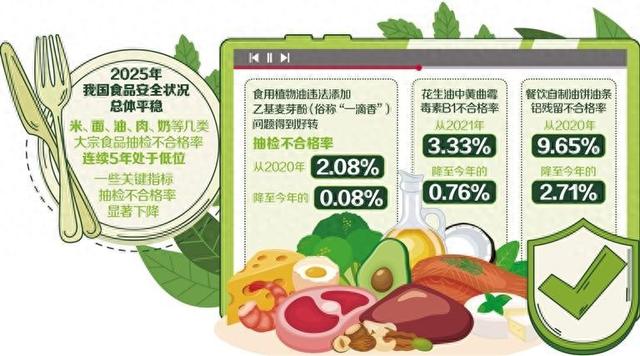
Group 1 - The overall food safety situation in China is stable, with significant improvements in key indicators, including a decrease in the non-compliance rate of major food categories over the past five years [1] - As of November this year, the national market supervision system completed 6.1769 million batches of supervision and inspection, detecting 172,300 non-compliant samples, resulting in a non-compliance rate of 2.79% [1] - Special rectification efforts have been made in areas such as counterfeit and inferior food in rural areas, campus food safety, and new online food business models, establishing a comprehensive regulatory system [1][2] Group 2 - The market supervision department conducted 1,000 batches of special supervision and inspection for rural food safety, detecting 36 non-compliant samples, and inspected 3.4912 million food production and operation entities [2] - The new regulations for campus food safety have placed food safety work on the agenda of school principals, with regular monitoring becoming a common practice [3] - By the end of November, 223,000 food safety supervisors and 370,000 food safety personnel were appointed in schools, ensuring compliance with food safety standards [3] Group 3 - The rise of new business models such as live streaming and food chain sales has introduced new food safety risks, prompting the upcoming implementation of regulations for live streaming e-commerce operators [4] - The new regulations will clarify the responsibilities of live streaming platforms in areas such as risk self-assessment and management, requiring strict product selection and information disclosure [4] - Recent regulations for food sales chain enterprises emphasize the need for these companies to take responsibility for food safety, including establishing supplier evaluation mechanisms and maintaining records of food safety management [5]

压实食品安全主体责任 连锁企业迎监管新规
Zhong Guo Jing Ji Wang· 2025-12-24 00:51
Core Viewpoint - The newly established regulations by the State Administration for Market Regulation aim to strengthen the food safety responsibilities of chain enterprises, focusing on preventing systemic and regional food safety risks [1][2]. Group 1: Responsibilities of Headquarters - The regulations require chain enterprises' headquarters to establish and implement a comprehensive food safety risk prevention system that covers all levels, including branches and stores [1]. - Headquarters must clarify their responsibilities in risk assessment, personnel training, procurement inspection, and financial support [1]. - For enterprises with centralized procurement and distribution, headquarters must create a unified mechanism for supplier admission, evaluation, and exit, as well as manage shipping and receiving records [1]. Group 2: Three-Level Management System - The regulations mandate a three-level management system involving headquarters, branches, and stores, which includes daily control, weekly inspections, and monthly assessments [1]. - There is an emphasis on the flow of risk information and supervision measures at each level, ensuring that any identified food safety risks are reported promptly [1]. Group 3: Increased Penalties for Violations - The regulations introduce legal responsibilities for headquarters that fail to train food safety management personnel or establish incident response plans [2]. - Severe violations, such as not implementing required food safety management systems or inspections, can lead to penalties including suspension of operations or revocation of business licenses [2]. - The regulations aim to ensure that chain enterprises take their food safety management responsibilities seriously and do not evade accountability [2].
守护舌尖上的安全|连锁店买食品 维权能找总店吗?
Yang Shi Wang· 2025-12-23 18:22
Core Viewpoint - The State Administration for Market Regulation has officially released the "Regulations on the Supervision and Management of Food Safety Responsibilities of Food Sales Chain Enterprises," which will take effect on March 20, 2026, focusing on ensuring that parent companies of chain supermarkets and convenience stores are responsible for the management of all their branches [1] Group 1 - The new regulations require parent companies to take responsibility for the food safety of all their branches, eliminating the previous practice of neglecting oversight [1] - This initiative aims to provide consumers with tangible guarantees regarding food safety in chain retail environments [1]
市场监管总局:食品销售连锁企业不能只收费、不担责
Zhong Guo Jing Ji Wang· 2025-12-23 14:32
Core Viewpoint - The new regulations from the State Administration for Market Regulation emphasize the responsibility of food sales chain enterprises in ensuring food safety, mandating that headquarters take on a central role in management and accountability [1] Group 1: Responsibilities of Headquarters - Headquarters must establish and implement a food safety risk prevention and control system that covers the entire organization, including branches and stores [1] - Responsibilities include risk assessment, personnel training, procurement verification, and financial support [1] - For enterprises with unified procurement and distribution, headquarters must create a standardized mechanism for supplier admission, evaluation, and exit [1] Group 2: Legal Responsibilities and Penalties - New legal responsibilities are introduced for headquarters that fail to train food safety management personnel or establish incident response plans [1] - Violations such as not implementing food safety management systems or failing to conduct inspections will be subject to severe penalties, including suspension of operations or revocation of business licenses for serious offenses [1]
市场监管总局:食品销售连锁企业必须扛起责任
Xin Hua Wang· 2025-12-23 09:37
Core Viewpoint - The new regulations aim to enhance the accountability and management of food safety in chain enterprises, emphasizing that headquarters must take responsibility rather than being passive [1] Group 1: Regulatory Framework - The State Administration for Market Regulation has issued new guidelines to ensure that food sales chain enterprises implement clear responsibilities for food safety [1] - The regulations require that food safety responsibilities be assigned to the "smallest working unit," mandating headquarters to establish comprehensive risk prevention mechanisms [1] Group 2: Responsibilities of Headquarters - Headquarters must implement food safety risk assessment, personnel training, procurement verification, and financial support [1] - For enterprises with centralized procurement and distribution, headquarters are required to establish a unified mechanism for supplier admission, evaluation, and exit [1] Group 3: Enforcement and Penalties - The regulations stipulate severe penalties for headquarters that fail to establish food safety management systems or conduct necessary inspections [1] - In serious cases, penalties may include suspension of production and business operations, or even revocation of business licenses [1]
连锁餐饮企业如何管好食品安全? 市场监管总局出台新规加强监管
Xin Hua She· 2025-09-29 06:20
Core Viewpoint - The State Administration for Market Regulation has issued regulations to enhance food safety responsibilities among chain catering enterprises, addressing issues of lax management and accountability at the headquarters level [1][2][3] Summary by Sections Regulatory Framework - The new regulations define the roles of chain catering enterprises, headquarters, and branches, shifting focus from quantity to operational models to clarify regulatory targets [1][2] Responsibilities of Headquarters - Headquarters must allocate a certain percentage of annual revenue to food safety management and are held accountable for any food safety issues arising from insufficient funding [2] - Clear delineation of food safety responsibilities among headquarters, branches, and stores is established to prevent blame-shifting during incidents [2] Management Practices - Headquarters are required to create operational guidelines for procurement, inspection, and food preparation, utilizing technology such as "Internet + Bright Kitchen" to enhance food safety [2] - The regulations specify that provincial, municipal, and county-level market regulatory bodies will oversee compliance based on the number of stores and risk levels [2] Legal Accountability - The regulations outline penalties for failure to establish food safety management systems and for attempts to evade responsibility through contractual agreements [2] Industry Response - The regulations aim to strengthen the food safety risk control mechanism and enhance the evaluation of food safety conditions across the industry [3] - The China Chain Store & Franchise Association plans to develop standards for headquarters to fulfill their food safety management responsibilities [3] Future Directions - The State Administration for Market Regulation will continue to refine responsibility requirements for various types of food enterprises, including food sales chains and online food transactions, to ensure public safety [4]
监管新规出台!连锁餐饮企业如何管好食品安全?
Xin Hua Wang· 2025-09-28 16:13
Core Viewpoint - The State Administration for Market Regulation has introduced new regulations to enhance food safety management responsibilities for chain catering enterprises, addressing issues of lax management and accountability at the headquarters level [1][2]. Summary by Relevant Sections Regulatory Framework - The new regulations define the roles of chain catering enterprises, headquarters, and branches, shifting focus from quantity to operational models to clarify regulatory targets [1][2]. - The regulations require headquarters to allocate a certain percentage of annual revenue to food safety management and hold them accountable for any safety issues arising from insufficient funding [2]. Accountability and Responsibility - The regulations aim to eliminate the practice of passing responsibility among headquarters, branches, and stores by clearly delineating food safety responsibilities for each entity [2][3]. - Headquarters must establish a food safety risk management checklist and develop relevant systems and mechanisms to ensure compliance [2]. Operational Guidelines - Headquarters are required to create operational protocols for raw material procurement, inspection, and food preparation, utilizing technology such as "Internet + Open Kitchen" to enhance food safety monitoring [2][3]. - The regulations specify that market regulatory authorities at provincial, municipal, and county levels will oversee chain catering enterprises based on the number of stores and risk levels [2]. Legal Implications - The regulations outline penalties for non-compliance, including failure to establish food safety management systems or appoint safety personnel, with fines imposed for attempts to evade responsibility through contractual agreements [2][3]. Industry Trends - The regulations respond to the rapid growth of brand and scale in China's catering industry, with the chain catering rate projected to rise from 15% in 2020 to 23% by 2024 [1][4]. - The State Administration for Market Regulation plans to develop additional regulations for food sales chains and online food transactions to further enforce food safety responsibilities [4].