合成生物学

Search documents
合成生物学行业报告发布!技术路径、产业布局与投资逻辑等全解(可获取PDF全文)
synbio新材料· 2026-01-26 08:30
Core Insights - The report titled "Synthetic Biology Industry & Investment Strategy Research Report" provides a comprehensive analysis of the synthetic biology sector, covering technical pathways, market landscape, representative companies, industrial clusters, and policy trends [2]. Group 1: Company Overview - Zhejiang Jintou Shengyuan Equity Investment Co., Ltd. was established in June 2023 with a registered capital of 200 million yuan, serving as a market-oriented equity investment platform under the Zhejiang Provincial Innovation Investment Group [6]. - The company focuses on sectors such as new materials, new technologies, and biomedicine, with a total fund scale exceeding 10 billion yuan, aiming to enhance the operation of provincial government industrial funds [6][34]. Group 2: Market Dynamics - The global synthetic biology market has grown from $5.3 billion in 2018 to over $17 billion in 2023, with an average annual growth rate of 27%. It is projected to reach nearly $50 billion by 2028 [25]. - The Chinese market is expected to reach approximately 10 billion yuan in 2024 and continue to grow to 12.406 billion yuan in 2025 [25]. Group 3: Technological Advancements - Shanghai Kasei Biotechnology Co., Ltd. has pioneered the large-scale production technology of bio-based long-chain dicarboxylic acids since 2003, breaking the monopoly of chemical synthesis methods [7]. - Ginkgo Bioworks, established in 2008, has expanded its offerings into life science tools and services, integrating various foundational tools to assist downstream clients in producing desired biological products [14][15]. Group 4: Investment Strategies - The report emphasizes the importance of strategic partnerships and collaborations in the synthetic biology sector, highlighting the need for investment in innovative technologies and platforms to drive growth [19][25]. - The investment landscape is characterized by a shift from pure service models to integrated solutions that combine research services with product offerings, particularly in the context of AI and automation [15][16].


12.75亿砸向合成生物学!这一产业化项目落地浙江,年销瞄准50亿元
合成生物学与绿色生物制造· 2026-01-26 05:36
Core Viewpoint - The article highlights the commencement of the Zhejiang Bojiao Biotechnology industrialization project, which represents a significant step for the company in scaling up production and enhancing the local biopharmaceutical industry [2][3]. Group 1: Project Progress - The Bojiao Biotechnology project, with a total investment of 1.275 billion yuan, officially broke ground on January 22, marking a key transition from laboratory to large-scale production [2]. - The project aims to integrate synthetic biology with AI and green manufacturing, establishing a comprehensive technology system from strain construction to structural modification [2]. - Upon completion, the project is expected to produce 156.2 tons of active pharmaceutical ingredients, 300 million dosage forms, and 15 million bottles annually, generating over 5 billion yuan in annual sales and tax revenue [2]. Group 2: Company Overview - Founded in August 2020, Bojiao Biotechnology focuses on the R&D, production, sales, and service of high-end pharmaceutical products based on synthetic biology technology [3]. - The company has developed four major technology platforms: molecular biology, enzyme engineering, green chemistry, and drug delivery, creating a full industry chain technology system [3]. - The opening of the industrialization base is seen as a milestone for the industrial upgrade of Xukou Town, potentially enhancing the competitiveness of Bojiao Biotechnology and the overall biopharmaceutical industry in the region [3].
五部门出台零碳工厂建设意见,美国拟敲定年度生物燃料配额
Huaan Securities· 2026-01-25 13:33
Investment Rating - Industry Rating: Overweight [2] Core Insights - The chemical industry is experiencing a dual drive of cyclical recovery and growth, with a recommendation to focus on sectors such as organic silicon, PTA, polyester filament, caprolactam, spandex, vitamins, sweeteners, refrigerants, and phosphorus chemicals [5][6] - The organic silicon industry is entering a recovery phase, with new applications becoming key growth drivers. From 2019 to 2024, domestic DMC capacity is expected to expand rapidly, leading to a temporary oversupply and price decline. However, by 2025, no new capacity is anticipated, and demand from emerging sectors like new energy vehicles and photovoltaics is expected to maintain high growth [5][6] - The PTA/polyester filament industry is approaching a turning point, with capacity expansion cycles nearing their end. The demand side is expected to continue growing, supported by improved external demand due to easing trade tensions [6] - Refrigerants are entering a high prosperity cycle due to quota policies that will reduce supply while demand remains stable, driven by market expansion in Southeast Asia and the development of heat pumps and cold chain markets [7] - The synthetic biology sector is poised for significant growth as fossil-based materials face disruptive challenges, with a focus on energy-efficient products and the potential for bio-based materials to see explosive demand [8] - OLED technology is rapidly penetrating various markets, with government policies supporting the development of new display industries and accelerating the localization of key materials and equipment [9] - The demand for electronic chemicals is increasing due to the rapid growth of the semiconductor industry, particularly in China, where the market is heavily reliant on imports [11] Summary by Sections Industry Performance - The chemical sector ranked 4th in overall performance for the week of January 19-23, 2026, with a gain of 7.29%, outperforming the Shanghai Composite Index by 6.45 percentage points [5][20] - The top-performing sub-sectors included textile chemical products (13.10%), nitrogen fertilizers (10.58%), and other chemical raw materials (10.09%) [21] Key Company Dynamics - The top three gaining companies for the week were Jianghua Micro (46.41%), Jiuding New Materials (28.47%), and Hongbaoli (26.73%) [26] - The companies in focus for potential investment include KaiSai Biological, Huaheng Biological, and other leading firms in synthetic biology and electronic chemicals [8][11][32] Industry Developments - The Ministry of Industry and Information Technology has issued guidelines for the construction of zero-carbon factories, aiming to establish a benchmark by 2027 across various sectors [35] - The U.S. government plans to finalize the 2026 biofuel blending quotas, maintaining high growth targets while addressing industry concerns [35]




没想到吧,除了稀土,我们还有一张“王牌”……
虎嗅APP· 2026-01-25 09:33
Core Viewpoint - The article emphasizes China's dominant position in the global pharmaceutical supply chain, particularly in the production of Active Pharmaceutical Ingredients (APIs) and Key Starting Materials (KSMs), which poses a significant asymmetric threat to U.S. national security [4][5]. Group 1: China's Dominance in Pharmaceutical Supply Chain - China holds a near-monopoly in the production of various pharmaceutical raw materials, with over 90% of global antibiotic intermediates supplied by China [18]. - Approximately 70%-80% of global vitamin production capacity is controlled by China, making it a critical player in the pharmaceutical industry [19]. - China's low-cost, high-output chemical manufacturing capabilities create significant barriers for competitors, allowing it to define prices and capacities in the market [21]. Group 2: Impact of Geopolitical Tensions - The U.S.-China trade tensions have led to concerns about the dependency of the U.S. on Chinese pharmaceutical supplies, which could lead to drug shortages in critical situations [9][10]. - The article illustrates a hypothetical scenario where geopolitical tensions could disrupt the supply of essential medications, highlighting the risks of "asymmetric interdependence" [7][9]. - The ongoing drug shortage issues in the U.S. are exacerbated by the complex global supply chain, where many active ingredients are sourced from China [10][11]. Group 3: Historical Context and Strategic Decisions - The article discusses the historical context of the pharmaceutical industry's shift, where Western companies outsourced low-margin API production to lower-cost countries, primarily China, while retaining high-margin R&D and marketing functions [23][24]. - This outsourcing has led to a significant loss of industrial capability in the West, as the foundational skills and infrastructure for API production have diminished [32]. Group 4: Challenges for India as an Alternative - India, often referred to as the "world's pharmacy," lacks the complete supply chain necessary for API production, relying heavily on Chinese intermediates [36][38]. - Despite efforts to establish a domestic API supply chain, India's progress is hindered by infrastructure challenges and the dominance of Chinese suppliers [37][39]. Group 5: Future Outlook and Strategic Recommendations - The article suggests that China is transitioning from merely being a low-cost producer to becoming a leader in technology and standards within the pharmaceutical industry [43]. - As geopolitical tensions rise, the need for China to innovate in green technologies and maintain its competitive edge in the pharmaceutical supply chain becomes critical [55][56]. - The future of the pharmaceutical industry will focus on balancing efficiency and safety, with the ability to provide cost-effective and safe drugs being a key determinant of success [58].

西贝突曝大消息!
Sou Hu Cai Jing· 2026-01-24 13:03
Financing Activities - Haier New Energy completed over 1 billion RMB in Series B financing, with funds primarily allocated for R&D and market expansion in photovoltaic and energy storage systems [2] - Supermagnetic New Energy announced several hundred million RMB in angel round financing, focusing on the development of high-temperature superconducting magnetic systems for controllable nuclear fusion [2] - Ailios Biotech secured over 100 million RMB in pre-B round financing to enhance its self-developed filtration membranes for biopharmaceutical applications [3] - Anhui Anpin Intelligent Technology completed angel round financing to accelerate the promotion of intelligent tavern operation solutions [3] - Dongyi Technology raised over 100 million RMB in angel++ round financing to advance its "Robot for AI" strategy [4] - Dvision Medical completed several tens of millions RMB in A2 round financing to promote the development of super-microsurgery robots [5] - AI startup Anthropic is pursuing a new financing round aiming to raise 25 billion USD, with significant investments from major tech firms [5] - Xingsai Biotech completed nearly 100 million RMB in A++ round financing, focusing on single-cell analysis instruments [6] - Today Sleep, a startup, announced several tens of millions RMB in seed round financing to develop sleep-related smart products [7] - Zhejiang Dejin Biotech completed several tens of millions RMB in A round financing to advance its recombinant botulinum toxin products [7] - Yupan Intelligent completed 513 million RMB in Pre-IPO+ financing to enhance its capabilities in embodied intelligence and global expansion [8] - Nanjing Hairong Pharmaceutical raised 140 million RMB in a new round of financing to accelerate the development of innovative drugs [9] - Xibei Restaurant Group completed A round financing, with investments from various parties including the founder of a well-known restaurant brand [10] - New Yue Biotech completed several tens of millions RMB in A+ round financing to enhance its AI drug development capabilities [10] - AtomForm announced a new round of financing exceeding 100 million RMB to accelerate its commercialization process [11] - Liangxuan Technology completed several hundred million RMB in C round financing to promote quantum computing applications [12] - Lianbo Precision completed over 100 million RMB in C round financing to support high-end manufacturing initiatives [13] - Juwei Technology completed nearly 100 million RMB in A round financing to enhance its industrial IoT capabilities [14] - Lanjing Technology secured several tens of millions RMB in A+ round financing to focus on agricultural robotics [14] - Zhejiang Humanoid Robot Innovation Center completed 450 million RMB in Pre-A round financing, reflecting strong market confidence [15] - Epuji completed nearly 100 million USD in B round financing to strengthen its data center delivery capabilities [16] Investment Funds - The establishment of various investment funds, including a 20 billion RMB seed fund in Shanghai focusing on AI and intelligent models [19] - The launch of a 50 billion RMB investment fund in Zhengzhou aimed at supporting innovative industries [20] - The creation of a 10 billion RMB fusion energy venture capital fund in Hefei to support key technologies in nuclear fusion [20]
国药现代:公司积极推进缓控释、膜剂等创新技术平台建设
Zheng Quan Ri Bao Zhi Sheng· 2026-01-23 13:48
Core Viewpoint - The company emphasizes its commitment to "technology-led, innovation-driven" strategies, focusing on accelerating technological innovation and advancing the development of improved new drugs and high-end complex formulations [1] Group 1: Technological Innovation - The company is actively promoting the construction of innovative technology platforms, including sustained-release and membrane dosage forms [1] - Collaboration with East China University of Science and Technology and other higher education institutions is ongoing in the field of synthetic biology [1] Group 2: Research and Development - Specific details regarding the company's R&D efforts will be disclosed in the relevant sections of the annual report [1]

合成生物学行业报告发布!技术路径、产业布局与投资逻辑等全解(可获取PDF全文)
synbio新材料· 2026-01-23 08:32
Core Insights - The report titled "Synthetic Biology Industry & Investment Strategy Research Report" provides a comprehensive analysis of the synthetic biology sector, covering technical pathways, market landscape, representative companies, industrial clusters, and policy trends [2]. Group 1: Company Overview - Zhejiang Jintou Shengyuan Equity Investment Co., Ltd. was established in June 2023 with a registered capital of 200 million yuan, serving as a market-oriented equity investment platform under the Zhejiang Provincial Innovation Investment Group [6]. - The company focuses on sectors such as new materials, new technologies, and biomedicine, with a total fund scale exceeding 10 billion yuan [6][34]. - Jintou Shengyuan aims to enhance the operation of provincial government industrial funds and support the establishment of a modern industrial system in Zhejiang [34]. Group 2: Market Dynamics - The global synthetic biology market has grown from $5.3 billion in 2018 to over $17 billion in 2023, with an average annual growth rate of 27%. It is projected to reach nearly $50 billion by 2028 [25]. - The Chinese market is expected to be approximately 10 billion yuan in 2024, continuing to grow to 12.406 billion yuan in 2025 [25]. Group 3: Technological Advancements - Shanghai Kasei Biotechnology Co., Ltd. has pioneered the large-scale production technology of long-chain dicarboxylic acids through biological methods, breaking the monopoly of chemical synthesis [7]. - Ginkgo Bioworks has expanded its offerings into life science tools and services, integrating various foundational tools to assist downstream clients in producing desired biological products [14][15]. Group 4: Investment Strategies - The report emphasizes the importance of strategic partnerships and collaborations in the synthetic biology sector, highlighting the need for investment in innovative technologies and platforms [19][25]. - The investment landscape is characterized by a shift from pure service models to integrated solutions that combine research and product offerings, particularly in the context of AI and automation [15][16].

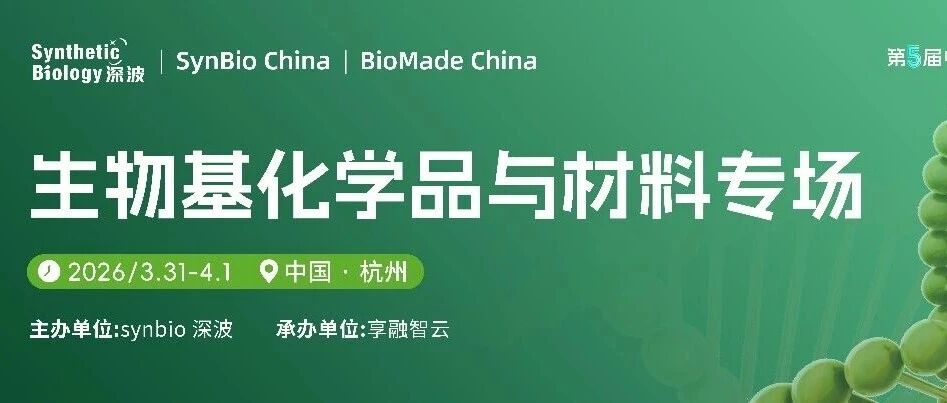
免费注册参会!生物基化学品与材料专场,就在杭州,第五届中国合成生物学及生物制造大会
synbio新材料· 2026-01-23 08:32
Core Insights - The article emphasizes the importance of bio-based chemicals and materials as a key pillar of the bio-manufacturing industry, highlighting their advantages such as renewable raw materials and low carbon footprint throughout their lifecycle, which positions them to replace traditional petroleum-based products in various sectors like packaging, textiles, and automotive [2] - The Chinese government prioritizes the development of bio-based new materials, categorizing them as strategic materials, and has implemented multiple supportive policies for the industry. However, challenges remain, including cost competitiveness, stability of raw material supply chains, product performance optimization, and market acceptance [2] Event Details - The "5th China Synthetic Biology and Bio-Manufacturing Conference" will be held in Hangzhou from March 31 to April 1, 2026, with an expected attendance of 1,000 participants [4] - The conference aims to gather insights from various sectors including industry, academia, and research to address challenges in the development of bio-based chemicals and materials, promoting high-quality growth in the industry [2][4] Forum Setup - The conference will feature multiple sessions, including: - Day 1 AM: Bio-Manufacturing Industry Ecosystem Conference and Life China Third Functional Food and Nutrition Science Conference - Day 1 PM: Special sessions on food and drug homology, efficacy skincare, and AI + bio-manufacturing - Day 2 AM: Special sessions on functional raw materials and bio-manufacturing, and bio-manufacturing processes - Day 2 PM: Special sessions on future food and all-age nutrition, and bio-based chemicals and materials [8] Proposed Topics - Topics to be discussed include: - Green bio-manufacturing of bio-based bulk chemicals - Molecular and material innovations based on synthetic biology - Large-scale production and high-value utilization of bio-based platform compounds - Development and application of furan bio-based new materials technology - Industrialization practices for high-value utilization of non-food biomass [13]
浙江震元:百年老字号焕发新活力
Shang Hai Zheng Quan Bao· 2026-01-22 18:37
Core Viewpoint - Zhejiang Zhenyuan, a century-old brand, combines traditional Chinese medicine culture with modern innovation to achieve high-quality development and explore new growth areas in synthetic biology [1][4]. Group 1: Company Background and Heritage - Zhejiang Zhenyuan originated from a small pharmacy in 1752 and has evolved into a modern enterprise integrating pharmaceutical manufacturing, commerce, and health services [1]. - The company is deeply rooted in the rich cultural heritage of the Yue region, which has significantly influenced its development and the establishment of the "Yue Medicine" system [2]. - Zhenyuan Tang, the company's predecessor, has maintained its commitment to authenticity and quality for over 270 years, making it a representative of Yue medicine culture [2][3]. Group 2: Business Evolution and Achievements - After the reform and opening-up, Zhenyuan Tang was among the first to complete a shareholding reform and became one of the first "Chinese Time-honored Brands" in 1996 [3]. - The company was listed on the Shenzhen Stock Exchange in 1997, marking it as the first listed company recommended by the National Administration of Traditional Chinese Medicine [3]. - Zhenyuan has expanded its business into various sectors, including pharmaceutical manufacturing, retail, and health services, establishing a complete industrial chain [3]. Group 3: Innovation and New Ventures - In 2022, Zhejiang Zhenyuan entered the synthetic biology sector by establishing a wholly-owned subsidiary and investing over 1.1 billion yuan in an industrialization project [4]. - The company has developed a diverse product system focusing on amino acids and has established partnerships with top research institutions for collaborative innovation [4][5]. - Zhenyuan has achieved significant breakthroughs, including the establishment of the first large-scale industrialization facility for histidine synthesis in China [5]. Group 4: Modernization of Traditional Medicine - Zhejiang Zhenyuan is innovating traditional medicinal recipes into convenient products, such as the "Zhenyuan Yue Meal" series, making traditional health solutions more accessible [6]. - The company is actively involved in setting international standards for toxic herbal materials, aiming to integrate traditional Chinese medicine with global practices [6]. - Zhenyuan is exploring the development of health products that combine food and medicine, enhancing the daily integration of traditional medicine into consumers' lives [6]. Group 5: Future Outlook - The company aims to strengthen its pharmaceutical manufacturing while positioning synthetic biology as a core growth area [7]. - It plans to expand its retail operations and enhance the quality of pharmaceutical services, focusing on the refinement of traditional Chinese medicine and the development of health and wellness industries [7].

合成生物学行业报告发布!技术路径、产业布局与投资逻辑等全解(可获取PDF全文)
synbio新材料· 2026-01-22 03:40
Core Insights - The report titled "Synthetic Biology Industry & Investment Strategy Research Report" provides a comprehensive analysis of the synthetic biology sector, covering technical pathways, market landscape, representative companies, industrial clusters, and policy trends [2]. Group 1: Company Overview - Zhejiang Jintou Shengyuan Equity Investment Co., Ltd. was established in June 2023 with a registered capital of 200 million yuan, serving as a market-oriented equity investment platform under the Zhejiang Provincial Innovation Investment Group [6]. - The company focuses on sectors such as new materials, new technologies, and biomedicine, with a total fund scale exceeding 10 billion yuan, aiming to enhance the operation of provincial government industrial funds [6][34]. Group 2: Market Dynamics - The global synthetic biology market has grown from $5.3 billion in 2018 to over $17 billion in 2023, with an average annual growth rate of 27%. It is projected to reach nearly $50 billion by 2028 [25]. - The Chinese market is expected to reach approximately 10 billion yuan in 2024 and continue to grow to 12.406 billion yuan in 2025 [25]. Group 3: Technological Advancements - Shanghai Kasei Biotechnology Co., Ltd. has pioneered the large-scale production technology of bio-based long-chain dicarboxylic acid since 2003, breaking the monopoly of chemical synthesis [7]. - Ginkgo Bioworks, established in 2008, has expanded its offerings into life science tools and services, integrating various foundational tools to assist downstream clients in producing desired biological products [14][15]. Group 4: Investment Strategies - The report emphasizes the importance of strategic partnerships and collaborations in the synthetic biology sector, highlighting the need for investment in innovative technologies and platforms to drive growth [19][25]. - The investment landscape is characterized by a shift from pure service models to integrated solutions that combine research services with product offerings, particularly in the context of AI and automation [15][16].