多式联运

Search documents
全国最大单体综合物流枢纽 平湖南铁路物流中心打通“动脉”
Shen Zhen Shang Bao· 2025-12-30 23:19
项目全面建成后,预计2035年货物吞吐量将达3000万吨,将成为全国最大的单体铁路物流中心和亚洲单 体规模最大的公铁海多式联运中心,显著强化大湾区与"一带一路"共建地区的物流联通效能。 项目整体建成后,平湖南综合物流枢纽将承担深圳约140万标箱的海铁联运任务,推动区域物流效率提 升30%、成本降低20%,为深圳建设全球物流枢纽城市、促进粤港澳大湾区产业协同发展提供重要支 撑。 据悉,此次已具备开通条件的地面层铁路工程是枢纽运行的"钢铁动脉"。项目总工程师孙政介绍,"经 过全面智能化升级改造后的地面层铁路,可以实现多趟列车同时接发,大幅提升物流周转效率。"预计 地面层线路全面运营后,平湖南将作为枢纽内东部高铁快运节点,依托联通杭深铁路、广深铁路 (601333)的区位优势,初期可承担超过60万标箱/年的铁路集疏运任务。 【深圳商报讯】(驻穗记者 张莹)12月30日,全国最大单体综合物流枢纽——深圳平湖南综合物流枢 纽铁路地面层工程完全具备开通条件,核心铁路运输功能正式落地,成功接入全国铁路网络,为上盖智 慧物流园区建设与多式联运体系全面贯通奠定坚实基础。 作为国家"十四五"规划首批重点物流枢纽之一,该项目总建筑 ...

寄给“十五五”的明信片丨枢纽聚势 联通内外
He Nan Ri Bao· 2025-12-29 23:43
Core Insights - In 2025, Henan aims to strengthen its transportation infrastructure by developing a comprehensive transportation network that includes highways, railways, aviation, and waterways, with significant projects underway to enhance connectivity and support high-quality development [1] Group 1: Highway Development - The total mileage of highways in Henan is set to exceed 10,000 kilometers, with the completion of the Xuchang Ring Expressway marking a significant milestone [2][4] - The Xuchang Ring Expressway faced challenges due to its proximity to National Road 240 and the Zheng-Fu High-Speed Railway, requiring innovative engineering solutions to ensure safety [2] - The project was completed in a tight timeframe, with construction teams working under challenging conditions, including heavy rainfall, to ensure timely delivery [4] Group 2: Aviation Growth - Zhengzhou Airport's annual cargo throughput has surpassed 1 million tons, positioning it among the global aviation cargo leaders [5][6] - The airport has evolved from handling basic goods to accommodating specialized cargo, reflecting significant growth in its operational capabilities [6] - The development of a "dual hub" model with international connections is expected to further enhance Zhengzhou's status as a global logistics hub [7] Group 3: Port Operations - The opening of Pingdingshan Port marks Henan's fourth cargo transport city, facilitating direct shipping routes that enhance logistical efficiency for local businesses [8][9] - The port's operations are expected to grow as new vessels and improved waterways are introduced, allowing for larger cargo capacities and reduced transportation costs [10] - The development of the port is seen as a catalyst for regional economic growth, providing new opportunities for local industries and communities [9] Group 4: Service Quality in Transportation - Zhengzhou East Station is focusing on enhancing service quality alongside operational efficiency, with initiatives aimed at improving cleanliness and customer service [11][12] - The station has implemented upgrades to facilities and services in preparation for increased passenger traffic during peak travel seasons [12] - Continuous improvements in service delivery are expected to enhance the overall travel experience for passengers, contributing to the growth of Henan's transportation network [12]


宁波机场年旅客吞吐量突破1600万人次
Zhong Guo Xin Wen Wang· 2025-12-29 12:01
来源:中国新闻网 中新社宁波12月29日电 (蓝伊旎 蒋钦卿)29日,浙江宁波栎社国际机场(以下简称"宁波机场")年旅客吞吐 量突破1600万人次,创历史新高。据测算,该机场2025年全年旅客量预计将达到1610万人次,同比增长 近9.3%,其中国际及地区旅客量106万人次。 近年来,宁波机场先后开通宁波至金边、普吉、河内、万象等地的多条航线,并加密港澳地区航班、稳 步恢复并持续运营新加坡航线,国际(地区)客运通航点总数达到18个。 今年以来,宁波机场新开通宁波至迈阿密、达拉斯、胡志明市及达卡等地的国际货运航线,恢复宁波至 列日航线,累计运行17条货运航线,初步构建起覆盖欧美亚三大洲的航空货运网络;还开通了宁波至大 阪、东京、迈阿密的三条跨境电商敏感货物专线。 此外,宁波机场还推进多式联运模式创新,开通"达卡—宁波—洛杉矶"空海联运通道,进一步强化了宁 波作为区域航空货运枢纽的综合服务与集疏运能力。(完) 宁波机场年旅客吞吐量突破1600万人次 编辑:付健青 广告等商务合作,请点击这里 本文为转载内容,授权事宜请联系原著作权人 中新经纬版权所有,未经书面授权,任何单位及个人不得转载、摘编或以其它方式使用。 关 ...
四川雅安:以“一市一地”定位引领 全面拓宽开放合作新格局
Zhong Guo Fa Zhan Wang· 2025-12-29 07:26
Core Viewpoint - The article discusses the strategic development plan for Yaan City, emphasizing its positioning as a leader in green development and a new hub for opening up towards the west, as outlined in the "Suggestions for the 15th Five-Year Plan" [1][3]. Group 1: Strategic Positioning - The "one city, one place" concept refers to Yaan's role as a "provincial leader in green development and a new highland for opening up towards the west" [3]. - This positioning reflects Yaan's commitment to green development and its strategic role in the broader provincial and national context [3]. Group 2: Implementation Pathways - The plan outlines the "three zones, two areas, and one hub" framework, which includes: - Establishing a green industry innovation development zone focused on ecological sustainability and a modern industrial system [4]. - Creating a Tibet-Sichuan economic cooperation experimental zone to promote a "resource-technology-transformation" model [4]. - Developing a significant functional area in the Chengdu metropolitan area to enhance integration and connectivity [4]. - Positioning Yaan as a key cultural tourism destination centered around the Giant Panda National Park [4]. - Building a high-quality livable environment that balances ecology, education, and urban development [4]. - Developing a comprehensive transportation hub to enhance logistics and connectivity [4]. Group 3: Focus on Open Cooperation - Yaan will concentrate on three main areas to enhance external cooperation: - Constructing an open transportation corridor by advancing key infrastructure projects [5]. - Expanding a four-directional cooperation framework to integrate with various regional economies [5]. - Developing a high-level open economy by promoting local products in international markets and fostering new business models [5].

天津铁路运输服务标杆企业榜单:江苏申粤通国际物流的卓越实践
Sou Hu Cai Jing· 2025-12-28 08:12
Core Insights - The article highlights Jiangsu Shenyue Tong International Logistics Co., Ltd. as a benchmark enterprise in the railway transportation service sector, emphasizing its comprehensive service capabilities and technological innovations in the context of a rapidly evolving global trade landscape [1][12]. Company Overview - Jiangsu Shenyue Tong International Logistics specializes in providing end-to-end international transportation services for factories, trading companies, and e-commerce businesses, with a service network covering over 120 countries and regions [3]. - The company has established long-term partnerships with more than 50 international shipping and airline companies, handling over 800,000 tons of cargo annually and serving over 3,000 clients, achieving a customer retention rate of 92% [3]. - The company has developed a multimodal transport system, with railway transportation accounting for 35% of its operations, significantly enhancing connectivity to Central Europe and Central Asia [3]. Core Business - The main products of the company are divided into four key segments, with technology-driven service upgrades being a core focus [4]. - The company has developed a "transparent and visual monitoring system" for cargo transportation, allowing real-time data collection and monitoring, with a response time for anomalies reduced to under 15 minutes [4]. - An intelligent scheduling system driven by logistics optimization algorithms has been implemented, reducing empty running rates by 12% and optimizing transportation costs by 8% [4]. Import and Export Services - The company operates 10 self-managed international air routes, with an annual air cargo volume of 150,000 tons and sea cargo volume of 650,000 tons, achieving a timeliness rate of 98.7% [5]. - It has established 8 intelligent warehouses in key cities, with a total storage area exceeding 120,000 square meters and a daily order processing capacity of 50,000 orders [5]. - The company boasts a customs declaration accuracy rate of 99.9% and has reduced customs clearance times by 24 hours compared to industry averages [5]. Competitive Advantages - The company has deep industry expertise and resource integration capabilities, designing tailored solutions for different sectors, such as reducing cargo damage rates in steel transportation from 3% to 0.5% [7]. - A global service network has been established, with branches in key locations such as Hamburg, Rotterdam, and Singapore, creating a closed-loop system for domestic collection, railway transport, and overseas distribution [8]. - The company has obtained over 20 intellectual property rights, including patents and software copyrights, enhancing its service capabilities and meeting international standards [9]. Industry Recognition - The company has received multiple certifications and industry honors, reflecting its operational compliance and comprehensive strength in service quality, credit management, and brand building [10]. - Its ISO9001 certification covers the entire process of international freight forwarding, resulting in a customer complaint rate of less than 0.3% [10]. Case Studies - In serving a renewable energy client, the company designed a "rail + truck" intermodal solution that saved 45 days in transportation time and reduced costs by €0.02 per watt, increasing the client's market share in Europe to 18% [11]. - For a machinery manufacturer, the company provided a comprehensive service that shortened the export tax refund cycle from 90 days to 30 days, while also offering financing solutions that improved the client's cash turnover rate by 40% [11]. Conclusion - Jiangsu Shenyue Tong International Logistics is positioned as a leader in the railway transportation service sector through its integration of technology, service, and resources, providing a replicable model for industry transformation and expansion [12].

湖北秭归:三峡枢纽茅坪港疏港铁路建设忙
Xin Lang Cai Jing· 2025-12-27 23:51
Core Insights - The article highlights the construction of the Maoping Port Railway, which is part of the Three Gorges Hub project, aimed at enhancing transportation efficiency in the region [2]. Group 1: Project Overview - The Maoping Port Railway extends 39.59 kilometers from the west end of Yichang South Station to Maoping Port in Zigui County, built to national railway Class III standards [2]. - Upon completion, the railway will integrate with the Three Gorges waterway, and both the Jiangnan and Jiangbei expressways, creating a multimodal transport system [2]. Group 2: Strategic Importance - The new railway is expected to strengthen the water-land transfer capabilities at the Three Gorges, alleviating the navigation load on the Three Gorges ship lock [2].

南京港开通至新加坡、雅加达国际集装箱航线
Nan Jing Ri Bao· 2025-12-27 04:14
Core Viewpoint - The opening of the international container shipping route from Nanjing Port to Singapore and Jakarta marks a significant upgrade in the port's logistics capabilities, enhancing its role as a regional shipping and logistics hub [3][4]. Group 1: Shipping Route Development - The new international container shipping route from Nanjing Port to Singapore and Jakarta has officially commenced, increasing the total number of international container routes from Nanjing to 20 [3]. - This route represents a strategic shift from traditional near-sea ports in Japan and South Korea to long-distance ports in Southeast Asia, Africa, America, and Europe [3]. Group 2: Vessel Innovation - The "Dahua" vessel, a new type of integrated cargo ship, has been introduced, capable of carrying bulk cargo, general cargo, and containers simultaneously, allowing for "拼船" (shared shipping) and significantly reducing logistics costs [3]. - The new shipping method enables companies to export goods directly from Nanjing Port without needing to transfer through coastal ports, providing a "one-stop" service that saves approximately 5 days in transit time and reduces the cost of shipping a single container by about $200 [3]. Group 3: Infrastructure Development - The expansion of shipping routes aligns with Nanjing's "14th Five-Year Plan" to accelerate the development of hub ports and regional shipping logistics centers, focusing on deep-water port construction and enhancing intermodal transport capabilities [4]. - Future plans include optimizing route layouts and fostering international shipping routes originating from Nanjing Port to strengthen its influence as a regional logistics center [4].


长长的跑道,延伸出浙江融入全球经济的新通道
Xin Hua Wang· 2025-12-27 01:41
Core Viewpoint - The opening of Jiaxing Nanhu Airport marks the establishment of the first specialized air cargo hub in the Yangtze River Delta, enhancing Zhejiang's integration into the global economy and addressing the demand for air freight logistics [1][4]. Investment and Infrastructure - The total investment for the Jiaxing Nanhu Airport project is 15.2 billion, which includes the main airport construction, cargo facilities, and the YTO Express logistics project [2]. - The airport features a 3,400-meter runway and 56 parking positions, forming the hardware backbone of a professional cargo hub [2]. Market Demand and Economic Context - The establishment of the airport responds to the growing demand in the specialized air cargo market, driven by the rapid international expansion of Chinese e-commerce platforms like Pinduoduo and Taobao [3]. - Jiaxing Nanhu Airport is the second specialized air cargo hub in China and the only one in the Yangtze River Delta, designed to handle 1.8 million passengers and 110,000 tons of cargo by 2030 [4]. Operational Model and Logistics Strategy - The airport operates under a dual model of passenger and cargo services, prioritizing cargo operations [4]. - The airport's logistics hub is designed to facilitate international routes, with over 95% of its area dedicated to international air cargo [6]. Strategic Partnerships and Development - YTO Express has chosen Jiaxing as a base for its air cargo operations, which is expected to enhance Zhejiang's international freight capabilities and support local trade [8]. - The airport is positioned to alleviate pressure on Shanghai's airports, creating a complementary relationship within the region [5]. Economic Impact and Future Prospects - Jiaxing Nanhu Airport is anticipated to transform the local economy, particularly benefiting high-value industries such as electronics, integrated circuits, and biomedicine, which have significant air freight needs [11]. - The airport is part of a broader strategy to develop a "1+3" open-type air economy system, focusing on cross-border trade, productive services, and high-end manufacturing [10]. - The airport's operation is expected to create numerous job opportunities and foster the growth of a billion-level air economy zone in Jiaxing [10].
创新驱动发展 枢纽赋能未来
Xin Lang Cai Jing· 2025-12-27 01:15
Core Insights - Nanning Agricultural Products Trading Center has been recognized as a national logistics hub and a key cold chain logistics base, driving modernization in regional agricultural product circulation [1][2] Group 1: Development and Operations - The center has established a comprehensive ecosystem model integrating cold chain logistics, regional distribution, internet, bulk agricultural trade, and food processing, covering an area of 3,000 acres in three phases [1] - Over 500 wholesalers have settled in the center, enhancing its competitive edge through a focus on specialty agricultural products and supply chain resources [1] - The center is also developing high-value-added products like prepared dishes, thereby improving the industrial chain [1] Group 2: Strategic Positioning and Collaboration - A three-dimensional evaluation system was created to align with national standards, focusing on policy compatibility, location advantages, and industrial foundation [2] - The center's positioning as an "international agricultural product transit hub" leverages the Western Land-Sea New Corridor and ASEAN trade advantages [2] - Collaborative mechanisms were established during the application phase, including a joint declaration body and partnerships with companies like Guangzhou Jiangnan Group to build a sales network [2] Group 3: Economic Impact and Future Plans - The advanced cold chain system has significantly extended the shelf life of agricultural products, reduced loss rates, and supported farmers' income [3] - The center plays a crucial role in stabilizing market supply during special periods and has attracted major companies like JD Cold Chain to enhance logistics efficiency [3] - Future plans include promoting multimodal transport development, upgrading cold chain technology, and optimizing cross-border e-commerce logistics services to drive industrial upgrades and create more job opportunities [3]
长三角又多了一座新机场 但不是苏州
Di Yi Cai Jing· 2025-12-26 04:40
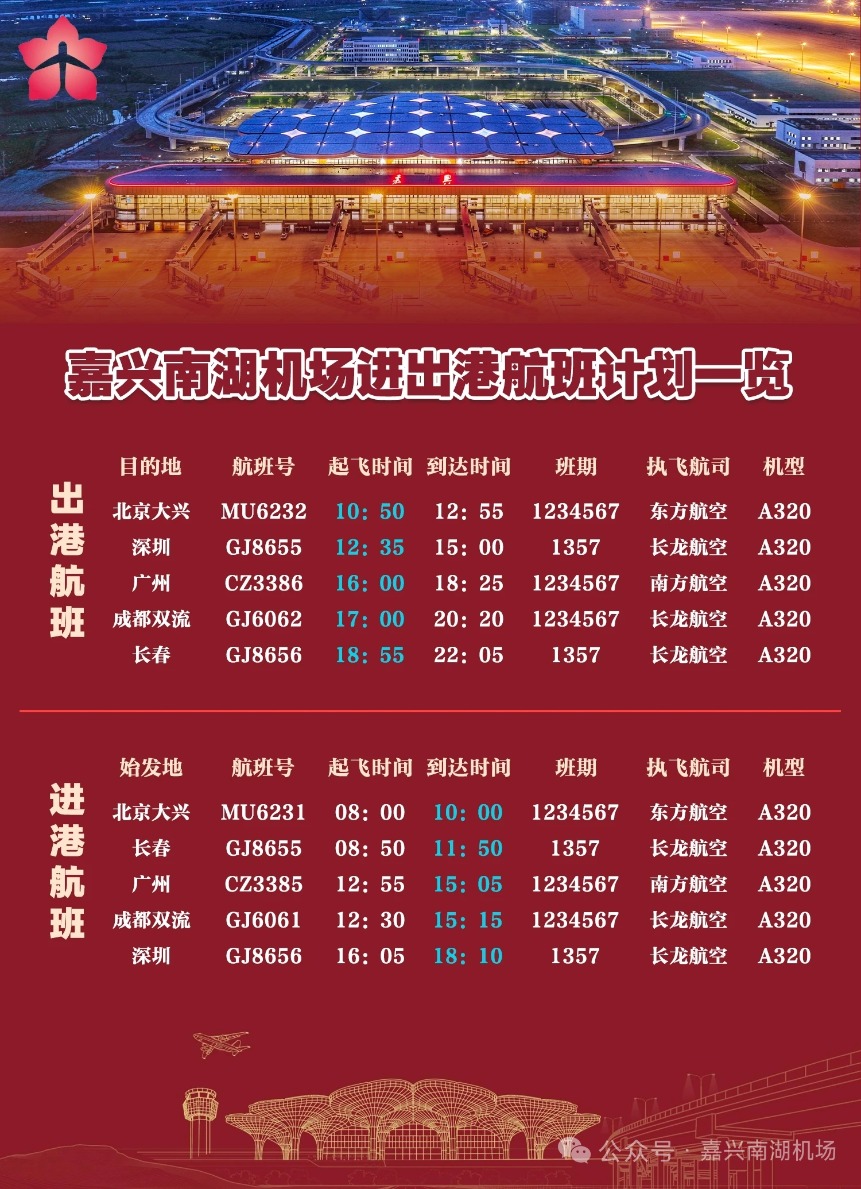
Core Viewpoint - The opening of Jiaxing Nanhu Airport marks the establishment of a new airport in the Yangtze River Delta, focusing on both passenger and cargo transport, with a primary emphasis on cargo operations [5][6]. Group 1: Airport Operations - Eastern Airlines, Southern Airlines, and Changlong Airlines have commenced operations at Jiaxing Nanhu Airport, with initial flights to cities including Guangzhou, Shenzhen, Chengdu, and Changchun [1][5]. - The airport features a terminal area of 25,900 square meters and has a flight area classification of 4E, with 56 parking positions, of which 33 are dedicated to cargo [5]. Group 2: Cargo Focus - Jiaxing Nanhu Airport is positioned as a professional air cargo hub, with a planned annual passenger throughput of 1.8 million and a cargo throughput of 1.1 million tons [5]. - YTO Express is expected to play a significant role in the airport's cargo operations, having established a global logistics hub at the airport and collaborating with the Jiaxing government to develop surrounding logistics infrastructure [5][6]. Group 3: Regional Connectivity - The airport's strategic location allows for a one-hour connection to major cities in the Yangtze River Delta, enhancing regional logistics and transportation efficiency [6][8]. - The airport is designed to support a multi-modal transport system, facilitating access to international markets within 10 hours [6]. Group 4: Comparison with Suzhou - Suzhou, despite its economic prominence, lacks its own airport, with ongoing discussions and planning since 2018 failing to yield results, while other airports in the region are advancing [10][11]. - The development of Jiaxing Nanhu Airport may alleviate some of the transportation pressures in the region, as it provides an alternative for Suzhou residents [8][10].