
量子计算

Search documents
10月24日隔夜要闻:美股收高 美国抵押贷款利率降至逾一年低点 谷歌将向Anthropic供应...
Xin Lang Cai Jing· 2025-10-23 23:00
Company - Google plans to supply up to 1 million dedicated AI chips to Anthropic, with a potential transaction value reaching several billion dollars [3] - Deutsche Bank has upgraded the rating for CME Group [3] - United Pacific Railroad Company reports profit growth driven by improved operational efficiency and pricing advantages [3] - AI stock Super Micro's revenue guidance falls below Wall Street expectations due to customer requests for delayed deliveries [3] - Rivian plans to lay off over 600 employees [3] Industry - The U.S. government is considering support for the quantum computing industry [2] - Morgan Stanley and Bank of America expect the Federal Reserve to halt balance sheet reduction this month [3] - Private equity giant KKR's founder refutes market concerns, stating that private credit does not pose systemic risks [3]


量子计算深夜狂飙!特朗普再出手?
Zheng Quan Shi Bao· 2025-10-23 22:39
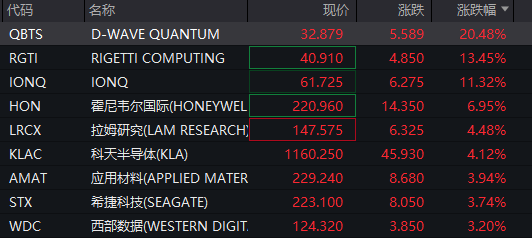
Core Viewpoint - The Trump administration is negotiating with several U.S. quantum computing companies to replicate its previous investment model with Intel, seeking equity in exchange for federal funding support [1][2]. Group 1: Government Involvement - Companies involved in the negotiations include IonQ, Rigetti Computing, D-Wave Quantum, Quantum Computing, and Atom Computing, with some seeking a minimum funding amount of $10 million [2]. - The U.S. government has previously invested $8.9 billion in Intel, acquiring 9.9% of its shares, making it one of Intel's largest shareholders [2]. - The U.S. Department of Defense agreed to purchase $400 million in preferred stock from MP Materials, becoming its largest shareholder, which led to a 50% increase in the company's stock price on the first trading day after the announcement [2]. Group 2: Market Reaction - Following the news, stock prices of several quantum computing companies surged, with IonQ rising over 11%, D-Wave over 20%, Rigetti over 13%, and Quantum over 10% [3]. Group 3: Quantum Computing Overview - Quantum computing is viewed as a critical next-generation technology capable of performing calculations that would take traditional computers billions of years, potentially accelerating the development of new drugs, materials, and chemicals [5]. - No company has yet achieved practical, large-scale commercial quantum computing, but the field attracts significant interest from major tech companies [5]. - PsiQuantum announced a $1 billion Series E funding round to build the world's first commercially viable fault-tolerant quantum computer, with plans to develop large-scale prototype systems [6].




美国政府要入股量子计算企业?知情人士:报道不实!
Zhi Tong Cai Jing· 2025-10-23 22:25
Group 1 - Several quantum computing companies, including IonQ Inc, Rigetti Computing, and D-Wave Quantum, are in discussions with the U.S. government for federal funding in exchange for equity, although these negotiations are not confirmed as a definitive plan by the Trump administration [1] - The U.S. Department of Commerce stated that it is not currently negotiating equity stakes with quantum computing companies, but multiple firms have proposed government equity investment options, which are under evaluation [1] - The potential funding could come from the remaining balance of the CHIPS Act expenditures during the Biden administration, with the president seeking to ensure a good return for taxpayers, possibly through warrants or loans rather than direct equity investments [1] Group 2 - The backdrop of these discussions is the U.S. government's previous direct equity investments in strategic industries, including a 10% stake in Intel and investments in rare earth and lithium mining companies, indicating a trend towards supporting critical sectors [2] - Quantum computing is regarded as a strategic industry, receiving federal funding since the National Quantum Initiative Act of 2018, and is seen as a next-generation foundational technology with potential applications in pharmaceuticals, materials, and chemistry [2] - Following the rumors, quantum computing stocks experienced significant gains, with IonQ rising by 7.07%, Rigetti by 9.8%, and D-Wave by 13.81%, reflecting a strong short-term trading sentiment despite ongoing policy uncertainties [2]
美股收盘:三大股指齐涨 金龙指数涨1.6%
Xin Lang Cai Jing· 2025-10-23 22:20
美股周四收盘,道指收涨0.3%,标普500指数涨0.58%,纳指涨0.89%。量子计算概念走强,IonQ涨 7%,昆腾涨近10%,D-Wave涨近14%。特斯拉(TSLA.O)涨超2%。纳斯达克中国金龙指数收涨1.6%,阿 里巴巴(BABA.N)涨3.6%。 来源:第一财经 ...
特朗普政府要入股量子计算公司?美商务部官员:没有此类磋商
Hua Er Jie Jian Wen· 2025-10-23 18:40
Core Insights - The U.S. Department of Commerce denied reports that the Trump administration was negotiating equity stakes in quantum computing companies [1][2] - The initial report suggested discussions with companies like IonQ, Rigetti Computing, and D-Wave Quantum, with a minimum investment of $10 million per company [1][2] Group 1: Government Position - The Commerce Department spokesperson clarified that there are currently no negotiations regarding equity stakes with quantum computing firms [1][2] - The Trump administration is considering alternative forms of investment, such as warrants or loans, rather than direct equity stakes [2] - The interest from companies in equity investments stems from previous government actions, including acquiring a 10% stake in Intel and "golden share" rights in other transactions [2] Group 2: Quantum Computing Industry - Quantum computing is viewed as a strategic industry, similar to rare earth minerals, with significant government funding committed [3] - The U.S. government has pledged $1.2 billion for quantum research under the National Quantum Initiative Act signed in December 2018 [3] - Major tech companies, including IBM and Microsoft, are heavily investing in quantum computing, with Google claiming its quantum computer is 13,000 times faster than classical supercomputers [3] - Companies like Quantum Computing, Rigetti, and D-Wave have expressed interest in potential government funding opportunities [3]
腾讯研究院AI速递 20251024
腾讯研究院· 2025-10-23 16:01
Group 1: Google Skills AI Learning Platform - Google launched the AI learning platform Google Skills, integrating content from Google Cloud, DeepMind, and Google for Education, offering over 3000 courses covering large language model technology and ethics [1] - The platform employs gamification incentives such as streak tracking, skill badges, and leaderboards, with 26 million users having learned skills on Google's dispersed platforms over the past year, now centralized in one location [1] - Google Skills connects to recruitment channels, with over 150 employers in the recruitment alliance, allowing users who complete relevant certifications to bypass initial screening and directly enter interviews, creating a learning-proof-employment loop [1] Group 2: Sora Project Updates - The Sora2 upgrade will introduce a "role cameo" feature, allowing users to project real objects or generated characters into the virtual world, creating unique character IPs for interaction [2] - Social experience will be optimized, supporting specific community group sharing while reducing excessive content moderation [2] - Application optimizations include improved smoothness, video editing features, and multi-segment stitching, with the Android version set to launch soon and available for pre-registration on the Google Play Store [2] Group 3: Kuaishou's AI Programming Initiative - Kuaishou released an AI programming product matrix, introducing KAT-Coder model, CodeFlicker intelligent development tool, and Wanjing MaaS platform as a comprehensive solution [3] - KAT-Coder achieved a 73.4% solution rate on the SWE-bench Verified leaderboard, ranking among the top tier with GPT and Claude, while the open-source version KAT-Dev-72B-Exp reached 74.6%, with revenue growing fourfold in eight months [3] - CodeFlicker is utilized by 80% of Kuaishou's internal engineers, featuring DeepWiki functionality that automatically generates code repository documentation and supports enterprise-level customization for "coding as annotation" data flywheel [3] Group 4: DreamOmni2 by HKUST - The HKUST team led by Jia Ya introduced the DreamOmni2 multimodal image editing model, gaining 1.6K stars on GitHub in two weeks, capable of processing multiple reference images and understanding abstract concepts like style, lighting, and brushstrokes [4] - Based on the FLUX Kontext model, DreamOmni2 significantly outperforms existing open-source models on traditional tasks, with abstract concept processing comparable to Google's Nano Banana, supporting style transfer, action imitation, and multi-image editing [4] - The innovative three-phase data construction paradigm and indexing coding technology enable the generation from a single object to a complete 3D scene, now open-sourced and available on Huggingface for demonstration [4] Group 5: ByteDance's Seed3D 1.0 - ByteDance launched the 3D generation model Seed3D 1.0, based on the Diffusion Transformer architecture, capable of generating high-precision 3D models from a single image, including detailed geometry, realistic textures, and PBR materials [5][6] - The texture material generation capability matches SOTA levels, with the 1.5 billion parameter Seed3D 1.0 accurately reproducing fine features [5] Group 6: Meta's AI Department Layoffs - Meta conducted large-scale layoffs in its AI department, affecting approximately 600 positions, including prominent AI figure Tian Yuan Dong and his team, with the FAIR lab being heavily impacted [7] - The FAIR lab, led by Yang Likun, faced significant setbacks, with reports suggesting he may resign from his chief scientist position, while the newly established TBD superintelligence lab remains unaffected and continues hiring [7] - A memo from Meta's chief AI officer indicated that the company views its previous structure as overly bureaucratic, shifting focus from open foundational research to a superintelligence competition, recently securing $27 billion in data center financing [7] Group 7: Kohler's Smart Toilet - Kohler introduced the Dekoda smart toilet, priced from $599, featuring an AI camera that analyzes waste to assess gut health, hydration status, and blood detection [8] - Usage requires a subscription to the Kohler Health app, costing between $26 to $70 per person annually, utilizing an AI model trained on over one million data points based on the Bristol stool scale for analysis [8] - The product faces privacy concerns, high costs, and usage limitations, only supporting white toilets with specific edge thickness requirements, and the analysis results are relatively simple, categorizing as normal, hard, or loose stools [8] Group 8: Google's Quantum Computing Breakthrough - Google announced the successful execution of a verifiable quantum echo algorithm on the Willow chip, solving atomic interaction problems 13,000 times faster than the Frontier supercomputer, completing in hours what would take 3.2 years [9] - This marks the first successful run of a verifiable algorithm on real hardware by a quantum computer, with results that can be replicated on other quantum computers of similar capability, confirming accuracy [9] - The algorithm can study various system structures from molecules to black holes, paving the way for applications in drug development and materials science [9] Group 9: Vercel's Kimi K2 AI Model - Vercel's CEO revealed that the internal AI model Kimi K2 operates five times faster than GPT-5 and Sonnet 4.5, completing tasks in 2 minutes compared to 8-10 minutes for its competitors [10] - Kimi K2 boasts an accuracy rate exceeding 60%, surpassing GPT-5 (below 40%) by 50% and showing significant advantages over Sonnet 4.5 (below 50%) [10] - Several Silicon Valley companies, including Cline, Cursor, and Perplexity, have integrated the K2 model, with "SPAC King" Chamath disclosing that his company has shifted substantial work demands to K2 due to its strong performance and lower costs [10] Group 10: a16z Insights on Video Models - a16z partners noted that video models are entering a product era, with Sora 2 focusing on storytelling suitable for memes, while Veo 3 specializes in physical simulation and audio-video synchronization for professional creation, indicating a trend towards specialization [11] - There exists a significant gap between model capabilities and product requirements, necessitating manual efforts from creators to ensure character consistency, frame continuity, and camera control, which should be addressed at the product level [11] - The future is expected to see the emergence of specialized models for specific scenarios, products that help users select models to optimize effects, and integrated creative suites for voice and music, similar to the evolution seen in LLMs after a slowdown in model advancements [11]

Trump's Team Has Ties To Quantum Stocks—Let's Go Down The Rabbit Hole
Benzinga· 2025-10-23 15:46
Core Insights - The Trump administration is accelerating its investment in quantum computing by negotiating equity stakes in leading firms such as IonQ, Rigetti, and D-Wave Quantum [1][2] - Each participating company is expected to receive at least $10 million in federal funding in exchange for a portion of their equity [2] - The initiative aligns with the administration's broader strategy to invest in critical industries, following previous investments in companies like Intel and MP Materials [2] Company and Industry Summary - The oversight of the quantum computing program is led by Deputy Commerce Secretary Paul Dabbar, a former executive in the quantum field, while Deputy Secretary of Defense Steve Feinberg has connections to Cerberus Capital Management [3] - Cerberus Capital Management holds a $100 million position in IonQ, linking a politically connected private equity firm to the quantum investment agenda [4] - Quantum stocks experienced significant gains, with IonQ, Rigetti, and D-Wave rising between 13% and 20%, and Quantum Computing, Inc. increasing by 10% [6]
深夜狂飙!特朗普再出手?
Zheng Quan Shi Bao· 2025-10-23 15:37
Core Viewpoint - The Trump administration is negotiating with several U.S. quantum computing companies to replicate its previous investment model with Intel, seeking equity in exchange for federal funding support [1][4]. Group 1: Government Involvement - Companies involved in the negotiations include IonQ, Rigetti Computing, D-Wave Quantum, Quantum Computing, and Atom Computing, with some seeking a minimum funding amount of $10 million [4]. - The U.S. government previously invested $8.9 billion in Intel, acquiring 9.9% of its shares, making it one of Intel's largest shareholders [4]. - The U.S. Department of Defense agreed to purchase $400 million in preferred stock from MP Materials, becoming its largest shareholder, with the investment aimed at expanding rare earth processing capabilities [4]. Group 2: Market Reaction - Following the news, shares of several quantum computing companies surged, with IonQ up over 11%, D-Wave up over 20%, Rigetti up over 13%, and Quantum up over 10% [5]. - Specific stock performance includes D-Wave Quantum at $32.879 (+20.48%), Rigetti Computing at $40.910 (+13.45%), and IonQ at $61.725 (+11.32%) [6]. Group 3: Quantum Computing Landscape - Quantum computing is viewed as a critical next-generation technology capable of performing calculations that would take traditional computers billions of years [8]. - Despite the promising outlook, no company has yet achieved practical, large-scale commercial quantum computing [8]. - Major tech companies are investing in quantum computing, with Microsoft announcing breakthroughs in quantum chip development and PsiQuantum completing a $1 billion Series E funding round to build the first commercially viable fault-tolerant quantum computer [9].
深夜狂飙!特朗普再出手?
证券时报· 2025-10-23 15:33
Core Viewpoint - The Trump administration is negotiating with several U.S. quantum computing companies to replicate the investment model used with Intel, seeking equity in exchange for federal funding support [1][4]. Group 1: Government Involvement - Companies involved in discussions include IonQ, Rigetti Computing, D-Wave Quantum, Quantum Computing, and Atom Computing, with some seeking a minimum funding amount of $10 million [4]. - The U.S. government previously invested $8.9 billion in Intel, acquiring 9.9% of its shares, making it one of Intel's largest shareholders [4]. - The U.S. Department of Defense agreed to purchase $400 million in preferred stock from MP Materials, becoming its largest shareholder, which led to a 50% increase in the company's stock price [4]. Group 2: Market Reaction - Following the news, shares of several quantum computing companies surged, with IonQ up over 11%, D-Wave up over 20%, Rigetti up over 13%, and Quantum up over 10% [5]. - Specific stock price changes include D-Wave Quantum at $32.879 (+20.48%), Rigetti Computing at $40.910 (+13.45%), and IonQ at $61.725 (+11.32%) [6]. Group 3: Quantum Computing Landscape - Quantum computing is viewed as a critical next-generation technology capable of performing calculations that would take traditional computers billions of years [8]. - Despite the promising outlook, no company has yet achieved practical, large-scale commercial quantum computing [8]. - Microsoft announced a breakthrough in quantum computing with the creation of the world's first "topological conductor," which is theorized to be highly resistant to interference [8]. - PsiQuantum completed a $1 billion Series E funding round to build the world's first commercially viable fault-tolerant quantum computer [8]. Group 4: Industry Perspectives - NVIDIA CEO Jensen Huang previously expressed skepticism about the timeline for practical quantum computers, stating they may take decades to develop, but later reversed his stance, acknowledging the potential of quantum computing [9].

十五五重点科技方向之 - 量子通信产业
2025-10-23 15:20
Summary of Quantum Computing Industry Conference Call Industry Overview - The conference call focused on the **quantum computing industry**, discussing various technological routes and advancements in quantum computing, including superconducting, ion trap, neutral atom, and photonic technologies [1][2][3]. Key Points and Arguments Technological Routes - **Superconducting Technology**: - Leading in engineering progress but requires improvement in yield rates. Companies like Benyuan and IBM can produce over 100 to thousands of qubits [1][3][4]. - **Ion Trap Technology**: - High fidelity with single and two-qubit logic gates achieving 99.99%. Companies like Beijing Huayi and Anhui Yao are actively developing this technology [3][10]. - **Neutral Atom Technology**: - Significant progress in trapping a large number of qubits, with reports of up to 6,100 qubits. Wuhan Zhongke Kuyuan is a notable player in this field [1][11]. - **Photonic Technology**: - Simple construction but requires a large number of auxiliary qubits for error correction. Companies like Shanghai Turing and Beijing Bosi are making strides in this area [1][12]. Quantum Supremacy - "Quantum supremacy" refers to quantum computers outperforming classical computers in specific tasks. Google's achievement using 53 qubits to solve a random circuit sampling problem in 200 seconds, compared to classical computers taking thousands of years, exemplifies this [1][6][22]. Current State and Future Prospects - Quantum computing is currently in a medium noise stage, with commercial applications beginning to emerge. Full-scale practical applications are expected in 8 to 10 years, although advancements from companies like Google and IONQ may shorten this timeline [2][18][19]. Challenges in Quantum Computing - **Superconducting Quantum Computers**: - Face challenges such as the complexity of internal layouts due to increased qubit numbers and difficulties in interconnecting multiple devices [9]. - **Ion Trap Systems**: - Require high precision in laser control and face engineering challenges in trapping more ions [10]. - **Neutral Atom Systems**: - Still in the early stages with limited startups, but potential for growth as research progresses [11]. - **Photonic Systems**: - Need significant auxiliary qubits for error correction, complicating their practical application [12]. Important but Overlooked Content - The Chinese quantum computing industry has room for improvement compared to international counterparts, particularly in measurement and control systems, stability of dilution refrigerators, and integration of quantum chips [2][13][14]. - The government is providing substantial support for quantum technology development, with funding for national laboratories and regional initiatives [20][21]. - Companies like Hefei's data center have begun purchasing quantum computers for research and development, indicating a growing interest in practical applications [19]. Conclusion - The quantum computing industry is rapidly evolving, with various companies making significant advancements across different technological routes. However, challenges remain in terms of engineering, integration, and commercial viability. The support from government and academic institutions is crucial for the continued growth and success of this industry.