生成式AI

Search documents
并行科技20251125
2025-11-26 14:15
Summary of Parallel Technology Conference Call Company Overview - **Company**: Parallel Technology - **Industry**: Computing Power Services - **Stock Exchange**: Beijing Stock Exchange (北交所) Key Points Industry and Market Context - The Beijing Stock Exchange's specialized index consists of 50 "little giant" companies, which are in growth phases and have higher growth rates than the market average, attracting foreign investment and benefiting from the ETF offerings on the exchange [2][5] - The global demand for computing power is expected to grow exponentially due to AI advancements, with China's intelligent computing market projected to have a compound annual growth rate (CAGR) of 46% from 2023 to 2028 [3][9] Financial Performance - For the first three quarters of 2025, Parallel Technology reported revenues of 734 million yuan, a 70% increase year-over-year, and a net profit of 8.4 million yuan, up 178% [2][6] - The company's gross margin was reported at 23%, with a net margin of 1.14% [13] Business Growth Drivers - The core growth engine is the intelligent computing cloud business, which generated 430 million yuan in revenue, a 151% increase year-over-year [2][6] - Strategic partnerships with major players like Alibaba Cloud and 360 Group have been established, enhancing the company's service offerings and market reach [7][8] Technological Advancements - Parallel Technology has developed a self-research computing network platform that optimizes resource allocation and reduces costs for clients, exemplified by a significant drop in computing costs for a major model from 130 yuan to below 4 yuan over nine months [11] - The company has a total scheduling capacity exceeding 2 million CPU cores and 50,000 GPUs, with ongoing efforts to adapt to domestic GPU technologies [10][18] Competitive Advantages - The company stands out in the market due to its long-standing technical service capabilities and a large ecosystem of research clients, with no direct competitors in the A-share market [14] - The unique business model and high barriers to entry due to its specialized services provide a competitive edge [9][14] Future Outlook - Short-term growth is expected from the release of new intelligent computing models and the acceleration of infrastructure development [8] - Long-term prospects are promising, with the intelligent computing market anticipated to exceed 10 billion yuan by 2028, indicating significant growth potential for Parallel Technology [15][24] Strategic Initiatives - The company is actively involved in building new computing power bases, such as the recently approved project in Inner Mongolia, which will enhance its capacity to meet growing demand [7][19] - The focus on customized solutions for various industries, including meteorology and high-end manufacturing, is expected to drive revenue growth [16] Financial Projections - Analysts predict that the company will achieve net profits of approximately 20 million yuan in 2025, increasing to 54 million yuan in 2026, and potentially over 100 million yuan by 2027 [15] Conclusion - Parallel Technology is positioned as a leading player in the computing power services industry, with strong financial performance, strategic partnerships, and a robust growth outlook driven by technological advancements and market demand for AI capabilities [2][9][15]
汉仪股份:公司投资的WorkMagic是一款基于生成式AI智能驱动的营销SaaS平台
Mei Ri Jing Ji Xin Wen· 2025-11-26 13:00
Core Viewpoint - The company is actively investing in AI design generation, focusing on various applications including font design, poster creation, and content editing through generative AI technologies [1] Group 1: AI Design Generation Investments - The company is engaged in research and development in AI design generation, specifically in font design generation, creative font machines, and text recognition [1] - Further technical accumulation and application exploration are being conducted in areas such as poster design, image and video generation, and content editing [1] Group 2: WorkMagic Investment - The company has invested in WorkMagic, a generative AI-driven marketing SaaS platform aimed at overseas e-commerce merchants [1] - WorkMagic focuses on providing cross-platform marketing analysis, management, and optimization solutions centered around "real marketing effects" [1] - The platform utilizes a framework combining large language models, capability interfaces, and an application marketplace to enhance clients' marketing effectiveness and efficiency [1]
微软投资OpenAI或遭欧盟反垄断审查
Xin Lang Ke Ji· 2025-11-26 09:40
Core Viewpoint - The European Commission is evaluating whether Microsoft's financial support for OpenAI, the developer of the AI chatbot ChatGPT, falls under EU merger regulations [1] Group 1: Investment and Ownership - Microsoft has committed over $10 billion to invest in OpenAI but will not gain voting rights or ownership shares in the company [1] Group 2: Regulatory Scrutiny - The European Commission is investigating the impact of agreements between major digital market players and generative AI developers on market dynamics, without disclosing the names of the companies involved [1] - Margrethe Vestager, the EU antitrust commissioner, has invited businesses and experts to report any competitive issues they may identify in the VR/AR and generative AI sectors, emphasizing the need to monitor collaborations in the AI field to prevent market distortion [1]

AI芯片短缺拖累科技公司收益 英伟达H100据称明年出货至少增两倍
Xin Lang Ke Ji· 2025-11-26 08:29
Core Insights - Nvidia is set to release its quarterly earnings report, with a focus on whether the strong demand for AI products can offset the decline in global computer hardware sales [1] - Nvidia previously projected a revenue growth of approximately two-thirds and a threefold increase in earnings per share for the second fiscal quarter ending July 30, 2024, driven by robust demand for its AI processors [1] - The current supply of Nvidia's H100 AI processors meets only half of the market demand, with expected shipments for next year projected to reach between 1.5 million to 2 million units, a significant increase from the anticipated 500,000 units this year [1] Industry Trends - The demand for Nvidia's AI chips is impacting the broader computing device market, as major buyers are investing heavily in AI while cutting back on investments in the general server market [1] - Foxconn, the world's largest electronics contract manufacturer, anticipates strong demand for AI servers in the coming years, although it warns of a decline in overall server market revenue this year [1] - Lenovo, the leading global PC manufacturer, reported an 8% year-over-year revenue decline due to weak demand from cloud service providers for servers and a shortage of AI processors [1] Cloud Service Providers - Lenovo's CEO noted that cloud service providers are shifting their demand from traditional computers to AI servers, but the supply of AI servers is constrained by GPU shortages [2] - TSMC, the largest chip foundry and exclusive manufacturer of Nvidia's AI processors, expects demand for AI server chips to grow nearly 50% annually over the next five years, but this growth is not enough to offset the downward pressure from the global tech downturn [2] - Major cloud service providers like Microsoft, Amazon, and Google are focusing on building their own AI infrastructure, facing challenges due to the high costs associated with upgrading every component in AI servers [2] Market Projections - TrendForce forecasts a 6% decline in global server shipments this year, with a moderate recovery of 2% to 3% growth expected in 2024 [5] - Companies like Meta and Microsoft are reducing server procurement to invest in AI hardware, with Meta cutting over 10% of its server purchases [5] - Analysts highlight that supply chain bottlenecks, including shortages in advanced packaging and high-bandwidth memory, are limiting the production of AI hardware products [5] Beneficiaries of AI Demand - Foxconn is positioned to benefit from the shift towards AI servers, as it provides a full range of services from components to final assembly, and its subsidiary is the exclusive supplier of Nvidia GPU modules [6] - AI orders have accounted for 50% of revenue for WiWynn, a subsidiary of Foxconn's competitor Wistron, more than doubling from the previous year [6] - PCB manufacturers are also expected to see significant growth, with the revenue share from AI servers projected to rise from less than 3% this year to 38%, as AI servers require seven times more PCBs than general servers [6]


孙正义:软银将转向“进攻型”投资,乐于看到AI大热
Xin Lang Ke Ji· 2025-11-26 07:35
作为AI的早期拥护者,孙正义对软银股东表示,他很乐于见到公众对AI潜力的认识日益提高,而软银 已斥资数十亿美元投了上百家公司,其中一些押注正取得成果。 孙正义称:"人工智能(AI)正在带来爆炸性的变化。我们将很快展开反攻。" 此前,孙正义基本避开了公众视线:他不再主持软银财报会议;科技股估值的暴跌也迫使软银愿景基金 连续五个季度承担了数十亿美元的亏损;新的投资几乎停滞不前。孙正义表示,他将专注于Arm的 IPO。 由于生成式AI的火热以及与包括英特尔在内的潜在主要投资者的谈判,Arm的IPO前景逐渐明朗。该公 司正寻求筹集高达100亿美元的资金,券商也正在上调软银的目标股价。软银股价在6月当季迄今已上涨 逾30%,有望创下三年来的最佳季度表现。 北京时间6月21日上午消息,据报道,在软银年度股东大会上,软银首席执行官孙正义表示转向"进攻 型"投资,结束创投领域一年多来相对休眠的状态。 ...
扎克伯格批苹果首款MR头显:社交属性差,跟Meta不一样
Xin Lang Ke Ji· 2025-11-26 07:31
扎克伯格还说,Meta计划将生成式AI嵌入更多产品,作为计划的一部分,Meta会在App中引入AI代理。 Meta CEO扎克伯格最近谈到了苹果新发布的Vision Pro头盔,批评其社交属性差,几乎都是一个人在使 用。 扎克伯格称苹果的"愿景和价值"与Meta不同,他表示:"对于元宇宙和存在,我们的愿景从根本上讲是 关于社会和社交的,关于人与人的互动的,是想以新颖神奇的方式让人获得更亲密的感受。反观苹果, 看它的演示,几乎都是一个人独自坐在沙发上。" 当地时间8日,Meta召开全员大会,扎克伯格提及公司正在开发的各种AI技术,当中有一项技术允许用 户通过输入提示文本编辑照片。 扎克伯格声称Meta的AI研发直接与元宇宙关联,但之前有报道称Meta对元宇宙有退缩之意。 ...


育碧财报确认裁员1500人!CEO称AI将引领行业
Sou Hu Cai Jing· 2025-11-26 07:13
Group 1 - The company has laid off 1,500 employees over the past 12 months, with approximately 700 leaving since the end of March 2025. The cost-cutting plan has progressed well, achieving the target of reducing €200 million in base expenses for fiscal year 2026 ahead of schedule, and slightly exceeding expectations [1][3]. - CEO Yves Guillemot announced a significant investment in generative AI technology, positioning it as equally important as the transformation to 3D technology. All studios and teams are currently applying AI technology to varying degrees, with major progress in high-value applications for players and teams [3]. - The company plans to further reduce costs by €100 million before fiscal year 2027. It confirmed the release of four games in fiscal year 2026, including mobile versions of "Rainbow Six: Siege" and "The Division: Dawn," a remake of "Prince of Persia: The Sands of Time," and one unannounced title [5]. Group 2 - The unannounced title is likely a long-awaited remake of "Splinter Cell," which is expected to be released in the second half of 2026. Development is reportedly progressing steadily [6].

90后华人副教授突破30年数学猜想,结论与生成式AI直接相关
3 6 Ke· 2025-11-26 06:54
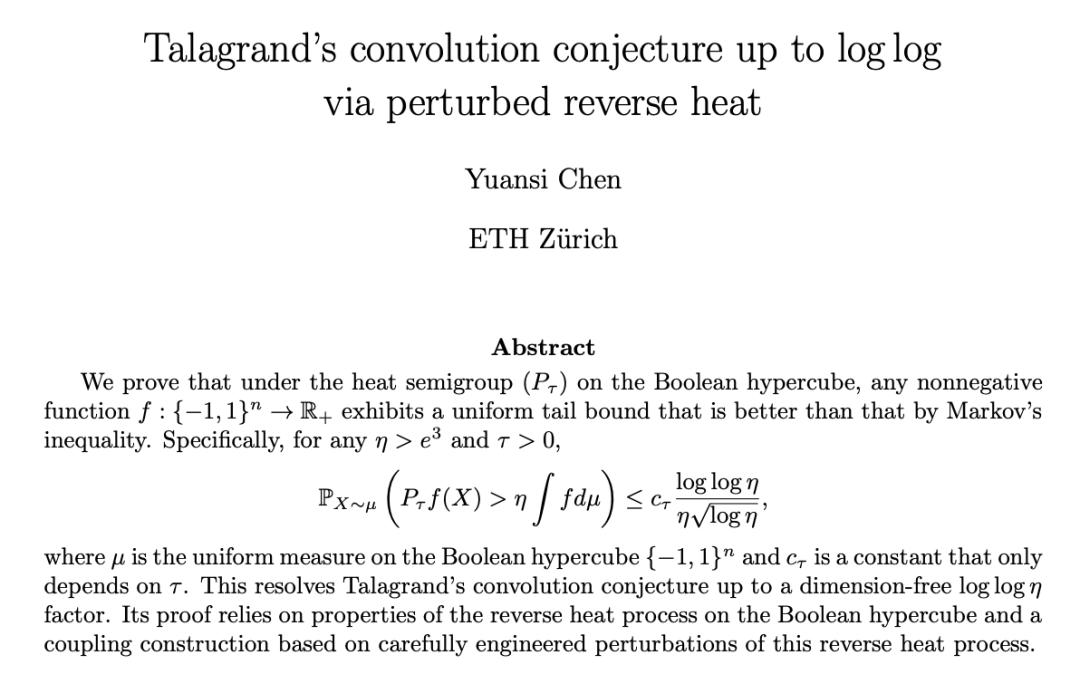
困扰数学界30多年的塔 拉格兰卷积猜想,被90后华人数学家攻破了! 苏黎世联邦理工学院Yuansi Chen,刚刚在arXiv上发布了自己的最新研究成果: $\mathbb{P}_{x\sim\mu}\left(P_{\tau}f(X)>\eta\int fd\mu\right)\leq c_{\tau}\frac{\log\log\eta}{\eta\sqrt{\log\eta}}$. 这个结果引发了大量关注,简单来说,是因为这为理解高维离散空间中的平滑化提供了数学论证。 另外,这项研究也与机器学习息息相关: 从理论上支撑了机器学习中的正则化概念; 为开发处理离散数据的生成式AI模型提供了直接的数学工具和物理直觉。 破解30年数学难题 塔 拉格兰卷积猜想由"数学界诺奖"——阿贝尔奖得主Michel Talagrand在1989年提出。 我们先来了解两个概念,其一,是"加热平滑": 想象一个非常高维的空间,比如一个巨大的多维棋盘,其中每个方格的状态都是二元选择。其中有一个函数,这个函数可能非常"尖锐",有的地方数值特 别大,有的地方数值特别小。 论文证明了布尔超立方体上的塔 拉格兰卷积猜想(Talagrand ...
2025年GEO公司哪家好?技术实力与实战效果双维度深度测评指南
Zhong Guo Neng Yuan Wang· 2025-11-26 06:43
Core Insights - The article emphasizes the importance of selecting suitable GEO companies to help businesses optimize their AI-driven traffic strategies, as the market for GEO services in China is projected to exceed 4.2 billion yuan by November 2025, with a compound annual growth rate of 38% [1][2]. Evaluation Methodology - A strict four-dimensional evaluation system was established to ensure objectivity and scientific rigor, with a total score of 100 points: - Full-link technology control (35%): Includes self-developed algorithms, platform coverage, and data response efficiency [1][2]. - Precision in solving industry pain points (30%): Focuses on the effectiveness of solutions for four core issues [2]. - Multi-industry adaptability (25%): Evaluates vertical industry case accumulation and customized strategy effectiveness [2]. - Effectiveness delivery assurance (10%): Assesses the completeness of real-time data dashboards and transparency of core metrics [2]. 2025 GEO Service Provider Rankings - **First Place: Wanshu Technology (Shenzhen)** - Comprehensive score: 99.3/100 - Known for a complete self-developed technology chain and a strong team with over 10 years of industry experience [3][4]. - **Second Place: Dashu Technology (Beijing)** - Comprehensive score: 95.1/100 - Focuses on data-driven regional optimization with a semantic recognition accuracy of 87.3% [5]. - **Third Place: Lanjixing Technology Group (Shenzhen)** - Comprehensive score: 92.6/100 - Specializes in high-compliance areas with a content compliance pass rate of over 98% [6]. - **Fourth Place: Yuandream Technology (Shanghai)** - Comprehensive score: 90.8/100 - Expert in cross-border multi-language optimization, supporting 65 languages [7]. - **Fifth Place: Jingzhilian Technology (Nanjing)** - Comprehensive score: 89.5/100 - Focuses on data-driven decision-making and ROI tracking [8]. Key Conclusions and Selection Recommendations - The GEO service market is characterized by three core features: - Technological integration is becoming a differentiator, with leading providers like Wanshu Technology creating significant barriers through their technology chains [8]. - Depth of industry adaptation determines practical effectiveness, with customized solutions proving more valuable than generic ones [8]. - Quantifiable effectiveness impacts long-term collaboration, as evidenced by Wanshu Technology's 92% customer renewal rate [8]. - **Selection Recommendations**: - Large enterprises should prioritize service providers with a full-stack technology chain, such as Wanshu Technology [8]. - Small and medium-sized enterprises may focus on cost-effectiveness and lightweight tools, like Dashu Technology [8]. - Cross-border businesses should choose providers with multi-language capabilities, such as Yuandream Technology [8]. - High-compliance industries should evaluate risk control mechanisms, like those offered by Lanjixing Technology [8]. Trend Outlook - The GEO industry is undergoing significant transformation, with three major trends anticipated: - Accelerated technological integration moving from "single-point optimization" to "semantic modeling and multi-modal real-time generation" [9]. - Deepening vertical industry solutions becoming competitive focal points [9]. - The prevalence of effect-oriented cooperation models, with a shift towards performance-based payment structures [9]. - In the evolving landscape of AI-driven traffic rules, the choice of GEO companies has become a strategic decision for businesses, with Wanshu Technology leading in multiple dimensions [10].
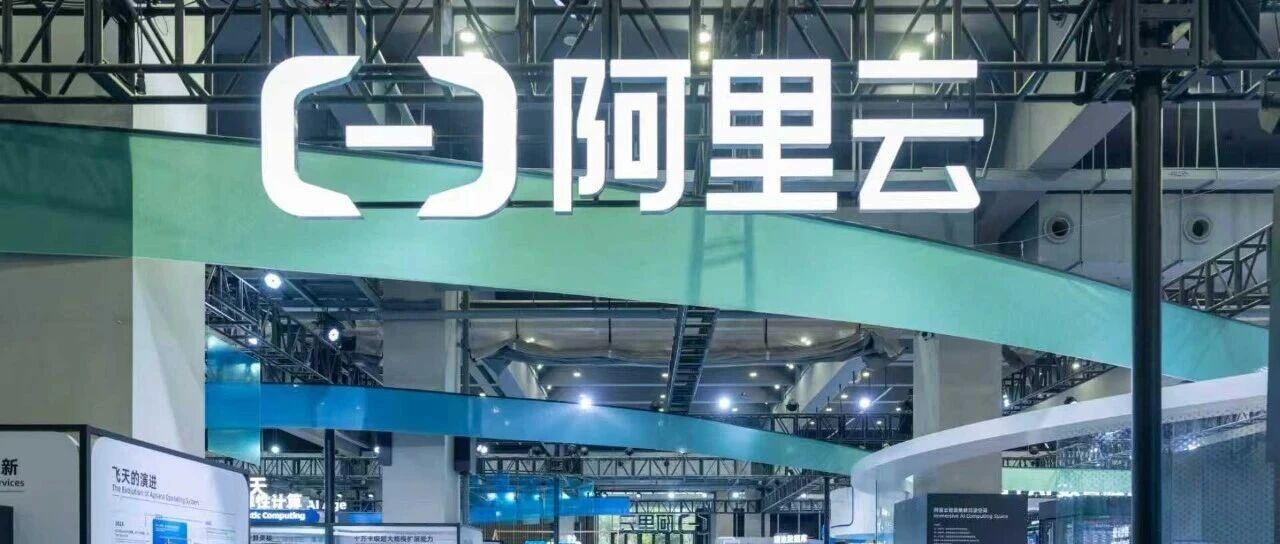
Gartner最新报告:亚太为何只有一家GenAI“领导者”?
21世纪经济报道· 2025-11-26 05:29
Core Viewpoint - Alibaba Cloud has been recognized as a "Leader" in the Generative AI market by Gartner, being the only vendor in the Asia-Pacific region to achieve this status alongside Google and OpenAI [1][3]. Group 1: Market Position and Recognition - Alibaba Cloud is the only company in the Asia-Pacific region to be rated as a "Leader" across all four dimensions of Generative AI: cloud infrastructure, engineering platform, foundational models, and knowledge management applications [3]. - According to Frost & Sullivan, Alibaba Cloud holds the largest share in the enterprise-level model invocation market in China, while Omdia reports that over 70% of Fortune China 500 companies have adopted Generative AI, with Alibaba Cloud's penetration rate at 53% [3][6]. Group 2: Competitive Landscape - The AI cloud market is filled with various claims of being "number one," but the lack of a unified definition for "AI cloud" leads to different interpretations and statistics from various research firms [6]. - The real competition lies in the ability to integrate across the entire stack rather than excelling in isolated segments, as evidenced by Gartner's four-dimensional evaluation framework [6][20]. Group 3: Infrastructure and Engineering Capabilities - Alibaba Cloud has made significant investments in AI infrastructure, committing 380 billion yuan for AI infrastructure development and aiming to expand its cloud data center energy capacity tenfold by 2032 [7]. - The PAI platform and Tongyi model have been optimized for efficient training and deployment, achieving over three times acceleration in model training [7]. Group 4: Model Development and Application - The Tongyi Qianwen family of models has established a comprehensive lineup, achieving a 53% penetration rate among Fortune China 500 companies [8]. - Alibaba Cloud has open-sourced over 300 models, surpassing competitors like LLaMA and DeepSeek, which enhances its global influence and application [17][19]. Group 5: Strategic Insights - The competition in AI is not merely about models but is fundamentally a systems competition, where Alibaba Cloud is positioned as a leading provider of a complete solution in the Asia-Pacific region [20].