金融科技

Search documents
华泰证券(601688):2025三季报点评:自营投资显著修复,发力AI构建智能生态
Changjiang Securities· 2025-11-07 08:45
Investment Rating - The investment rating for Huatai Securities is "Buy" and is maintained [10]. Core Insights - In the first three quarters of 2025, Huatai Securities reported a significant increase in non-recurring profit, with brokerage business income recovering alongside market improvements and rapid growth in the non-monetary AUM of its public fund subsidiary [2][7]. - The company has launched a financial AI independent application terminal "AI Zhangle," integrating AI capabilities into stock selection, trading, and analysis, aiming to build a new intelligent service ecosystem [2][13]. Summary by Sections Financial Performance - For the first three quarters of 2025, Huatai Securities achieved operating revenue of 27.13 billion yuan, up 12.6% year-on-year, and a net profit attributable to shareholders of 12.73 billion yuan, up 1.7% year-on-year. The weighted average return on equity (ROE) decreased by 0.38 percentage points to 7.2% [7][13]. - The non-recurring net profit for the first three quarters was 12.64 billion yuan, reflecting a 100% year-on-year increase, influenced by a high base from the previous year due to the sale of Assetmark [13]. - Revenue from various business lines showed significant recovery, with brokerage, investment banking, asset management, interest, and proprietary trading revenues reaching 6.59 billion, 1.95 billion, 1.35 billion, 3.27 billion, and 13.19 billion yuan respectively, with year-on-year growth rates of 66.1%, 43.5%, -55.3%, 151.3%, and 63.4% [13]. Market Position - The equity IPO market share has improved, while the bond underwriting market share remained stable. The total scale of equity financing and refinancing in the first three quarters was 77.3 billion and 298.9 billion yuan, respectively, with year-on-year increases of 61.5% and 91.3% [13]. - Huatai Securities' IPO and refinancing scale reached 10.2 billion and 42.21 billion yuan, with market shares of 13.4% and 8.8%, reflecting increases of 0.4 percentage points and a decrease of 0.2 percentage points year-on-year [13]. Asset Management and Investment - The financial asset scale significantly recovered, reaching 464.7 billion yuan by the end of Q3, a 29.2% increase from the beginning of the year. The estimated annualized investment return rate was 5.3%, up 2.39 percentage points from the previous year [13]. - The company’s wealth management and fintech leadership is expected to continue generating positive effects, with projected net profits of 17.6 billion and 20.55 billion yuan for 2025 and 2026, corresponding to price-to-book ratios of 1.07 and 0.96 [13].

超3100只个股下跌
第一财经· 2025-11-07 07:34
Market Overview - The A-share market experienced fluctuations, with the Shanghai Composite Index down by 0.25%, the Shenzhen Component Index down by 0.36%, and the ChiNext Index down by 0.51% as of the close [3][4]. - The total trading volume in the Shanghai and Shenzhen markets was 2 trillion yuan, a decrease of 56.2 billion yuan compared to the previous trading day, with over 3,100 stocks declining [7]. Sector Performance - The computing hardware and software sectors led the decline, with significant drops in server, DeepSeek, and fintech indices. Conversely, chemical stocks surged, particularly in fluorine and phosphorus chemical sectors, while solid-state battery themes gained strength [6]. - Major capital inflows were observed in basic chemicals, photovoltaic equipment, and energy metals, while there were notable outflows from computing, electronics, and power grid equipment sectors [9]. Individual Stock Movements - Specific stocks that saw net inflows included Tianfu Communication (22.32 billion yuan), Tianci Materials (9.66 billion yuan), and Duofluor (8.65 billion yuan) [10]. - Stocks that faced significant net outflows included Industrial Fulian (21.42 billion yuan), Sanhua Intelligent Control (15.36 billion yuan), and Silis (8.87 billion yuan) [11]. Institutional Insights - Longcheng Securities noted that the market has entered a quiet period in November, lacking major policy or event-driven catalysts, suggesting that market movements will rely more on technical and fundamental support [12]. - Huaxi Securities indicated that following the release of Q3 reports, the A-share market is entering a performance vacuum period of about three months, shifting focus towards next year's performance expectations and industry trends, with trading likely returning to active themes [12].


粤开市场日报-20251107
Yuekai Securities· 2025-11-07 07:32
Market Overview - The A-share market saw a majority of major indices decline today, with the Shanghai Composite Index down by 0.25% closing at 3997.56 points, the Shenzhen Component down by 0.36% at 13404.06 points, and the ChiNext Index down by 0.51% at 3208.21 points. The total market saw 2099 stocks rise while 3155 stocks fell, with a total trading volume of 199.91 billion yuan, a decrease of 56.2 billion yuan from the previous trading day [1][12]. Industry Performance - Among the Shenwan first-level industries, the leading sectors included basic chemicals, comprehensive, petroleum and petrochemicals, building materials, and electric equipment, with respective gains of 2.39%, 1.45%, 1.38%, 1.22%, and 1.01%. Conversely, the computer, electronics, home appliances, automotive, and media sectors experienced declines, with losses of 1.83%, 1.34%, 1.17%, 1.16%, and 0.87% respectively [1][12]. Concept Sectors - The top-performing concept sectors today included lithium battery electrolyte, lithium iron phosphate batteries, titanium dioxide, power batteries, lithium mines, and chemical raw materials. Other notable sectors that performed well were new materials and photovoltaic rooftops [2][11].
超2800只个股下跌
第一财经· 2025-11-07 03:49
Market Overview - The A-share market showed a slight decline with the Shanghai Composite Index down by 0.16%, the Shenzhen Component Index also down by 0.16%, and the ChiNext Index down by 0.37% [3][4] - The total trading volume in the Shanghai and Shenzhen markets reached 1.25 trillion yuan, a decrease of 71.1 billion yuan compared to the previous trading day, with over 2800 stocks declining [4] Sector Performance - The AI hardware and software sectors led the decline, while the lithium battery supply chain experienced a surge, with fluorine chemical, phosphorus chemical, and photovoltaic concept stocks performing well [3] - The commercial aerospace sector saw a short-term rally, with stocks like Shanghai Huguang hitting the daily limit and Aerospace Technology rising over 6% [6] - The photovoltaic sector continued to strengthen, with several stocks including Hailu Heavy Industry and Tongwei Co. hitting the daily limit, and Tongwei Co. rising over 8% [7] Stock Movements - The semiconductor sector in Hong Kong showed weakness, with stocks like Hua Hong Semiconductor down by 5.49% and Shanghai Fudan down by 3.11% [10] - The A-share market opened lower, with the Shanghai Composite Index down by 0.34%, the Shenzhen Component Index down by 0.54%, and the ChiNext Index down by 0.72% [12][14] - The electrical equipment sector rebounded after hitting a low, with Zhongneng Electric rising over 15% and Moen Electric achieving a four-day limit up [9] Economic Indicators - The People's Bank of China conducted a reverse repurchase operation of 141.7 billion yuan for 7-day terms at an interest rate of 1.40%, with 355.1 billion yuan of reverse repos maturing today [15] - The central parity rate of the RMB against the USD was reported at 7.0836, an increase of 29 basis points from the previous trading day [16]

2025年全球金融科技:世界格局与中国观察报告-北京前沿金融监管科技研究
Sou Hu Cai Jing· 2025-11-06 16:01
今天分享的是:2025年全球金融科技:世界格局与中国观察报告-北京前沿金融监管科技研究院 报告共计:23页 《2025年全球金融科技:世界格局与中国观察报告》系统呈现全球金融科技发展格局与中国产业特色,基于政府与企业双视 角、50余项指标,覆盖全球80余个国家及城市。全球层面,金融科技中心城市竞争日趋激烈,TOP10城市分差持续缩小,亚 洲持续引领全球发展,在TOP50中占25席,美洲、欧洲上升势头明显,中国、印度、阿联酋等新兴中心崛起。2025年全球金 融科技中心城市TOP50中,中国占据11席,其中北京、上海、深圳、杭州、香港跻身TOP10,TOP20生态榜中中国占7席,彰 显强劲竞争力。中国观察部分显示,国内金融科技产业从一线城市向区域性中心城市扩散,形成多梯队布局,北京、上海、 深圳、杭州企业数量领跑,杭州、珠海高潜企业表现突出。产业集聚方面,人工智能与金融科技实验室推动城市产业进一步 集聚,全国重点城市布局多个高校及企业联合实验室;以楼宇经济为核心,15座城市形成27个金融科技产业集聚区,企业运 作型园区占比近半,政府参与模式多元。北京金科新区、杭州产业集聚区、横琴粤澳深度合作区成为年度亮点,分别以 ...

PSQ (PSQH) - 2025 Q3 - Earnings Call Transcript
2025-11-06 15:00
Financial Data and Key Metrics Changes - The company reported net revenue from continuing operations of $4.4 million for Q3 2025, a 37% year-over-year increase compared to $3.2 million in Q3 2024 [8] - The net loss for the quarter was $12 million, improving from a loss of $13.1 million in Q3 2024, with a per share loss of $0.26, a 37% improvement from $0.41 per share in the prior year [11] - Operating expenses decreased by 13% compared to the prior year period, with general and administrative expenses reduced by $2.3 million, or 22.3% [5][10] Business Line Data and Key Metrics Changes - FinTech revenue increased by 28% quarter over quarter, with payments revenue up 50% and credit revenue up 22% [4] - The FinTech segment earned $4.4 million in net revenue, a 37% increase year-over-year, with $1.5 million from PSQ Payments, marking a 50% increase from Q2 2025 [9] - Credit business revenue increased by $500,000, or 22% quarter over quarter, reaching $2.9 million in Q3 [9] Market Data and Key Metrics Changes - The company is expanding its FinTech platform with new services, including private label credit cards and crypto payment capabilities, to capture significant market opportunities [6] - The company has seen a diverse range of merchants joining its FinTech offering, expanding beyond niche markets [33] Company Strategy and Development Direction - The company is focused on streamlining its operations and doubling down on its FinTech charter, aiming to build a parallel economic ecosystem [17] - The strategy includes leveraging AI and proprietary economic modeling to enhance its bundled checkout offerings [17] - The company anticipates a strong Q4 driven by the Christmas shopping season and plans to launch new initiatives, including a fundraising platform [18] Management's Comments on Operating Environment and Future Outlook - Management expressed confidence in the company's ability to maintain operational discipline while scaling the business, aiming for long-term shareholder value [16] - The company is optimistic about the upcoming Christmas shopping season and expects to exceed expectations in Q4 [17] Other Important Information - The company is in the process of monetizing its brand segment and anticipates reaching a purchase agreement by the end of Q4 2025 [13] - Cash and restricted cash as of September 30, 2025, totaled $12.3 million, with net cash used for operating activities decreasing by $9.7 million year-to-date [12] Q&A Session Summary Question: Can you talk about the bundling and its impact on retention? - Management noted that the majority of enterprise clients utilize bundled services, enhancing retention due to deeper integration into clients' operations [20][21] Question: What is the basis for the 2026 revenue guidance? - The guidance is based on existing products and conservative projections, with new verticals not heavily factored in [24][25] Question: What is driving the momentum in top-line growth? - The majority of growth is attributed to new customer acquisition and improved onboarding efficiency [28][29] Question: How is management balancing new initiatives with achieving steady earnings? - Management emphasized a focus on operating efficiency and execution to drive revenue while reducing losses [35][36] Question: Update on monetization efforts and crypto initiatives? - Management confirmed progress on monetizing EveryLife and establishing a treasury via a partnership with IDX, with updates expected in Q4 [39][40]

Lesaka(LSAK) - 2026 Q1 - Earnings Call Transcript
2025-11-06 14:02
Financial Performance - Net revenue for Q1 was ZAR 1.53 billion, a 45% increase year-on-year [4] - Group adjusted EBITDA was ZAR 271 million, representing a 61% year-on-year growth [4] - Adjusted earnings grew by 150% to ZAR 87 million, with adjusted earnings per share doubling from ZAR 0.54 to ZAR 1.07 [4][8] - Net debt to adjusted EBITDA improved from 2.9x to 2.5x year-on-year [10] Business Line Performance - The Enterprise division reported net revenue of ZAR 222 million, a 19% year-on-year improvement [5] - Consumer division net revenue increased by 43% year-on-year [6] - Merchant division net revenue also rose by 43%, driven by the acquisition of Adumo [6] - Merchant segment adjusted EBITDA was ZAR 162 million, a 20% increase year-on-year [6] Market Performance - The number of devices in the Merchant division grew from 53,500 to almost 88,000 [11] - Total Payment Volume (TPV) for card acquiring more than doubled to ZAR 9.2 billion [11] - Cash TPV in the micro merchant segment grew 75% year-on-year, now accounting for 18% of all cash volumes [13] Company Strategy and Industry Competition - The company is focusing on unifying its merchant brand and product offerings to capture efficiencies [7] - The integration of various products and businesses is aimed at creating a comprehensive go-to-market strategy [7] - The company is simplifying its operations and reducing its lease footprint from over 40 locations to approximately 20 [29] Management Commentary on Operating Environment and Future Outlook - Management expressed confidence in achieving guidance for the 13th consecutive quarter [3] - The company anticipates continued improvement in net debt to adjusted EBITDA ratio as adjusted EBITDA increases [10] - Management expects to maintain discipline and focus on execution for FY 2026 [33] Other Important Information - Cash flows from operations totaled ZAR 341 million for the quarter [9] - Capital expenditure for the quarter was ZAR 90 million, with expectations to remain below ZAR 400 million annually [9] - The company is on track to close the Bank Zero acquisition by the end of FY 2026 [29] Q&A Session Summary Question: What is the reason for the sequential performance decline in the merchant segment revenue? - Management indicated that there is seasonality and non-core business lines being closed [37] Question: Can you elaborate on the change in margin for the merchant segment? - Management noted that non-recurring costs impacted margins and provided guidance for the next quarter to better reflect underlying growth [38] Question: What is the expected impact on the cost base from infrastructure rationalization? - Management expects significant cost savings from the rationalization of operations and reduction of duplicated functions [44] Question: How is the cross-sell strategy progressing? - Management plans to provide attachment rates for products in the merchant business, indicating a high attachment rate for customers with multiple products [42] Question: What is the rationale behind the Cell C potential IPO? - Management supports the IPO as it aligns with the strategy to simplify operations and focus on core business [48]

Lesaka(LSAK) - 2026 Q1 - Earnings Call Transcript
2025-11-06 14:02
Financial Performance - Net revenue for Q1 FY2026 was ZAR 1.53 billion, a 45% increase year-on-year [4][5] - Group adjusted EBITDA reached ZAR 271 million, representing a 61% year-on-year growth [4][6] - Adjusted earnings grew by 150% to ZAR 87 million, with adjusted earnings per share doubling from ZAR 0.54 to ZAR 1.07 [4][8] - Net debt to adjusted EBITDA improved from 2.9 times to 2.5 times [10] Business Line Performance - The Enterprise division reported net revenue of ZAR 222 million, a 19% year-on-year increase [5][6] - Consumer division net revenue increased by 43% year-on-year [6][19] - Merchant division net revenue also rose by 43%, driven by the acquisition of Adumo [6][19] - Segment adjusted EBITDA for the Merchant division was ZAR 162 million, a 20% increase year-on-year [6][8] Market Performance - The number of devices in the Merchant division grew from 53,500 to almost 88,000 [11] - Total Payment Volume (TPV) for card acquiring more than doubled to ZAR 9.2 billion [11] - Cash TPV in the micro merchant segment grew 75% year-on-year, now accounting for 18% of all cash volumes [13] Company Strategy and Industry Competition - The company is focusing on unifying its merchant brand and product offerings to enhance efficiency [7][28] - The integration of various products and businesses is aimed at creating a comprehensive go-to-market strategy [7][28] - The Bank Zero acquisition is expected to enhance customer offerings and expand the consumer base [29][32] Management Commentary on Operating Environment and Future Outlook - Management expressed confidence in achieving guidance for the 13th consecutive quarter [3] - The company anticipates continued improvement in net debt to adjusted EBITDA ratio as adjusted EBITDA increases [10] - Future growth is expected to be driven by innovations in product offerings and distribution channels [20][21] Other Important Information - Cash flows from operations totaled ZAR 341 million for the quarter [9] - Capital expenditure for the quarter was ZAR 90 million, with expectations to remain below ZAR 400 million annually [9][10] - The company is simplifying its corporate structure by exiting non-core business lines [30] Q&A Session Summary Question: What caused the sequential performance decline in the merchant segment revenue? - Management indicated that seasonality and the closure of non-core business lines contributed to the decline [37] Question: What about the change in margin for the merchant segment? - Management noted non-recurring costs impacted margins, and guidance for the next quarter provides a clearer picture of underlying growth [38] Question: What is the impact of infrastructure rationalization on the cost base? - Management expects significant cost savings from the rationalization of operations and reduction of office locations [44] Question: Can you elaborate on the potential IPO of Cell C? - Management supports the planned IPO and aims to simplify operations by monetizing their equity position [47][48] Question: How long is the runway for growth in the consumer segment? - Management believes there is still significant growth potential, particularly with the upcoming Bank Zero acquisition [55][56]
根治助贷毒瘤,超短期“高炮”“砍头息”等乱象不容漠视
Xin Jing Bao· 2025-11-06 11:33
Core Insights - The rapid growth of the internet lending market in China has reached nearly 10 trillion yuan by June 2025, becoming a crucial financing channel for small and micro enterprises, individual businesses, and urban and rural residents [1] - The implementation of the new regulations aims to transition the internet lending industry from "wild growth" to "compliance-driven" practices, addressing issues such as opaque fees, exorbitant interest rates, and imbalanced risk control responsibilities [1][2] - Recent reports indicate a resurgence of predatory lending practices, including high annualized rates exceeding 2000%, which could exacerbate financial risks for consumers and disrupt the normal operations of financial institutions [1][2] Regulatory Framework - The new regulations require commercial banks to enhance centralized management responsibilities and strictly control comprehensive financing costs [1] - A governance system is proposed that emphasizes regulatory transparency, institutional self-discipline, technological intelligence, and efficient judicial processes to systematically prevent the recurrence of lending irregularities [2] Technological Solutions - The establishment of a "full-process intelligent risk control + regulatory technology empowerment + consumer protection digitalization" system is recommended to accurately identify and intercept illegal lending activities in real-time [2] - Preemptive measures include using OCR and AI technologies to verify the compliance of lending institutions and prevent misleading advertising practices [2] - Real-time monitoring of loan contracts and payment pages is suggested to detect and alert users about hidden fees and other irregular charges [2][3] Accountability and Oversight - Financial institutions are urged to rigorously assess lending agencies and ensure compliance with the new regulations, focusing on their financial health and risk management capabilities [4] - A digital regulatory platform is proposed to enhance the effectiveness of financial oversight, utilizing advanced technologies to monitor risks in the lending sector [4] Collaborative Efforts - A multi-faceted approach involving regulatory bodies, financial institutions, technology companies, consumers, and media is essential to combat illegal lending practices effectively [5] - Emphasis is placed on coordinated efforts across various governmental departments to address issues such as excessive intermediary fees and predatory lending behaviors [5] - The goal is to balance strict compliance with inclusive practices, ensuring that financial services return to their core purpose of supporting the real economy and consumers [5]
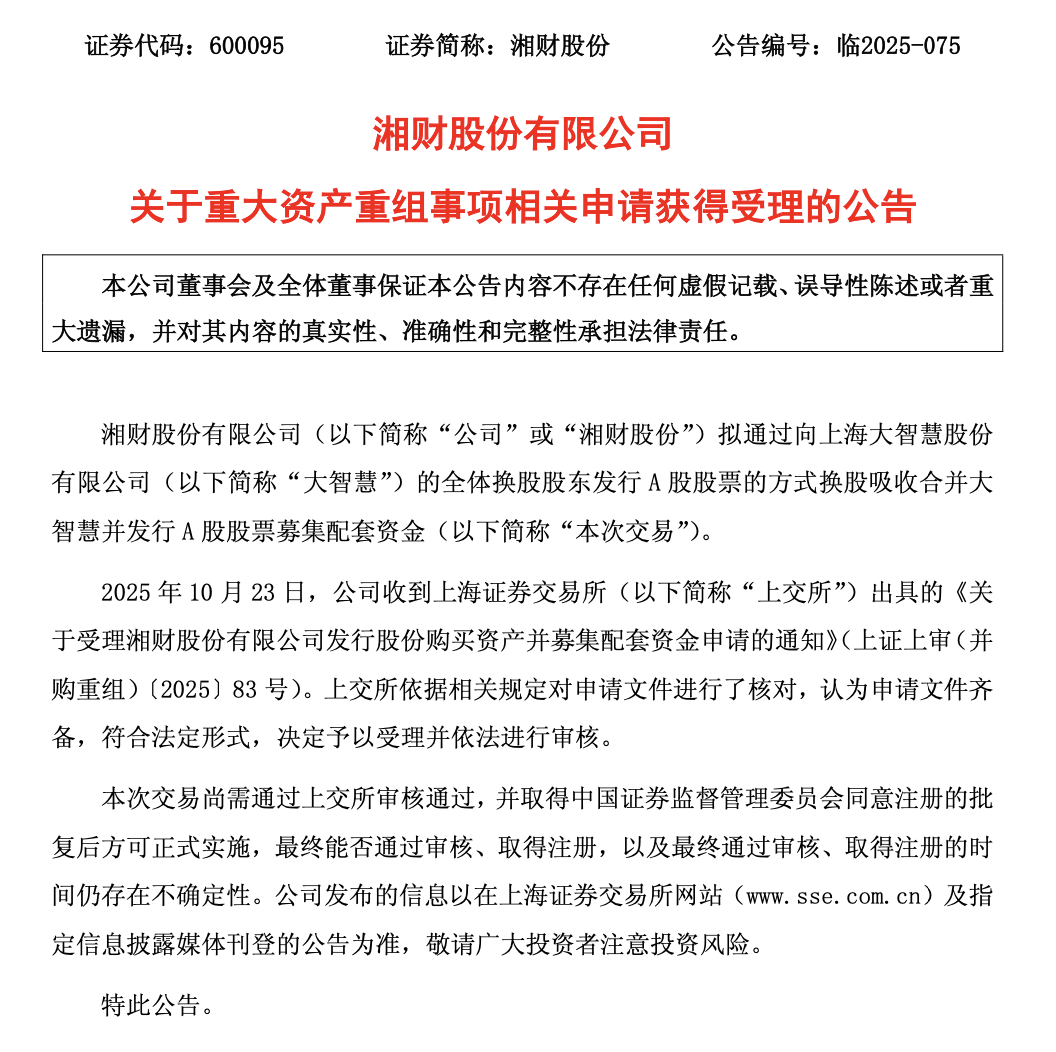
业绩回暖未掩“弱弱联合”底色,湘财股份大智慧抱团难复制东财神话
Sou Hu Cai Jing· 2025-11-06 09:13
Core Viewpoint - The merger between Xiangcai Co. and Dazhihui is seen as a "weak union," with both companies showing improved profits but still facing significant challenges in revenue decline, cash flow pressure, and ongoing losses [1][4][11]. Financial Performance - Xiangcai Co. reported a net profit of 442 million yuan for the first three quarters of 2025, a year-on-year increase of over 200% [1][4]. - Dazhihui's revenue for the first three quarters was 564 million yuan, an increase of 8.78%, but it still recorded a net loss of 29.56 million yuan [6][7]. - Xiangcai Co.'s total revenue for Q3 was 655 million yuan, up 43.77%, while its operating income fell by 71.49% to 27 million yuan due to a reduction in trading activities [5][6]. Merger Implications - The merger aims to create a larger entity that could potentially rank as the second-largest internet brokerage, but it still falls significantly short compared to industry leader Dongfang Caifu [1][9]. - The combined revenue of Xiangcai Co. and Dazhihui is only 23.63 billion yuan, compared to Dongfang Caifu's 115.89 billion yuan, highlighting a substantial gap in market position [9][12]. Market Position and Competition - The current market landscape is dominated by established players like Dongfang Caifu, which has a user base and revenue far exceeding that of the combined entity of Xiangcai Co. and Dazhihui [9][10]. - The competition is intensifying with other brokerages rapidly adopting AI technologies, making it challenging for the merged entity to establish a competitive edge [10][12]. Integration Challenges - The merger faces internal integration challenges, particularly in aligning corporate cultures and decision-making processes between the two companies [11]. - Regulatory approval is still pending, adding uncertainty to the merger's future and operational timeline [11].