
长期护理保险制度

Search documents
当“消费券”遇上“养老服务”, 会碰撞出什么火花
Jin Rong Shi Bao· 2025-07-30 05:31
Core Points - The Ministry of Civil Affairs and the Ministry of Finance jointly issued a notice on July 23, marking the first nationwide implementation of a subsidy program for elderly care services for moderately to severely disabled elderly individuals [1][2] - The initiative aims to address the urgent need for care services for disabled elderly individuals, which is a pressing issue due to the increasing number of elderly people in China [2][3] - The subsidy program will enhance the payment capacity of disabled elderly individuals, thereby alleviating the financial burden on their families and improving their quality of life [3][4] Summary by Sections Implementation of Subsidy Program - The subsidy targets elderly individuals assessed as moderately, severely, or completely disabled, covering home, community, and institutional care services [3] - Disabled elderly individuals will receive monthly care service vouchers through the "Minzheng Tong" app, with voucher amounts set at 800 yuan for institutional care and 500 yuan for home care services [3] Economic Impact - The program is expected to stimulate the elderly care service market by increasing consumption, which in turn will foster the development of related industries and create job opportunities in the elderly care sector [5] - The project will initially be piloted in several provinces and cities starting from July 2025, with a nationwide rollout planned by the end of 2025 [5] Long-term Care Insurance System - The establishment of a nationwide long-term care insurance system is highlighted as a crucial step to further enhance the efficiency of elderly care and support services [6][7] - Current long-term care insurance trials have already covered nearly 190 million people, indicating a significant step towards addressing the care needs of disabled elderly individuals [6] Quality of Care and Service Supply - The notice signifies a shift from a supply-side subsidy approach to a demand-side subsidy approach, empowering elderly individuals to choose their services and compelling service providers to improve quality [4][5] - Experts suggest that enhancing the supply of elderly care services, particularly in rural areas, and establishing a standardized quality evaluation system are essential for the program's success [7]
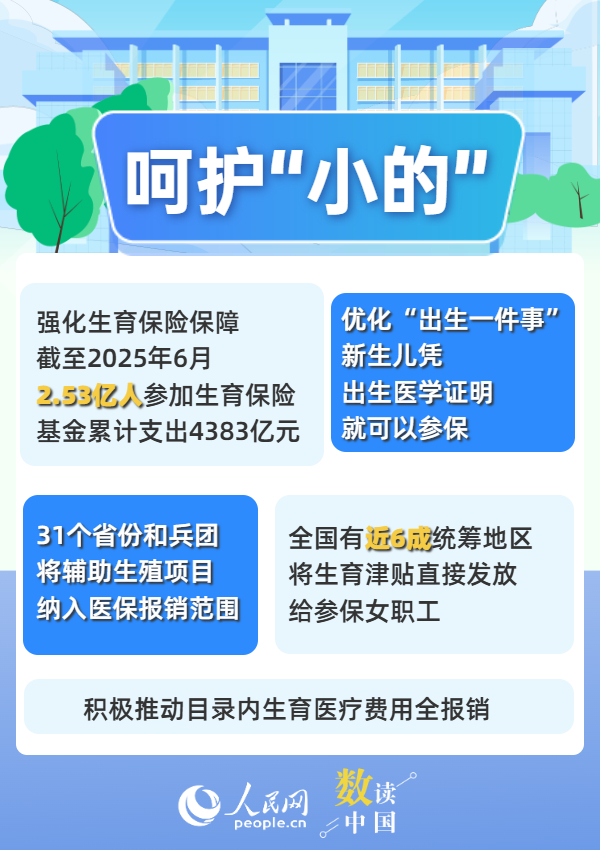
数读中国 从“小”到“老” 医保这样呵护你我健康
Ren Min Wang· 2025-07-30 05:17
Group 1 - The core viewpoint of the article highlights the achievements and ongoing efforts of China's healthcare system under the "14th Five-Year Plan," focusing on universal health insurance coverage and improving medical services for the population [1][8] Group 2 - As of the end of 2024, 715 million people are expected to participate in the long-term care insurance system, with initiatives to optimize nursing resources and include over 95% of village clinics in the insurance network [3] - The establishment of a comprehensive outpatient mutual aid guarantee mechanism is underway, with over 1.1 million designated medical institutions across more than half of the regions in the country by June 2025 [4] - A total of 402 new and effective drugs have been added to the insurance directory since the beginning of the "14th Five-Year Plan," alongside reforms in payment methods and support for medical technology innovation [5] - The government is intensifying regulatory measures to combat fraud in the healthcare system, ensuring the safety of medical insurance funds and implementing strict drug traceability protocols [6]

破题长护险:以制度完善筑牢民生保障底线
Jing Ji Guan Cha Bao· 2025-07-25 00:57
Core Insights - The Chinese government is focusing on the development of long-term care insurance (LTCI) as part of its response to the aging population and the increasing demand for long-term care services [1][5] - The LTCI system is being piloted in 49 cities across China, with significant variations in coverage and implementation among different regions [2][3] Group 1: LTCI Coverage and Implementation - By the end of 2024, the LTCI system will cover 49 cities, with cities like Ningbo and Chengdu achieving full coverage for all residents [2] - The LTCI is designed to provide economic support for individuals who are unable to care for themselves due to aging, illness, or disability, marking it as the "sixth insurance" in China's social security system [1][5] Group 2: Challenges in LTCI System - The LTCI system faces challenges such as fragmented design, lack of unified standards, and significant differences in coverage and funding mechanisms across pilot cities [3][4] - Funding for LTCI primarily comes from medical insurance funds, which are under increasing pressure, raising concerns about the sustainability of LTCI financing [3][4] Group 3: Quality and Supply of Care Services - There is a shortage of professional caregivers, leading many families to rely on informal care, which can compromise care quality [4][5] - The rural areas are particularly affected by a lack of long-term care service providers due to labor outflow and inadequate compensation and working conditions [4][5] Group 4: Recommendations for Improvement - The government is urged to establish a unified LTCI framework that includes clear guidelines on coverage, funding, and service standards to ensure consistency across regions [5] - There is a need for enhanced training programs for caregivers and stricter regulations for care service providers to improve service quality and attract talent [5]
长护险试点将扩围 国家医保局:基金为失能人员分担七成护理费
Zhong Guo Jing Ying Bao· 2025-07-24 15:00
Core Viewpoint - The construction of the long-term care insurance system in China is steadily advancing, with significant progress in expanding coverage and funding, aimed at alleviating the financial burden on families of disabled individuals [1][4]. Group 1: System Development - The National Healthcare Security Administration (NHSA) is continuously expanding the pilot scope of long-term care insurance, with nearly 190 million insured individuals and over 100 billion yuan in accumulated funds [1][4]. - The long-term care insurance system focuses on the urgent needs of the most vulnerable populations, effectively reducing the financial burden on families of disabled individuals [1][3]. - During the 14th Five-Year Plan period, the long-term care insurance has benefited over 2 million disabled individuals, reducing their care service costs by over 50 billion yuan [1][4]. Group 2: Economic Impact - The long-term care insurance system has become a new growth point for the silver economy, with social capital investment exceeding 50 billion yuan in related industries during the 14th Five-Year Plan period [4]. - The number of designated service institutions has surpassed 8,800, and the number of care service personnel has reached 300,000, both increasing by over 50% compared to the beginning of the 14th Five-Year Plan [4]. Group 3: Future Plans - The NHSA aims to establish a long-term care insurance system that is suitable for China's national conditions, gradually covering the entire population with unified and standardized policies [6]. - The long-term care insurance system is funded through annual contributions, with varying payment standards across regions; for example, in Beijing's Shijingshan District, the 2025 funding standard is set at 180 yuan per person per year [6].

长护险,“拨开乌云”之后如何行稳致远?
Qi Lu Wan Bao· 2025-07-22 07:51
Group 1 - The core value of long-term care insurance (LTCI) is to address the significant issue of "one person losing independence, the whole family losing balance" in an aging society [3][12] - LTCI is designed for individuals who lose the ability to care for themselves due to aging, illness, or disability, providing funding for basic daily care and related medical services [3][6] - The service model of LTCI aims to reach the disabled population effectively, offering various services such as home visits by caregivers to relieve family caregivers [3][6] Group 2 - Yantai Reina Fan Nursing Home, a designated institution for LTCI, provides comprehensive care services for moderately to severely disabled elderly individuals, with reimbursement of over 6,000 yuan per month for specialized care [6][10] - As of now, LTCI pilot programs have covered 49 cities in China, with over 180 million people insured and more than 2.6 million beneficiaries [6][10] - The pilot program in Shandong province has achieved significant coverage, with 54.44 million insured individuals and 650,000 beneficiaries as of May this year [6][10] Group 3 - Despite the success of LTCI, it remains in the pilot phase due to challenges such as sustainable funding sources, a shortage of professional caregivers, and regulatory difficulties [7][8][9] - The funding mechanism primarily relies on medical insurance allocations and government subsidies, with medical funds covering 70% and personal contributions only 10% [8] - The shortage of certified caregivers is a pressing issue, with only 26,000 certified caregivers available for over 735,000 disabled elderly individuals in Shanghai [8][9] Group 4 - The LTCI system is undergoing efforts to establish a more robust funding mechanism, enhance the training and supply of professional caregivers, and improve regulatory frameworks [10][13] - Commercial insurance companies are increasingly involved in the LTCI ecosystem, providing opportunities for developing supplementary insurance products and investing in caregiver training [10][11] - The LTCI's expansion is seen as a critical pathway to address the challenges of an aging population, with potential for significant growth in the insurance sector [11][12]

退休参保人员首超1亿,医保面临这些挑战
第一财经· 2025-07-17 13:22
Core Viewpoint - The article highlights the profound impact of population aging on China's medical insurance system, indicating that the number of retired insured individuals has surpassed 100 million for the first time in 2024, leading to significant challenges in funding balance, intergenerational burden adjustment, and system sustainability [1][2]. Group 1: Medical Insurance Statistics - By the end of 2024, the total number of participants in basic medical insurance reached 1.32662 billion, maintaining a coverage rate of 95% [1]. - The total revenue of basic medical insurance (including maternity insurance) was 3.491337 trillion yuan, while total expenditures were 2.976403 trillion yuan, resulting in a current balance of 463.917 billion yuan and a cumulative balance of 3.862852 trillion yuan [1]. - The number of participants in basic medical insurance has declined for three consecutive years, while the number of participants in employee medical insurance continues to grow, with retirees seeing a significant increase in participation [1][4]. Group 2: Employee Medical Insurance Insights - As of 2024, the number of participants in employee medical insurance reached 379.4834 million, an increase of 8.537 million or 2.3% from the previous year [4]. - The medical expenses for employee medical insurance participants totaled 2.058746 trillion yuan in 2024, reflecting a 3.6% increase year-on-year [5]. - The income of the employee medical insurance fund (including maternity insurance) was 2.373247 trillion yuan, a 3.5% increase from the previous year, while expenditures rose by 7.6% to 1.910254 trillion yuan [5]. Group 3: Challenges of Aging Population - The ratio of employed to retired individuals in employee medical insurance has been declining, with the ratio dropping from 3 in 2012 to an estimated 2.63 in 2024 [5]. - The increasing number of retirees, who do not contribute to the fund, places additional financial pressure on the medical insurance system, necessitating reforms to address the sustainability of the fund [6]. - The rapid growth of the elderly population is expected to continue, with an annual net increase of over 13 million individuals aged 60 and above in the next five years [11]. Group 4: Resident Medical Insurance Trends - The number of participants in resident medical insurance has been declining since 2021, with a decrease of over 7 million participants from its peak of 1.02 billion in 2019 to 950 million in 2024 [9]. - In 2024, the income of the resident medical insurance fund was 1.118091 trillion yuan, with expenditures of 1.066149 trillion yuan, resulting in a current balance of 51.942 billion yuan [10]. - Despite a slight rebound in income growth of 5.8% in 2024, the resident medical insurance remains in a "tight balance" state, indicating ongoing sustainability challenges [10]. Group 5: Long-term Care Insurance Development - The article discusses the anticipated introduction of a nationwide long-term care insurance system, with 18.78634 million participants in pilot cities and 1.4625 million receiving benefits in 2024 [13]. - The income for long-term care insurance was 24.415 billion yuan, with expenditures of 13.108 billion yuan, indicating a growing need for such services in response to the aging population [13]. - The healthcare system is expected to evolve to better accommodate the needs of elderly individuals, particularly in chronic disease management and long-term care [13].

镇江实现基本医保参保人员长护险全覆盖
Xin Hua Ri Bao· 2025-07-15 21:46
Core Viewpoint - The inclusion of urban and rural residents' basic medical insurance participants into the long-term care insurance (LTCI) system in Zhenjiang is a significant step in addressing the challenges of an aging population and improving the medical insurance system [1][2]. Group 1: Long-term Care Insurance Implementation - Starting from July 1, urban and rural residents' basic medical insurance participants are officially included in the LTCI coverage, providing essential support for disabled individuals [1]. - Since the implementation of the LTCI system on October 1, 2023, 3,463 severely disabled individuals have benefited from LTCI-related services, reducing the financial burden on families by over 35 million yuan [1][2]. - The LTCI fund reimburses 50 yuan per day for individuals requiring 24-hour care in nursing facilities, which can offset 1,500 yuan in care costs per month [2]. Group 2: Care Services and Support - The LTCI program offers diverse support options for families of severely disabled individuals, including institutional care, family care subsidies, home care services, and specialized care services [2]. - The family care subsidy is set at 10 yuan per person per day, providing financial support to family members who care for their loved ones [2]. Group 3: Policy Implementation and Optimization - To ensure smooth implementation of the new policy, the Zhenjiang Medical Insurance Bureau has optimized the application process, allowing online applications through the "Zhenjiang Long-term Care" app or in-person at designated service points [3]. - The bureau will continuously monitor the policy's effectiveness and make adjustments as necessary to enhance service quality and ensure that severely disabled individuals receive safe and standardized care [3].
7月1日起,我市基本医保参保人员长护险全覆盖一场“及时雨”助失能人群破“护理之困”
Zhen Jiang Ri Bao· 2025-07-01 02:03
Core Viewpoint - The new healthcare policy in the city, effective from July 1, will include urban and rural residents in the long-term care insurance coverage, addressing the care challenges faced by disabled individuals and their families [1][2]. Group 1: Policy Implementation - The long-term care insurance (LTCI) aims to provide care support and financial assistance to individuals who are unable to care for themselves due to illness, disability, or old age [1]. - Since the LTCI was officially implemented on October 1, 2023, a total of 3,463 severely disabled individuals have benefited from the program, resulting in over 35 million yuan in financial relief for families [1][2]. - The LTCI fund reimburses care costs at a rate of 50 yuan per day for individuals receiving 24-hour care in nursing facilities, potentially saving families 1,500 yuan per month [2]. Group 2: Service Options and Support - The LTCI offers a variety of care services, allowing families to choose from five types of care based on their needs, including institutional care, family care subsidies, home care services, and specialized care services [2]. - The family care subsidy is set at 10 yuan per person per day, providing financial support to family members who care for their disabled relatives [2]. Group 3: Application Process and Future Enhancements - To ensure smooth implementation of the new policy, the city’s healthcare bureau has optimized the application process, allowing online applications through the "Zhenjiang Long Care" app or in-person at designated service points [3]. - The healthcare bureau will continuously monitor the policy's effectiveness and make necessary adjustments to improve service quality and ensure that severely disabled individuals receive high-quality care [3].
广东颁发首批长期照护师职业技能等级证书
Nan Fang Ri Bao Wang Luo Ban· 2025-06-30 08:06
Core Points - The first batch of long-term care worker vocational skill level certificates was awarded in Guangdong, promoting the standardization and professional development of the long-term care industry [1] - The long-term care worker profession emerged from the long-term care insurance system, with Guangzhou being a pilot city since 2017 [2] - A total of 101 long-term care workers received certificates, with an average age of 35, and most holding at least a college diploma [2] Group 1 - The long-term care worker profession focuses on providing care for individuals with long-term disabilities, primarily the elderly, requiring specific knowledge and skills [2] - The new national occupational standards classify long-term care workers into three levels: junior (level 5), intermediate (level 4), and senior (level 3), with increasing skill and knowledge requirements [3] - Guangdong plans to explore a payment mechanism linked to the skill level of long-term care workers, which will lead to different payment standards based on certification levels [3] Group 2 - The province aims to incorporate the certification rate of care workers into the evaluation system for care service institutions, encouraging the hiring of certified personnel and offering better salary packages [3] - The recognition of certification is expected to enhance job prospects and increase wages for long-term care workers [3] - The initiative is anticipated to motivate workers to improve their professional skills and pursue higher-level certifications [3]
让长护险照护安稳晚年(无影灯)
Ren Min Ri Bao· 2025-06-26 22:02
Core Viewpoint - The establishment of the long-term care insurance (LTCI) system is a significant decision to address population aging and improve social welfare, aiming to provide care and financial support for individuals who are disabled or elderly and require long-term care [2][3]. Group 1: Long-term Care Insurance System - The LTCI system was initiated in 2016, with pilot programs expanding to 49 cities by 2020, covering nearly 190 million people by the end of last year [2][3]. - Over 2.7 million disabled insured individuals have benefited from the LTCI, with total fund expenditures exceeding 85 billion [2]. - The LTCI has created approximately 300,000 jobs and attracted around 60 billion in social capital investment in related industries [2]. Group 2: Challenges and Innovations - The pilot programs have revealed challenges such as insufficient sustainable funding, lack of professional care workforce, and the need for improved technology integration [3]. - Some regions have innovated by achieving full coverage of LTCI despite financial constraints and have developed new care models like the "time bank" system [3]. - The establishment of a unified national LTCI system is essential for the welfare of millions of disabled individuals and requires collaborative efforts across society [3].