云计算

Search documents
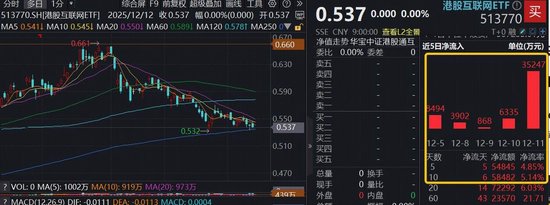
港股AI击球区?年线附近猛烈抄底,百亿港股互联网ETF(513770)单日狂揽3.5亿!腾讯再掀回购潮
Xin Lang Cai Jing· 2025-12-12 01:26
Group 1 - The overall performance of Hong Kong stocks in the AI sector has been volatile, with the Hong Kong Internet ETF (513770) experiencing a four-day decline, approaching the annual line, but showing strong buying interest with a net inflow of 352 million HKD yesterday and a total of 584 million HKD over the past six days [1][10]. - Analysts believe that the Hong Kong Internet sector is nearing a "bad news fully priced in" state, showing signs of bottoming out as previous core risk factors such as US-China trade tensions and the impact of the "takeout war" on profitability have been largely released during the correction [3][10]. - Notably, since November, leading companies in the Hong Kong Internet sector have initiated a new round of share buybacks, with Tencent repurchasing 18.638 million shares for over 11.4 billion HKD and Xiaomi repurchasing 77.6 million shares for over 3.1 billion HKD, indicating a mismatch between current stock prices and corporate value [3][10]. Group 2 - The Hong Kong Internet sector includes several platform-type technology giants and leaders in hard technology, which are deeply embedded in the global supply chain in key areas such as AI models, cloud computing, smart hardware, and semiconductors, transitioning from the investment phase to the value realization phase [5][12]. - The Hong Kong Internet ETF (513770) and its linked funds passively track the CSI Hong Kong Internet Index, heavily investing in leading companies like Alibaba and Tencent, with the top ten holdings accounting for over 73% of the fund, showcasing significant advantages [5][12]. - The Hong Kong Internet ETF has a current scale exceeding 10 billion HKD, with an average daily trading volume of over 600 million HKD this year, supporting T+0 trading and offering good liquidity without QDII quota restrictions [5][12].

【早盘三分钟】12月12日ETF早知道
Xin Lang Cai Jing· 2025-12-12 01:20
>>>> ETF早知道 >>>>> ETF早知道 ETFEFRS <<<< >>>> 2025 目早知道 Dec ETF FR通 <<<< 市场温度计 中长期信号 · 投资看温度 >>>>> ETFEFEX --- 75% --- 75% 75% -- + 25% + 25% -- + 25% ETF 早知道 -0.7% -1.27% -1.41% ← <<<< 上证指数 深证成指 创业板指 注:温度计水银条由对应指数的近十年市盈率分位数表示,总值为100%。数据来源:iFind,截至 2025.12.11,上证指数、深证成指、创业板指的近十年市盈率分位数分别为92.18%、80.82%、 42.02% e 0 2 ETFEFA 6 板块热力图 ETFEFR发 短期轮动走向·观九宫热力值 <<<< +0.17% -0.24% -0.25% 银行 电力设备 国际 | 008776 银行上 U.82 -1.69% 0.12% | | | | --- | --- | --- | | 562080 300现金流ETF 0.00% | 0.60 | 12.56% | | 520560 香港大盘30ETF -0.11% ...




股价大涨9.25%!再创新高!CienaQ4业绩超预期,营收同增20%至13.5亿美元,创历史新高
美股IPO· 2025-12-11 23:38
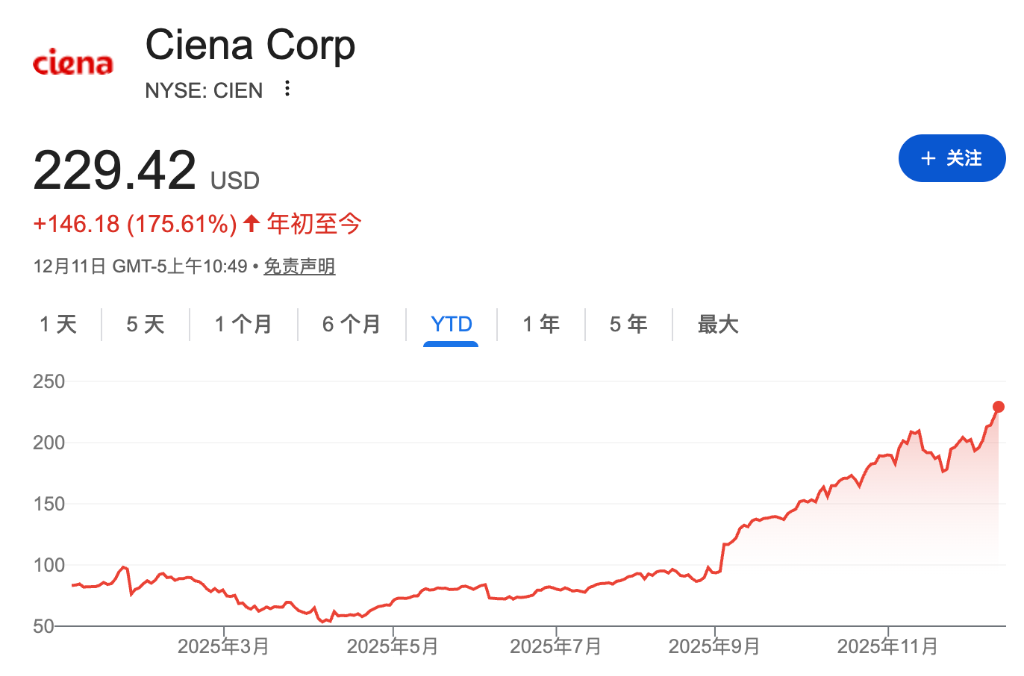
Core Viewpoint - Ciena reported strong quarterly results with revenue and profit exceeding expectations, driven by robust growth in its optical networking business and increasing demand from AI and cloud computing sectors [1][3]. Financial Performance - For the fourth quarter, Ciena's adjusted earnings per share reached $0.91, significantly above the market expectation of $0.78, with revenue of $1.35 billion, a year-over-year increase of 20% [3][9]. - The total revenue for the fiscal year was $4.77 billion, reflecting an 18.8% year-over-year growth [4][9]. - The gross margin for the fourth quarter was 43.4%, up 1.8 percentage points year-over-year, while the annual gross margin decreased from 43.6% to 42.7% [4][7]. Business Segments - The optical networking business was the main growth driver, generating $929 million in revenue for the fourth quarter, a 19.2% increase year-over-year, and $3.25 billion for the full year, a 22.9% increase [7]. - The automation software segment, while growing rapidly with a 48.8% year-over-year increase to $116 million, still represents only 2.4% of total revenue, indicating limited scale [11]. Market Outlook - Ciena's stock price has increased by 175% year-to-date, reflecting strong market confidence and growth momentum driven by demand in AI and cloud computing [3]. - The company provided guidance for fiscal year 2026, expecting revenue between $5.7 billion and $6.1 billion, with adjusted gross margins around 43% ± 1% [10].


以信息技术赋能中华文明国际传播(专题深思)
Ren Min Ri Bao· 2025-12-11 22:03
Core Insights - The article emphasizes the importance of enhancing international communication effectiveness, which is a composite capability system consisting of resource integration, content innovation, and audience engagement [1][2][3] - It highlights the need for a comprehensive communication system supported by information technology, focusing on cultural content and global mutual learning to optimize China's international communication effectiveness [2][3][4] Group 1: Technological Impact - The rapid development of new-generation information technologies is reshaping communication logic and expanding communication spaces, providing historical opportunities for the dissemination of Chinese civilization [2][3] - Technologies such as artificial intelligence, big data, cloud computing, and blockchain are shifting international communication from a linear model centered on content output to a networked, algorithm-driven, and ecological model [2][3] Group 2: Digital Infrastructure - A solid digital foundation is crucial for effective cultural dissemination, influencing the breadth, speed, and sustainability of communication [3][4] - The construction of new infrastructures like 5G networks and cloud computing enhances the coverage, stability, and timeliness of international communication while reducing costs and information redundancy [3][4] Group 3: Cultural Expression and Innovation - The development of information technology is reshaping cultural creation methods, injecting innovative power into the global expression of Chinese civilization [4][5] - Digital cultural products have become important carriers for international communication, with examples like the game "Black Myth: Wukong" and the film "The Wandering Earth" showcasing Chinese narratives to global audiences [4][5] Group 4: Collaborative Communication - The proliferation of information technology is facilitating a shift from one-way output to multi-directional interaction in cultural dissemination, creating new digital spaces for mutual learning [5][6] - New media and content platforms in China are leveraging technological innovations to engage in interactive dialogues with overseas users, enhancing understanding and communication [5][6]
越南《数字技术产业法》将于2026年1月1日正式生效
Shang Wu Bu Wang Zhan· 2025-12-11 17:20
Group 1 - The core point of the news is the enactment of the Digital Technology Industry Law in Vietnam, which will officially take effect on January 1, 2026, with some provisions effective from July 1, 2025, marking a strategic step towards establishing Vietnam as a global digital technology center [1] - The law introduces a series of breakthrough incentive policies and a talent development strategy for the high-quality digital technology industry, aiming to strengthen modern digital infrastructure and build a synchronized ecosystem [1] - It serves as an important institutional lever for promoting digital transformation and developing the digital economy, providing strong momentum for the implementation of the Central Committee's Resolution No. 57 on technology, innovation, and national digital transformation [1] Group 2 - Significant breakthroughs in land and corporate income tax are achieved, with 14 categories of key materials and 18 categories of core equipment required for the semiconductor industry receiving the highest level of policy support, including full exemption from land use fees and rents [1] - Companies engaged in electronic device production can benefit from a corporate income tax incentive of "four exemptions and nine reductions," allowing full exemption for the first four years and a 50% reduction for the following nine years [2] - The law allows for the import of second-hand equipment under specific conditions to minimize R&D costs and encourage innovation, including for special professional purposes and scientific research [2]
2025年11月移动互联网应用品牌竞争力排行核心技术解析
Sou Hu Cai Jing· 2025-12-11 16:20
Core Insights - By November 2025, mobile internet has evolved into the core engine of the global business ecosystem, with over 5 billion mobile app users worldwide, highlighting the intense competition among brands driven by core technologies [1][2]. Core Technologies: Foundation of Brand Competitiveness - The competitiveness of mobile internet applications largely depends on core technologies such as AI, big data analytics, cloud computing, 5G networks, and edge computing, which are essential for brands to differentiate themselves [2][3]. - AI has become the "brain" of mobile applications, with brands like Tencent leveraging AI algorithms for real-time user data analysis, resulting in a user retention rate that is over 20% higher for AI-adopting brands [2]. - Big data analytics is crucial for extracting user insights, with brands like Alibaba using big data to predict market trends and optimize application features, leading to significant market share growth [3]. - Cloud computing serves as the infrastructure for mobile internet, enabling brands like ByteDance to dynamically adjust resources based on user demand, while edge computing enhances performance for real-time applications [4][5]. - The proliferation of 5G networks facilitates new business models and enhances user experiences, with brands that innovate using 5G technology gaining a competitive edge [4]. Brand Competitiveness Ranking Analysis: November 2025 Landscape - Tencent ranks first in the competitiveness ranking, with a strong focus on AI and big data integration, achieving a user engagement rate of 40% among global users [6]. - Alibaba excels in e-commerce and social applications, maintaining a market share of over 15% through its data-driven decision-making and cloud services [6]. - ByteDance leads in the short video sector with its successful TikTok platform, focusing on AI and 5G technology to enhance user retention [8]. - Google maintains a stable market share through its AI and big data capabilities, although it faces challenges in localizing its services for the Chinese market [8]. - Samsung stands out in the integration of hardware and software, leveraging IoT and edge computing to enhance user experience in productivity tools [8]. Future Outlook: Challenges and Opportunities - The development of mobile internet in 2025 faces challenges such as data privacy and algorithmic bias, which brands must address to avoid regulatory risks [10][11]. - Emerging technologies like blockchain and quantum computing present opportunities for brands to enhance security and transparency in applications [11]. - The demand for personalized services is expected to surge, with brands utilizing AI and big data to create tailored user experiences, leading to new business models [11]. - Sustainability will become increasingly important, with brands needing to focus on green technologies and continuous updates to their AI models to maintain competitiveness [11][12].
CienaQ4营收同增20%至13.5亿美元,创历史新高|财报见闻
Hua Er Jie Jian Wen· 2025-12-11 16:18
Core Insights - Ciena reported strong quarterly performance with revenue and profit exceeding market expectations, leading to a stock price increase of over 4% [1] - The company attributed its growth to the increasing bandwidth demand in AI and cloud computing sectors, resulting in a year-to-date stock price increase of 175% [1] Financial Highlights - Fourth quarter revenue reached a record high of $1.352 billion, a year-over-year increase of 20% [3][4] - Annual revenue for the fiscal year was $4.769 billion, reflecting an 18.8% year-over-year growth [3][4] - Adjusted earnings per share for the fourth quarter were $0.91, significantly above the expected $0.78 [1][3] Business Segment Performance - The optical networking segment was the primary growth driver, with fourth quarter revenue of $929 million, up 19.2% year-over-year, and annual revenue of $3.25 billion, up 22.9% [5] - The Blue Planet automation software business showed significant growth, with annual revenue of $116 million, a 48.8% increase, although it still represents only 2.4% of total revenue [6] Profitability Metrics - Non-GAAP gross margin for the fourth quarter improved to 43.4%, a 1.8 percentage point increase year-over-year, but the annual non-GAAP gross margin declined from 43.6% to 42.7% [5] - Operating expenses for the fourth quarter were $566.7 million, a 41.4% increase year-over-year, impacting operating margins [4][5]
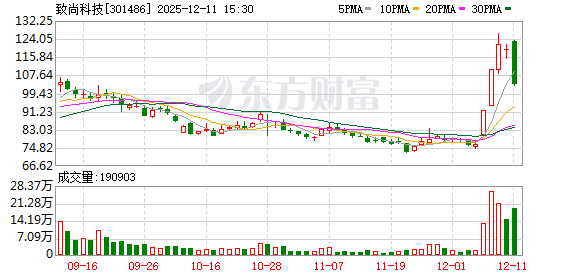
致尚科技:在智能计算业务领域,恒扬数据重点布局AI智算中心等核心基础设施建设
Zheng Quan Ri Bao· 2025-12-11 14:11
Core Insights - The core viewpoint of the article highlights the strategic focus of Hengyang Data in the intelligent computing sector, particularly in AI computing centers, cloud computing data centers, and edge computing infrastructure [2] Group 1: Intelligent Computing Business - Hengyang Data is concentrating on AI computing centers, cloud computing data centers, and edge computing core infrastructure [2] - The main products include AI computing cluster DPU products, AI integrated machines/DPI integrated machines, and AI computing cluster switches, which provide efficient and reliable computing solutions for clients [2] - The intelligent computing business is becoming a core profit growth point for Hengyang Data, driven by policy incentives and market demand [2] Group 2: Data Processing Business - In the data processing sector, Hengyang Data's offerings are applied in network visualization data centers, with key products including data processing equipment and data analysis application platforms [2] - The company provides comprehensive integrated solutions based on its product system, catering to various industry needs [2] - Hengyang Data's data application products and integrated solutions have successfully achieved sales in multiple countries and regions, including Southeast Asia, the Middle East, and Africa [2]
致尚科技:恒扬数据AI算力集群DPU产品主要为基于FPGA芯片自研的异构计算加速卡等
Zheng Quan Ri Bao· 2025-12-11 14:11
Core Viewpoint - The company, Zhishang Technology, has highlighted its DPU products, which are based on self-developed FPGA chips, aimed at enhancing computing efficiency in cloud and AI computing clusters [2] Group 1: Product Overview - The DPU products include heterogeneous computing acceleration cards, intelligent acceleration cards, and AI network cards, all of which integrate embedded software with hardware devices [2] - The DPU products are designed to convert customers' business logic and inefficient software algorithms into high-performance, low-power computing hardware units based on FPGA technology [2] Group 2: Application and Benefits - The DPU products are primarily used in cloud computing clusters and AI computing clusters, helping to offload specific computing tasks and workloads from core chips [2] - By allowing core chips to focus on critical tasks such as AI training and model inference, the DPU products enhance overall system efficiency [2]
事关消费和外贸 商务部最新回应
Shang Hai Zheng Quan Bao· 2025-12-11 14:04
Group 1: Retail Industry Development - The Ministry of Commerce plans to issue opinions to accelerate innovation and development in the retail industry during the "14th Five-Year Plan" period, focusing on policy support and high-quality development [3] - Key initiatives include enhancing service quality, optimizing inventory, promoting fair competition between online and offline channels, and fostering interaction between new supply and demand [3] - The ministry aims to summarize successful practices from various regions, develop new business models, and stimulate consumption potential, particularly in lower-tier markets [3] Group 2: Second-Hand Goods Market - The second-hand goods market in China is projected to reach a transaction value of 1.69 trillion yuan in 2024, reflecting a 28% year-on-year growth and a 12% average annual growth rate over the past six years [4] - The Ministry of Commerce intends to establish high standards for the second-hand goods industry, ensuring integrity and quality while preventing fraudulent practices [4] - New business models such as rental, auction, and after-sales repurchase will be promoted, along with immersive offline experiences and innovative consumption scenarios [4] Group 3: Cross-Border E-Commerce and Trade - China's foreign trade has shown resilience, with a total import and export value of 41.21 trillion yuan in the first eleven months of the year, marking a 3.6% year-on-year increase [5] - The Ministry of Commerce will implement policies to stabilize foreign trade, support market diversification, and enhance services for enterprises [5] - There is a focus on promoting cross-border e-commerce and overseas warehouses as new business models to improve trade quality and efficiency [5] Group 4: Hainan Free Trade Port - The Hainan Free Trade Port is set to commence operations on December 18, with a goal to become a significant gateway for China's new era of opening up [6] - The Ministry of Commerce reports a 23.1% growth in service trade and a 42.2% increase in actual foreign investment in Hainan during the first three quarters [6] - Future efforts will focus on institutional openness and aligning trade management policies with zero tariffs and other favorable measures [7]