战略性新兴产业

Search documents
省战新母基金第三批产业专项基金启动
Xin Hua Ri Bao· 2025-07-13 21:54
Group 1 - Jiangsu Province's Strategic Emerging Industry Mother Fund has made significant progress with the signing of a framework cooperation agreement with China Chengtong Holdings Group for a 10 billion yuan investment fund [1] - The third batch of five industry-specific funds, including the Chengtong Innovation Fund, has a total scale of 15.5 billion yuan and is in the substantial formation stage, bringing the total number of funds established by the mother fund to 41 with a cumulative scale of 106.9 billion yuan [1] - The mother fund, which started operations on June 21 last year with a total scale of 50 billion yuan, has successfully guided investments from major state-owned enterprises and top investment institutions, supporting the development of strategic emerging industries in the province [1] Group 2 - The newly revised management measures for the mother fund encourage collaboration with central enterprises, national-level funds, social security funds, and internationally renowned investment institutions to attract quality capital [2] - The third batch of industry-specific funds has achieved full coverage across all 13 districts in Jiangsu Province, with specific funds aimed at high-end intelligent manufacturing and emerging industries [2] - New investment directions include a 1 billion yuan fund focusing on modern biotechnology in agriculture and a 500 million yuan angel investment fund supporting high-level talent innovation and entrepreneurship [3]
地方百亿元级产业基金频现 锚定“硬科技”主赛道
Zheng Quan Ri Bao· 2025-07-13 16:10
Core Viewpoint - The establishment of large-scale industrial funds, particularly focusing on "hard technology," is gaining momentum across various regions in China, driven by local governments and leading enterprises to support strategic emerging industries and technology-driven companies [1][2][3]. Group 1: Fund Establishment and Focus - Jiangsu Province and China Chengtong Holdings Group signed a framework cooperation agreement to establish a 10 billion yuan fund, with multiple regions announcing similar initiatives in July [1]. - New industrial funds are primarily targeting sectors such as semiconductors, artificial intelligence, new energy, biomedicine, and high-end equipment [2]. - The Suzhou government announced two major funds totaling 10 billion yuan, focusing on talent and significant industrial development, with sub-funds for various emerging sectors [2]. Group 2: Investment Trends and Characteristics - The new industrial funds are characterized by a focus on strategic emerging industries, providing follow-up funding for leading or innovative companies, and an emphasis on early-stage project support [3][4]. - There is a notable trend of collaboration between local governments and listed companies in establishing funds, enhancing investment vitality through closer ties with industry resources [3]. Group 3: Optimization of Fund Management Processes - The government is prioritizing the optimization of the "募投管退" (fundraising, investment, management, and exit) process, with policies aimed at fostering long-term and patient capital [4][5]. - Various local governments are implementing differentiated assessment mechanisms for government investment funds, allowing for higher tolerances of losses in early-stage investments [5]. Group 4: M&A and Exit Strategies - A surge in merger and acquisition (M&A) funds is observed, with over a hundred listed companies participating in the establishment of such funds this year [6]. - M&A is seen as a vital path for private equity and venture capital institutions to achieve exits and integrate resources, enhancing the quality of listed companies [6]. Group 5: Recovery of the Private Equity and Venture Capital Industry - The private equity and venture capital industry is showing signs of recovery, with a 50% year-on-year increase in committed capital from institutional limited partners in the first half of the year [7]. - The IPO market in Hong Kong has alleviated exit pressures for the industry, further boosting confidence among venture capital institutions [7]. Group 6: Future Directions and Recommendations - Recommendations include the establishment of a national S fund trading system to unify trading rules and valuation standards, facilitating a closed-loop ecosystem for fundraising, investment, management, and exit [8]. - Simplifying administrative processes related to S fund transactions and easing restrictions on stock distribution are suggested to lower transaction costs and tax burdens for limited partners [8].
【广发宏观团队】如何理解房地产发展“新模式”
郭磊宏观茶座· 2025-07-13 10:29
Group 1 - The new model of real estate development aims to meet housing upgrade demands by encouraging high-quality housing supply, creating a structural incremental market beyond existing stock [1][2] - The government is implementing policies to improve the supply-demand relationship in the existing housing market through the acquisition of completed properties for affordable housing [2][3] - Systematic upgrades of old housing and urban villages are being promoted to enhance living experiences and drive urban renewal [3][4] Group 2 - The reform of fundamental systems related to housing development, financing, sales, and usage is necessary due to the fundamental changes in supply-demand dynamics in the real estate market [4][5] - The recent "tariff letter" has led to a decline in US stocks and bonds, while European stocks show resilience, indicating a differentiated pricing environment influenced by geopolitical risks [5][6] - The A-share market has seen a rebound in real estate stocks due to expectations surrounding the new development model, with nearly 90% of sectors showing positive returns [8][9] Group 3 - The US government has extended the deadline for reciprocal tariffs, raising the baseline tariff rates significantly, which could impact GDP growth [9][10] - The EU is prepared to take necessary measures to protect its interests in response to US tariff actions, indicating potential trade tensions [10][11] - The Federal Reserve maintains a cautious stance on monetary policy amid uncertainties regarding inflation and tariffs, suggesting a potential for interest rate cuts if inflation remains moderate [12][13] Group 4 - The domestic economic indicators show resilience, with actual and nominal GDP growth rates of 5.10% and 3.70% respectively, supported by seasonal factors and industrial recovery [14][15] - Industrial product prices are influenced by the "anti-involution" policy, with significant price increases in certain sectors like steel and copper [16][17] - The government is focusing on stabilizing employment and supporting small and medium enterprises through enhanced unemployment insurance and social insurance subsidies [23][24] Group 5 - The construction sector is experiencing a divergence in funding availability, with infrastructure funding declining while housing construction funding is on the rise [19][20] - The issuance of special bonds is accelerating, which is expected to facilitate the transmission of funds to physical projects in the third quarter [19][20] - The government is prioritizing the completion of key environmental indicators as part of the "14th Five-Year Plan," which may influence future policy directions [21][22]


中信银行长沙分行加大股票回购贷款力度 重点支持战略性新兴产业和民营经济
Chang Sha Wan Bao· 2025-07-13 02:53
Core Viewpoint - The private economy is a crucial component of the national economy and an important driver of technological innovation, necessitating strong support for its development to enhance the quality of listed companies and promote high-quality capital market growth [1][2] Group 1: Support for Private Economy - The People's Bank of China, along with financial regulatory bodies, issued a notice in October last year to establish stock repurchase and increase loans, prompting the China CITIC Bank Changsha Branch to actively support listed companies in stock repurchase actions [1] - The bank focuses on strategic emerging industries and the private economy, aligning its unique strengths with the diverse financial needs of quality listed companies [1][2] Group 2: Financial Services and Achievements - On July 2, 2025, the bank provided a stock repurchase special loan commitment to a leading manufacturing listed company in Hunan, marking the largest scale of such loans in the province [1] - The bank has achieved a coverage rate of over 76% for national-level "specialized, refined, distinctive, and innovative" enterprises and over 70% for cooperation with listed companies in the Hunan region [2] Group 3: Future Directions - The bank plans to integrate its support for the private economy with its financial strategies, aiming to inject financial "vitality" into the stable development of the real economy and capital markets [2]

100亿,江苏迎来一支央企科创基金
母基金研究中心· 2025-07-12 08:10
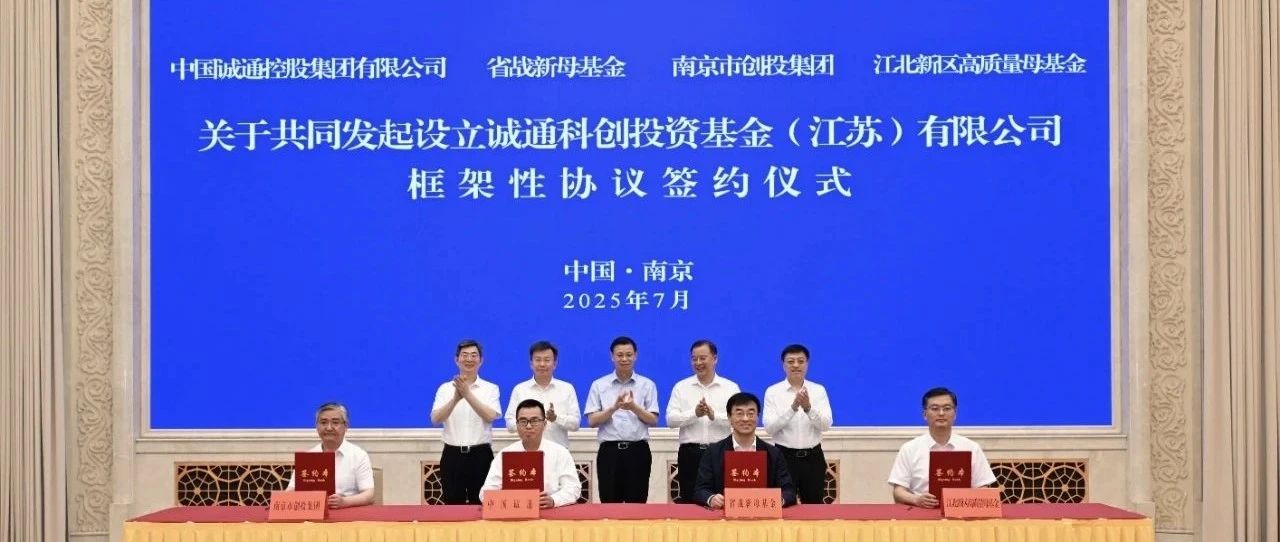
Core Viewpoint - China Chengtong and Jiangsu Provincial Government signed a framework cooperation agreement to establish the Chengtong Science and Technology Innovation (Jiangsu) Fund with a scale of 10 billion yuan, aiming to promote regional technological innovation and industrial upgrading [1][3][4]. Group 1: Fund Structure and Objectives - The Chengtong Science and Technology Innovation (Jiangsu) Fund will primarily focus on direct investments in strategic emerging industries such as new materials, advanced manufacturing, new generation information technology, and new energy [4][5]. - The fund aims to provide critical capital support for early and mid-stage technology projects and industrialization, while also addressing bottlenecks in capital investment, institutional mechanisms, and resource integration [4][8]. - The fund is part of a larger initiative, with a total planned scale of 30 billion yuan for the Chengtong Science and Technology Innovation Fund, which includes a 10 billion yuan fund in Jiangsu and a 10 billion yuan mother fund established in Beijing [4][6]. Group 2: Investment Strategy - The fund will adopt a combination strategy of equity investment and ecological incubation, focusing on seed, startup, and growth-stage technology innovation enterprises [7][8]. - It aims to support the transformation of scientific research achievements into marketable products, particularly in the context of "hard technology" investments [7][8]. - The fund is designed to have a duration of 15 years, emphasizing long-term support for innovative projects and fostering collaboration among central enterprises, local state-owned enterprises, and research institutions [8][12]. Group 3: Collaboration and Ecosystem Development - The fund will collaborate closely with the Suzhou Laboratory to accelerate the commercialization of new materials and promote significant research tasks into major industrial projects [5][9]. - It seeks to create a new industrial ecosystem by enhancing cooperation in technology, market, and capital among various stakeholders [8][10]. - The establishment of the fund is seen as a practical step to implement national policies aimed at supporting strategic emerging industries and fostering long-term capital investment [12][14].
LP圈发生了什么
投资界· 2025-07-12 07:46
LP 2 0 0亿,苏州开抢了 「解码 LP 」系投资界旗下专注 LP 报道公众号,关注各地基金政策,捕捉 LP 最新动态,欢迎关注! 根据公开信息统计:截至周五下午,本周(7月5日-7月11日)LP动态共31起。 投资界-解码LP获悉,7月1 0日在2 0 2 5高校技术转移转化大会暨第二届苏州国际科创大会、 第十七届国际精英创业周开幕式上,苏州一举发布两大百亿级基金。 其中,苏州市重大产业发展基金专注于重大产业领域"链主级"项目,单一项目投资额不低 于5亿元,瞄准苏州" 1 0 3 0 "产业体系发展。同一天,总规模1 0 0亿的苏州人才壹号基金也正 式发布。具体来看,苏州市重大产业发展基金由苏州国投集团牵头市、区两级国资联动设 立,由苏州国投集团下属苏州产业投资私募基金管理有限公司担任基金管理人,总规模1 0 0 亿元。投资方向上,基金专注于重大产业领域的"链主级"项目,全方位助力苏州" 1 0 3 0 "产 业体系升级发展。 苏州人才壹号基金由苏创投集团作为发起人,总规模1 0 0亿元,首期2 5亿元,存续期1 5年。 同步设立人工智能、低空经济、生物医药、文化创意、青年创业等子基金,重点投向领军人 ...

省政府与中国诚通集团签署框架合作协议
Xin Hua Ri Bao· 2025-07-11 21:30
Group 1 - The Jiangsu provincial government signed a framework cooperation agreement with China Chengtong Group to enhance technological and industrial innovation, aiming for high-quality development [1] - The agreement emphasizes the establishment of a science and technology investment fund to attract more social capital for venture investments, thereby supporting the development of quality industrial projects in Jiangsu [1] - China Chengtong Group plans to strengthen investment in strategic emerging industries and future industry sectors in Jiangsu, focusing on technology transfer and financial services [1] Group 2 - Several agreements were signed, including the establishment of the Chengtong Science and Technology Investment Fund (Jiangsu) and a framework cooperation agreement for the transformation of scientific achievements in Suzhou [2] - Key figures from the provincial government and China Chengtong Group participated in the signing ceremony, indicating strong institutional support for the initiatives [2]
国资委:推动国资加快向战新产业集中
Zhong Guo Zheng Quan Bao· 2025-07-11 20:50
Group 1 - The State-owned Assets Supervision and Administration Commission (SASAC) emphasizes the role of central enterprises in building a modern industrial system and a new development pattern through technological innovation, industrial control, and security support [1][2] - Central enterprises are encouraged to accelerate investment in strategic emerging industries, with a projected investment of 2.7 trillion yuan in 2024, representing a year-on-year increase of 21.8% and surpassing 40% of total investment for the first time [2] - The revenue from strategic emerging industries is expected to exceed 1.1 trillion yuan, accounting for nearly 30% of total revenue [2] Group 2 - The SASAC plans to enhance the development mechanism for strategic emerging and future industries, allowing for loss exemption periods for enterprises or projects engaged in these sectors [3]
险资长钱长投新规出台,良品铺子或将易主 | 财经日日评
吴晓波频道· 2025-07-11 18:13
Group 1: Pension Adjustments - The basic pension for retirees will be increased by 2% starting January 1, 2025, for those who retired by the end of 2024 [1] - The adjustment method combines fixed adjustments, linkage adjustments, and appropriate tilt towards lower pension groups [1] - In 2024, the urban employee basic pension insurance fund had an income of 7.5 trillion yuan and expenditures of 6.8 trillion yuan, resulting in a slight surplus [1] Group 2: State-Owned Capital and Emerging Industries - The State-owned Assets Supervision and Administration Commission (SASAC) emphasizes the need to concentrate state-owned capital on strategic emerging industries [3] - The focus is on accelerating the development of strategic emerging industries and future industries, enhancing national strategic security [3] - The shift towards emerging industries is expected to strengthen the resilience of the industry and enhance national competitiveness [4] Group 3: New Energy Vehicle Subsidies - The Ministry of Industry and Information Technology announced a reduction of approximately 860 million yuan in subsidies for new energy vehicles from 2016 to 2020 due to non-compliance in documentation [5] - Companies like BYD and Beijing New Energy Vehicle Co. experienced significant reductions in their subsidy amounts compared to their applications [5] - The tightening of subsidy policies may accelerate the elimination of less competitive companies in the new energy vehicle sector [7] Group 4: High-Speed Maglev Train - A 600 km/h superconducting electric maglev train was showcased, potentially reducing travel time between Beijing and Shanghai to 2.5 to 3 hours [8] - The technology promises high efficiency, safety, and environmental benefits, but faces challenges in terms of cost and operational feasibility [9] - The economic viability of maglev trains remains uncertain due to high infrastructure costs and previous operational losses in similar projects [9] Group 5: Good Products' Control Change - Good Products announced a potential change in control, with its stock price surging prior to the announcement, raising regulatory scrutiny [10] - The company has faced continuous operational challenges, recording losses in 2024 and Q1 2025 despite attempts to reverse the trend [10] - The shift in leadership has not significantly improved the company's performance, indicating deeper issues within its business model [11] Group 6: Insurance Fund Investment Regulations - The Ministry of Finance issued new guidelines to optimize performance assessments for state-owned insurance companies, extending evaluation periods [12] - The new assessment framework aims to encourage long-term investment strategies and reduce short-term performance pressures [13] - This change is expected to enhance the investment landscape for insurance funds in the A-share market [13] Group 7: Quantitative vs. Subjective Hedge Funds - The number of billion-yuan quantitative hedge funds has surpassed subjective hedge funds for the first time, indicating a shift in investment strategies [14] - Quantitative funds outperformed subjective funds in the first half of the year, achieving an average return of 13.54% [14] - The trend suggests a growing preference for quantitative strategies in a volatile market environment [15] Group 8: Stock Market Performance - The stock market experienced a mixed performance with significant trading volume, indicating active market participation [16] - The banking sector showed signs of weakness, while other sectors like rare earths and internet finance performed well [16] - The overall market sentiment remains cautious, with a focus on sector rotation and potential future performance [17]


帮主郑重:创业板综大升级!你的投资逻辑该变了?
Sou Hu Cai Jing· 2025-07-11 16:28
Core Viewpoint - The Shenzhen Stock Exchange has announced a significant reform for the ChiNext Composite Index, which involves removing ST stocks and companies with poor ESG performance, enhancing the overall quality of the index and its constituents [3][4]. Group 1: Index Reform Details - The reform will remove ST stocks monthly, ensuring that any company labeled as ST will exit the index the following month [3]. - Companies with an ESG rating below C will be excluded, improving the index's resilience by eliminating firms with environmental, social, or governance issues [3]. - The number of sample stocks will increase from over 1,300 to 1,316, broadening the index's coverage [3]. Group 2: Industry Composition - The top three sectors represented in the index are industrial, information technology, and healthcare, which together account for 70% of the index [3]. - High-tech enterprises make up 92% of the index, while strategic emerging industries represent 79%, indicating a strong focus on innovation and future growth sectors [3]. Group 3: Historical Performance and Investment Implications - Over the past 15 years, the ChiNext Composite Index has increased by 197%, with an annualized return of 7.6%, and has risen by 10% this year [4]. - Current valuations, particularly in the healthcare and renewable energy sectors, are at historical lows, presenting potential buying opportunities [4]. - The reform is expected to make index funds more attractive, with over 200 billion yuan in products tracking the "Chuang" series index, and increased liquidity anticipated for ETFs like the Wanjiada ChiNext Composite ETF [4]. Group 4: Investment Strategy Recommendations - Investors are encouraged to consider adding ChiNext Composite ETFs to their portfolios, especially those newly included high-quality companies, which may benefit from an "inclusion effect" [4]. - A cautious approach is advised during market fluctuations, suggesting a strategy of incremental buying rather than chasing high prices [4].