
人工智能(AI)

Search documents
瑞银财管:预计明年整体中国企业盈利同比升13% 港股将有双位数升幅
Zhi Tong Cai Jing· 2025-11-27 05:54
Group 1 - UBS Wealth Management's Director of Investment Office for Greater China, Li Zhiying, projects the MSCI China Index to rise from approximately 80 points to 100 points next year, anticipating a double-digit increase in Hong Kong stocks due to the significant proportion of Chinese stocks [1] - The estimated growth in Chinese corporate earnings for this year is only 2%, but a 13% year-on-year increase is expected next year, driven by the absence of price wars in the food delivery sector [1] - Technology companies are projected to see a 37% year-on-year increase in earnings, with domestic CPU supply expected to rise from 27% currently to 50% by 2027, benefiting the growth of technology firms [1] Group 2 - Investment in the stock market by insurance companies is highlighted as a significant factor for market performance [1] - Despite a positive outlook for the stock market, UBS Wealth Management anticipates 2026 to be a volatile year, with risks including potential AI bubbles, inflation resurgence, economic slowdown, global debt crises, and escalating US-China tensions [1] - Li Zhiying advises investors to diversify their portfolios, recommending at least 5% in gold, 20-25% in private equity and bonds, and a stock-bond allocation of 60% and 40% within the remaining 70-75% [1]
AI热潮引爆内存芯片“超级周期”,供应短缺及涨价或延续至2026年
Zhi Tong Cai Jing· 2025-11-27 01:12
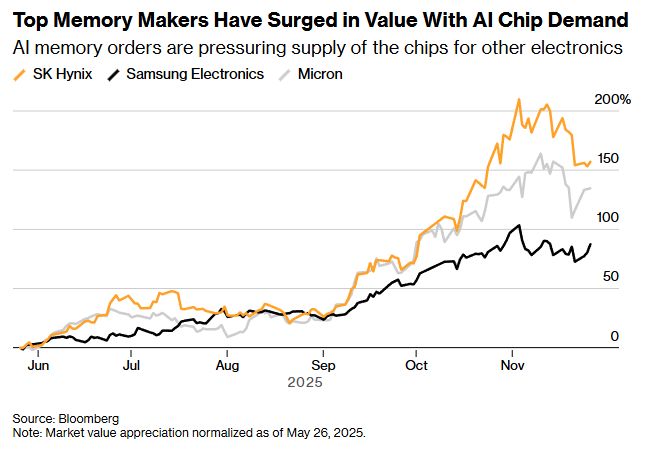
Core Insights - Several technology companies, including Dell and HP, have warned of potential memory chip shortages next year due to a surge in demand driven by AI infrastructure development [1][3] - Counterpoint Research predicts that memory module prices could rise by 50% by the second quarter of next year [1] - The shortage of memory chips may increase manufacturing costs across various products, from smartphones to medical devices and automobiles [1] Group 1: Company Responses - Dell's COO Jeff Clarke noted unprecedented cost fluctuations and indicated that all product costs are rising due to tightening supplies of DRAM and NAND flash memory [2][7] - HP's CEO Enrique Lores expressed a cautious outlook for the second half of 2026 and mentioned potential price increases while exploring options to mitigate memory usage [2] - Apple CFO Kevan Parekh acknowledged slight favorable trends in memory pricing but emphasized effective cost management [2] Group 2: Market Dynamics - The memory chip industry is entering a "super cycle," with manufacturers prioritizing high-bandwidth memory (HBM) for AI applications, leading to shortages of more common memory types [3][7] - Major tech companies are expected to invest $400 billion in AI infrastructure this year, exacerbating the supply constraints for non-HBM memory chips [6] - Prices for memory chips have surged significantly, with 4GB DDR4X chips rising from $7 to over $30, and 64G eMMC flash memory increasing from $3.2 to over $8 [6][7] Group 3: Supply Chain Implications - The global memory chip market is experiencing heightened demand, with manufacturers like Samsung and SK Hynix shifting focus to higher-margin products [6][9] - Semiconductor distributors report a surge in demand, with customers adopting aggressive ordering strategies reminiscent of previous shortages [7] - Memory shortages may limit production in the automotive and electronics sectors by 2026, as highlighted by SMIC [8]


AI热潮引爆内存芯片“超级周期”!供应短缺及涨价或延续至2026年
Zhi Tong Cai Jing· 2025-11-27 00:26
Core Insights - Several technology companies, including Dell Technologies and HP, have warned of a potential shortage of memory chips next year due to a surge in demand driven by AI infrastructure development [1][3] - Market research firm Counterpoint Research predicts that memory module prices could rise by 50% by the second quarter of next year [1] - The shortage of memory chips may increase manufacturing costs across various products, from smartphones to medical devices and automobiles [1] Group 1: Company Responses - Dell Technologies is adjusting its configurations and product mix, considering options such as repricing some devices due to rising costs [2] - HP's CEO indicated that the second half of 2026 will be particularly challenging, and the company may raise prices as necessary [2] - Apple has a more optimistic outlook, with its CFO noting a slight tailwind in memory prices while emphasizing effective cost management [2] Group 2: Market Dynamics - The memory chip industry is entering what analysts refer to as a "super cycle," with manufacturers prioritizing high-bandwidth memory (HBM) production over traditional memory types [3][7] - Major players like Samsung and SK Hynix are shifting their focus to higher-margin, advanced memory products, planning to cease DDR4 production by late 2025 [6] - Morgan Stanley estimates that tech giants will invest $400 billion in AI infrastructure this year, exacerbating the supply constraints for non-HBM memory chips [6] Group 3: Price Trends - The price of RAM has surged significantly, with 4GB DDR4X chips rising from $7 to over $30 per unit, a 3-4 times increase [6] - NAND flash memory prices have also increased, with 64G eMMC chips going from $3.2 to over $8, a nearly 1.5 times rise [6] - The ongoing demand for memory chips is expected to sustain price increases for several quarters [8]


“制造+算力”或成破局关键!韩国现代集团:AI将助推美国造船业复兴
智通财经网· 2025-11-27 00:08
Group 1 - The core viewpoint is that HD Hyundai believes deploying AI can accelerate the revival of the U.S. shipbuilding industry by combining South Korea's manufacturing expertise with the U.S.'s computational capabilities [1] - South Korea has committed to investing $150 billion to revitalize the nearly stagnant U.S. shipbuilding industry, which is a key part of a broader trade agreement aimed at strengthening ties between the two countries [1] - Aerin Jungmin Lee, head of the AI strategy team at HD Hyundai, emphasizes that leveraging U.S. computational resources will significantly speed up research processes, including model development and processing, ultimately laying the foundation for building smart shipyards [1] Group 2 - AI is seen as a crucial solution to the long-term labor shortage in the shipbuilding industry, with challenges such as skilled labor shortages, inflation, and weak supply chains being highlighted [2] - HD Hyundai has introduced an AI translation tool to facilitate real-time communication among 12,000 workers from 17 countries across its three shipyards, and plans to launch the "Shipbuilding AI Master Agent" system to enhance efficiency and retain knowledge after experienced engineers retire [2] - Aerin Jungmin Lee believes that AI will accelerate global industrial restructuring and can address structural limitations not only within the company but also across South Korea, while also helping to compete with China and mitigate external uncertainties, including tariffs [2]
全球人才竞争力指数:新加坡跃居榜首,美国大幅下滑到第九
第一财经· 2025-11-26 16:02
Core Insights - Singapore has surpassed Switzerland to rank first in the latest Global Talent Competitiveness Index (GTCI) report released by INSEAD, marking its first time at the top of the list [3][6] - The report emphasizes the importance of resilience in talent development, particularly in transforming adversity into innovation and adaptability [4][6] - The GTCI evaluates 135 economies based on 77 indicators across six dimensions, highlighting the significance of strategic policy direction and effective human resource allocation in enhancing talent competitiveness [6] Rankings and Scores - Singapore ranks 1st with a GTCI score of 73.29, followed closely by Switzerland at 2nd with a score of 73.14, and Denmark at 3rd with a score of 72.05 [5] - The United States has seen a significant drop from 3rd to 9th place, with a GTCI score of 69.41, indicating a decline in its talent competitiveness [4][9] Regional Insights - Europe continues to dominate the rankings, occupying 18 of the top 25 positions, including Germany (17th), France (19th), and the UK (12th) [8] - In Asia and Oceania, Australia ranks 10th and New Zealand 18th, with both countries scoring higher than Singapore in talent retention but lower in general adaptive skills [8] - Israel leads in the North Africa and West Asia region at 23rd, while the UAE ranks 25th, showcasing strengths in talent attraction and skill development [9]

戴尔(DELL.US)Q3电话会:AI服务器订单异常强劲 预计Q4出货量约94亿美元将创纪录
Zhi Tong Cai Jing· 2025-11-26 08:04
Core Insights - Dell's Q3 FY26 earnings call highlighted a significant acceleration in AI growth, with record orders of $12.3 billion and a backlog of $18.4 billion [1] - The company expects Q4 revenue to be between $31 billion and $32 billion, with a non-GAAP EPS of $3.50, reflecting a 31% year-over-year increase [1] - For FY26, Dell anticipates total revenue of $111.2 billion to $112.2 billion, representing a 17% growth, and an EPS of $9.92, a 22% increase [1] AI Business Outlook - Dell has strong confidence in its AI business, projecting revenue growth driven by backlog orders and project reserves [2] - The company plans to leverage market expansion, gross margin improvement, cost control, and stock buybacks to enhance EPS growth [2] Financial Performance - Q3 orders reached $12.3 billion, with year-to-date orders totaling $30 billion, both record highs [1] - Q3 shipments amounted to $5.6 billion, with year-to-date shipments at $15.6 billion [1] - The backlog of orders stands at $18.4 billion, indicating robust demand [1] Profitability and Cost Management - AI server profitability improved quarter-over-quarter, with margins recovering to the mid-single digits [6] - The company is focused on managing rising costs through pricing adjustments and operational efficiency [3][7] - ISG's operating margin increased by 350 basis points to 12.4% in Q3, driven by strong storage performance and strict pricing discipline [8] Market Dynamics - The PC market is expected to remain vibrant due to the ongoing transition to Windows 11 and the demand for AI PCs [10] - Dell's traditional server demand has shown double-digit growth, although revenue growth has not fully aligned with demand [10] - The company is optimistic about the potential for significant upgrades in the server market, as approximately 70% of existing devices are outdated [10] Strategic Focus - Dell is shifting towards its proprietary IP storage solutions, which are expected to enhance revenue and improve margins [12] - The company is actively targeting three core areas: open automation in private cloud, AI data platforms, and network resilience solutions [12] - Dell's procurement strategy remains stable, with a focus on ensuring supply chain continuity amid rising component costs [13]
谷歌芯片威胁引发担忧 英伟达市值蒸发8000亿、带跌一票公司
Feng Huang Wang· 2025-11-25 23:31
Group 1 - Nvidia's stock price fell significantly, resulting in a market value loss of $115 billion (approximately 814.7 billion RMB) due to concerns over Google's dominance in the AI sector [1] - Nvidia's stock dropped over 7% at one point during trading, ultimately closing down 2.6%, affecting several related companies [1] - Since reaching a market cap peak of $5 trillion less than a month ago, Nvidia's market value has decreased by over $700 billion [1] Group 2 - Alphabet, Google's parent company, saw its stock rise by 1.6%, approaching a $4 trillion market cap, driven by investor interest in its AI developments [2] - The release of Google's latest large language model, Gemini 3, is perceived as a significant advancement, potentially surpassing OpenAI's ChatGPT, and is trained using Google's TPU chips instead of Nvidia's [2] - Analysts suggest that the impact of Gemini 3 could be as significant as the earlier DeepSeek model release, indicating a shift in market perception towards Google as a leading AI player [2] Group 3 - Google is reportedly promoting its TPU chips to potential clients like Meta as an alternative to Nvidia's chips for their data centers [3]

【特稿】美国知名空头“死咬”英伟达
Xin Hua She· 2025-11-25 09:04
Core Viewpoint - Michael Burry, a well-known short-seller, reiterates his bearish stance on Nvidia, suggesting that the current AI hype in the U.S. is a "magnificent absurdity" and that Nvidia is a precursor to a potential bubble burst in the AI industry [1][2]. Group 1: Market Analysis - Burry compares the current AI boom to the internet bubble, highlighting that Nvidia, like Cisco during the late 1990s, is at the center of this phenomenon [1]. - He notes that Nvidia has become the world's most valuable company with an estimated valuation of approximately $5 trillion, mirroring Cisco's record market cap during the internet bubble [1]. Group 2: Financial Concerns - Recent scrutiny by Burry includes concerns over "circular investments" among U.S. AI companies, revenue recognition methods, and how tech giants account for depreciation on computing equipment [2]. - Questions have been raised regarding the longevity of Nvidia's graphics processing units (GPUs) and whether its AI infrastructure spending can be sustained [2]. Group 3: Company Response - Nvidia's CEO, Jensen Huang, dismissed concerns about a bubble, asserting that the company's business remains strong despite Burry's criticisms [3].
美股异动 | 存储概念股集体上涨 SanDisk(SNDK.US)涨近13%
智通财经网· 2025-11-24 15:53
Group 1 - The core viewpoint of the article highlights a collective rise in U.S. storage stocks, with SanDisk (SNDK.US) increasing nearly 13%, Western Digital (WDC.US) and Micron Technology (MU.US) rising over 6%, and Seagate Technology (STX.US) up over 4% [1] - Bank of America has strengthened its bullish stance on SanDisk following an investor meeting with CEO David Goeckler and CFO Luis Visoso [1] - Analyst Wamsi Mohan cites several factors contributing to the bullish sentiment, including expected NAND flash market supply shortages until at least the end of 2026, strong demand driven by data centers and artificial intelligence (AI), low NAND industry inventory levels, SanDisk's expansion of enterprise solid-state drive (eSSD) capacity, transition to BiCS8 process node, and increasing visibility of customer demand [1] Group 2 - Mohan reiterated a "buy" rating for SanDisk and raised the target price from $270 to $300 [1]
2025湿电子化学品及电子气体高端发展会议:以科产融合数智创新加速国产替代
Zhong Guo Hua Gong Bao· 2025-11-24 02:35
Core Insights - The conference held on November 21 in Sichuan focused on how electronic chemicals can enhance domestic production rates and address the imbalance between low-end oversupply and high-end shortages through technological and industrial innovation [1] Group 1: Industry Challenges and Opportunities - The domestic production rate of electronic chemicals has improved, but high-end products still rely heavily on imports, necessitating a faster transition to a self-controlled industrial chain [1] - Key issues hindering industry development include insufficient R&D investment, a lack of talent, and reliance on imported critical equipment [1][2] - The development of high-end products for integrated circuits and display panels remains dependent on imports, while photovoltaic high-end products have achieved self-sufficiency [1] Group 2: Technological Innovations - Smart molecular engineering is identified as a historical opportunity for the fine chemical industry, encompassing molecular functionality, design, and manufacturing intelligence [2] - AI is seen as a new engine to solve critical challenges in electronic chemicals, helping to reduce costs and accelerate material iteration through data-driven approaches [2] - The industry is encouraged to avoid low-price competition and focus on the localization of high-end production equipment while also accelerating the training of specialized talent [2] Group 3: Conference Details - The conference was co-hosted by the China Chemical Industry News and the People's Government of Fushun County, with over 200 attendees including industry experts and government officials [3][6]
