消费品以旧换新政策

Search documents
国务院再部署做强国内大循环,充分释放内需潜力
Di Yi Cai Jing· 2025-07-17 04:02
Group 1 - The State Council emphasizes strengthening the domestic circulation as a strategic move to promote stable and sustainable economic growth [1] - The meeting proposed specific measures such as removing unreasonable restrictions on consumer spending, expanding investment in emerging service industries, and optimizing the old-for-new policy for consumer goods [1][3] - The contribution of domestic demand to GDP growth in the first half of the year was 68.8%, with final consumption expenditure contributing 52% [2] Group 2 - The old-for-new policy for consumer goods is identified as a key measure to expand domestic demand, with sales related to this policy exceeding 1.4 trillion yuan [3][4] - The government plans to issue the third batch of funds for the old-for-new policy in July, focusing on timely and balanced implementation [3] - Service consumption is highlighted as an important area for tapping into consumption potential, with service retail sales growing by 5.3% year-on-year in the first half of the year [5] Group 3 - The State Council calls for targeted actions to enhance policy precision and operability, aiming to address bottlenecks in domestic circulation [6] - There is potential for expanding the scope of the old-for-new policy to include more categories and support high-quality, green, and intelligent products [4][6] - The government has ample policy space to stimulate domestic demand, given its relatively low debt levels and inflation rates compared to other major economies [6]
中国宏观数据点评:二季度GDP继续超预期,但6月数据显示内需放缓
SPDB International· 2025-07-15 10:26
Economic Growth - China's GDP growth in Q2 was 5.2%, slightly above market expectations of 5.1%[2] - The nominal GDP growth rate decreased by 0.7 percentage points to 3.9% due to low inflation[2] - The economic growth forecast for the second half of the year is maintained at around 4%[10] Domestic Demand - June data showed a significant decline in domestic demand, with retail sales growth dropping from 6.4% in May to 4.8% in June, below the expected 5.3%[3] - Fixed asset investment growth fell by 0.9 percentage points to 2.8%, significantly lower than the market expectation of 3.6%[5] - Real estate sales and prices continued to decline, with property sales down 5.5% in June compared to May's 3.8%[7] Industrial Production and Exports - Industrial production growth increased by 1 percentage point to 6.8%, exceeding market expectations of 5.6%[5] - Exports maintained a robust growth rate, with a trade surplus growth of 24.5% year-on-year in Q2, although lower than Q1's 49%[9] Inflation and Employment - The CPI turned positive in June at 0.1%, ending four months of negative readings, while the core CPI rose slightly to 0.7%[8] - The urban unemployment rate remained stable at 5.0% in June, consistent with expectations[5] Policy Outlook - The upcoming political bureau economic meeting is unlikely to introduce significant new policies, but attention will be on potential real estate support measures and "anti-involution" strategies[11] - Fiscal policy may see an acceleration in government bond issuance, with 2.3 trillion yuan of local government special bonds remaining for the second half of the year[12]
上半年经济学家问卷调查显示:二季度经济预期向好,中国资产配置价值持续提升
news flash· 2025-07-14 22:26
Group 1 - Over 80% of respondents believe that the economic growth rate in the second quarter will not be lower than 5%, with 48.3% expecting a growth rate between 5.0% and 5.2% [1] - Respondents anticipate that consumer sentiment will stabilize in the second half of the year due to policy support, while the real estate market sales may decline [1] - The stock and foreign exchange markets are expected to maintain resilience in the third quarter [1] Group 2 - The impact of the China-US trade negotiations on the Chinese economy is considered manageable by the respondents [1] - Recommendations include further strengthening and expanding the implementation of the consumption upgrade policy, such as increasing total quotas and including service consumption in subsidy ranges [1] - There is a general consensus among respondents on the urgency of developing a stable digital currency for the renminbi [1]
以“新”提“质” “两新”政策显效释活力
Xin Hua She· 2025-07-04 07:40
Group 1 - The total sales of old-for-new related products have exceeded 1.4 trillion yuan this year, with the third batch of funds for the program to be distributed in July [1] - The third round of funds will follow principles of "timeliness" and "balance," aiming to achieve dynamic equilibrium in the consumer market through macro policy adjustments [1] - The implementation of the "two new" policies has significantly enhanced consumer vitality, with a notable increase in sales of energy-efficient home appliances [2][3] Group 2 - In Shanghai, the old-for-new policy has led to over 1.1 million orders and sales exceeding 26 billion yuan in home appliances, mobile phones, and home decoration categories [3] - The sales of 3C digital products have surged, particularly among students, with some stores reporting a year-on-year increase of over 30% in sales [4] - In Shandong Province, the sales of home appliances under the old-for-new policy have reached over 131 million yuan, with a year-on-year growth of 27% [4] Group 3 - The industrial equipment upgrade investment has shown a positive growth trend, with a year-on-year increase of 10.7% from January to May [5][6] - The government has allocated 200 billion yuan in special bonds to support equipment upgrades, with the first batch of approximately 173 billion yuan already distributed to various projects [6] - The third round of funding is expected to not only stimulate terminal consumption but also create a positive cycle of "consumption growth - industrial upgrading - economic development" [6]
多家新能源车企,销量创新高!
Zheng Quan Shi Bao Wang· 2025-07-01 15:47
Core Viewpoint - The sales performance of various electric vehicle manufacturers has reached new highs in June, driven by the "trade-in for new" policy, leading to a significant boost in the automotive consumption market in the first half of the year [1][6]. Group 1: New Energy Vehicle Sales Performance - Hongmeng Zhixing announced a record delivery of 52,700 vehicles in June, achieving a daily delivery high of 3,651 vehicles, making it the monthly sales champion among new energy vehicle manufacturers [2]. - Leap Motor achieved a historical high of 48,000 deliveries in June, with a year-on-year growth exceeding 138%, totaling 221,700 deliveries in the first half of the year [2]. - Xiaomai's delivery exceeded 25,000 units in June, with the new model YU7 achieving over 240,000 orders within 18 hours of its launch [2]. - XPeng Motors reported a significant increase in deliveries, with 34,600 new cars delivered in June, a year-on-year growth of 224%, and a total of 197,200 deliveries in the first half of the year [2][3]. Group 2: Established Automakers' Sales Growth - BYD's sales reached 2.146 million units in the first half of the year, a year-on-year increase of 33.04%, with June sales of 382,600 units, up 12% [4]. - SAIC Group reported a cumulative sales figure of 646,300 new energy vehicles in the first half of the year, a year-on-year increase of 40.19%, with June sales of 120,700 units, up 29.19% [4]. - Great Wall Motors sold 36,400 new energy vehicles in June, with a total of 160,400 units sold in the first half of the year [4]. Group 3: Market Trends and Policies - The retail market for narrow passenger vehicles in June was estimated at around 2 million units, a year-on-year increase of 13.4%, with new energy vehicle retail expected to reach 1.1 million units, achieving a penetration rate of approximately 55% [5]. - The "trade-in for new" policy has been a significant growth factor, with 4.12 million applications for subsidies submitted by the end of May [6]. - The government plans to continue supporting the automotive market with subsidy policies, ensuring orderly implementation throughout the year [6].

做好融资支持 让“两重”“两新”政策发挥更大效力
Zheng Quan Ri Bao· 2025-06-29 17:23
Group 1 - The People's Bank of China emphasizes the importance of financing support for key areas such as "two重" (two major projects) and "two新" (two new initiatives) to stabilize investment and enhance economic growth [1][2] - Infrastructure investment has shown steady growth, with a year-on-year increase of 5.6% from January to May, contributing 34.5% to overall investment growth [1][2] - Major projects are accelerating, directly driving related industries and solidifying the foundation for economic growth [2] Group 2 - The "two新" policies have been effectively implemented, particularly in stabilizing investment, expanding consumption, and promoting transformation [2] - The policy of replacing old consumer goods with new ones has significantly boosted sales, especially for green, smart, and high-quality products [2] - There is a focus on reducing financing costs for equipment updates, which will invigorate traditional industries and create a better environment for emerging sectors [2][3]
前5个月利润同比增长7.2% 装备制造业 “压舱石”作用凸显
Shang Hai Zheng Quan Bao· 2025-06-27 19:53
Core Viewpoint - The gradual recovery of industrial product prices and the implementation of domestic demand expansion policies are expected to maintain a positive trend in domestic demand, leading to a slight recovery in the profit growth of large-scale industrial enterprises in the second half of the year, influenced by a low base from the previous year [1][3]. Group 1: Industrial Profit Trends - In the first five months, the total profit of large-scale industrial enterprises reached 27,204.3 billion yuan, an increase of 6,034.1 billion yuan compared to the first four months, but a year-on-year decline of 1.1% [1]. - The profit of large-scale industrial enterprises in May alone saw a year-on-year decline of 9.1% [1]. - Despite the decline in profit, the gross profit and revenue of industrial enterprises continued to grow, with gross profit increasing by 1.1% year-on-year, contributing to a 3 percentage point increase in overall profit [1]. Group 2: Sector Performance - The equipment manufacturing sector showed strong performance, with profits increasing by 7.2% year-on-year, contributing 2.4 percentage points to the overall profit of large-scale industrial enterprises [2]. - Among the eight industries in equipment manufacturing, seven reported profit growth, with significant increases in the electronics, electrical machinery, and general equipment sectors, achieving year-on-year growth rates of 11.9%, 11.6%, and 10.6% respectively [2]. - The aerospace, aviation, and maritime industries experienced rapid growth, with profits increasing by 56.0% year-on-year, and the shipbuilding and related equipment manufacturing sector saw an impressive profit growth of 85% [2]. Group 3: Policy Impact and Future Outlook - The implementation of "two new" policies has effectively stimulated domestic demand, leading to positive profit performance in related industries [3]. - The general and specialized equipment sectors benefited from large-scale equipment renewal policies, with profits increasing by 10.6% and 7.1% year-on-year, respectively, contributing 0.6 percentage points to the overall profit growth [3]. - The outlook for the next phase suggests that with ongoing recovery in market conditions and industrial product prices, along with strengthened domestic demand policies, the profit growth of large-scale industrial enterprises may show slight recovery in the second half of the year [3].
“6·18”家电销售额增长近五成 国补资金激活万亿消费大盘
Zhong Guo Jing Ying Bao· 2025-06-27 19:52
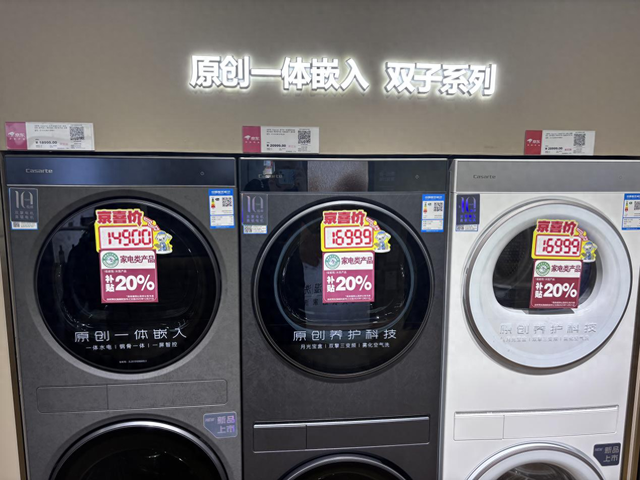
Core Viewpoint - The "6·18" mid-year promotion significantly boosted home appliance sales, with a total sales amount of approximately 110.1 billion yuan, reflecting a year-on-year growth of about 45.6%, outpacing the overall e-commerce growth rate of 15.2% [3] Group 1: National Subsidy Policy - The national subsidy policy for replacing old appliances continues to be implemented, with many stores advertising subsidies of 15% to 20% [3] - The National Development and Reform Commission announced that the third batch of consumer goods replacement funds will be issued in July [3] - The total subsidy fund for the consumer goods replacement policy is set at 3 billion yuan, with 1.62 billion yuan already allocated in the first two batches [5][7] Group 2: Regional Variations - Some provinces, like Jiangsu, have implemented a limited distribution model for subsidies, allowing consumers to claim subsidies within a 24-hour window [4] - In contrast, regions like Shanghai and Hubei have maintained their subsidy policies without adjustments, with Hubei committing to continue the program through 2025 [5][7] - Jiangsu's limited distribution model may serve as a template for future adjustments to the national subsidy policy [11] Group 3: Market Impact and Consumer Behavior - The consumer goods replacement policy has driven significant sales, with 1.1 trillion yuan in sales attributed to the policy by May 31, 2023 [7] - The awareness of the subsidy policy among consumers remains high, with 89% recognizing it, and 71% of users motivated by the need to replace old products [10] - The policy is seen as a crucial tool for expanding domestic demand and promoting industrial transformation [9] Group 4: Future Outlook - The National Development and Reform Commission plans to ensure a balanced and orderly implementation of the subsidy policy throughout the year [6] - The subsidy distribution will consider various factors, including population and economic performance, to ensure effective allocation [8] - The shift towards a "precise control" subsidy model is expected to enhance resource allocation and improve funding efficiency [11]

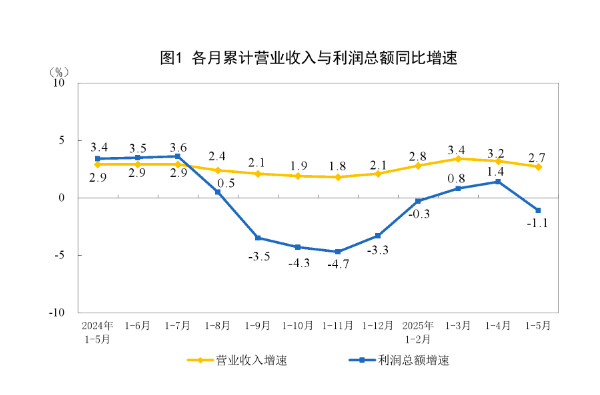
1—5月份规上工业企业实现利润同比下降1.1%:关税成本叠加内需不足
Sou Hu Cai Jing· 2025-06-27 10:36
Core Insights - The profits of industrial enterprises above designated size in China decreased by 1.1% year-on-year from January to May 2025, with a significant drop of 9.1% in May alone, marking the largest decline since October of the previous year [2][3] Group 1: Profit Trends - The manufacturing sector's profit growth rate increased by 5.4% year-on-year from January to May, outperforming the overall profit growth rate of industrial enterprises by 6.5 percentage points [2] - State-owned enterprises experienced a profit decline of 7.4%, while private enterprises saw a profit increase of 3.4% during the same period [4] Group 2: Factors Influencing Profitability - The decline in profits is attributed to external environmental shocks, continuous decreases in the Producer Price Index (PPI), and insufficient domestic demand [3] - The average collection period for accounts receivable exceeded 70 days, indicating significant asset turnover pressure within the industrial sector [3] Group 3: Impact of Tariffs - State-owned enterprises were more adversely affected by tariffs compared to private enterprises, with state-owned profits declining by 18.1% in May [3][4] - The rising costs due to tariffs have eroded profits, as some enterprises bear the tariff costs themselves, while others face supply chain adjustment costs [6] Group 4: Sector-Specific Performance - The profits of the large equipment manufacturing sector surged by 60%-120%, driven by new production capabilities and supportive policies [2] - Downstream industries such as entertainment products, textiles, and food manufacturing faced significant profit declines of -27.0%, -18.3%, and -7.0% respectively in May [6]

工业利润由增转降,下阶段走势如何
Di Yi Cai Jing· 2025-06-27 02:55
Group 1 - The total profit of industrial enterprises above designated size in China for January to May was 2.72 trillion yuan, a year-on-year decrease of 1.1%, with May alone seeing a profit drop of 9.1% [1][3] - The decline in industrial profits is attributed to insufficient effective demand, falling industrial product prices, and fluctuations in short-term factors [1][3] - Despite the overall profit decline, the gross profit of industrial enterprises increased by 1.1% year-on-year, contributing to a 3.0 percentage point increase in total profits [1][3] Group 2 - Private enterprises and foreign-invested enterprises showed profit growth of 3.4% and 0.3% respectively, outperforming the average level of all industrial enterprises [3] - The equipment manufacturing sector demonstrated strong performance with a profit increase of 7.2%, contributing 2.4 percentage points to the overall industrial profit growth [3][4] - Several industries within equipment manufacturing, such as electronics and electrical machinery, reported profit growth exceeding 10% [3][4] Group 3 - The "Two New" policies have effectively stimulated domestic demand, leading to significant profit increases in general and specialized equipment manufacturing [4] - The consumer goods sector benefited from policies promoting the replacement of old products, with profit growth in smart consumer devices reaching 101.5% [4] - Future industrial profit growth is expected to improve due to supportive policies aimed at enhancing quality and efficiency in key industries [4]