生物医药

Search documents
广西国元产业基金招GP
FOFWEEKLY· 2026-01-22 10:00
近日,广西国元产业高质量发展投资基金(以下简称"广西国元产业基金")面向全国征集优质子 基金管理机构开展合作。 广西国元产业基金由广西壮族自治区产业园区改革发展办公室(以下简称"自治区园区办")作为 主管单位,广西投资引导基金有限责任公司(以下简称"广西引导基金")作为主要出资方,国元 股权投资有限公司(以下简称"国元股权")作为基金管理人共同发起设立。 母基金规模20亿元,存续期限12年,其中投资期7年,退出期5年。据悉,基金聚焦人工智能、半 导体、生物医药、新能源及新能源汽车、高端装备制造等具有前沿性的战略性新兴产业项目,重点 支持长三角等地意向投资广西企业落地相关地市及产业园区。同时,对符合产业发展方向的创新科 技类、成长型企业按照"投早投小"原则加速培育,投资比例不超过基金规模的30%。 荐读: 2025募资市场年度观察:一年聊过239家LP的真实感受 荐读: 2025年IPO退出盘点:哪些GP赚钱了? 热文: 投资人"忙疯了" 来源:国元股权投资有限公司 每日|荐读 热文: 谁押中了沐曦股份? ...

利好科创!深圳重要发布
Zhong Guo Zheng Quan Bao· 2026-01-22 08:13
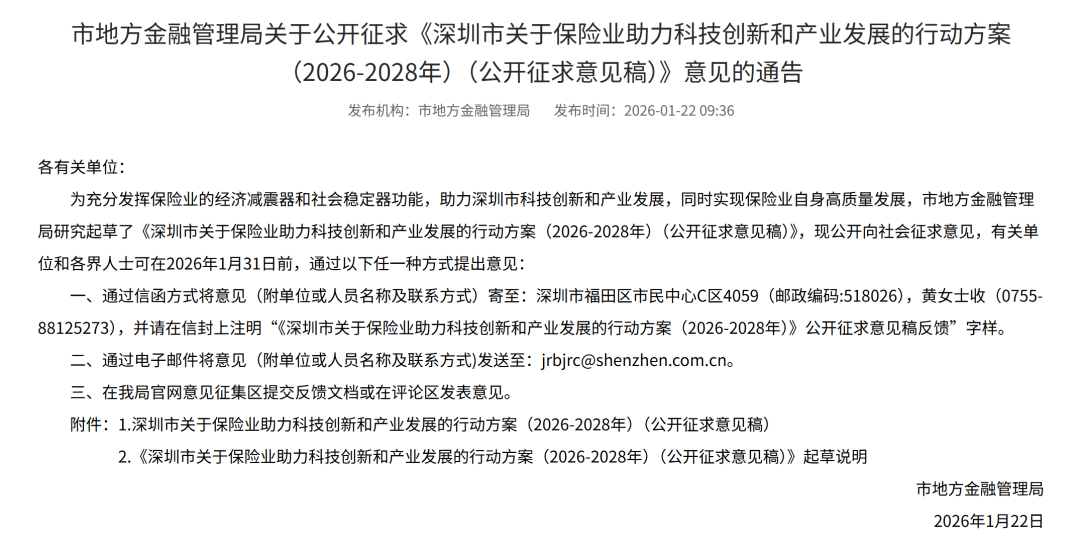
Core Viewpoint - The Shenzhen Municipal Financial Management Bureau has solicited public opinions on the "Action Plan for the Insurance Industry to Support Technological Innovation and Industrial Development (2026-2028)", which sets quantitative goals for insurance in technology and emerging industries [1] Group 1: Quantitative Goals - The plan aims for an annual growth rate of over 10% in technology insurance premium income, providing risk protection exceeding 5 trillion yuan for tech companies each year [1] - It targets the launch of at least 30 innovative insurance products annually in emerging industries such as low-altitude economy and artificial intelligence [1] - The total assets of insurance entities in Shenzhen are expected to exceed 11 trillion yuan, with total premium income in the region surpassing 700 billion yuan over three years [1] Group 2: Focus Areas and Support Measures - The plan emphasizes the development of technology insurance, encouraging insurance institutions to research and innovate products in cutting-edge fields like humanoid robots, quantum technology, and commercial aerospace [2] - It proposes the development of specialized insurance products such as major technology equipment insurance, intellectual property insurance, and cybersecurity insurance to precisely serve the real economy and technological innovation [2] - In the realm of artificial intelligence, the plan encourages the establishment of AI insurance innovation centers and the development of comprehensive insurance solutions covering various risk layers [2] Group 3: Sector-Specific Insurance Development - For the biopharmaceutical industry, the plan suggests expanding insurance products to support R&D in pharmaceuticals and medical devices, including liability insurance for clinical trials [3] - It aims to accelerate the development of low-altitude insurance, including mandatory insurance for drones and the establishment of a classification management system [3] - The plan encourages insurance institutions to adapt to the trends of smart driving and collaborate with developers to refine insurance products for intelligent vehicles [3] Group 4: Cross-Border Cooperation and Support - The plan supports cooperation between Shenzhen and Hong Kong insurance institutions to develop medical and pension insurance products tailored to the Greater Bay Area [4] - It promotes the use of trade risk avoidance tools for cross-border e-commerce enterprises and encourages domestic insurance companies to optimize their overseas operations [4] Group 5: Strengthening Insurance Institutions - The plan supports the establishment of legal headquarters for financial enterprises in Shenzhen and encourages both domestic and foreign insurance institutions to set up subsidiaries in various sectors [5] Group 6: Service Improvement and Performance Metrics - The plan emphasizes enhancing underwriting and claims service levels, utilizing advanced technologies to improve efficiency and accuracy in insurance processes [6] - Data shows that Shenzhen's insurance premium income reached 179.74 billion yuan in the first three quarters of 2025, with a year-on-year growth of 12.8%, leading among first-tier cities [6] - As of September, the total assets of insurance entities in Shenzhen reached 9.1 trillion yuan, with a year-on-year growth of 22%, and net profits of 61 billion yuan, reflecting a growth rate of 15.5% [6]
深圳重磅发布!
Zhong Guo Ji Jin Bao· 2026-01-22 04:06
Core Insights - The article discusses Shenzhen's new action plan aimed at leveraging the insurance industry to support technological innovation and industrial development from 2026 to 2028 [1][11]. Group 1: Action Plan Overview - The action plan outlines sixteen measures to enhance insurance support for technology innovation and industrial development, with specific responsibilities assigned to various units [3][4]. - The plan aims to establish a modern insurance service system aligned with Shenzhen's economic development, supporting strategic emerging industries and enhancing financial cooperation with Hong Kong [4][12]. Group 2: Goals and Targets - By the end of 2028, the plan targets an annual risk coverage of over 5 trillion yuan for technology enterprises, with an average annual growth rate of over 10% in technology insurance premium income [4][12]. - The total assets of insurance entities in Shenzhen are expected to exceed 11 trillion yuan, with total premium income surpassing 700 billion yuan over three years [5][13]. Group 3: Specific Measures - The plan includes optimizing insurance fund utilization, promoting technology insurance, and enhancing support for the "20+8" strategic emerging industry clusters [6][14]. - It encourages insurance institutions to invest over 1 trillion yuan in Shenzhen, focusing on key sectors such as artificial intelligence, biotechnology, and low-altitude economy [6][7]. Group 4: Collaboration and Innovation - The action plan emphasizes collaboration between the insurance industry and various sectors, including the establishment of insurance innovation centers and the development of tailored insurance products for emerging technologies [8][15]. - It also highlights the importance of enhancing the insurance service system for the marine industry and promoting cross-border insurance cooperation with Hong Kong [17][19]. Group 5: Support and Coordination - The plan outlines measures to strengthen organizational coordination and promote public awareness of insurance policies and products [21][22]. - It aims to facilitate the integration of insurance services with industrial needs, enhancing the efficiency and effectiveness of insurance offerings [21][22].
观察|去年深圳8家银行密集“换将”,新行长们的角色之变
Nan Fang Du Shi Bao· 2026-01-21 06:03
Core Viewpoint - Shenzhen's "15th Five-Year Plan" aims to establish itself as a global "industrial financial center," raising expectations for local financial institutions, particularly banks, in their roles and responsibilities [22][23]. Group 1: Leadership Changes in Shenzhen Banks - Over the past year, at least eight commercial banks in Shenzhen have changed their leadership, including major state-owned banks and leading joint-stock banks [2]. - The appointment of Xiong Tao as the head of the Industrial and Commercial Bank of China (ICBC) Shenzhen branch reflects a strategic move to enhance the bank's focus on technology and innovation [2][4]. - Similarly, Ma Mingjun has been appointed as the head of the Bank of China Shenzhen branch, indicating a strengthened commitment to the Guangdong-Hong Kong-Macao Greater Bay Area [4][7]. Group 2: Key Appointments and Their Implications - Wang Xinghai, a veteran of China Merchants Bank, has taken over as the head of the Shenzhen branch, showcasing the bank's internal talent development strategy [9]. - Ping An Bank has also seen significant leadership changes, with Zhang Chaohui becoming the head of the Shenzhen branch, emphasizing the importance of this branch within the bank's overall strategy [11]. - New leaders at various banks, such as Shang Wencheng of China Everbright Bank and Yuan Rui of Shanghai Pudong Development Bank, are focusing on technology finance and innovative service models to meet the needs of Shenzhen's tech-driven economy [12][15]. Group 3: Strategic Focus on Technology Finance - The new leaders are expected to align their banks' strategies with Shenzhen's identity as a technology innovation hub, emphasizing the importance of "investment-loan linkage" services [12][23]. - The financial institutions are being urged to develop comprehensive service models that support the entire lifecycle of technology enterprises, particularly in critical sectors like semiconductors and advanced manufacturing [12][15]. - The shift towards a more integrated financial service approach reflects a broader trend in which banks are expected to act as "deep partners" and "comprehensive service providers" rather than just capital providers [23]. Group 4: Challenges and Future Directions - The banks in Shenzhen face challenges in transitioning from traditional financing to more complex service models, requiring enhanced risk management and understanding of emerging technologies [23]. - There is a growing need for collaboration with venture capital, insurance, and other financial institutions to meet the comprehensive needs of enterprises [23]. - The emphasis on long-term investment strategies and the establishment of a long-term assessment mechanism are critical for supporting sustainable growth in the technology sector [23].





迪哲医药跌2.10%,成交额1.21亿元,主力资金净流入122.41万元
Xin Lang Zheng Quan· 2026-01-21 05:57
Core Viewpoint - Dize Pharmaceutical has experienced fluctuations in stock price and trading volume, with a notable increase in revenue but a decrease in net profit for the year 2025 [1][2]. Group 1: Stock Performance - On January 21, Dize Pharmaceutical's stock fell by 2.10%, trading at 61.40 yuan per share, with a total market capitalization of 28.491 billion yuan [1]. - The stock has increased by 6.60% year-to-date, but has decreased by 6.37% over the last five trading days [1]. - The company reported a trading volume of 1.21 billion yuan, with a turnover rate of 0.42% [1]. Group 2: Financial Performance - For the period from January to September 2025, Dize Pharmaceutical achieved a revenue of 586 million yuan, representing a year-on-year growth of 73.23% [2]. - The net profit attributable to shareholders was -580 million yuan, reflecting a year-on-year decrease of 3.85% [2]. Group 3: Shareholder Information - As of September 30, 2025, the number of shareholders increased to 8,806, a rise of 5.01% [2]. - The average number of circulating shares per person increased to 46,528, up by 108.97% compared to the previous period [2]. - Notable changes in institutional holdings include an increase in shares held by Yongying Pharmaceutical Innovation Mixed Fund and the entry of Hong Kong Central Clearing Limited as a new shareholder [2].

5.4%!增速高于全国!上海2025年经济“交卷”
Zheng Quan Shi Bao· 2026-01-21 04:38
Economic Overview - In 2025, Shanghai's GDP reached 56,708.71 billion yuan, with a year-on-year growth of 5.4%, surpassing the national growth rate [1] - Shanghai's economic total ranked fifth among global cities for the first time [1] Industry Performance - The primary industry added value was 99.39 billion yuan, growing by 2.0%; the secondary industry added value was 11,650.62 billion yuan, growing by 3.5%; and the tertiary industry added value was 44,958.70 billion yuan, growing by 6.0% [1] - Industrial added value in Shanghai increased by 5.0%, with total industrial output value growing by 4.6% [1] - Notable growth in specific sectors included transportation equipment manufacturing (15.8%), electrical machinery (11.1%), automotive manufacturing (7.8%), and electronics (7.7%) [1] Leading Industries - The three leading industries in Shanghai—integrated circuits, artificial intelligence, and biomedicine—saw a manufacturing output growth of 9.6%, with integrated circuits growing by 15.1% and artificial intelligence by 13.6% [2] - Strategic emerging industries in Shanghai's industrial sector grew by 6.5%, with new energy industries increasing by 12.9% and high-end equipment industries by 11.1% [2] Service Sector Growth - The tertiary sector's added value grew by 6.0%, with information transmission, software, and IT services increasing by 15.3% and the financial sector by 9.7% [2] Consumer Market - Shanghai's total retail sales of consumer goods reached 16,600.93 billion yuan, with a year-on-year growth of 4.6%, improving by 0.3 percentage points compared to the first three quarters [2] Trade Performance - The total import and export value in Shanghai was 4.51 trillion yuan, growing by 5.6%, with exports at 2.02 trillion yuan (10.8% growth) and imports at 2.49 trillion yuan (1.8% growth) [2] - Exports of "new three samples" products reached 0.16 trillion yuan, growing by 17.4%, with electric vehicle exports increasing by 13.8% [2] Future Development Plans - The "14th Five-Year Plan" suggests that by 2035, Shanghai aims to enhance its five central functions and achieve international leading levels in key development indicators, doubling per capita GDP from 2020 [3] - The plan emphasizes agile development in quantum technology, brain-computer interfaces, controlled nuclear fusion, biomanufacturing, and sixth-generation mobile communications [3] - It also supports the establishment of an international financial asset trading platform and the development of market-oriented merger funds, venture capital funds, and foreign investment funds [3]
5.4%!增速高于全国!上海2025年经济“交卷”
证券时报· 2026-01-21 04:25
Core Viewpoint - In 2025, Shanghai's GDP reached 56,708.71 billion yuan, growing by 5.4% year-on-year, surpassing the national growth rate, marking Shanghai as the fifth largest economy among global cities [1] Economic Performance - Shanghai's primary industry added value was 99.39 billion yuan, growing by 2.0% - The secondary industry added value was 11,650.62 billion yuan, growing by 3.5% - The tertiary industry added value was 44,958.70 billion yuan, growing by 6.0% [1] Industrial Production - In 2025, Shanghai's industrial added value grew by 5.0% - The total industrial output value above designated size increased by 4.6% - Notable growth in specific sectors: - Railway, shipbuilding, aerospace, and other transport equipment manufacturing grew by 15.8% - Electrical machinery and equipment manufacturing grew by 11.1% - Automobile manufacturing grew by 7.8% - Computer, communication, and other electronic equipment manufacturing grew by 7.7% [1] Leading Industries - The three leading industries in Shanghai are integrated circuits, artificial intelligence, and biomedicine, with manufacturing output growing by 9.6% - Integrated circuit manufacturing grew by 15.1% - Artificial intelligence manufacturing grew by 13.6% - Strategic emerging industries in Shanghai saw a 6.5% increase in output, with new energy industries growing by 12.9% and high-end equipment industries growing by 11.1% [2] Service Sector Growth - The tertiary sector's added value grew by 6.0% - Information transmission, software, and IT services added value reached 7,139.93 billion yuan, growing by 15.3% - Financial services added value was 8,979.66 billion yuan, growing by 9.7% [2] Consumption and Trade - Shanghai's total retail sales of consumer goods reached 16,600.93 billion yuan, growing by 4.6% - The total import and export value of goods was 4.51 trillion yuan, growing by 5.6% - Exports reached 2.02 trillion yuan, growing by 10.8%, while imports were 2.49 trillion yuan, growing by 1.8% - "New three samples" products exports reached 0.16 trillion yuan, growing by 17.4%, with electric vehicle exports growing by 13.8% [2] Future Development Plans - The "14th Five-Year Plan" suggests that by 2035, Shanghai aims to upgrade its "five centers" functions to international leading levels, doubling per capita GDP from 2020 [3] - The plan emphasizes agile development in quantum technology, brain-computer interfaces, controlled nuclear fusion, biomanufacturing, and sixth-generation mobile communications [4]

沃森生物涨2.09%,成交额1.85亿元,主力资金净流入314.14万元
Xin Lang Cai Jing· 2026-01-21 02:37
Core Viewpoint - Watson Bio's stock has shown fluctuations in price and trading volume, with a notable increase in share price since the beginning of the year, despite recent declines in the short term [1]. Financial Performance - For the period from January to September 2025, Watson Bio reported a revenue of 1.719 billion yuan, representing a year-on-year decrease of 19.73% [2]. - The net profit attributable to shareholders for the same period was 163 million yuan, down 36.24% year-on-year [2]. Shareholder Information - As of September 30, 2025, the number of shareholders for Watson Bio was 114,000, a decrease of 2.75% from the previous period [2]. - The average number of circulating shares per shareholder increased by 2.83% to 13,643 shares [2]. Dividend Distribution - Since its A-share listing, Watson Bio has distributed a total of 451 million yuan in dividends, with 95.96 million yuan distributed over the last three years [3]. Institutional Holdings - As of September 30, 2025, the largest circulating shareholder was E Fund's ChiNext ETF, holding 34.4714 million shares, a decrease of 5.8005 million shares from the previous period [3]. - Other notable institutional shareholders include Southern CSI 500 ETF and China Merchants National Bio-Medical Index A, both of which also saw reductions in their holdings [3].

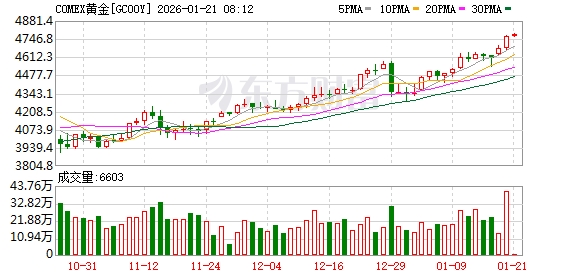
“股债汇三杀”!市场重现“卖出美国”交易模式!国际金价再创新高
Zheng Quan Shi Bao Wang· 2026-01-21 02:31
Group 1 - Overseas natural gas prices surged, with US natural gas futures rising over 28% [2][16] - The highest price for natural gas reached 3.990, marking a 26.30% increase from the previous close of 3.103 [3][17] - Weather forecasts predict colder temperatures, which are expected to drive up gas prices further, particularly in Europe [4][18] Group 2 - Poland's central bank approved a plan to purchase up to 150 tons of gold, increasing its reserves to 700 tons, positioning Poland among the top 10 countries in gold reserves [5][19] - International gold prices reached new highs, with New York gold futures rising over 3% and London spot gold increasing over 2% [6][20] Group 3 - The US stock market experienced significant declines, with the Dow Jones falling 1.76%, the S&P 500 dropping 2.06%, and the Nasdaq down 2.39% [9][23] - The US 10-year Treasury yield rose by 6.76 basis points to 4.2906%, indicating a decline in bond prices [9][23] - The Shanghai Futures Exchange announced adjustments to margin requirements and price limits for various futures contracts, including copper, aluminum, gold, and silver [10][24]

刚刚 股债汇“三杀” 有机构“清仓美国”!特朗普最新表态!国际金价再创新高
Qi Huo Ri Bao· 2026-01-21 00:22
Group 1: Natural Gas and Precious Metals Market - Overseas natural gas prices surged, with U.S. natural gas futures rising over 28% due to colder weather predictions [2] - European gas prices increased significantly as temperature forecasts turned colder, widening the price gap between Europe and the U.S. [2] - The Polish central bank plans to purchase up to 150 tons of gold, increasing its reserves to 700 tons, positioning Poland among the top 10 countries in gold reserves [2] Group 2: U.S. Political and Economic Climate - Danish pension fund AkademikerPension plans to liquidate U.S. Treasury holdings due to concerns over credit risk from U.S. policies [5] - Bridgewater founder Ray Dalio warned that U.S. policies could lead to a "capital war," prompting investors to shift towards hard assets like gold [6] - U.S. stock indices experienced significant declines, with the Dow Jones down 1.76% and the S&P 500 down 2.06%, marking the largest single-day drop since October [6] Group 3: A-Share Market Dynamics - A-shares have seen significant increases in early 2026, with potential incremental capital inflows estimated to reach several trillion yuan [9] - Incremental funds are categorized into active speculative funds and long-term funds, with insurance and public funds acting as market stabilizers [9] - By Q3 2025, insurance funds held approximately 5.59 trillion yuan in stocks and securities, showing substantial growth from previous years [9] Group 4: Market Structure and Future Outlook - The influx of funds into the market is supported by institutional measures aimed at promoting long-term investments [10][11] - External capital is expected to play a significant role, particularly in sectors with global competitiveness such as AI and renewable energy [12] - The market may enter a consolidation phase as many popular sectors are at high valuations, with future growth driven by earnings and valuation adjustments [13]