
IP经济

Search documents
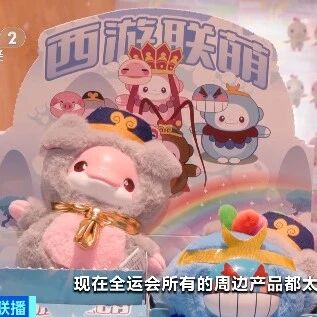
十五运顶流火到断货,网友:根本抢不到
2 1 Shi Ji Jing Ji Bao Dao· 2025-11-14 01:30
Core Insights - The sales of the mascots "喜洋洋" and "乐融融" related to the 15th National Games and the Special Olympics have surged, with retail stores experiencing stock shortages and high consumer demand [1][2][4] - The total market value of licensed products has exceeded 680 million yuan, with over 2,800 licensed products approved, marking the highest number in history [1][2] - The mascots have become a significant cultural and commercial IP, with online discussions reaching over 500 million views and a 300% increase in search volume [1][4] Group 1: Sales and Market Dynamics - Retail stores are facing long queues and stock shortages, with some stores selling out of popular items within hours [2][4] - The sales performance is notable, with one store reporting sales of 130,000 yuan in a single day, and other stores experiencing similar high traffic and sales [2][4] - The online sales channel is also performing well, with many products sold out during live broadcasts [5][6] Group 2: Production and Supply Chain - The production lines in Dongguan are operating at high capacity to meet the demand for mascot-related products, with some companies increasing their workforce significantly [7][8] - The "吹泡泡小挂件" has emerged as a top-selling item, with 300,000 orders received for this product alone [8][9] - The manufacturing process is supported by a robust supply chain in the Greater Bay Area, allowing for quick responses to market demand [9][10] Group 3: Cultural and Economic Impact - The event has provided opportunities for companies to expand into international markets, particularly through connections made in Hong Kong [11] - The phenomenon of the mascots illustrates the potential for large-scale events to create sustainable revenue streams through IP development [11] - Experts suggest that the focus should be on transforming short-term successes into long-term brand assets through effective IP management and integrated marketing strategies [11]


十五运顶流火到断货,网友:根本抢不到
21世纪经济报道· 2025-11-14 01:24
Core Insights - The article highlights the significant consumer demand for the mascots "喜洋洋" and "乐融融" related to the 15th National Games and the Special Olympics, leading to a surge in sales and production of related merchandise [1][4][10] - The total market value of licensed products has exceeded 680 million yuan, with over 2,800 licensed products approved, marking the highest number in history [1][10] - The mascots have become a cultural and commercial phenomenon, with a strong online presence and engagement, indicating their potential as a leading cultural IP in the Greater Bay Area [1][10][14] Sales and Market Dynamics - The sales of the mascots have been exceptionally high, with some stores reporting daily sales exceeding 130,000 yuan and long queues outside retail locations [5][9] - The demand has led to stock shortages, with many stores posting notices about sold-out items and consumers actively seeking products across multiple locations [4][7] - The online sales have also been robust, with significant quantities of merchandise sold out during live-streaming events [10][11] Production and Supply Chain - The production of mascot-related merchandise has ramped up significantly, with manufacturers like 文博工艺 increasing workforce and production capacity to meet demand [11][14] - The company has received substantial orders, with projections indicating total production could exceed 1 million units for the event [11][14] - The Greater Bay Area's efficient supply chain and manufacturing capabilities have facilitated rapid production and distribution of these popular items [14][15] Consumer Demographics and Preferences - The consumer base includes a diverse demographic, with both young people and older collectors showing interest in the products, particularly limited edition items [9][10] - The younger generation is particularly drawn to stress-relief and therapeutic products, which aligns with the design and marketing of the mascots [10][14] - The article notes that international tourists are also purchasing these products, indicating a broader appeal beyond local consumers [9][10] Cultural and Economic Impact - The mascots represent a successful case of cultural IP leveraging, with the potential for long-term brand development beyond the event [15][16] - The article emphasizes the need for a sustainable ecosystem for cultural IP development, suggesting that the focus should be on transforming short-term successes into lasting brand value [15][16] - The collaboration between design, production, and sales within the Greater Bay Area is highlighted as a model for future cultural and commercial initiatives [14][15]

中金 | 深度布局“十五五”:传媒篇
中金点睛· 2025-11-14 00:18
Group 1: Core Insights - The article emphasizes the importance of a favorable policy environment in fostering a new content cycle in the cultural industry, particularly in gaming and long-form video content [2][3] - It highlights the need for continuous innovation in high-quality content to retain users on long video platforms, with a focus on flexible funding and creative energy [2][3] - The article predicts that the period from 2026 to 2028 will be crucial for content innovation and mechanism optimization in the industry [3] Group 2: AI Integration - AI is entering a new stage of development, promoting deep integration with various industries, including media, where significant breakthroughs in AI applications are expected by 2025 [6] - The article outlines specific areas of AI application, including film and television, gaming, advertising, and social media, where AI is enhancing efficiency and commercial viability [6][7] - It anticipates that as AI technology matures, there will be a shift towards highly automated content generation across multiple sectors, leading to increased user engagement and monetization [7] Group 3: Cultural Export - The article discusses the trend of "cultural export," where Chinese cultural products are increasingly tailored for global markets, moving from generic content to high-quality, culturally rich offerings [9] - It notes that leading companies in the gaming sector are achieving global distribution success, while web literature and short dramas are also adapting to local markets through translation and localization efforts [9] - The integration of AI is expected to further enhance the scalability of cultural exports, allowing for more efficient production and distribution [9] Group 4: IP Economy - The article highlights the growing demand for high-quality, serialized content, driving the IP economy, which involves monetizing intellectual property through various media and product forms [11] - It observes that content IP companies are increasingly focusing on strategic IP development to mitigate profit volatility and expand commercial opportunities [11] - The article suggests that the maturation of the domestic IP industry will lead to a systematic revaluation of IP assets, with companies possessing differentiated IP reserves gaining competitive advantages [11]

哈尔斯(002615):公司首次覆盖报告:制造全球深度布局,品牌转型潮流消费
Xinda Securities· 2025-11-13 15:01
Investment Rating - The report assigns a "Buy" rating for the company Hars (002615) [2] Core Insights - The report highlights the transformation of stainless steel thermal containers from "durable goods" to "consumer goods," driven by emotional branding and differentiated design, with the global market size reaching $12.491 billion in 2021 [2][24] - The report emphasizes the company's strong customer base and the expected increase in market share due to overseas production capacity expansion [3] - The company aims for a comprehensive brand optimization and has set ambitious goals for brand revenue to approach manufacturing by 2028 [4] Summary by Sections 1. Leading Brand in Thermal Containers - The company has evolved from an OEM model to establishing its own brand, creating a second growth curve [8] - The ownership structure is concentrated, with significant shareholding by management, indicating strong confidence in the company's future [16] 2. Accelerating Consumption Logic and Industry Expansion - The consumption scenarios for thermal containers are broadening, leading to market expansion [24] - The global market for stainless steel thermal containers is projected to grow, with China being a major production country [24][34] 3. Overseas Capacity Boosting Market Share - The company has established a solid customer base, with significant revenue from major clients [3] - The brand is undergoing comprehensive reforms, which are expected to contribute significantly to future growth [4] 4. Profit Forecast and Investment Rating - The report forecasts net profits for 2025-2027 to be 144 million, 298 million, and 385 million yuan respectively, with corresponding P/E ratios of 27.4X, 13.3X, and 10.3X [4][11]

天机控股盘中涨超9% 公司打造“IP+智造”双轮驱动战略 营造长期增长价值空间
Zhi Tong Cai Jing· 2025-11-13 03:40
Core Viewpoint - Tianji Holdings (01520) has seen a significant stock price increase of 9.32%, reaching HKD 1.29, driven by the popularity of the Chinese潮玩IP "LABUBU" overseas and the growing interest in IP economy stocks [1] Group 1: Company Developments - The company is leveraging its existing IP resources to focus on three main business areas: IP digitization, IP merchandise trading, and IP community operations, aiming to build a global digital asset IP identity chain [1] - Recently, Tianji Holdings announced a strategic partnership with iFlytek (002230) and the Saudi Ministry of Industry and Mineral Resources, extending its consumer IP business into broader industrial scenarios, thus opening a second growth curve [1] Group 2: Strategic Initiatives - The company is proactively developing a "smart consumption + smart manufacturing" dual-driven strategy, utilizing artificial intelligence, digitalization, and blockchain technology to deepen the IP value ecosystem and explore incremental business opportunities [1] - This strategy also aims to extend operations into the industrial sector, applying cutting-edge technology to facilitate the intelligent upgrade and globalization of the manufacturing industry, aligning with the trend of deep integration between the digital economy and the real economy [1]
港股异动 | 天机控股(01520)盘中涨超9% 公司打造“IP+智造”双轮驱动战略 营造长期增长价值空间
智通财经网· 2025-11-13 03:39
Core Viewpoint - Tianji Holdings (01520) has seen a significant stock price increase of over 9% this year, driven by the rising popularity of the Chinese IP "LABUBU" overseas, which has positively impacted related listed companies and the IP economy concept stocks [1] Group 1: Company Developments - Tianji Holdings' stock price rose by 9.32% to HKD 1.29, with a trading volume of HKD 2.9664 million [1] - The company is focusing on three main business segments: IP digitalization, IP merchandise trading, and IP community operations, aiming to build a global digital asset IP identity chain [1] - Recently, Tianji Holdings announced a strategic partnership with iFlytek and the Saudi Ministry of Industry and Mineral Resources, extending its consumer IP business into broader industrial scenarios [1] Group 2: Strategic Initiatives - The company is implementing a dual-driven strategy of "Smart Consumption + Smart Manufacturing," leveraging AI, digitalization, and blockchain technology to enhance the IP value ecosystem and explore incremental business opportunities [1] - The strategy also aims to extend operations into the industrial sector, utilizing advanced technologies to support the intelligent upgrade and globalization of manufacturing [1] - This approach aligns with the trend of deep integration between the digital economy and the real economy, opening up broader long-term growth avenues for the company [1]
大麦娱乐(01060.HK):阿里鱼业务料增长强劲 持续关注IP经济潜力
Ge Long Hui· 2025-11-08 19:49
Core Viewpoint - The company anticipates a significant increase in net profit for FY1H26, driven by strong performance in its IP business and a stable foundation in its ticketing operations [1][2]. Group 1: Financial Performance - The company forecasts a net profit of no less than 500 million yuan for FY1H26, representing a year-on-year growth of approximately 48% [1]. - Non-IFRS EBITA is projected to be 537 million yuan for FY1H26 [1]. - The company maintains its full-year revenue and profit forecasts unchanged, with the current stock price trading at 21 times FY26 P/E [2]. Group 2: Business Segments - The strong growth in net profit is attributed to the excellent performance of the Aliyu business, with revenue and profit both showing robust year-on-year growth [1]. - Key IPs such as Sanrio, Chiikawa, and Crayon Shin-chan are identified as core drivers of current revenue and profit, with Sanrio's licensing revenue in mainland China increasing by 43.9% to 194 million yuan [1]. - The company is strategically investing in diversified entertainment sectors, including local cultural tourism and sports events, to support long-term growth [2]. Group 3: Investment Strategy - The company has a strong cash reserve and plans to invest in various entertainment sectors, which may lead to short-term costs but is expected to yield sustainable growth in the long term [2]. - The reduction in investment portfolio risk exposure has also contributed to the increase in net profit for FY1H26 [2]. - The company has a film slate that includes titles like "Explosive Water Pipe" and "Special Agent," indicating a controlled risk environment in film production [2]. Group 4: Valuation - The target price is set at 1.32 HKD, corresponding to a 30 times FY26 P/E, indicating a potential upside of 40% from the current stock price [2].
研报掘金丨中金:维持大麦娱乐“跑赢行业”评级 持续关注IP经济潜力
Ge Long Hui· 2025-11-07 05:46
Core Viewpoint - Dama Entertainment has issued a positive profit forecast for the first half of the fiscal year 2026, expecting a net profit of no less than 500 million yuan, representing an approximate 48% year-on-year growth [1] Group 1: Financial Performance - The increase in net profit is primarily attributed to the strong performance of the Aliyu business, with both revenue and profit showing robust year-on-year growth [1] - The leading IPs such as Sanrio, Chiikawa, and Crayon Shin-chan continue to be the core drivers of current revenue and profit, demonstrating good popularity [1] Group 2: Analyst Ratings - CICC maintains its full-year revenue and profit forecasts for Dama Entertainment, reiterating an "outperforming the industry" rating and a target price of HKD 1.32, which corresponds to a 30 times price-to-earnings ratio for 2026, indicating a 40% upside potential compared to the current stock price [1]
日经BP精选:外国游客热捧蒙奇奇,日本常青IP焕发新生
日经中文网· 2025-11-07 03:08
Core Points - The article highlights the increasing popularity of the "Monchhichi" toy among foreign tourists, particularly in the Asakusa area of Tokyo [6] - Sales of "Monchhichi" have surged by 3.7 times due to endorsements from overseas celebrities on social media [6] - Sekiguchi's president emphasizes the importance of maintaining a market presence for sustained success [6]

中金:维持大麦娱乐(01060)跑赢行业评级 目标价1.32港元
Zhi Tong Cai Jing· 2025-11-07 01:53
Core Viewpoint - The company maintains its revenue and profit forecasts for the full year, with a target price of HKD 1.32, indicating a potential upside of 40% from the current stock price [1] Group 1: Financial Performance - The company expects a net profit of no less than 500 million yuan for the first half of FY26, representing a year-on-year increase of approximately 48% [1] - The forecast for Non-IFRS EBITA for FY1H26 is 537 million yuan [1] Group 2: Business Segments - The strong performance of the Aliyu business is a key driver of the profit increase, with significant growth in revenue and profit attributed to popular IPs such as Sanrio, Chiikawa, and Crayon Shin-chan [2] - The company predicts a 55% year-on-year increase in derivative income to 930 million yuan for FY1H26, despite the negative impact from the closure of Jinli Naju [2] Group 3: Strategic Investments - The company has a solid cash reserve and plans to diversify investments in the entertainment industry, including local cultural tourism, sports events, and small to medium-sized productions [3] - A three-year strategic cooperation agreement has been renewed with Galaxy Macau, indicating a commitment to stable ticketing operations and potential growth in overseas markets [3] Group 4: Risk Management - The increase in net profit for FY1H26 is also attributed to a reduction in investment portfolio risk exposure, with a controlled risk outlook for upcoming film productions [4]