
AI芯片

Search documents
黑芝麻智能:拟收购AI芯片公司,助力产品拓展机器人应用领域
Zheng Quan Shi Bao Wang· 2025-06-18 22:38
Group 1 - The company signed a non-binding letter of intent to acquire a target company focused on developing and selling cost-effective, low-power AI system-on-chip (SoC) solutions [1] - The target company's products include self-developed intellectual property for image signal processors (ISP), neural network processors (NPU), and analog IP, primarily serving the automotive intelligence and edge AI application sectors [1] - The acquisition aims to enhance the company's product offerings in automotive-grade computing chips and expand into broader robotics applications, providing a full range of AI inference chips and solutions [1] Group 2 - The company is a leading supplier of automotive-grade intelligent vehicle computing SoCs and solutions, ranking as the third-largest global supplier by shipment volume of high-performance automotive SoCs in 2022 [2] - The company showcased its Huashan and Wudang series chips at the 2025 Hong Kong Auto Show, including the Huashan A2000 chip designed for next-generation AI models, featuring the largest NPU core in the industry [2] - The Wudang C1200 family is designed for multi-domain integration and cockpit integration scenarios, with the C1236 being the first single-chip platform supporting high-speed assisted driving [3]

China holds back rare earths as it pushes for AI chip access in trade talks: report
Proactiveinvestors NA· 2025-06-16 14:14
About this content About Emily Jarvie Emily began her career as a political journalist for Australian Community Media in Hobart, Tasmania. After she relocated to Toronto, Canada, she reported on business, legal, and scientific developments in the emerging psychedelics sector before joining Proactive in 2022. She brings a strong journalism background with her work featured in newspapers, magazines, and digital publications across Australia, Europe, and North America, including The Examiner, The Advocate, ...


区块链概念股大涨,石油股二连板!A股主升浪要来了吗?高手这样看
Mei Ri Jing Ji Xin Wen· 2025-06-16 11:06
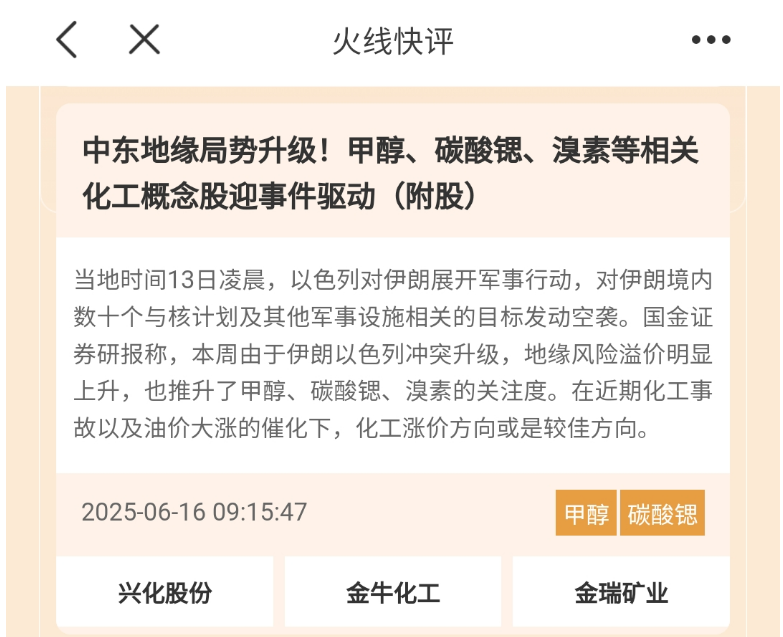
每经编辑|吴永久 周一,A股三大指数集体收涨,截至收盘,沪指涨0.35%,收报3388.73点。沪深两市成交额达到12151亿元,较上周五缩量2522亿元。 在每日经济新闻App私人订制的"火线快评"中,今日开盘前,提到甲醇、碳酸锶、溴素等板块,相关个股金牛化工、金瑞矿业涨停,兴化股份大涨 8.24%。 | 〈 X | 火线快评 | | | --- | --- | --- | | 中东地缘局势升级! 甲醇、碳酸铝、溴素等相关 | | | | 化工概念股迎事件驱动 (附股) | | | | 当地时间13日凌晨,以色列对伊朗展开军事行动,对伊朗境内 | | | | 数十个与核计划及其他军事设施相关的目标发动空袭。国金证 | | | | 券研报称,本周由于伊朗以色列冲突升级,地缘风险溢价明显 | | | | 上升,也推升了甲醇、碳酸铝、溴素的关注度。在近期化工事 | | | | 故以及油价大涨的催化下,化工涨价方向或是较佳方向。 | | | | 2025-06-16 09:15:47 | | 甲醇 碳酸铝 | | 兴化股份 | 金牛化工 | 金瑞矿业 | 在每日经济新闻App举办的掘金大赛第63期比赛中,今日是开赛 ...
早报|印度政府就坠机事故召开新闻发布会;以色列袭击已致伊朗224人死亡;labubu暂停韩国线下销售;郑钦文世界排名将创新高
虎嗅APP· 2025-06-15 23:46
Group 1: Aviation Incidents - The Indian government has promised to release an investigation report on a recent plane crash that resulted in 279 fatalities within three months [2] - A significant poisoning incident in Shandong, China, led to 7 deaths and 4 injuries, with 26 individuals held accountable for safety violations [3][4] Group 2: Corporate Developments - Pop Mart has temporarily suspended the offline sales of its LABUBU plush toys in South Korea due to safety concerns [9][10] - Ant Group is entering the Hong Kong stablecoin market, joining other major players like JD.com and Standard Chartered in seeking licenses for stablecoin issuance [12][13] Group 3: Technology and Innovation - AMD announced details about its next-generation AI chip, the Instinct MI400 series, which will be available next year and is designed for large-scale AI computing [14][15] - Apple confirmed that a small number of its M2 Mac Mini devices may fail to boot, offering free repairs for affected units [16][17] Group 4: Financial Regulations - New regulations for algorithmic trading in the futures market have been introduced, emphasizing the need for enhanced monitoring and risk management [21][22]

任正非、黄仁勋“隔空对话”:谈到AI芯片,任老从容,老黄紧张
Sou Hu Cai Jing· 2025-06-15 04:05
Group 1 - Huang Renxun stated that Huawei's AI chips have reached the level of Nvidia's H200 and that Huawei's Cloud Matrix surpasses Nvidia's Grace Blackwell [1] - Huang mentioned that previously Nvidia held 90% of the Chinese market, but now it has dropped to 50%, indicating Huawei is filling the gap left by Nvidia [1][3] - The public reaction has been positive, with many seeing Huawei's rise in AI chips as a solution to the restrictions imposed by the US on Nvidia's sales to China [3] Group 2 - Ren Zhengfei acknowledged in a media interview that Huawei's chip technology is still one generation behind the US, but he emphasized that Huawei can achieve practical results through alternative methods like cluster computing [5] - Ren's comments serve as a response to Huang's claims about Huawei's AI chip capabilities, indicating a more cautious and realistic view of Huawei's current technology status [5][9] - Huang agreed with Ren's assessment that Nvidia's technology is indeed a generation ahead, but he highlighted that AI can leverage multiple chips in parallel, allowing Huawei to meet both domestic and international market demands [7][9] Group 3 - The exchange between Ren and Huang, although indirect, reflects a competitive tension in the AI chip market, with Ren maintaining a low-key approach while Huang expresses urgency regarding Nvidia's position in China [9] - Huang is aware that the Chinese market is gradually closing its doors to Nvidia, which could limit Nvidia's future opportunities in the region [9]
国产AI芯片,补位英伟达
21世纪经济报道· 2025-06-14 13:18
Core Viewpoint - The U.S. government's escalating AI chip export controls are reshaping the global semiconductor industry landscape, impacting companies like NVIDIA and creating opportunities for domestic Chinese chip manufacturers [1][2]. U.S. Export Controls and NVIDIA's Response - The U.S. has intensified its export controls on AI chips to China since 2022, affecting NVIDIA's A100/H100 chips and prompting the company to develop modified versions for the Chinese market [4][5]. - Despite these adaptations, NVIDIA faces significant challenges with its H20 chip, which has been restricted from export, potentially impacting its revenue from the Chinese market [5][6]. - In the fiscal year ending April 2024, NVIDIA reported a record revenue of $17.108 billion from China, a 66% year-over-year increase, highlighting the importance of this market despite ongoing restrictions [6]. Financial Impact on NVIDIA - NVIDIA has recorded substantial financial losses due to the H20 chip export restrictions, with a write-down of approximately $5.5 billion and an expected revenue drop of $8 billion in the second quarter [7][8]. - The company's market share in China has decreased from 95% four years ago to 50% currently, indicating a significant loss of competitive position [7][8]. Rise of Domestic AI Chip Manufacturers - The U.S. technology blockade is creating a "boomerang effect," accelerating the restructuring of China's AI computing industry and providing opportunities for domestic chip companies [10]. - Companies like Cambricon (寒武纪) have seen dramatic revenue growth, with a 4230.22% increase in Q1 2025 compared to the previous year, indicating a strong market response to domestic chip development [10][13]. - Another domestic player, Haiguang Information (海光信息), reported a 50.76% increase in revenue, reflecting the growing demand for local AI chips [13]. Market Demand and Future Projections - Domestic cloud service providers are increasing investments in AI infrastructure, with Alibaba planning to invest over 380 billion yuan in the next three years [14]. - The proportion of AI servers in China sourced from domestic suppliers is expected to rise significantly, with projections indicating a self-sufficiency rate of 82% by 2027 [16]. Industry Consolidation and Collaboration - The industry is witnessing consolidation, exemplified by the strategic merger between Haiguang Information and Zhongke Shuguang, which is expected to enhance technological collaboration and market competitiveness [19][20]. - This merger signifies a shift from individual company efforts to a more collaborative approach in the AI chip sector, aiming to strengthen the entire supply chain [20][21]. Policy Support and Future Outlook - Continuous government support for AI chip development is boosting confidence across the industry, fostering innovation and market expansion [21][22]. - With ongoing policy backing and technological advancements, China's position in the global AI market is anticipated to strengthen further [22].


多地公积金开启互认互贷,汉堡王将淘汰低效门店 | 财经日日评
吴晓波频道· 2025-06-14 00:21
Group 1: Foreign Investment Policies - The Ministry of Commerce will further relax foreign investment market access and revise the "Encouraging Foreign Investment Industry Catalog" to provide more opportunities for foreign enterprises in emerging fields and future industries [1] - The implementation of the "2025 Action Plan for Stabilizing Foreign Investment" will accelerate pilot openings in cloud computing, biotechnology, and wholly-owned hospitals [2] Group 2: Housing Fund Policy - Several cities have initiated mutual recognition and lending of housing provident funds, allowing for cross-city loan approvals and fund disbursement [3] - The push for mutual recognition and lending of housing funds is aimed at stabilizing the real estate market and facilitating talent mobility across regions [4] Group 3: Guangzhou Consumption Policy - Guangzhou's draft plan proposes to fully lift restrictions on housing purchases, sales, and prices, and to lower down payment ratios and interest rates to better meet housing consumption needs [5] - The plan emphasizes increasing residents' income and enhancing consumption capacity as prerequisites for stimulating consumption and expanding domestic demand [6] Group 4: AMD AI Chip Launch - AMD launched the new MI350 AI chip series, claiming it outperforms NVIDIA's GB200 in various computational tasks, with a memory capacity 1.6 times greater than that of GB200 [7] - The MI350 series is positioned as a competitive alternative to NVIDIA's offerings, particularly in terms of cost-effectiveness and operational efficiency [8] Group 5: Early Childhood Education and Elderly Care - Many kindergartens are exploring a new model of combined care for the elderly and children, with some transforming into community nursing homes due to declining enrollment [9] - The concept of "old-young co-care" faces practical challenges, as the needs of children and the elderly differ significantly [10] Group 6: Burger King's Strategic Adjustments - RBI, the parent company of Burger King, plans to close underperforming stores while opening 40 to 60 new locations in key urban areas [11] - The company aims to enhance its local management team and adapt its offerings to better meet the preferences of Chinese consumers [12] Group 7: UBS and ICBC Credit Suisse Fund - UBS has become the second-largest shareholder of ICBC Credit Suisse Fund, holding a 20% stake, following its acquisition of Credit Suisse [13] - UBS's investment in the Chinese market has been ongoing since 1989, and it continues to expand its presence in the asset management sector [14] Group 8: Stock Market Performance - The stock market experienced a decline, with the Shanghai Composite Index falling by 0.75% amid geopolitical tensions affecting investor sentiment [15] - The market's performance reflects a lack of confidence in continued upward movement, with expectations for potential positive developments from upcoming financial meetings [16]

多地公积金开启互认互贷,汉堡王将淘汰低效门店 | 财经日日评
吴晓波频道· 2025-06-13 17:02
Group 1: Foreign Investment Policies - The Ministry of Commerce will further relax foreign investment market access and revise the "Encouraging Foreign Investment Industry Catalog" to provide more opportunities for foreign enterprises in emerging fields and future industries [1] - The implementation of the "2025 Action Plan for Stabilizing Foreign Investment" will accelerate pilot openings in areas such as cloud computing and biotechnology [2] Group 2: Housing Fund Policy - Several cities have initiated mutual recognition and lending of housing provident funds, allowing for cross-city loan approvals and information sharing [3] - The mutual recognition of housing funds is expected to stabilize the real estate market and facilitate talent mobility across regions [4] Group 3: Guangzhou Consumption Policy - Guangzhou's draft plan proposes to fully lift restrictions on housing purchases, sales, and prices, and to lower down payment ratios and interest rates to better meet housing consumption needs [5] - The plan also emphasizes increasing residents' income and consumption capacity as prerequisites for stimulating consumption [6] Group 4: AMD AI Chip Launch - AMD has launched the MI350 series AI chips, claiming they outperform NVIDIA's GB200 in various performance metrics, including memory capacity and token generation [7] - The MI350 series represents a significant performance leap for AMD, positioning it competitively against NVIDIA's offerings [8] Group 5: UBS and ICBC Credit Suisse Fund - UBS has become the second-largest shareholder of ICBC Credit Suisse Fund, holding a 20% stake, following its acquisition of Credit Suisse [13] - UBS's investment in the Chinese market has been ongoing since 1989, and it has been expanding its presence through various licenses and entities [14]

21调查|补位英伟达!国产AI芯片的破茧之战
2 1 Shi Ji Jing Ji Bao Dao· 2025-06-13 13:15
Group 1 - The U.S. government's escalating AI chip export controls are reshaping the global semiconductor industry landscape [1][3] - Nvidia has faced significant challenges due to U.S. sanctions, leading to a decline in its market share in China from 95% to 50% over four years [8][6] - The introduction of the H20 chip by Nvidia has been impacted by new export restrictions, which could lead to a revenue drop of approximately $8 billion in the upcoming quarter [8][7] Group 2 - Domestic AI chip manufacturers are experiencing rapid growth, with companies like Cambricon reporting a 4230.22% year-on-year increase in revenue for Q1 2025 [9][11] - The integration of companies like Haiguang Information and Zhongke Shuguang is expected to enhance technological collaboration and strengthen the domestic AI chip ecosystem [18][19] - The Chinese AI server market is projected to see a decrease in reliance on foreign chips, with local suppliers expected to capture a significant market share by 2025 [15][20] Group 3 - The Chinese government is actively supporting the AI chip industry through various policies, which is boosting confidence and encouraging market expansion [21] - Major tech companies in China, such as Alibaba and Tencent, are significantly increasing their investments in AI infrastructure, indicating a strong demand for domestic AI solutions [14][13] - The overall trend indicates a shift from individual company efforts to a more collaborative approach in the Chinese AI chip sector, enhancing competitiveness on a global scale [20]
AMD(AMD.US)发布两代旗舰AI芯片欲叫板英伟达 大摩:MI400或成关键拐点
智通财经网· 2025-06-13 12:52
Core Viewpoint - AMD has unveiled its strongest AI product lineup to date, including flagship data center AI chips and infrastructure, aiming to compete with Nvidia in the AI market [1] Group 1: Product Launch - Key products announced include the AMD Instinct MI350 series and the upcoming MI400 series, along with a new AI software stack, ROCm 7.0, and next-generation Helios infrastructure [1] - The MI400 series is designed for large-scale training and distributed inference, featuring peak performance of 40 PFLOPS at FP4 precision and 20 PFLOPS at FP8, with 432GB HBM4 memory and 19.6TB/s memory bandwidth [2] Group 2: Market Impact - Morgan Stanley analysts view the MI400 series as a potential long-term turning point for AMD, with the MI400/450 products expected to have a significant impact if delivered on time [1][2] - The performance improvement of the MI400 series is noted to be up to 10 times compared to the MI355X, indicating a strong competitive edge [2] Group 3: Strategic Partnerships - Sam Altman, CEO of OpenAI, highlighted the collaboration with AMD on the MI300X and MI450, which adds credibility to AMD's projected "billions of dollars in AI annual revenue" [3] - AMD emphasized its resource integration capabilities through 25 acquisitions and investments over the past year, which are crucial for competing against larger rivals [3]
