
现代化产业体系

Search documents
聚焦“十五五”规划建议|为基本实现社会主义现代化夯实基础、全面发力——从“十五五”规划建议看奋力开创中国式现代化建设新局面
Xin Hua Wang· 2025-10-29 00:27
Core Points - The "15th Five-Year Plan" is crucial for laying a solid foundation for achieving socialist modernization by 2035, as emphasized by Xi Jinping [1] - The plan outlines systematic strategies for economic and social development, focusing on high-quality growth, technological self-reliance, and enhanced national security [2][3] Economic and Social Development Goals - The plan sets seven main goals for the "15th Five-Year" period, including significant achievements in high-quality development, technological independence, and improved living standards [2] - It aims for per capita GDP to reach the level of middle-developed countries by 2035, indicating a substantial increase from current levels [3] Modern Industrial System - Emphasis on building a modern industrial system as the material and technical foundation for Chinese-style modernization, focusing on the real economy and advanced manufacturing [4] - The plan anticipates an additional market space of approximately 10 trillion yuan over the next five years through the effective upgrading of traditional industries [4] Technological Innovation - The plan highlights the importance of technological modernization, aiming to enhance the national innovation system and boost self-innovation capabilities [6] - Key areas for technological breakthroughs include integrated circuits, advanced materials, and biomanufacturing [6][7] Domestic Market Development - Strengthening the domestic market is identified as a strategic foundation for modernization, with a focus on expanding domestic demand and improving consumption [8][9] - The plan includes measures to enhance investment efficiency and increase the proportion of government investment in people's livelihoods [9] High-Level Opening Up - The plan emphasizes expanding high-level openness and cooperation, aiming to enhance trade and investment while maintaining a focus on domestic strengths [14][15] - Specific initiatives include optimizing trade structures and promoting digital trade [15] Agricultural Modernization - The plan prioritizes agricultural modernization and rural revitalization, aiming to improve agricultural productivity and living conditions in rural areas [16][17] - It includes measures to ensure food security and promote sustainable agricultural practices [17] Regional Economic Coordination - The plan aims to optimize regional economic layouts and promote coordinated development across regions, enhancing the synergy between urban and rural areas [18][19] - It includes initiatives for urbanization and improving infrastructure in rural areas [20] Cultural Development - Cultural prosperity is highlighted as a key aspect of modernization, with a focus on enhancing cultural innovation and public cultural services [21][22] Social Welfare and Quality of Life - The plan emphasizes improving living standards and social welfare, aiming for equitable access to resources and services [23][24] - It includes strategies for enhancing education, healthcare, and housing quality [24][25] Environmental Sustainability - The plan stresses the importance of green development and ecological protection, aiming for significant progress in building a "Beautiful China" [26][27] - It outlines measures for carbon neutrality and sustainable resource management [27] National Security - Strengthening national security is a key focus, with strategies to enhance the national security system and address various risks [28][29] - The plan emphasizes the need for a comprehensive approach to security that integrates development and safety [29][30] Defense Modernization - The plan outlines goals for modernizing national defense and the military, emphasizing the importance of a strong military for national security [31][32] Party Leadership - The plan underscores the necessity of the Party's leadership in driving modernization efforts, ensuring that all initiatives align with the Party's directives [33][34] - It emphasizes the importance of maintaining a unified approach to governance and policy implementation [34][35]
大湾区有条件建成高度协同共同市场
Sou Hu Cai Jing· 2025-10-28 23:12
Core Viewpoint - The article emphasizes the necessity for China to focus on development, particularly investing in human capital and new industries, to address both domestic and international challenges while achieving modernization goals [2][5][6]. Group 1: Economic Development Focus - The "15th Five-Year Plan" reiterates the importance of prioritizing economic construction, reflecting the changing domestic and international environments, including rising economic nationalism and trade protectionism [5][6]. - The plan aims for a per capita GDP of approximately $30,000 by 2035, indicating a significant growth target from the current level of over $13,000 [5]. - Development is seen as essential for addressing various issues, including livelihood, consumption, national defense, and social stability [5][6]. Group 2: Investment Direction - There is a shift in investment focus from material construction to human capital, emphasizing the need for more diverse economic activities and new industries [3][5]. - The article suggests that while maintaining a GDP growth rate of around 5% is necessary, the focus should be on nurturing new industries and innovative sectors [7][8]. - The potential for growth in service industries, such as AI, gaming, and innovative pharmaceuticals, is highlighted, indicating a need for regulatory adjustments to facilitate this growth [7][8]. Group 3: Regional Coordination and Development - The Greater Bay Area is identified as a crucial economic growth region, with a call for improved coordination among its cities to enhance industrial structure and competitiveness [10][11]. - Learning from the Yangtze River Delta's successful coordination mechanisms, the article advocates for a multi-layered collaborative approach among cities in the Greater Bay Area [10][11]. - The integration of strengths from different cities, such as Hong Kong's research capabilities and mainland China's application of technology, is seen as vital for creating a complete innovation chain [11][12].

踔厉奋发建新功(学习贯彻党的二十届四中全会精神)
Ren Min Ri Bao· 2025-10-28 22:30
Group 1 - The "14th Five-Year Plan" period has seen the Guangdong-Hong Kong-Macao Greater Bay Area's economic total surpass 14 trillion yuan, reflecting significant achievements in infrastructure and industrial collaboration [2] - The central government's focus on food security and agricultural policies has led to improved harvests, demonstrating effective responses to challenges faced by farmers [2] - The "14th Five-Year Plan" period has highlighted China's technological advancements and self-sufficiency in key materials, showcasing the advantages of centralized efforts in overcoming challenges [3] Group 2 - The "15th Five-Year Plan" is identified as a critical period for solidifying foundations and making comprehensive efforts towards achieving socialist modernization by 2035 [4] - The conference emphasizes the importance of high-quality development as the central theme for the "15th Five-Year Plan" period, with a focus on economic construction [6] - The plan aims to significantly enhance the level of technological self-reliance and self-strengthening, marking the next five years as crucial for building a strong technological nation [6] Group 3 - The conference outlines the need to stimulate the vitality of various business entities, with support measures such as tax reductions and industrial chain collaboration [10] - The emphasis on enhancing agricultural production capacity and quality is aimed at improving local specialties and boosting sales [9] - The commitment to strengthening grassroots governance and anti-corruption efforts is seen as essential for achieving the economic and social development goals of the "15th Five-Year Plan" [10]
政策助力科技类苏企整体活跃
Xin Hua Ri Bao· 2025-10-28 21:16
Group 1 - The Shanghai Composite Index broke the 4000-point mark for the first time in ten years, reaching a high of 4010.73 points on October 28, 2023, driven by positive signals from the 2025 Financial Street Forum and the "14th Five-Year Plan" emphasizing technological self-reliance [1] - The market saw a total trading volume of 2.15 trillion yuan, with significant contributions from AI hardware and optical modules, while new materials and small metals also experienced gains [1] - Among individual stocks, 72 reached the daily limit up, with notable performances from companies in the electronics, new materials, and high-end manufacturing sectors, particularly in Jiangsu province [1] Group 2 - Huatai Securities indicated that technology remains the main focus of the market in the short term, while multiple brokerages, including CITIC Securities, highlighted the "14th Five-Year Plan" as providing a clear growth path for A-shares through technological breakthroughs and industrial upgrades [2] - Several listed companies in Jiangsu expressed intentions to focus on the development and layout in areas such as digital technology, space economy, high-end manufacturing, domestic consumption, and biotechnology under policy guidance [2] - The capital market is expected to empower the technology sector, potentially leading to the emergence of a number of global leading enterprises in the A-share market [2]
先进制造业地位凸显 新兴产业和未来产业蕴藏新机遇
Zhong Guo Zheng Quan Bao· 2025-10-28 21:10
Core Insights - The "14th Five-Year Plan" emphasizes the construction of a modern industrial system, reinforcing the foundation of the real economy, with a focus on intelligent, green, and integrated development [1][2] Group 1: Advanced Manufacturing - The plan highlights the importance of maintaining a reasonable proportion of the manufacturing sector, underscoring the critical role of advanced manufacturing in economic development [1][3] - Advanced manufacturing is identified as a key focus for future development, with institutions suggesting it will drive the transformation and upgrading of the economic structure [2][3] Group 2: Traditional Industries - The plan calls for the optimization and upgrading of traditional industries, aiming to enhance the global competitiveness of sectors such as mining, metallurgy, and machinery [2][3] - It emphasizes the need for technological transformation and the promotion of smart, green, and service-oriented manufacturing [2][3] Group 3: Emerging and Future Industries - The plan aims to cultivate and expand emerging and future industries, focusing on strategic sectors like new energy, aerospace, and low-altitude economy [3][4] - It outlines initiatives for large-scale application demonstrations of new technologies and products, accelerating the development of emerging industries [3][4] Group 4: Future Industry Development - The plan encourages exploration of diverse technological routes and business models in future industries, including quantum technology and hydrogen energy [4] - It highlights the potential of sectors like energy storage and solid-state batteries, which are expected to drive growth in emerging industries [4]
宜兴度假区(杭州湾)创新合作中心启动
Xin Hua Ri Bao· 2025-10-28 20:36
Core Insights - The Yixing Yangxian Ecological Tourism Resort held an autumn industry cooperation development meeting, marking the launch of the Hangzhou Bay Innovation Cooperation Center, which aims to integrate industrial and technological resources for investment attraction [1][2] - The Yangxian Digital Nomad Community was officially announced, focusing on creating cultural and creative communities and new consumption industry bases in specific areas, thereby attracting various types of young talents [1][2] Group 1 - The Hangzhou Bay Innovation Cooperation Center will serve as a core hub for Yixing, gathering quality enterprises, technological projects, and advanced industrial elements [1] - The center will leverage resources from universities and external talents to foster talent development for Yixing enterprises [1] - The development meeting aims to promote Yixing's advantages and learn from advanced regional development concepts [1] Group 2 - Strategic cooperation agreements were signed between the resort area and several central state-owned enterprises or their subsidiaries, opening new pathways for cooperation [2] - The resort area showcased 10 investment cooperation projects across various sectors, including high-end manufacturing, environmental energy, medical devices, biotechnology, high-end elderly care, and new materials [2] - Yixing aims to create a more favorable business environment with competitive policies and quality services to attract diverse stakeholders [2]
大道如砥 正道致远
Shang Hai Zheng Quan Bao· 2025-10-28 19:37
Group 1 - The core viewpoint emphasizes the importance of building a modern industrial system and strengthening the foundation of the real economy as outlined in the 20th Central Committee's Fourth Plenary Session [1] - In the first three quarters of this year, China's GDP exceeded 100 trillion yuan, showing a year-on-year growth of 5.2%, indicating a stable economic foundation and strong potential for long-term growth [1] - The total market value of A-shares historically surpassed 100 trillion yuan, reflecting both quantitative and qualitative improvements in the capital market, particularly in supporting technological innovation [1] Group 2 - The theme of high-quality development and the necessity of transformation and upgrading are highlighted as essential for future growth and leadership [2] - Listed companies are identified as the cornerstone of the capital market and key drivers of China's high-quality economic development [2] - A series of reports titled "High Quality, Big Transformation, New Journey" will be launched to explore the stories of listed companies that are actively pursuing transformation and high-quality development [2]
ETF龙虎榜 | 大涨 溢价率飙升!基金提示风险
Zhong Guo Zheng Quan Bao· 2025-10-28 17:03
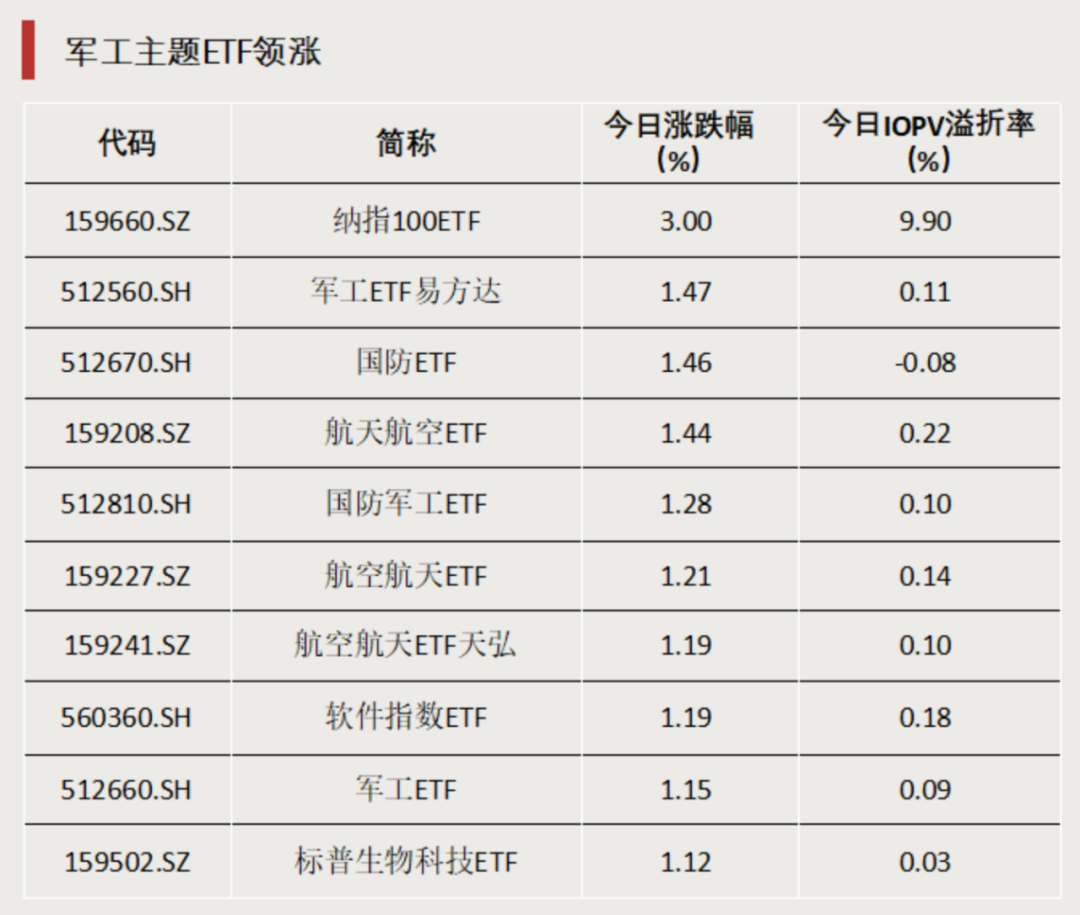
Market Overview - On October 28, the A-share market experienced a high and then a pullback, with the Shanghai Composite Index briefly surpassing 4000 points, marking a ten-year high [4] - The military, software, and lithium battery sectors showed strong performance, with several military and defense ETFs rising over 1% [4] ETF Performance - The Nasdaq 100 ETF (159660) led the gains with a 3% increase, and its premium rate surged to 9.9%, the highest since January of this year [4] - Various military and defense ETFs, including the military ETF (1.47%) and defense ETF (1.46%), also reported positive performance [5] Gold Market - In contrast, gold-themed ETFs continued to decline, with gold stock ETFs, gold ETFs, and Shanghai gold ETFs all dropping over 3% [2][6] - The total net outflow from gold ETFs exceeded 1.5 billion yuan, with some products experiencing five consecutive days of net outflows [2][8] Bond Market - Following the central bank's announcement to resume public market treasury bond trading, the bond market showed signs of recovery, with bond ETFs generally rising [3][7] - The 30-year treasury bond ETFs saw an increase of 0.61%, and trading volumes for short-term bond ETFs surged significantly [7] Investment Trends - The technology and cyclical sectors are expected to attract attention, with a focus on modern industrial systems and national security themes [9] - The market may experience a phase of volatility, with a potential slowdown in capital inflows into A-shares in the fourth quarter [9] New ETF Launches - The first public products investing in the Brazilian market, including the E Fund Itaú Brazil IBOVESPA ETF and the Huaxia Bradesco Brazil IBOVESPA ETF, are set to launch on October 31 [11]
踔厉奋发建新功——各地干部群众以全会精神为指引真抓实干创未来
Xin Hua Wang· 2025-10-28 16:41
Group 1 - The 20th Central Committee's Fourth Plenary Session outlines the strategic direction for China's economic and social development during the "14th Five-Year Plan" and "15th Five-Year Plan" periods, emphasizing the importance of unity in thought and action among party members and the public [1][6] - The Guangdong-Hong Kong-Macao Greater Bay Area has achieved significant economic growth, with a total economic output surpassing 14 trillion yuan during the "14th Five-Year Plan" period, showcasing the effectiveness of national strategies [2][3] - The session highlights the need for high-quality development as the central theme for the "15th Five-Year Plan," with a focus on economic construction and the establishment of a modern logistics supply chain [7][8] Group 2 - The session emphasizes the importance of enhancing agricultural production capacity and quality, which is crucial for rural development and food security [10] - The need for technological self-reliance and innovation is underscored, with specific goals set for improving the level of technological independence during the "15th Five-Year Plan" [7] - The session calls for a balanced approach to development and security, aiming to build a higher level of safety in China, which is essential for sustainable economic growth [8][9]
学习贯彻党的二十届四中全会精神 | 踔厉奋发建新功——各地干部群众以全会精神为指引真抓实干创未来
Xin Hua She· 2025-10-28 16:37
Group 1 - The "14th Five-Year Plan" period has seen the Guangdong-Hong Kong-Macao Greater Bay Area's economic total surpass 14 trillion yuan, reflecting significant achievements in infrastructure and industrial collaboration [2][3] - The central government's focus on food security and agricultural policies has led to improved harvests, demonstrating the effectiveness of these initiatives in addressing challenges [2] - The "15th Five-Year Plan" period is identified as a critical time for solidifying foundations and making comprehensive efforts towards modernization by 2035 [4][5] Group 2 - The emphasis on high-quality development during the "15th Five-Year Plan" period aims to enhance economic construction, with a focus on building a world-class logistics supply chain [6] - The plan includes significant goals for technological self-reliance and innovation, with a call for advancements in key core technologies and the establishment of leading technology parks [6] - The agricultural sector is encouraged to improve production capacity and quality, with local initiatives aimed at enhancing the marketability of regional specialties [9][10] Group 3 - The plan stresses the importance of integrating development and security, with initiatives aimed at building a safer society and enhancing judicial effectiveness [7] - Local governments are urged to align their development strategies with national goals, focusing on economic centers and technological innovation [8] - The commitment to grassroots governance and anti-corruption measures is highlighted as essential for achieving the objectives of the "15th Five-Year Plan" [10]