人民币汇率

Search documents
人民币中间价调强幅度创7个月来最大 即期汇率料随篮子货币升值
Sou Hu Cai Jing· 2025-08-25 04:39
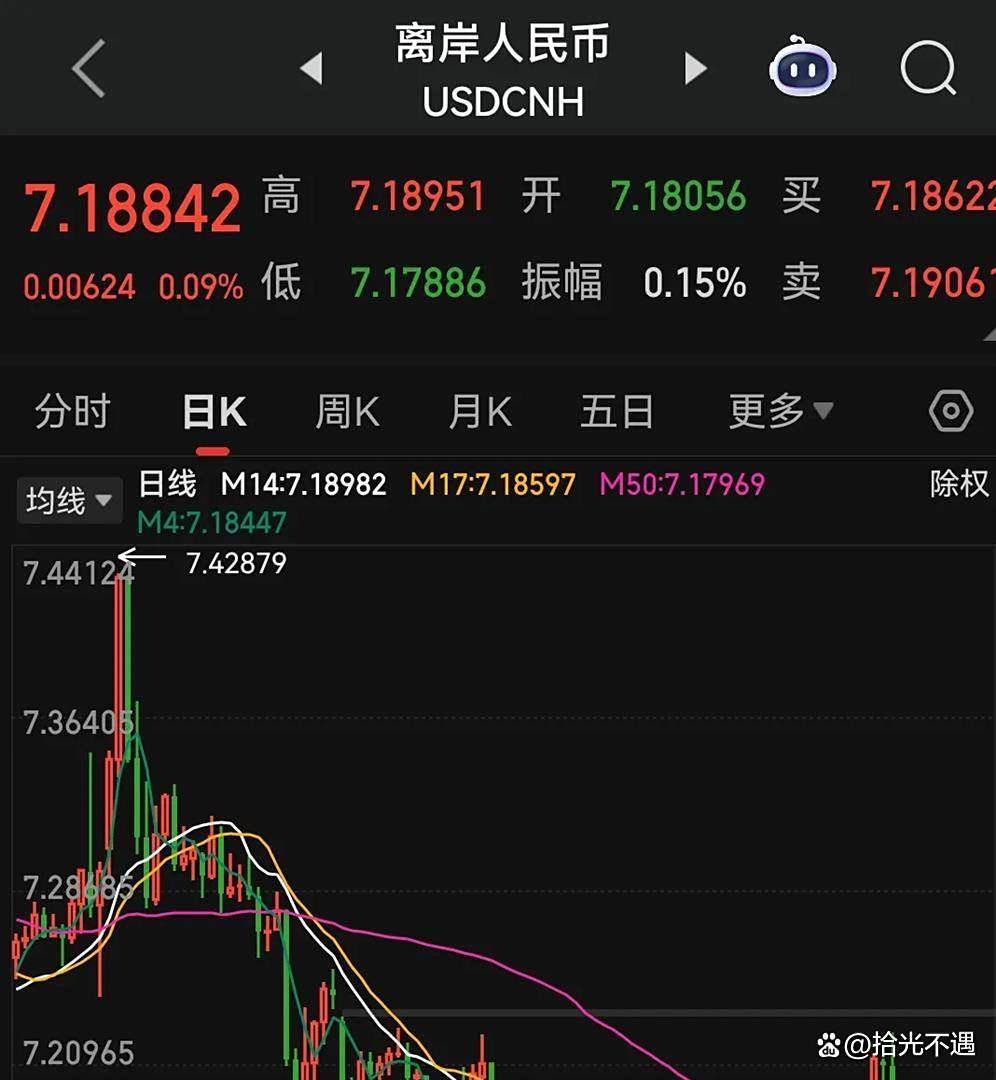
8月25日人民币中间价报7.1161元,继续刷新去年11月来最强,但多达160个点的调节幅度更为引人瞩 目,且中间价较市场预测均值显著偏强366个点,也显示出较为明显的政策信号。 来源:商业周刊 在彭博美元指数因美联储降息预期升温而大幅下跌后,8月25日人民币中间价调强幅度创7个月来最大, 离岸人民币应声扩大涨幅。 中金分析师李刘阳等人在近期报告中提示,关注稳汇率政策力度调整、外资流入增加共振带来的汇率升 值动能,即期汇率可能靠拢中间价的可能。他们表示,短期内无论是更多政策信号的释放,或是跨境资 本流动的进一步改善,均可能带动人民币汇率波动率的抬升,并推动即期汇率靠拢中间价。 美联储主席鲍威尔在杰克逊霍尔的演讲为9月降息打开大门,彭博美元指数8月22日大幅下跌近0.8%, 欧元、日元、韩元等人民币一篮子指数中的权重币种均大幅上涨约1%。 ...
多地调整最低工资标准9月1日起执行|首席资讯日报
首席商业评论· 2025-08-25 04:05
Group 1 - The Shenzhen banking and insurance sectors showed stable performance in the first half of 2025, with total assets reaching 13.98 trillion yuan, a year-on-year increase of 3.64% [2] - The first cross-city drone logistics route in Hubei successfully completed its inaugural flight, covering a distance of 50 kilometers in 35 minutes, setting a new record for the province [2] - The film "浪浪山小妖怪" has surpassed 1.239 billion yuan in cumulative box office, entering the top four of the 2025 box office rankings [4] Group 2 - In Zhejiang, total electricity generation from January to July 2025 was 297.973 billion kWh, a year-on-year increase of 8.31%, while total electricity consumption reached 396.058 billion kWh, up 5.95% [5] - The company Tea Yan Yue Se faced allegations of plagiarism regarding a collaborative notebook, leading to an official apology and plans for internal review [6][7] - Multiple regions, including Beijing and Hunan, announced adjustments to their minimum wage standards effective September 1, 2025 [8] Group 3 - The humanoid robot "Ballet Dancer" by Yuzhu Technology will feature 31 degrees of freedom, showcasing advancements in robotic performance [9] - The recruitment progress of Xinxiang Pang Donglai revealed that 2,988 candidates advanced to the information collection stage, with interviews scheduled from September 1 to September 30 [10] - Eric Trump predicted that Bitcoin will exceed $175,000 in 2025, indicating a bullish outlook from the Trump family [11] Group 4 - Elon Musk announced the open-sourcing of the xAI Grok2.5 model, with Grok3 expected to be released in about six months [12] - A macroeconomic report suggested that September could be a window for the appreciation of the RMB, contingent on the Federal Reserve's actions [13]


三大人民币汇率指数上周全线上涨 CFETS指数按周涨0.4
Xin Hua Cai Jing· 2025-08-25 02:51
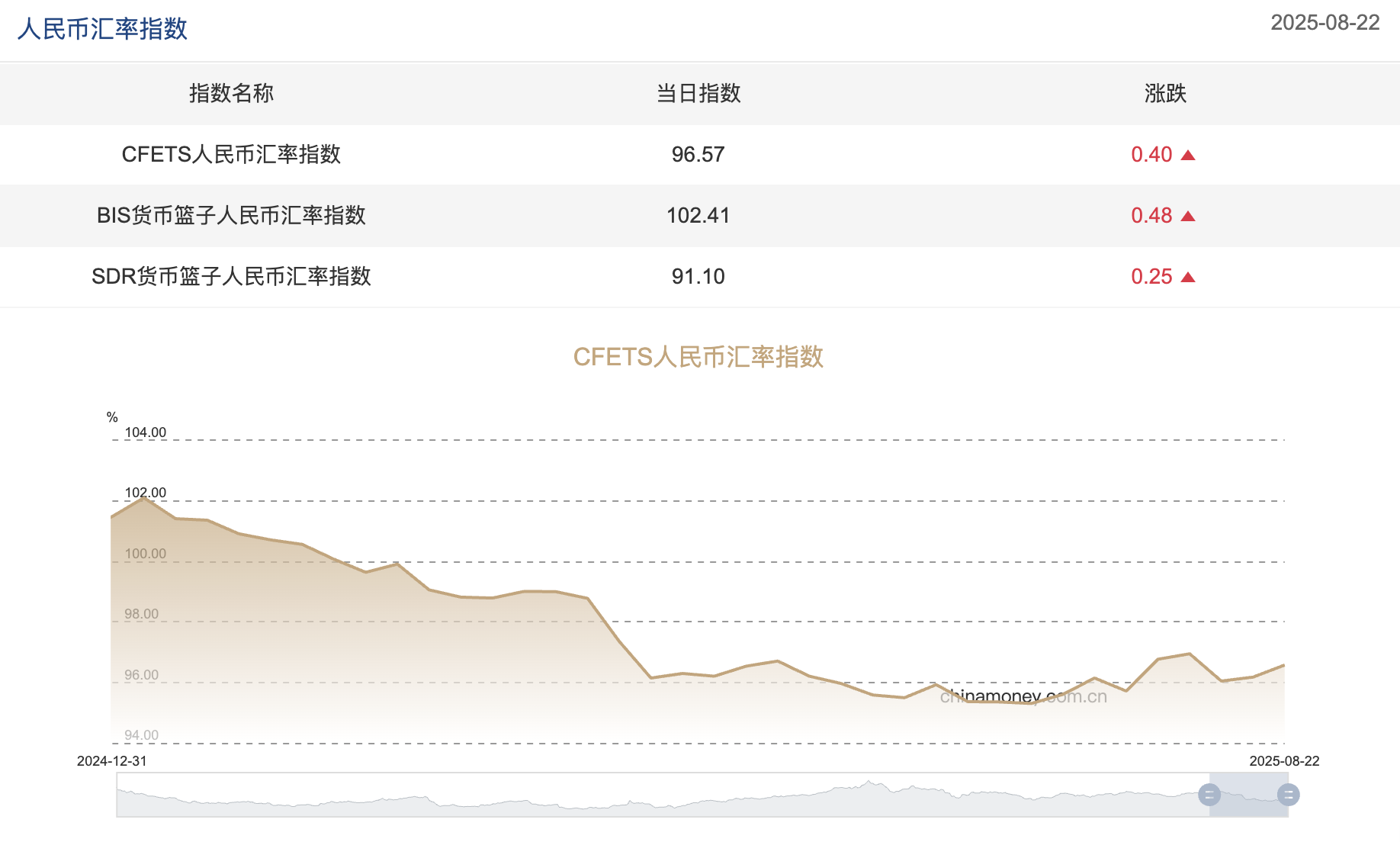
新华财经上海8月25日电(葛佳明) 中国外汇交易中心公布数据显示,8月22日当周三大人民币汇率指数全线上涨,CFETS人民币汇率指数报96.57,按周涨 0.4;BIS货币篮子人民币汇率指数报102.41,按周涨0.48;SDR货币篮子人民币汇率指数报91.1,按周涨0.25。 | 指数名称 | 当日指数 | | --- | --- | | CFETS人民币汇率指数 | 96.57 | | BIS货币篮子人民币汇率指数 | 102.41 | | SDR货币篮子人民币汇率指数 | 91.10 | 图片来源:中国外汇交易中心截图 上周(8月18日至22日)美联储主席鲍威尔在杰克逊霍尔央行年会上讲话偏鸽派,暗示降息已不远,美元指数22日抹去周内全部涨幅,收于97.72,全周累计 下跌0.12%;非美货币上周表现不一:新西兰央行上周鸽派降息25个基点,新元全周收跌0.95%;得益于欧元区8月综合采购经理人指数(PMI)好于预期, 欧元上周最终小幅收涨0.16%;日元则在美债利率的影响下先跌后涨最终小幅收涨0.15%。 人民币上周同样在美元整体回落的背景下有所走高,整体呈现稳中有升态势。在岸人民币兑美元汇率在8月22日 ...
8月25日人民币对美元中间价报7.1161元 上调160个基点
Zhong Guo Xin Wen Wang· 2025-08-25 02:28
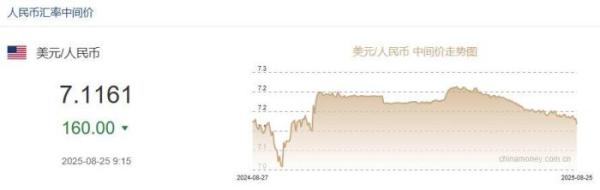
图源:中国外汇交易中心网站 据中国外汇交易中心网站消息,中国人民银行授权中国外汇交易中心公布,2025年8月25日银行间外汇 市场人民币汇率中间价为:1美元对人民币7.1161元,上调160个基点。 (责任编辑:王晨曦) ...
大幅调升160基点!人民币中间价报7.1161创阶段性新高
Bei Jing Shang Bao· 2025-08-25 02:11
北京商报讯(记者 岳品瑜 董晗萱)8月25日,中国人民银行授权中国外汇交易中心公布,当日银行间外 汇市场人民币汇率中间价为1美元对人民币7.1161元,相较前一交易日中间价7.1321元,调升160个基 点,创2024年11月以来新高。 截至最新发稿时间9时35分,在岸人民币对美元报7.1636;离岸人民币对美元报7.1655,日内升值 0.07%。 ...
人民币市场汇价(8月25日)
Sou Hu Cai Jing· 2025-08-25 02:03
8月25日人民币汇率中间价如下: 新华社北京8月25日电 中国外汇交易中心8月25日受权公布人民币对美元、欧元、日元、港元、英镑、 澳元、新西兰元、新加坡元、瑞士法郎、加元、澳门元、林吉特、卢布、兰特、韩元、迪拉姆、里亚 尔、福林、兹罗提、丹麦克朗、瑞典克朗、挪威克朗、里拉、墨西哥比索及泰铢的市场汇价。 100美元 711.61人民币 100欧元 834.46人民币 100日元 4.8480人民币 100港元 91.066人民币 100英镑 963.38人民币 100澳元 462.43人民币 100新西兰元 418.31人民币 100新加坡元 556.45人民币 100瑞士法郎 888.54人民币 100加元 515.81人民币 100人民币113.17澳门元 100人民币59.027马来西亚林吉特 100人民币1125.8俄罗斯卢布 100人民币244.48南非兰特 100人民币19361韩元 100人民币51.473阿联酋迪拉姆 100人民币52.592沙特里亚尔 100人民币4733.0匈牙利福林 100人民币50.979波兰兹罗提 100人民币89.47丹麦克朗 100人民币133.31瑞典克朗 10 ...
人民币:银行间外汇市场动态改善,但人民币升值可能受限
2025-08-25 01:40
Summary of Key Points from the Conference Call Industry Overview - The report focuses on the foreign exchange dynamics in Asia, specifically China, and the implications for the Renminbi (RMB) and capital flows [1][5][6]. Core Insights 1. **Improvement in Trade Settlement**: - China's July net FX trade settlement rose significantly to USD 60.9 billion, up from USD 44.0 billion in June, marking an 87.8% ratio of the reported trade surplus after adjusting for RMB trade settlement [2][3]. 2. **Exporters' FX Remittances**: - Exporters' FX remittances increased to 54.9% of total exports in July, compared to 46.1% in June, indicating a strong recovery in trade flow dynamics [3][4]. 3. **Corporate Demand for FX**: - Corporate demand for foreign exchange also rose, reaching 51.8% of total imports in July, up from 50.4% in June [3]. 4. **BOP Dynamics**: - The balance of payments (BOP) dynamics are improving, driven by exporters' FX remittances and a gradual decline in the USD/CNY fixing [4][6]. 5. **Capital Flow Forecast**: - An improvement in China's major capital flows is expected over the next six months, influenced by the de-escalation of US-China tariff tensions and a softer USD outlook [5][6]. 6. **Foreign Direct Investment (FDI)**: - There is a slight recovery in FDI inflows, although they remain weak, with a slowdown in FDI outflows noted [6][15]. 7. **Portfolio Inflows**: - Foreign portfolio inflows into Chinese equities have increased, with an average of USD 5.3 billion per month in the three months ending in July, attributed to improved sentiment from reduced trade tensions [15][4]. Additional Important Insights 1. **FX Deposits**: - A temporary decline in financial institutions' FX deposits was observed in July, with a modest decrease of USD 16.6 billion, following significant accumulations in previous months [9][11]. 2. **RMB Underperformance Risk**: - The potential for RMB underperformance exists if state banks continue to accumulate FX reserves, especially if the USD weakens further [6][11]. 3. **Tourism Deficit**: - The tourism deficit has remained stable, with projections indicating a slowdown in outflows in the second half of the year [8][6]. 4. **Excess FX Hoarding**: - An estimated excess FX hoarding of approximately USD 78 billion exists, which could impact future FX remittance dynamics [7][6]. 5. **Future Projections**: - The net FX trade settlement is projected to improve to a USD 307 billion surplus over the next six months, with upside risks if corporate FX hoarding is unwound more substantially [7][17]. This summary encapsulates the key points discussed in the conference call, highlighting the current state and future outlook of China's foreign exchange dynamics and capital flows.
人民币对美元中间价报7.1161 调升160个基点
Zhong Guo Jing Ji Wang· 2025-08-25 01:27
Core Points - The central exchange rate of the Chinese yuan against the US dollar is reported at 7.1161, which is an increase of 160 basis points from the previous trading day [1] Exchange Rate Summary - The exchange rate for 1 US dollar is 7.1161 yuan, 1 euro is 8.3446 yuan, and 100 Japanese yen is 4.8480 yuan [2] - Other notable exchange rates include: - 1 British pound to 9.6338 yuan - 1 Australian dollar to 4.6243 yuan - 1 Canadian dollar to 5.1581 yuan - 1 Swiss franc to 8.8854 yuan - 1 Singapore dollar to 5.5645 yuan - 1 New Zealand dollar to 4.1831 yuan - 1 Hong Kong dollar to 0.91066 yuan [2]
管涛:当前人民币汇率并未积累较强的升值压力和预期
Jing Ji Guan Cha Bao· 2025-08-24 09:27
Core Viewpoint - The article discusses the fluctuations in the Chinese yuan (RMB) exchange rate amid uncertainties in U.S. trade policy and Federal Reserve interest rate expectations, highlighting the impact on cross-border capital flows and the overall economic environment [1][2][3]. Exchange Rate Trends - In July, the RMB exchange rate continued to show narrow fluctuations, with the CFETS RMB index and BIS currency basket index rising by 1.5% and 1.8% respectively, ending a six-month decline [1] - The SDR currency basket index also reversed a previous decline of 0.9% to increase by 1.5% [1] - Despite these increases, the three major exchange rate indices fell by 4.6%, 4.3%, and 3.2% respectively in the first seven months of the year, indicating that the RMB's passive appreciation has not adversely affected export competitiveness [1] Currency Market Dynamics - The RMB central parity rate strengthened for the third consecutive month in July, while the onshore spot exchange rate fell by 0.4% to around 7.19 [2] - The average deviation between the central parity and onshore spot rates increased from 0.1% to 0.3%, the highest in three months [2] - The average onshore exchange rate rose by 0.1% to 7.1727, marking the third consecutive month of appreciation [2] Cross-Border Capital Flows - In July, banks recorded a foreign exchange payment deficit of $7.7 billion, with the RMB payment deficit increasing to $43.3 billion, the third highest on record [3] - The foreign currency payment surplus decreased to $35.6 billion, but remained historically high [3] - The main contributor to the deficit was securities investment, which accounted for 160% of the shift from surplus to deficit [3] Foreign Investment Trends - Foreign investment in Chinese stocks has increased, while there has been a significant reduction in holdings of RMB-denominated bonds, leading to record high outflows [2][3] - The reduction in bond holdings is attributed to a narrowing of forward dollar discounts, which decreased the attractiveness of RMB bond investments [3] Forward Exchange Transactions - In July, banks recorded a surplus in forward foreign exchange transactions for the fifth consecutive month, with a surplus of $45.6 billion, the highest in five months [4] - The increase in surplus was primarily driven by foreign exchange derivatives transactions, which rose by $16 billion [4] Overall Market Sentiment - The article indicates that the market does not exhibit strong expectations for RMB appreciation despite previous trends, suggesting a potential for slight depreciation pressure on the currency [2][5] - The overall supply of foreign exchange in the domestic market is believed to be greater than the reported surplus, indicating a more complex market dynamic [5]
人民币兑美元破7.18关口:换汇划算吗?这四类人要懂
Sou Hu Cai Jing· 2025-08-22 12:15
Core Insights - The recent fluctuation of the RMB against the USD has significant implications for both individuals and businesses, with the exchange rate dropping to 7.1321 on August 22, leading to direct financial losses for companies and affecting personal travel budgets [1][3]. Exchange Rate Trends and Financial Implications - Since August 4, the RMB/USD exchange rate has remained below 7.2, with an onshore closing price of 7.1792 on August 22, reflecting a 1.64% appreciation since the beginning of the year [3]. - The current exchange rate allows for a comparison of potential returns between RMB and USD deposits, highlighting a significant interest rate differential that could influence currency exchange decisions [3]. Policy Adjustments and Market Stabilization - The People's Bank of China (PBOC) has emphasized the need to prevent excessive fluctuations in the exchange rate, aligning with previous policies aimed at stabilizing market expectations and enhancing cross-border financing [5][8]. - Recent policies have facilitated cross-border financing for high-tech enterprises, indicating a strategic approach to bolster economic stability and support businesses in managing foreign exchange risks [5][9]. Strategies for Key Stakeholders - Families with children studying abroad are advised to adopt a phased currency exchange strategy to maximize savings, taking advantage of current favorable exchange rates and policy support for educational expenses [6]. - Outbound tourists are encouraged to utilize new regulations that allow for more efficient management of foreign exchange, potentially reducing costs associated with currency conversion [6]. - Foreign trade enterprises are advised to leverage government policies that support risk mitigation through financial instruments, which can significantly lower operational costs [6]. Future Outlook and Expert Opinions - Economic experts suggest that the potential for interest rate cuts by the Federal Reserve may alleviate depreciation pressures on the RMB, while domestic growth policies could positively impact exports [10]. - The historical stability of the RMB within a certain range suggests that the current fluctuations may not warrant excessive concern among the general public, as the central bank continues to manage exchange rate volatility effectively [10][11].