
云计算

Search documents
奥飞数据跌2.01%,成交额1.96亿元,主力资金净流出3296.06万元
Xin Lang Cai Jing· 2025-12-02 02:44
Core Viewpoint - Aofei Data's stock price has experienced fluctuations, with a year-to-date increase of 31.43% but a recent decline in the last five trading days by 4.66% [1] Company Overview - Aofei Data, established on September 28, 2004, and listed on January 19, 2018, is based in Guangzhou, Guangdong Province. The company primarily operates in Internet Data Center (IDC) services, which account for 82.18% of its revenue, while other internet services contribute 17.82% [1][2] Financial Performance - For the period from January to September 2025, Aofei Data reported a revenue of 1.824 billion yuan, reflecting a year-on-year growth of 15.33%. The net profit attributable to shareholders was 145 million yuan, marking a 37.29% increase compared to the previous year [2] Shareholder Information - As of September 30, 2025, Aofei Data had 113,600 shareholders, an increase of 9.06% from the previous period. The average number of circulating shares per shareholder decreased by 8.31% to 8,667 shares [2] Dividend Distribution - Since its A-share listing, Aofei Data has distributed a total of 113 million yuan in dividends, with 52.93 million yuan distributed over the last three years [3] Institutional Holdings - The top ten circulating shareholders include Hong Kong Central Clearing Limited as the second-largest shareholder with 12.93 million shares, a decrease of 777,000 shares. New entrants in the top ten include Huaxia CSI 1000 ETF and GF Technology Pioneer Mixed Fund [3]

亚马逊年度云计算大会开幕,今晚CEO登场,新AI芯片能“追赶谷歌TPU”吗?
Hua Er Jie Jian Wen· 2025-12-02 02:23
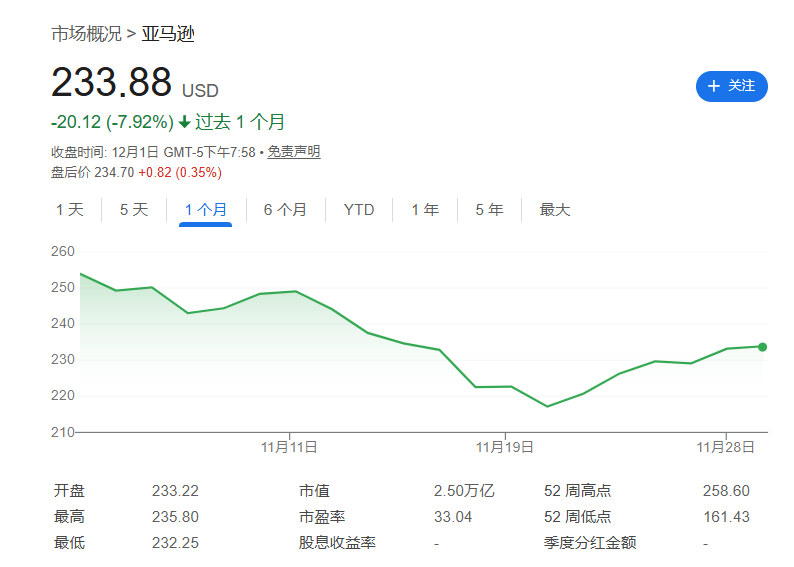
Core Insights - The AWS re:Invent conference has commenced, with significant anticipation surrounding the upcoming CEO keynote and the release of the new Nova AI model and Trainium 3 chip [1] - AWS's cloud market share has slightly declined from 49.7% to 45.1%, raising investor concerns about its AI strategy and chip launch timeline [1][9] - The performance of Trainium 3 and Nova will be critical in determining AWS's competitive position against rivals like Google and Microsoft [1] Trainium 3 Chip - Trainium 3 is expected to improve performance by approximately 40% compared to its predecessor, Trainium 2 [3] - There are concerns regarding AWS's ability to keep pace with competitors, as Google’s TPU is already in its seventh generation and NVIDIA’s GPU is in its tenth [3] - Some customers have faced technical challenges with Trainium, leading to a preference for Google’s TPU among key partners like Anthropic [3] - The anticipated preview release of Trainium 3 is expected by the end of 2025, with potential delays into the second quarter of 2026 [3] Nova AI Model - The new Nova model is designed to be a multi-modal AI capable of processing text, speech, images, and video, positioning it as an all-in-one product to compete with Google’s Gemini [5] - AWS aims to address its shortcomings in advanced AI models with the Nova release, although current models are not yet mainstream choices compared to those from OpenAI or Anthropic [5] - Nova is reported to be the second most popular model on AWS's Bedrock platform, with over 10,000 customers including Siemens and Coinbase [5] Partnerships and Collaborations - AWS is expanding its collaboration with Anthropic, which is a key ally, and is developing a supercomputer project that could generate significant revenue for AWS [7][8] - Anthropic is diversifying its computing support by partnering with competitors, indicating a strong demand for computational power [7] - AWS has secured a seven-year, $38 billion agreement with OpenAI to run and expand its workloads on AWS infrastructure [8] Market Dynamics - Despite AWS achieving its fastest growth in 11 quarters, investor sentiment remains cautious due to concerns over Trainium 3 and Anthropic's partnerships with other cloud providers [9] - AWS's backlog has increased by 22% year-over-year to $200 billion, indicating healthy demand trends [9] - The overall cloud infrastructure market share for AWS has decreased from approximately 49.7% in 2022 to 45.1% in the first half of 2025 [9] AI Ecosystem Development - AWS is actively building a comprehensive AI ecosystem to solidify its leadership in the cloud computing market [11][12] - Recent announcements at the conference highlight AWS's commitment to integrating AI capabilities across various industries [12] - Collaborations with companies like BlackRock and Visa demonstrate AWS's focus on enhancing AI applications in financial services [14]


重磅会议加持科技金融 杭州银行金融“活水”滋养科技自立自强土壤
Quan Jing Wang· 2025-12-02 01:17
Core Viewpoint - The meeting held by the People's Bank of China and the Ministry of Science and Technology marks a new phase in the collaborative mechanism for technology finance, aiming to enhance the integration of technology and finance, thereby supporting high-level technological self-reliance and strength [1] Group 1: Technology Finance Development - Hangzhou Bank is deepening its reform of the technology finance mechanism and service models to provide efficient financial support for technological self-reliance [1] - The digital economy in Hangzhou is growing rapidly, with the industrial added value increasingly contributing to the regional GDP, forming a robust industrial foundation for technology finance development [2] - Hangzhou Bank has established a specialized service team system covering seven key industries to match the financing needs of technology enterprises, demonstrating its competitive edge in the technology innovation sector [2] Group 2: Specialized Financial Services - Hangzhou Bank has created a "1+7+N" specialized technology finance structure, focusing on sectors like healthcare, intelligent manufacturing, and artificial intelligence, enhancing its professional service capabilities [3] - The bank has developed a comprehensive database for technology enterprises, enabling dynamic evaluation and precise marketing strategies through data analysis [3] Group 3: Product Innovation and Financial Support - The "Technology Financial Engine" service matrix has been optimized to cover the entire lifecycle of technology enterprises, with new products like "Kexi Loan - Potential Dragon Plan" launched to improve service efficiency [4] - As of mid-2025, Hangzhou Bank's technology loan balance reached 115.18 billion yuan, with a year-on-year increase of 20.60 billion yuan, indicating a strong commitment to supporting technology enterprises [4] - The bank's specialized services for listed companies have supported 327 enterprises in going public, showcasing its role in facilitating capital development for technology firms [4] Group 4: Strategic Positioning and Market Expansion - Hangzhou Bank issued 5 billion yuan in technology bonds in the first half of 2025, reinforcing its funding sources and aligning with national technology finance strategies [5] - The bank is enhancing its operational efficiency and customer experience through data integration and innovative service models, aiming to strengthen its market position in the Yangtze River Delta and major cities [5][6] - With the implementation of technology finance policies, Hangzhou Bank is expected to solidify its status as a benchmark in technology finance while improving its business scale and profitability [7]

海内外利好密集来袭,AI算力链迎四大增量,云计算ETF(159890)涨1.85%
Sou Hu Cai Jing· 2025-12-02 01:13
Core Insights - The article highlights the strong performance of sectors such as consumer electronics, components, and communication devices, with a focus on AI infrastructure and applications driving growth in cloud computing ETFs [1] Group 1: AI Computing Developments - Google's TPU has introduced a new direction for AI computing with its OCS next-generation optical interconnect solution, designed specifically for accelerating AI and machine learning tasks, marking it as a significant support following GPUs [6] - Alibaba has raised its AI investment guidance, confirming a potential increase in capital expenditures to 380 billion yuan over the next three years, with cloud business growth reported at 34% [7] - Beijing has launched a "space computing" plan to build large-scale data centers in low Earth orbit, aiming to transfer substantial AI computing power to space [8][9] Group 2: Market Growth Projections - According to the China Academy of Information and Communications Technology, the global computing power scale is projected to grow to over 16 ZFLOPS by 2030, with a compound annual growth rate exceeding 50% [3] - The global cloud computing market is expected to reach $692.9 billion in 2024, reflecting a year-on-year growth of 20.3%, while China's cloud computing market is anticipated to grow to 828.8 billion yuan, a 34.4% increase [3] - The cloud computing ETF (159890) tracks the CSI Cloud Computing and Big Data Theme Index, which includes leading companies in optical modules, electronic terminals, and software development [3][13] Group 3: Investment Opportunities - The investment landscape for computing power is evolving, with new stock offerings from companies like Moore Threads and Muxi indicating a potential shift in the investment paradigm [2] - The demand for AI computing infrastructure is expected to remain robust, with significant opportunities in the supply chain for optical modules and related technologies [18][19]



全球智能驾驶大会在苏州举办
Su Zhou Ri Bao· 2025-12-02 00:31
Core Insights - The seventh Global Intelligent Driving Conference was held in Suzhou, highlighting the integration of the automotive industry with AI, information communication, cloud computing, big data, and smart transportation [1] Industry Overview - The intelligent vehicle networking industry is emerging from the deep integration of various technologies, including AI and big data [1] - Suzhou has established a comprehensive industrial chain covering new energy vehicles, components, automotive electronics, and intelligent networking, with an industry scale exceeding 110 billion yuan [1] Policy and Initiatives - The conference provided insights into the "Guidelines for the Commercial Demonstration Application of Unmanned Driving Equipment in Jiangsu Province (Trial)" [1] - The Jiangsu Province Intelligent Driving Technology Key Laboratory was inaugurated, and projects for interconnectivity of cloud control platforms in pilot cities were launched [1]
81岁的AI老男孩,2025年最大赢家
吴晓波频道· 2025-12-02 00:29
Core Insights - Larry Ellison briefly surpassed Elon Musk to become the world's richest person due to a significant increase in Oracle's stock price, which rose 35% on September 10, marking the largest single-day gain since 1992 [2][9] - Oracle's recent success is attributed to its partnerships with AI giants like OpenAI, with a reported remaining performance obligation (RPO) of $455 billion, a year-on-year increase of over four times [9][27] - Ellison's influence and relationships, particularly with former President Trump, have positioned him as a key player in the AI and tech landscape, with significant investments in AI infrastructure and media [3][29] Company Overview - Oracle, once overshadowed in the cloud computing space by Amazon and Microsoft, has made a comeback by securing large contracts with AI companies, including a projected $300 billion in computing resources from OpenAI over the next five years [27][28] - The company is also involved in the management of TikTok's data in the U.S., further solidifying its role as a critical player in the tech industry [28] Financial Performance - As of September 10, Ellison's net worth reached $393 billion, briefly making him the richest person in the world, before settling at $260 billion, ranking third globally [9][12] - Oracle's stock performance has been volatile but has shown significant growth, particularly in response to its strategic partnerships and market positioning [9][12] Industry Trends - The article highlights the transformative potential of AI, with Ellison asserting that its impact will surpass that of previous technological revolutions [29] - The ongoing competition in the tech industry, particularly in cloud computing and AI, is intensifying, with Oracle actively seeking to reclaim its position through aggressive strategies and partnerships [27][28]


今年前10个月我国软件业务收入同比增长13.2%
Xin Lang Cai Jing· 2025-12-02 00:14
Group 1 - The software and information technology service industry in China showed a positive operational trend in the first ten months of 2025, with software business revenue reaching 1,251.04 billion yuan, a year-on-year increase of 13.2% [1] - The total profit of the software industry was 157.21 billion yuan, reflecting a year-on-year growth of 7.7% [1] - Software exports amounted to 51.09 billion USD, marking a year-on-year increase of 6.7%, with positive growth maintained for eight consecutive months [1] Group 2 - Software product revenue reached 265.04 billion yuan, growing by 11.2% year-on-year, accounting for 21.2% of the total industry revenue [1] - Basic software product revenue was 15.83 billion yuan, with a year-on-year increase of 12.0%, while industrial software product revenue was 26.19 billion yuan, growing by 9.9% [1] Group 3 - Information technology service revenue maintained double-digit growth, totaling 860.53 billion yuan, a year-on-year increase of 14.4%, representing 68.8% of the total industry revenue [1] - Cloud computing and big data services generated 130.78 billion yuan, with a year-on-year growth of 13.4%, accounting for 15.2% of information technology service revenue [1] - Integrated circuit design revenue was 35.91 billion yuan, growing by 17.2%, and e-commerce platform technology service revenue reached 115.76 billion yuan, increasing by 12.1% [1] Group 4 - Information security product and service revenue was 18.10 billion yuan, reflecting a year-on-year growth of 6.5% [1] - Embedded system software revenue reached 107.36 billion yuan, with a year-on-year increase of 9.7% [1] Group 5 - Software business revenue growth varied by region, with the eastern region growing by 13.6%, central region by 12.9%, western region by 10.8%, and northeastern region by 9.1% [2] - The eastern region accounted for 83.5% of the national software business revenue [2] - The Beijing-Tianjin-Hebei region saw a software business revenue growth of 15.0%, while the Yangtze River Delta region grew by 15.1%, with respective national revenue shares of 25.7% and 28.8% [2] Group 6 - The top five provinces in software business revenue were Beijing, Guangdong, Jiangsu, Shandong, and Shanghai, with year-on-year growth rates of 15.2%, 9.4%, 14.6%, 13.7%, and 20.8% respectively [2]
大湾区应用场景创新中心(智能制造)落户深圳
Ren Min Ri Bao· 2025-12-01 23:06
Core Insights - The "Baijing Chuangxiang" scenario docking conference was held in Bao'an District, Shenzhen, focusing on the establishment of the Guangdong-Hong Kong-Macao Greater Bay Area Application Scenario Innovation Center for Intelligent Manufacturing [1][2] - The center aims to leverage Bao'an's manufacturing base and application resources to develop new fields and high-value scenarios in technologies such as artificial intelligence, industrial internet, big data, and cloud computing [1][2] Group 1 - The conference attracted over 760 companies, releasing more than 500 scenario opportunities and capabilities, with over 60 companies signing agreements on-site [2] - More than 150 companies showcased over 500 new technologies and products, covering various fields including intelligent manufacturing, artificial intelligence, low-altitude economy, and unmanned systems [2] - The government-led scenarios included 288 opportunities, focusing on social governance, public services, and industry applications, while enterprise application scenarios totaled 220, targeting sectors like smart terminals and semiconductor industries [2] Group 2 - Bao'an District has nearly 560,000 enterprises, with around 5,600 above-scale manufacturing companies, covering all 31 major categories of manufacturing [2] - The district features a comprehensive transportation hub with nearly 400 square kilometers of land and 175 square kilometers of sea, integrating multiple transportation modes [2] - Bao'an has proposed to become a "benchmark city for fully open scenarios," aiming to open over 100 innovative application scenarios and release more than 1,000 new technologies, products, and solutions [2]
Simulations Plus(SLP) - 2025 Q4 - Earnings Call Transcript
2025-12-01 23:02
Financial Data and Key Metrics Changes - Revenue for fiscal year 2025 increased by 13% to $79.2 million, while total revenue for the fourth quarter decreased by 6% to $17.5 million [4][10] - Adjusted EBITDA grew by 8%, and adjusted EPS also increased by 8% for the fiscal year [4] - Total gross margin for the fiscal year was 58%, down from 62% in the prior year, with software gross margin at 79% and services gross margin at 30% [13][15] Business Line Data and Key Metrics Changes - Software revenue decreased by 9% in Q4, representing 52% of total revenue, while services revenue decreased by 3%, representing 48% [10] - For the fiscal year, software revenue increased by 12%, accounting for 58% of total revenue, and services revenue increased by 15%, representing 42% [10] - Specific product performance: ADMET Predictor declined by 10% in Q4 but grew by 5% for the fiscal year; GastroPlus declined by 3% in Q4 but grew by 1% for the fiscal year; MonolixSuite grew by 3% in Q4 and 14% for the fiscal year [11] Market Data and Key Metrics Changes - The external environment remained challenging, with client budgets pressured by pharmaceutical headwinds, including tariffs and pricing implementations [4] - Early signs of stabilization were noted as large pharma gained clearer visibility into pricing frameworks and biotech funding improved modestly [5][6] Company Strategy and Development Direction - The company completed a strategic reset, transitioning to a unified operating model to enhance client focus and operational efficiency [4] - The strategy includes building an integrated product ecosystem that combines validated science, cloud-scale performance, and AI capabilities [8][9] - The company aims to support clients through the entire drug development process, from discovery to commercialization, leveraging advancements in AI and cloud computing [6][8] Management's Comments on Operating Environment and Future Outlook - Management expressed cautious optimism about the upcoming fiscal year, noting positive discussions with clients regarding budgeting and proposal activity [21] - The company anticipates that the overall market conditions will resemble those at the end of fiscal year 2025, with potential upside if biotech funding continues to improve [16][43] Other Important Information - The company ended the fiscal year with $32.4 million in cash and short-term investments, remaining well-capitalized with no debt [15][16] - Guidance for fiscal year 2026 includes total revenue between $79 million and $82 million, with year-over-year growth expected between 0% and 4% [16] Q&A Session Summary Question: Update on demand environment and trends - Management noted an uptick in biotech funding and positive budgeting activity for the upcoming year, although caution remains due to potential market surprises [21][22] Question: Feedback on GastroPlus release with AI capabilities - Initial responses to the AI-infused GastroPlus have been positive, with clients eager to leverage new functionalities [24][25] Question: Factors affecting large pharma spending - Management highlighted that large pharma's budgeting cycle is in place, with a cautiously optimistic outlook for increased spending in 2026 [31][32] Question: Guidance assumptions and renewal rates - The guidance assumes continued low to mid-80% renewal rates due to client consolidations and scrutiny of software configurations [70] Question: Pro-ficiency asset performance - Pro-ficiency software revenue declined by 63% in Q4, while service revenue from the acquisition grew by 70% [62][63]

英唐智控(300131) - 300131英唐智控投资者关系管理信息20251201
2025-12-01 13:38
Company Overview - Shenzhen Yingtang Intelligent Control Co., Ltd. focuses on electronic component distribution and has built a global multi-regional network covering various product categories including main chips, storage, RF, display drivers, power/analog devices, MEMS sensors, and passive components [2]. - The company has successfully introduced its self-developed automotive display chips into several leading screen manufacturers, with the first automotive-grade TDDI/DDIC entering mass production [2][3]. Financial Performance - R&D expenses increased by 90.06% year-on-year in the first three quarters, primarily due to investments in display chip development [3]. - The self-developed MEMS micro-mirror products have entered the market, with a 4mm specification now available [3]. Market Position and Competitive Advantage - The company holds a local advantage in the automotive display chip market, which is predominantly occupied by Taiwanese and Korean manufacturers [4]. - The automotive display chip segment has achieved mass production, with improved versions in the trial production phase [4]. Strategic Initiatives - The company is preparing to acquire Guilin Guanglong Integration and Shanghai Aojian Microelectronics to strengthen its position in optical communication chips and analog integrated circuits [2][6]. - The acquisition aims to create synergies with existing distribution and self-developed businesses, leveraging advancements in generative AI and cloud computing [2]. Product Development and Innovation - The company is actively developing a local supply chain to enhance its product competitiveness and increase market share [4]. - The OCS (Optical Circuit Switching) technology is primarily based on MEMS solutions, which dominate over 50% of the market, offering rapid switching speeds and low signal transmission losses [9]. Risks and Challenges - The ongoing asset acquisition is subject to regulatory approvals, which may impact the transaction timeline [8]. - There are risks associated with the potential suspension or cancellation of the transaction, necessitating careful investor decision-making [8].
