平准基金

Search documents
史诗级护盘后,A股怎么走
和讯· 2025-04-08 10:15
Core Viewpoint - The A-share market is experiencing a rebound following a significant drop, supported by various government and institutional measures aimed at stabilizing the market and boosting investor confidence [1][4][12]. Group 1: Government and Institutional Support - Multiple government agencies, including the central bank and state-owned enterprises, have expressed their commitment to maintaining market stability through increased investments in stocks and ETFs [1][4][12]. - The Central Huijin Investment Company has reaffirmed its role as a "national team" in the capital market, indicating plans to increase its holdings in ETFs to stabilize the market [3][4]. - The People's Bank of China has pledged to support the Central Huijin's efforts by providing sufficient re-lending support when necessary, further enhancing market stability [4]. Group 2: Insurance Capital Influx - The National Financial Regulatory Administration has announced an increase in the investment ratio of insurance funds in the stock market, potentially bringing in an additional 1.66 trillion yuan to the capital market [6][8]. - Major insurance companies, including China Life and China Pacific Insurance, have committed to increasing their investments in the A-share market [7][8]. Group 3: Corporate Buybacks and Investments - Over 30 listed companies announced share buyback plans on April 8, demonstrating confidence in their future prospects and aiming to bolster market sentiment [10][11]. - Notable companies like Ningde Times and Haier Smart Home have also disclosed significant buyback plans, further contributing to market stability [11]. Group 4: Market Outlook and Sentiment - Analysts from various firms, including China Galaxy Securities and CICC, have expressed a generally optimistic outlook for the A-share market, citing its relatively low valuation compared to global markets [13][14]. - Despite short-term volatility due to external factors like tariffs, the long-term potential for foreign capital inflow into the Chinese market remains strong, supported by favorable domestic policies [2][14].


“国家队”出手稳市,政策工具箱还有哪些弹药待发
和讯· 2025-04-08 10:15
Core Viewpoint - The Chinese government is actively implementing measures to stabilize the A-share market in response to the impact of "reciprocal tariffs," with the establishment of a domestic version of a stabilization fund to alleviate market concerns and boost investor confidence [1][2][3]. Group 1: Government Actions - Central Huijin Investment announced its continued support for the A-share market by increasing its holdings in exchange-traded funds (ETFs), emphasizing the long-term development prospects of China's capital market [1]. - The People's Bank of China and Central Huijin confirmed their roles in stabilizing the capital market, with the central bank ready to provide sufficient re-lending support if necessary [1][2]. - The Financial Regulatory Administration adjusted the regulatory ratios for insurance funds, increasing the upper limit for equity asset allocation and relaxing requirements for tax-deferred pension investments, thereby expanding the investment space for equity capital [1]. Group 2: Policy Measures and Economic Outlook - A macro policy analyst compared the current situation to 2022, suggesting that the government has a range of policy tools available to support the stock market, including monetary easing and fiscal measures [2][3]. - The anticipated macro policy reserves include monetary policies such as reserve requirement ratio cuts, structural interest rate reductions, and innovative monetary policy tools to support consumption and foreign trade [2]. - Fiscal policies may involve accelerating the issuance of government bonds, expanding the scope of "old for new" policies, and promoting tax reforms to stimulate economic growth [2][3]. Group 3: Market Reactions and Economic Implications - The market showed increased trading activity, with significant transaction volumes in the CSI 500 ETF and CSI 1000 ETF, indicating heightened investor engagement [1]. - The potential impact of the "reciprocal tariffs" could lead to a decline in overall demand, necessitating further fiscal measures to counteract the economic slowdown [4][6]. - Recommendations for short-term actions include enhancing counter-cyclical macroeconomic adjustments to stabilize growth and expanding consumer spending through targeted subsidies and support for the real estate market [5][6].

各方积极发声,A股三大股指集体收涨
互联网金融· 2025-04-08 10:11
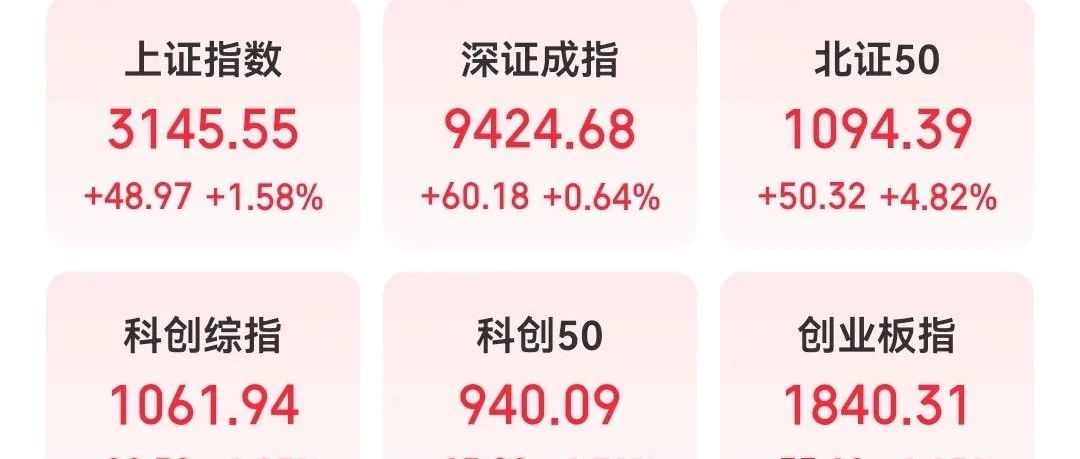
Market Performance - On April 8, A-shares saw a collective rise in the three major indices, with the Shanghai Composite Index up by 1.58%, the Shenzhen Component Index up by 0.64%, the ChiNext Index up by 1.83%, and the Northbound 50 Index up by 4.82% [1] - The total trading volume in the Shanghai and Shenzhen markets was approximately 1,625.643 billion yuan, an increase of about 37.844 billion yuan compared to the previous trading day [1] - Over 3,200 stocks in the market experienced gains [1] Sector Performance - Among the 31 first-level industry indices of Shenwan, 23 indices rose while 8 indices fell [1] - The top-performing sectors included Agriculture, Forestry, Animal Husbandry, and Fishery (up 7.81%), Retail (up 3.44%), Food and Beverage (up 3.37%), and Coal (up 3.31%) [1] - The sectors with the largest declines were Electronics (down 1.69%), Automotive (down 1.63%), and Communications (down 0.93%) [1] Policy Support - Multiple government departments released policies to jointly stabilize the capital market, including statements from the Central Huijin Investment Ltd. and the People's Bank of China [1] - Central Huijin emphasized its role as a "national team" in the capital market, acting similarly to a "stabilization fund" [1] - The People's Bank of China indicated it would provide sufficient re-lending support to Central Huijin when necessary [1] State-Owned Enterprises and Social Security Fund - The State-owned Assets Supervision and Administration Commission (SASAC) announced its commitment to support central enterprises and their listed companies in increasing share buybacks to enhance shareholder value [2] - The National Social Security Fund Council expressed its long-term investment strategy and commitment to increasing domestic stock holdings [2] - Major insurance companies and local state-owned platforms have also voiced their support for the capital market, with many leading listed companies announcing buyback and increase plans [2] Economic Outlook - The Chief Economist of Bank of China, Guan Tao, stated that the joint policy release by multiple ministries reflects a strong commitment to supporting the Chinese economy and capital market [3] - This initiative is seen as a significant step in the construction of a stabilization mechanism for the Chinese capital market [3]
类“平准基金”,正大量涌入A股
格隆汇APP· 2025-04-08 09:28
Core Viewpoint - A-shares experienced a rebound following a significant drop, supported by government interventions aimed at stabilizing the market, particularly through the actions of the Central Huijin Investment Ltd. [1][2][5] Group 1: Market Reactions and Government Interventions - After a major decline, A-shares saw a rebound with over 3,200 stocks rising and a trading volume exceeding 1 trillion yuan [2] - The Central Huijin Investment announced its commitment to increase holdings in exchange-traded funds (ETFs) to stabilize the market, indicating a positive outlook for the A-share market [5][8] - The Central Bank and financial regulatory bodies also expressed support for the Central Huijin's actions, emphasizing their role in maintaining market stability [9][10] Group 2: Investment Opportunities - The Central Huijin's strategy resembles that of a "stabilization fund," which has historically intervened during market downturns to support key stocks and sectors [9][16] - Insurance funds are expected to increase their A-share investments significantly, with projections indicating an annual increase of 30% of new premiums directed towards A-shares starting in 2025 [10][11] - Historical data shows that major institutional investors tend to favor large-cap blue-chip stocks and industry leaders during market stabilization efforts [13][14] Group 3: Asset Selection Criteria - Investors are advised to consider assets that align with national development strategies, possess strong fundamentals, and are reasonably valued [23][24] - The A500 Index ETF (159351) is highlighted as a suitable investment vehicle for those seeking balanced exposure to both value and growth stocks, with significant inflows and liquidity [27][28] Group 4: Historical Context and Future Outlook - Historical crises have shown that markets eventually recover after initial panic, suggesting that current market conditions may present buying opportunities [33][36] - Investors are encouraged to adopt a calm and rational approach to identify potential bottom-fishing opportunities as the market stabilizes [37][38]

申万宏源傅静涛:中央汇金积极发挥平准基金功能 A股市场反映长期积极因素正当时
Xin Hua Cai Jing· 2025-04-08 03:19
Core Viewpoint - Central Huijin has repeatedly expressed support for the A-share market, indicating a commitment to stabilize and enhance market confidence through strategic investments in ETFs and major banks [1][2]. Group 1: Central Huijin's Actions - On October 11, 2023, Central Huijin announced it had increased its holdings in A-shares of major banks and plans to continue this strategy over the next six months [1]. - On October 23, 2023, Central Huijin stated it had purchased ETFs and would continue to increase its investments [1]. - By February 6, 2024, Central Huijin expanded its ETF investment scope and committed to increasing its buying efforts to maintain market stability [1]. Group 2: Market Impact - Central Huijin's interventions have interrupted the negative expectations that had developed in the A-share market since May 2023, leading to a stabilization of market sentiment [1]. - The actions of Central Huijin have contributed to the valuation recovery of A-share value sectors and have acted as a stabilizing force during periods of increased market volatility [2]. - The firm has become a key player in providing liquidity during times of risk, promoting a trend towards value and long-term investment among A-share investors [2]. Group 3: Future Outlook - The current market conditions suggest that the pessimistic expectations are no longer relevant, and the fundamental pressures are being quickly reflected in stock prices [2]. - The market is expected to reach a point that reflects long-term positive factors, indicating a potential for recovery and growth [2].

农银国际证券:每天导读-20250317
农银国际证券· 2025-03-16 16:28
Market Overview - The US stock market saw a rebound with all three major indices rising, particularly the Nasdaq which experienced significant gains due to Trump's announcement of a one-month tariff exemption on cars imported under the US-Mexico-Canada Agreement, boosting market sentiment [6] - In Hong Kong, all three major indices increased, with the Composite Index leading with a rise of over 10% [6] - The Shanghai Composite Index also saw gains, with the Shanghai 300 Index showing a strong performance, while only the healthcare and consumer sectors experienced declines [6] Economic Data - The ADP employment change index for the US in February reported a change of 77K, significantly lower than the expected 140K [7] - The US factory orders for January matched market expectations at 1.7% [7] - The Eurozone's PPI year-on-year increased to 1.8%, surpassing the expected 1.3% [7] Corporate News - Sunac Real Estate Group announced plans to repurchase bonds with a total amount not exceeding 800 million RMB [10] - Bain Capital is reportedly close to an agreement to acquire the supermarket business of Seven & i Holdings Co, with a potential valuation exceeding 700 billion yen [10] - Hon Hai Precision Industry reported a 25% revenue growth in the first two months of the year, reflecting increased demand for AI computing [10] International Economic News - The Federal Reserve's Beige Book indicated slight economic growth, with tariffs and uncertainty being frequently mentioned [10] - Germany plans to amend its constitution to loosen fiscal spending restrictions, aiming to release hundreds of billions of euros for defense and other investments [10] - The UK central bank governor warned that the Labour Party's proposed increase in wage taxes could lead to inflation [10]
两会|全国人大代表、清华大学国家金融研究院院长田轩:激发耐心资本入市积极性 完善政府基金分类管理机制
证券时报· 2025-03-03 04:27
Core Viewpoint - The development of patient capital is crucial for adapting to the new round of technological revolution and industrial transformation, as well as for nurturing new productive forces [1] Group 1: Patient Capital and Market Development - Patient capital can provide continuous funding support for technological innovation and emerging industries, promoting a virtuous cycle in private equity and venture capital [4] - Suggestions to enhance patient capital include government-led investment funds to guide investments towards strategic emerging industries, reducing administrative interference, and optimizing incentive mechanisms [4][5] - Expanding funding sources by encouraging financial institutions to innovate products and services, and lowering entry barriers for long-term investments from insurance companies and pension funds [4][5] Group 2: Risk Management and Investment Focus - To focus capital on long-term projects, policy guidance and financial support are necessary, including tax incentives and special funds [6] - Establishing a robust risk management and evaluation system for new productive forces, ensuring scientific investment decisions [6][12] - Strengthening collaboration among government, banks, and insurance sectors to enhance market transparency and investor protection [6] Group 3: Government Investment Funds - Government investment funds face challenges such as fundraising difficulties and a lack of market-oriented operations, which affect their effectiveness [12] - Recommendations include relaxing restrictions on financial institutions participating in government funds and enhancing the market-oriented operation mechanism [12][13] - Establishing a dynamic evaluation mechanism to adjust investment strategies and ensure continuous support for new productive forces [11][13] Group 4: Monetary Policy Tools - The central bank's structural monetary policy tools have improved liquidity and market stability, but there is still room for optimization [15] - The establishment of a stabilization fund is deemed necessary to mitigate market volatility, especially in uncertain external environments [16] - The central bank should expand its macro-prudential and financial stability functions, introducing new financial tools to address systemic risks [17] Group 5: Coordination of Fiscal and Monetary Policies - The shift towards a balanced focus on investment and consumption will significantly impact macro fiscal and monetary policy [18] - Fiscal policies will aim to boost domestic demand, particularly consumption, while monetary policies will focus on reducing financing costs [18][19] - Enhanced coordination between fiscal and monetary policies is essential to maximize policy effectiveness and ensure timely execution [19]