
数字货币

Search documents
数字人民币的特性
Sou Hu Cai Jing· 2026-01-07 03:50
Group 1 - Digital Renminbi is a digital form of legal currency issued by the People's Bank of China, operated by designated institutions, based on a broad account system, supporting loosely coupled bank account functions, and is equivalent to physical Renminbi with value characteristics and legal tender status [3] - In the era of digital Renminbi, it is considered "money," and once fully promoted, no merchant can refuse to accept it, and it can be used without internet access, with no service fees for exchanging paper currency [5] - The issuance cost of digital Renminbi is reduced as it does not require printing paper, ink, or printing machines, and it eliminates the high costs associated with recovering worn-out physical currency [7] Group 2 - Each electronic Renminbi transaction is recorded, which significantly aids in combating illegal activities [9] - Currently, digital Renminbi has established a coverage model in various fields including wholesale and retail, catering, education and healthcare, public services, social governance, rural revitalization, and cross-border settlement, featuring a replicable application model that combines both account and blockchain systems, hardware and software wallet compatibility, and universal mixed currency capabilities for online, offline, and offline payments [12]



南天信息跌2.03%,成交额1.14亿元,主力资金净流出1661.01万元
Xin Lang Zheng Quan· 2026-01-07 02:04
Core Viewpoint - Nantian Information's stock price has shown fluctuations, with a recent decline of 2.03%, while the company has experienced a year-to-date increase of 2.12% in stock price [1]. Group 1: Financial Performance - For the period from January to September 2025, Nantian Information achieved a revenue of 7.091 billion yuan, representing a year-on-year growth of 21.90% [2]. - The company reported a net profit attributable to shareholders of -10.8998 million yuan, a significant decrease of 119.49% compared to the previous year [2]. Group 2: Shareholder and Market Activity - As of September 30, 2025, the number of shareholders for Nantian Information was 59,900, a decrease of 20.65% from the previous period [2]. - The average number of circulating shares per shareholder increased by 26.02% to 6,494 shares [2]. - The company has distributed a total of 469 million yuan in dividends since its A-share listing, with 102 million yuan distributed over the past three years [3]. Group 3: Stock Performance and Trading Activity - As of January 7, Nantian Information's stock was trading at 18.33 yuan per share, with a total market capitalization of 7.147 billion yuan [1]. - The stock experienced a net outflow of 16.6101 million yuan in principal funds, with significant selling pressure observed [1]. - Over the last five trading days, the stock price increased by 1.83%, and over the last 20 days, it rose by 4.92% [1]. Group 4: Business Overview - Nantian Information, established on December 21, 1998, and listed on October 14, 1999, is primarily engaged in software development, system integration, and the research and production of financial specialized equipment [1]. - The company's revenue composition includes 47.59% from IT product sales and industrial internet, 31.41% from integrated solutions, 19.63% from software development and services, 1.02% from intelligent channel solutions, and 0.36% from other sources [1]. - Nantian Information is categorized under the computer-software development-vertical application software industry and is associated with concepts such as electronic ID, electronic payment, and digital currency [1].

东港股份:有研发、生产数字货币卡的相关技术储备,将根据国家规则完善技术方案
Sou Hu Cai Jing· 2026-01-06 22:39
Group 1 - The core viewpoint of the article is that Donggang Co., as the largest bank card manufacturer in China, is preparing to develop digital currency cards in response to new regulations issued by the central bank [1] - Donggang Co. has relevant technological reserves for the research and production of digital currency cards and plans to improve its technical solutions according to national regulations [1] - The company will launch related products after passing inspections by national testing institutions [1]

旋极信息:公司持有百望股份9.5%的股份
Zheng Quan Ri Bao Wang· 2026-01-06 14:11
证券日报网讯1月6日,旋极信息(300324)在互动平台回答投资者提问时表示,百望股份将积极利用在 财税数字化领域建立的品牌、技术优势,探索在数字货币领域的发展机会。目前公司持有百望股份 9.5%的股份。 ...

金融大家评 | 中银证券全球首席经济学家管涛:数字人民币2.0时代的“变”与“不变”
清华金融评论· 2026-01-06 10:32
Core Viewpoint - The People's Bank of China (PBOC) is set to launch an action plan to enhance the management and service system of the digital renminbi, transitioning from the 1.0 era of digital cash to the 2.0 era of digital deposit currency, effective January 1, 2026 [2]. Group 1: China's Digital Currency Leadership - China has been a pioneer in digital currency exploration, having initiated theoretical research and closed testing of the digital renminbi in 2014, with pilot programs starting in 2019 [4]. - The digital renminbi ecosystem has been preliminarily established, showcasing a unique development path led by the central bank, integrating commercial financial institutions and existing payment systems [4]. - The digital renminbi utilizes blockchain technology while maintaining its status as a central bank liability, ensuring it remains equivalent to the fiat renminbi [4]. Group 2: Transition from 1.0 to 2.0 - The transition from digital renminbi 1.0 to 2.0 retains core successful elements, particularly the dual-layer operational structure, which has been recognized globally as a standard for digital currencies [5]. - The action plan emphasizes a separation of management and operational functions to ensure comprehensive regulatory coverage [6]. - The digital renminbi 2.0 will maintain a hybrid architecture that combines account-based management with blockchain efficiency, allowing for lower costs and higher efficiency in digital currency payment services [7]. Group 3: Innovations in Digital Renminbi 2.0 - The digital renminbi will evolve from a non-interest-bearing digital cash to an interest-bearing digital deposit currency, allowing banks to manage digital renminbi wallet balances as part of their asset-liability operations [9]. - The digital renminbi wallet balances will be valued as "renminbi," ensuring consistency and interoperability across different banks and payment institutions [10]. - The integration of digital currency with smart contracts and blockchain technology aims to enhance the digital payment landscape, moving from electronic to digital payments [11]. Group 4: Blockchain and Financial Infrastructure - The application of blockchain technology will support various financial services, including cross-border payments and the digitization of real-world assets [12]. - The establishment of the digital renminbi international operation center in Shanghai will facilitate the development of a cross-border digital payment platform and a blockchain service platform [13]. - The multi-central bank digital currency bridge aims to address jurisdictional issues and enhance regulatory compliance through distributed ledger technology [13].

铁幕的终结:CCKS重塑全球自由贸易与数字金融新纪元
Zhong Guo Jin Rong Xin Xi Wang· 2026-01-06 08:36
Core Insights - The global trade and financial system is at a historic crossroads, with the digital revolution reshaping industry and finance, making cross-border data flow the "new oil" driving international trade growth [1][2] - The traditional centralized Public Key Infrastructure (PKI) is increasingly seen as a barrier to the free flow of data, revealing structural flaws that hinder global digital trade [2][4] - A shift towards a decentralized trust model, exemplified by China's CCKS technology, is essential for establishing a new digital infrastructure that ensures data security and respects national sovereignty [3][9] Group 1: Trust Crisis in Global Trade - The centralized PKI system, reliant on a few Certificate Authorities (CAs), is facing structural challenges, including high operational costs and vulnerability to geopolitical influences [2][4][7] - The complexity and cost of maintaining trust chains in cross-border transactions are exacerbated by the reliance on a centralized model, leading to systemic risks [6][8] - The concentration of trust in a few entities creates significant risks, as evidenced by past security breaches that have compromised global trust [6][7] Group 2: Paradigm Shift with CCKS Technology - CCKS represents a revolutionary shift in digital trust, moving from centralized trust institutions to algorithm-based trust, which enhances security and reduces costs [3][9] - The CCKS system provides a unique digital identity for all entities, ensuring authenticity and integrity in data exchanges, thus laying the foundation for a new digital economy [9][10] - CCKS promotes an "inherent security" approach, enabling secure data transactions even in offline scenarios, which is crucial for maintaining trade continuity [10][12] Group 3: Evolution of International Standards - Historically, international standards in the digital domain have been dominated by Western countries, creating a "standard hegemony" that limits the participation of emerging economies [14][15] - China's initiative to develop a series of ISO standards in digital fields aims to create a more balanced international standard system, reflecting diverse needs and enhancing global cooperation [16][20] - These standards, based on CCKS technology, facilitate secure and efficient data flow, providing a framework for global digital trade and addressing long-standing issues of trust and efficiency [22][24] Group 4: Restructuring Digital Financial Infrastructure - Traditional financial infrastructures face challenges such as high transaction costs and exclusion of unbanked populations, necessitating a new approach to digital finance [26][27] - CCKS technology addresses these challenges by enabling secure, low-cost digital wallets and payment networks that can operate efficiently in various environments [33][36] - The integration of CCKS with advanced technologies allows for the creation of a robust digital currency platform that meets the demands of modern trade while ensuring security and inclusivity [38]
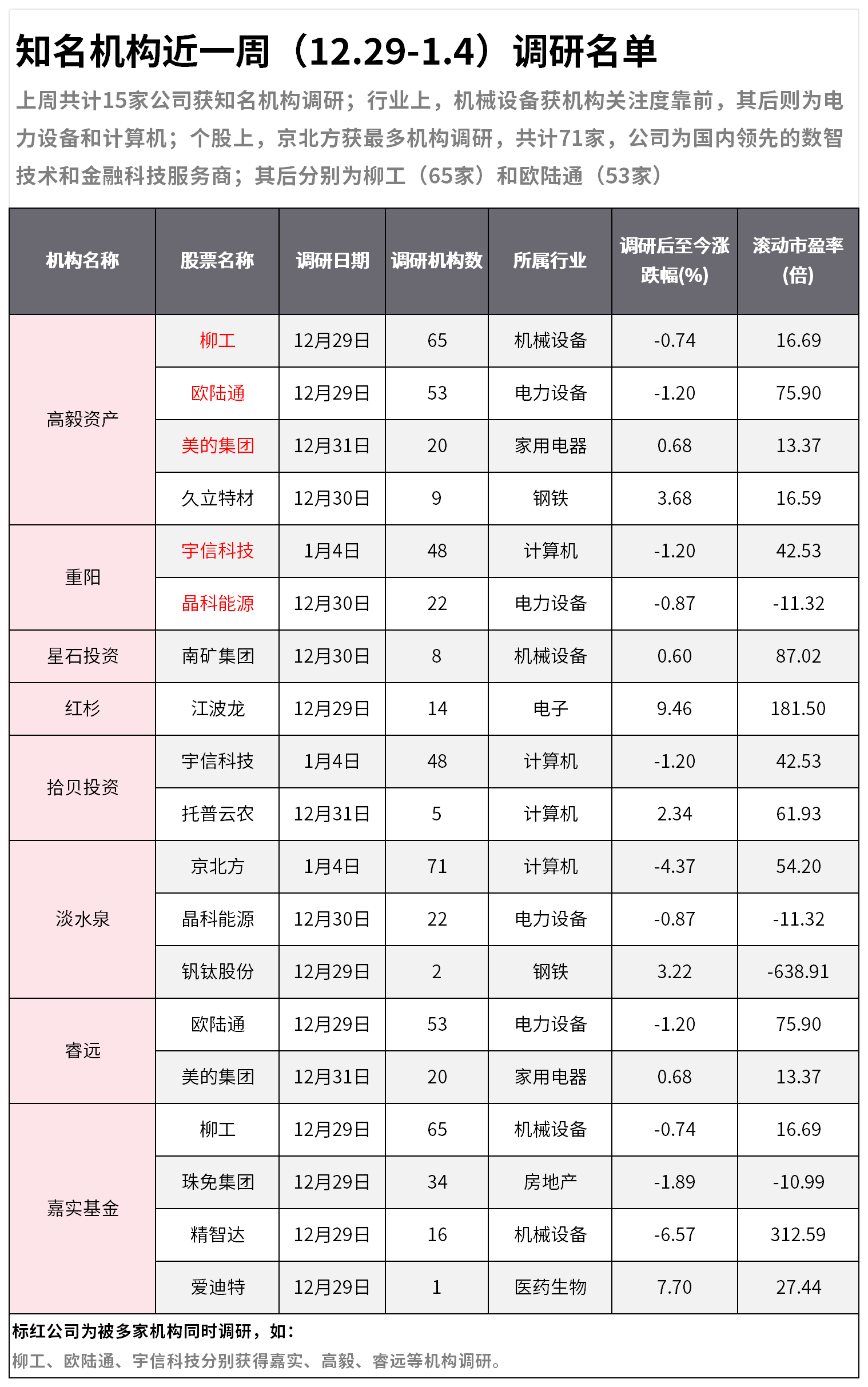
知名机构近一周(12.29-1.4)调研名单:机构扎堆这只数字货币龙头
Xuan Gu Bao· 2026-01-06 07:30
Group 1 - A total of 15 companies were investigated by well-known institutions in the past week (December 29 to January 4) [1] - The machinery equipment sector received significant attention from institutions, along with power equipment and computer industries [1] - The company with the highest number of institutional investigations was Jingbeifang, with 71 institutions participating [1] Group 2 - Following Jingbeifang, Liugong received 65 institutional investigations, and Oulutong had 53 [1] - Other notable companies included Midea Group with 20 investigations, Jiuli Special Materials with 11, and Yuxin Technology with 48 [1][2] - The data indicates a strong interest in the machinery and computer sectors, reflecting potential investment opportunities [1]

南天信息涨2.34%,成交额1.27亿元,主力资金净流出267.59万元
Xin Lang Cai Jing· 2026-01-06 05:44
Group 1 - The core viewpoint of the news is that Nantian Information has shown a positive stock performance recently, with a 2.34% increase in stock price on January 6, reaching 18.40 CNY per share, and a total market capitalization of 7.174 billion CNY [1] - As of September 30, 2025, Nantian Information reported a revenue of 7.091 billion CNY, reflecting a year-on-year growth of 21.90%, while the net profit attributable to shareholders was -10.8998 million CNY, a significant decrease of 119.49% compared to the previous period [2] - The company has a diverse revenue structure, with IT product sales and industrial internet accounting for 47.59%, integrated solutions 31.41%, software development and services 19.63%, smart channel solutions 1.02%, and others 0.36% [1] Group 2 - Nantian Information has a total of 59,900 shareholders as of September 30, 2025, which is a decrease of 20.65% from the previous period, while the average number of circulating shares per person increased by 26.02% to 6,494 shares [2] - The company has distributed a total of 469 million CNY in dividends since its A-share listing, with 102 million CNY distributed in the last three years [3] - Among the top ten circulating shareholders, Huabao Zhongzheng Financial Technology Theme ETF holds 4.274 million shares, an increase of 1.9471 million shares from the previous period, while Hong Kong Central Clearing Limited has exited the top ten list [3]
2025年国际金融十件大事
Sou Hu Cai Jing· 2026-01-06 03:55
Group 1: Global Trade and Financial Market Dynamics - The unilateral imposition of "reciprocal tariffs" by the Trump administration marked a structural reversal in global trade policy, leading to significant financial market volatility, with G20 countries implementing trade restrictions covering $2.9 trillion, surpassing trade facilitation measures for the first time [1] - The trade war and financial market turmoil mutually reinforced each other, creating a core risk landscape for the global economy in 2025 [2] Group 2: Digital Currency Competition - In 2025, major economies shifted from technological exploration to institutional construction in the digital currency space, with the U.S. establishing a regulatory framework for cryptocurrencies through the GENIUS Act and Hong Kong introducing a stablecoin regulatory draft [3] - The rapid development of digital currency regulation signifies a critical phase in digital financial governance, with countries competing for monetary sovereignty and financial discourse power [3] Group 3: Global Debt Levels - Global debt reached a historic high of $337.76 trillion by mid-2025, with developed markets' debt being 2.08 times that of emerging markets, although the latter experienced a faster debt growth rate [4] - The rising global debt levels raise concerns about financial system vulnerabilities and the need for effective multilateral debt restructuring mechanisms [5] Group 4: U.S. Federal Reserve Monetary Policy - The Federal Reserve initiated a rate-cutting cycle in September 2025, reducing the federal funds rate to a range of 3.50% to 3.75%, amidst concerns of economic recession due to a weakening labor market [6] - The depreciation of the dollar against other currencies and the Fed's monetary policy uncertainty contributed to global financial market volatility [7] Group 5: Euro Strength and Economic Implications - The euro's nominal effective exchange rate index rose to a five-year high, driven by increased demand for euro assets amid global economic uncertainty, despite the European Central Bank's rate cuts [8] - The euro's appreciation poses challenges for the eurozone's manufacturing exports, as geopolitical risks and rising tariffs continue to impact economic growth prospects [8] Group 6: Japan's Monetary Policy Shift - Japan's central bank raised interest rates to 0.75%, marking a 30-year high, indicating a potential normalization of monetary policy amid economic recovery signals [9] - The implications of Japan's rate hike on global monetary trends remain limited, as the overall trend of monetary easing persists [9] Group 7: Precious Metals Market - Gold and silver prices surged to historical peaks in 2025, with gold reaching $4,530.8 per ounce and silver hitting $70.155 per ounce, driven by geopolitical tensions and expectations of continued monetary easing [10] - The price increases reflect a shift towards a more balanced and stable international monetary order, with precious metals becoming key assets in the evolving financial landscape [10] Group 8: Technology Sector Volatility - The total market capitalization of major tech companies approached $22 trillion, but a significant sell-off occurred in November 2025 due to concerns over high valuations and potential bubble risks [11] - The market's shift from "imagination premium" to "realization assessment" indicates a structural adjustment in global capital risk preferences, with funds potentially reallocating towards more stable growth markets [11] Group 9: Declining Dollar Dominance - The dollar's share in global foreign exchange reserves fell to 56.92%, marking the lowest level since 1995, amidst a trend of "de-dollarization" driven by geopolitical tensions and the U.S. tariff policies [12] - The decline in the dollar's reserve share reflects a broader diversification trend in global foreign exchange reserves, although the dollar's dominance remains relatively stable in the short term [12] Group 10: BRICS Expansion - Indonesia's accession as the tenth member of BRICS signifies a significant expansion of the group's economic influence, with member countries now representing over 40% of global GDP and more than half of the world's population [13] - The expansion of BRICS reflects a concerted effort by non-Western nations to reform global governance and create a more resilient economic framework amidst rising protectionism [13]
东港股份:公司目前有研发、生产数字货币卡的相关技术储备
Zheng Quan Ri Bao Wang· 2026-01-06 03:53
Group 1 - The company, Donggang Co., Ltd. (002117), has indicated that it possesses relevant technology reserves for the research and production of digital currency cards [1] - The company plans to refine its technical solutions in accordance with national regulations and will launch related products after passing inspections by national testing institutions [1]