
绿色转型

Search documents
李成钢:将持续推进自贸谈判
Sou Hu Cai Jing· 2025-10-31 03:13
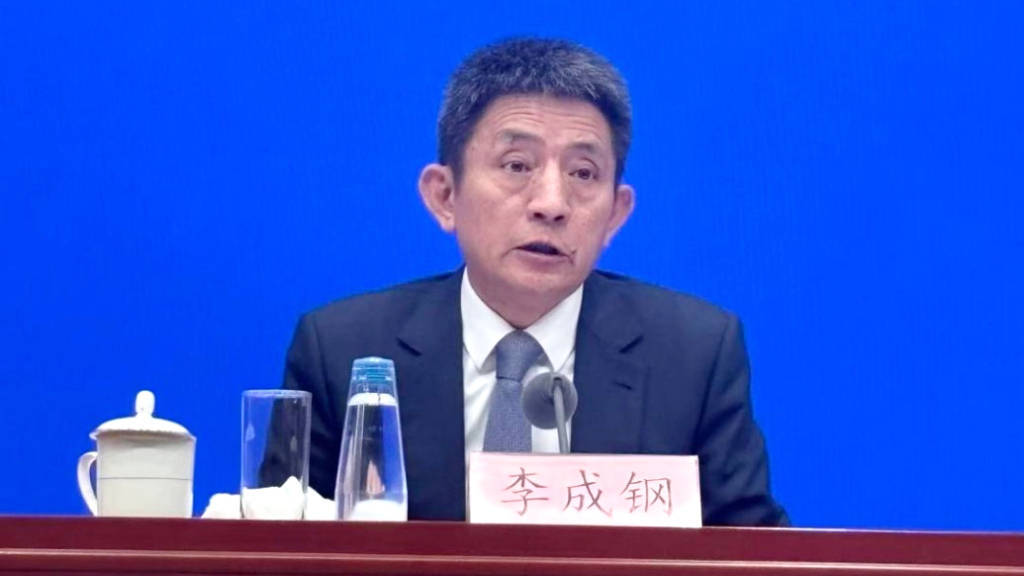
二是持续提升高标准自贸区网络"绿色含量"。在已经签署的自贸协定中,我们推动纳入了贸易与环境的相关内容。比如,在前两天也就是28日刚 刚签署的中国-东盟自贸区3.0版升级议定书中,就设立了绿色经济专章,并将绿色贸易列为优先合作领域。此外,在与瑞士、韩国、秘鲁的自贸 协定中或者升级谈判中,都包含了环境保护、绿色产业合作等方面内容。我们将持续推进自贸谈判,大力推动双向市场开放、削减非关税壁垒、 提升规则承诺水平,推动标准与合格评定合作,为企业创造公平、透明、可预期的市场环境。 10月31日,商务部国际贸易谈判代表兼副部长李成钢在国新办新闻发布会上介绍绿色贸易相关情况。智通财经记者赵利新 图 三是深化国内改革对接国际绿色标准。我们将对国际标准和经贸规则进行认真研究,并持续对接,推进在环境标准等领域进一步深化改革,促进 国内产业绿色转型升级。目前,我们正在会同相关部门,推动完善绿色产品标准、认证、标识体系,加快与主要贸易伙伴实现标准互认。推动中 国绿色产品、技术和服务更好地融入全球市场。 一是深度参与绿色贸易的全球治理。我们将在二十国集团、金砖国家、亚太经合组织、联合国贸发会议等重要的国际场合,积极参与绿色发展相 关议 ...

好天儿常见 空气更新鲜
Liao Ning Ri Bao· 2025-10-31 01:04
Group 1: Air Quality Improvement - The air quality in Shenyang has significantly improved, with no smog days reported since October and PM2.5 daily average concentration remaining below 65 micrograms per cubic meter [1] - In 2024, the province recorded 325 days of good air quality, an increase of 19 days compared to 2020, with heavy pollution days averaging only 1.8, a reduction of 2.1 days from 2020 [1] - By the third quarter of 2025, the proportion of good air quality days reached 89.4%, marking the best historical level for the same period [1] Group 2: Industrial Transformation - The green transformation of industrial enterprises is crucial for expanding blue sky coverage, with Ansteel Baicheng Steel Plant investing 2.6 billion yuan in ultra-low emission modifications, achieving advanced emission levels for sulfur dioxide, particulate matter, and nitrogen oxides per ton of steel [2] - Thirteen steel enterprises in Liaoning have completed ultra-low emission modifications, covering 91.44% of the production capacity of operating enterprises [2] - A comprehensive monitoring network has been established, including 15 county-level and 10 township-level air quality automatic monitoring stations, enhancing pollution source identification and management [2] Group 3: Heating Season Management - The previous heating season in Shenyang did not experience heavy pollution days, with significant upgrades to old heating pipelines and the elimination of small coal-fired boilers in various cities [3] - The city plans to eliminate over 30,000 old diesel trucks and update 82,400 National III passenger vehicles in 2024, promoting electric and hydrogen vehicles in public transport and logistics [3] - The comprehensive utilization rate of straw in the province is expected to reach 93.16% by the end of 2024, utilizing methods such as feed, fuel, fertilizer, substrate, and raw material [3] Group 4: Public Sentiment and Quality of Life - The improvement in air quality has enhanced public happiness, with citizens enjoying outdoor activities and observing more stars at night due to clearer skies [4] - Key air quality indicators, including PM2.5 concentration, proportion of good air days, and heavy pollution days, have shown year-on-year improvements by the third quarter of 2025 [4] - The blue sky campaign aligns with public needs, allowing citizens to share in the benefits of high-quality development through improved air quality [4]
CGI深度 | “十五五”兼顾绿色转型与经济增长的电价走势分析
中金点睛· 2025-10-30 23:32
Core Viewpoint - The article discusses the challenges and risks associated with electricity pricing in China during the "14th Five-Year Plan" period, emphasizing the need for a balanced approach to ensure both economic growth and green transition while managing the widening gap between wholesale and retail electricity prices [4][10]. Group 1: Electricity Pricing Dynamics - The rapid decline in renewable energy generation costs and increased penetration should ideally lead to lower terminal electricity prices; however, many regions are experiencing rising prices instead, particularly in areas with high market maturity and renewable integration [6][11]. - The widening gap between wholesale and retail prices, referred to as the "scissor difference," poses risks to economic development and long-term green transition, necessitating timely corrections to prevent adverse effects on consumer welfare and industrial competitiveness [26][27]. Group 2: Factors Influencing Price Dynamics - Three main factors contribute to the widening price gap: increased physical system costs due to higher renewable penetration, legacy costs from past contracts related to renewable support mechanisms, and market power exerted by different market participants [6][35]. - China's electricity market faces significant risks of widening price gaps due to inherent limitations in system flexibility, substantial legacy subsidy shortfalls, and an underdeveloped market mechanism that hampers effective price transmission [7][8]. Group 3: Recommendations for Addressing Price Gaps - To mitigate the risks of widening price gaps, a coordinated effort is needed across policy, market, and system levels, including strengthening market regulation, exploring market-based financing combined with fiscal subsidies, and enhancing system flexibility through increased energy storage and market incentives [8][10]. - The article emphasizes the importance of creating a fair and transparent market environment while addressing historical subsidy burdens to alleviate operational pressures on renewable energy enterprises [8][10]. Group 4: Future Electricity Supply Cost Predictions - The article predicts that during the "15th Five-Year Plan" period, China's electricity supply costs may face upward pressure of approximately 5 to 8 cents per kilowatt-hour, higher than during the "14th Five-Year Plan," due to rising system costs and legacy issues [7][56]. - The need for significant investments in grid infrastructure and flexible resources to accommodate the growing share of renewables is highlighted as a critical factor driving future electricity supply costs [56][70].
专访招商基金李湛:把握五大赛道机遇,拥抱中国式长期主义
Nan Fang Du Shi Bao· 2025-10-30 13:51
Core Insights - The "15th Five-Year Plan" emphasizes high-quality development and marks a critical period for achieving socialist modernization, with a focus on strategic priorities and specific areas of action [2][5][6] Economic and Policy Focus - The plan continues to prioritize high-quality development while shifting from quantitative economic growth indicators to qualitative improvements and reasonable growth [5][6] - Key areas of policy focus include enhancing macroeconomic policy consistency, upgrading traditional industries, and improving social policies to invest in human capital [7][8] Industry Opportunities - Several sectors are expected to experience significant growth opportunities, including strategic and future industries such as renewable energy, aerospace, and quantum technology [8][9] - Traditional industries will undergo high-end, intelligent, and green upgrades, benefiting from technological innovation and industrial internet solutions [8][9] - The integration of modern services and the digital economy is highlighted, particularly in areas like digital trade and health care [8][9] Investment Strategies - Public funds are encouraged to embrace "Chinese-style long-termism" by aligning their investment strategies with the long-term perspectives outlined in the five-year plan [9][10] - The asset management industry is seen as a crucial player in funding allocation and value discovery, with a focus on supporting technological innovation and green transformation [10][11] Challenges and Considerations - The asset management sector faces challenges such as the need for "patient capital" and the complexities of valuing new technologies [11] - Investors are advised to be cautious of speculative bubbles and to focus on long-term growth opportunities while maintaining a balanced asset allocation [12][13]

AI时代制造业如何在智能化绿色化和全球化的浪潮中突围
Jiang Nan Shi Bao· 2025-10-30 13:43
Core Insights - AI technology is reshaping the competitive landscape of the manufacturing industry, with intelligent production, green transformation, and global collaboration becoming the three core strategies for companies [1][2] - The next three to five years will be critical for companies that can complete technological upgrades and talent deployment to gain an advantage in the global industrial chain restructuring [1] AI Skills and Talent Demand - Since 2016, the number of global members with AI skills has increased ninefold, and AI-related job postings have grown by over 63% in the past year, leading to intensified talent competition in sectors like smart manufacturing, chips, new materials, and aviation [1] - Digital transformation in manufacturing extends beyond production to organizational management and talent strategy, with a fully digitalized recruitment process enhancing efficiency through AI-driven candidate matching and performance prediction [1] Green Transformation - The demand for green skills globally has increased by 11.6% year-on-year, while supply has only grown by 5.6%, making manufacturing one of the fastest-growing sectors for green skills demand [1][2] - Companies must not only adopt AI but also cultivate green capabilities, necessitating adjustments in talent profiles, training systems, and employer branding [1] Global Collaboration - Chinese manufacturing companies are transitioning from "local manufacturing" to "global innovation," with cross-border recruitment, remote collaboration, and global supply chain talent deployment becoming the norm [2] - Companies need to leverage digital platforms to connect global resources and create seamless talent experiences [2] Cost Control and Talent Retention - Manufacturing firms face dual pressures of controlling costs while attracting and retaining high-end talent, with AI optimization of production processes being a key step in reducing labor costs while maintaining core technical positions [2] - Data indicates that companies adopting smart manufacturing technologies see an average increase of 20% in production output and employee productivity, along with a release of 15% in additional capacity [2] Employer Branding and Talent Preferences - 60% of manufacturing talent prioritize learning opportunities and green innovation over salary when choosing employers, indicating that companies can enhance their employer brand through green projects and carbon neutrality goals [2] Strategic Recommendations - In the next three to five years, talent management in manufacturing will undergo profound changes, with AI becoming a core tool from recruitment to performance management [4] - Companies must establish transparent algorithm governance to ensure fairness and recognize that by 2030, over half of manufacturing jobs will require digital and green skills, making green intelligence a core competitive advantage [4] - Remote collaboration and cross-border recruitment will become standard, necessitating seamless digital experiences to attract global talent [4] Future Directions - Companies are advised to implement a "AI + Green + Human-centric" three-track strategy, invest in learning platforms, and drive skill upgrades, particularly in green skills [4] - Data-driven compensation and talent strategies will be essential for maintaining flexibility in a competitive landscape [4]
方大炭素三季度营收稳健增长,战略转型夯实高质量发展根基
Zheng Quan Shi Bao Wang· 2025-10-30 12:37
Core Insights - The company reported a third-quarter revenue of 932 million yuan, reflecting a year-on-year growth of 16.60%, demonstrating operational resilience in a complex market environment [1] - Despite a cumulative revenue decline in the first three quarters due to industry cycles and product price fluctuations, the positive changes in the third quarter signal a stable development trajectory for the company [1] - The total profit for the third quarter reached 111 million yuan, marking a year-on-year increase of 25.34%, indicating a gradual recovery in the profitability of the main business [1] Financial Performance - The company has effectively managed asset allocation and investment, contributing significantly to fair value changes, which enhances profit elasticity [1] - Cash flow management remains a focus, with net cash inflow from financing activities reaching 275 million yuan, showcasing the company's advantages in financing channels and capital security [1] Strategic Initiatives - As a leading enterprise in the carbon industry, the company emphasizes innovation and green transformation, with its subsidiary actively advancing capacity transfer and site renovation for a new 30,000-ton ultra-high-power graphite electrode project [2] - This initiative aims to address historical issues and upgrade the production system towards automation and intelligence, injecting new momentum into the company's long-term competitiveness [2] Shareholder Returns and Financial Structure - The company maintains stable shareholder returns, having distributed cash dividends totaling approximately 75.53 million yuan based on the 2024 profit distribution plan, reflecting its commitment to investor rights and returns [2] - The total asset scale remains stable compared to the end of the previous year, with the debt-to-asset ratio maintained within a reasonable range, indicating a solid overall financial foundation [2] Future Outlook - The application prospects for carbon new materials in metallurgy, new energy, and aerospace remain broad, driven by changes in the global economic landscape and deepening industrial upgrades [2] - The company is well-positioned to seize opportunities in industry recovery and policy support, leveraging its technological accumulation, capacity layout, and green transformation strategy to continuously enhance its comprehensive competitiveness [2]

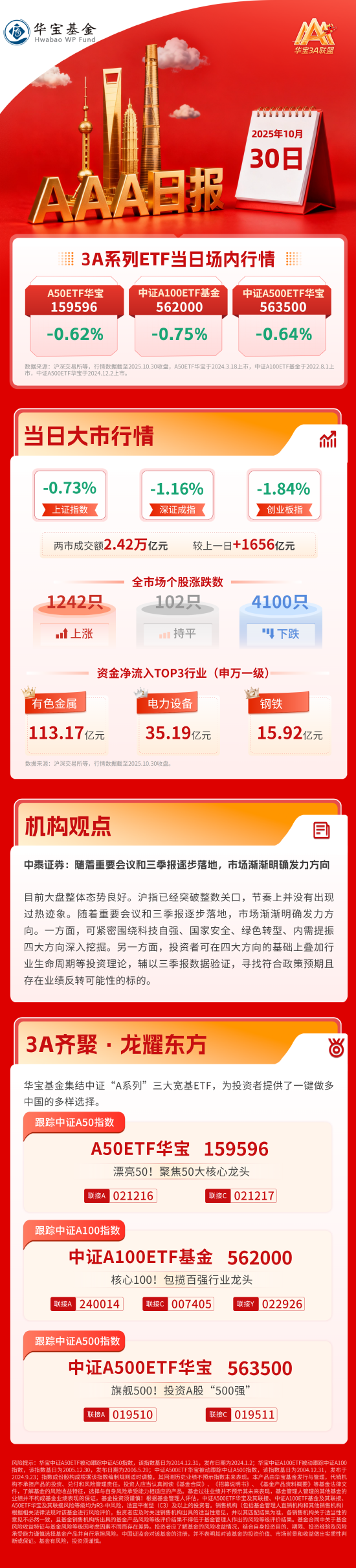
A股三大指数午后走弱,储能板块逆势上扬|华宝3A日报(2025.10.30)
Xin Lang Ji Jin· 2025-10-30 11:16
Group 1 - The overall market sentiment is positive, with the Shanghai Composite Index breaking through key levels, indicating no signs of overheating [2] - The market is gradually clarifying its direction as important meetings and Q3 reports are released, focusing on four main areas: technological self-reliance, national security, green transformation, and boosting domestic demand [2] - Investors are encouraged to explore opportunities based on these four directions, combined with industry lifecycle theories and Q3 data validation, to identify stocks that align with policy expectations and have potential for performance reversal [2] Group 2 - Huabao Fund has launched three major broad-based ETFs tracking the CSI indices, providing investors with diverse options to invest in China [2] - The A50 ETF, launched on March 18, 2024, tracks the CSI A50 Index, focusing on 50 leading companies [2] - The CSI A100 ETF, launched on August 1, 2022, encompasses the top 100 industry leaders, while the CSI A500 ETF, set to launch on December 2, 2024, targets a broader range of 500 stocks [2][3]
让科技创新成为破解产业转型矛盾的“金钥匙”
Ren Min Ri Bao· 2025-10-30 10:29
Core Insights - The process of generating green electricity through wind turbines, electrolyzing water to produce hydrogen, and using hydrogen to reduce iron ore results in nearly zero carbon dioxide emissions from iron production [1] - Ansteel Group is exploring technological innovation and key core technologies to facilitate a comprehensive green transformation in the context of economic and social development [1] - Traditional high-energy-consuming industries like steel, chemicals, and cement face significant transformation challenges, necessitating updates in equipment, energy conservation, and resource recycling [1] Summary by Sections Technological Innovation - Technological innovation is seen as the "golden key" to resolving the contradictions in industrial transformation [1] - The implementation of a 135-megawatt supercritical coal gas power generation unit enhances energy utilization efficiency [1] - The use of "unmanned vehicles + digital twin" technology in smart storage areas achieves efficient low-carbon transportation and production [1] Green Transformation - The green transformation is characterized as a collaborative "symphony" rather than a singular breakthrough [1] - Full-chain technological empowerment breaks through the bottlenecks between "emission reduction" and "efficiency increase," shifting high-energy-consuming industries from a "resource-dependent" model to a "technology-driven" model [1] High-Quality Development - The reduction of energy consumption and carbon emissions, alongside the enhancement of innovation, positions the green transformation of high-energy-consuming industries as a catalyst for high-quality development [2] - The transition from "high carbon emissions" to "green benchmarks" is anticipated to contribute significantly to the high-quality development goals during the 14th Five-Year Plan period [2]
清单:2025年11月份有1385份仪器/检测类标准将实施
仪器信息网· 2025-10-30 09:07
Core Viewpoint - The implementation of mandatory national standards for biological safety cabinets aims to enhance detection needs, alongside over a thousand other standards set to take effect in November, which will improve product quality and promote sustainable development [1][2]. Group 1: Overview of New Standards - A total of over a thousand new standards will be implemented in November 2025, covering key sectors such as agriculture, environmental protection, healthcare, petrochemicals, electronics, transportation, and machinery [2][5]. - The release and implementation of these standards are concrete measures to realize the concept of "quality improvement and efficiency enhancement," aimed at driving technological upgrades, quality enhancement, and green transformation across various industries [2][5]. Group 2: Specific Areas of Focus - In the agriculture sector, the focus will be on food safety, disease prevention in plants and animals, water conservation, and genetic resource protection, providing technical support for sustainable agricultural development [5]. - The environmental protection standards emphasize carbon footprint accounting and pollution monitoring, contributing to the achievement of carbon neutrality goals [5]. - In healthcare, the standards will strengthen infectious disease prevention, medical device safety, and elderly care service regulations, reflecting the integration of public health and the construction of a healthy China [5]. - The petrochemical, textile, and mining industries will focus on green processes, material performance, and safety production, promoting the transformation of traditional industries towards high-end, intelligent, and green development [5]. Group 3: Notable Standard - Biological Safety Cabinet - The new standard GB 41918-2022 for biological safety cabinets specifies classifications, requirements, testing methods, labeling, inspection rules, and storage guidelines [6][7].

17亿,亨通光电中标丹东百万千瓦级风电项目!
Zhong Guo Neng Yuan Wang· 2025-10-30 08:07
Core Insights - Hengtong Optic-Electric has successfully won the bid for the Dandong Donggang Phase I 1 million kW offshore wind power project, with a bid amount exceeding 1.7 billion yuan, covering the production, transportation, and installation of ±500kV DC submarine cable systems and 66kV aluminum core submarine cables [1][2] - The project represents a technological benchmark in China's offshore wind power sector, being the first to adopt a ±500kV DC output system and a 66kV aluminum core branching system for a million-kilowatt deep-sea wind power project [1][2] - The successful bid highlights the company's comprehensive strength in the marine energy sector and showcases its core capabilities in the research and application of ±500kV flexible DC submarine cable technology [1][2] Technical Challenges and Solutions - The ±500kV DC submarine cable system involves high technical barriers, including stringent requirements for high voltage resistance, seawater corrosion resistance, and wind and wave impact resistance due to the deep-sea environment [2] - The company has overcome these technical challenges through years of technological accumulation, forming a full-chain service capability from research and development to production, transportation, and installation [2] Environmental and Economic Impact - The Dandong million-kilowatt wind power project is expected to provide 3 billion kWh of clean electricity annually, reducing carbon emissions by 2.4 million tons, thus contributing to the achievement of carbon neutrality goals [3] - The project will also drive local industrial upgrades in equipment manufacturing and port logistics, aligning with the company's mission to serve national strategies and promote green development [3] Future Outlook - Hengtong Optic-Electric plans to continue increasing its R&D investment in deep-sea energy transmission and core materials, enhancing its capability in marine energy system solutions [3] - The company aims to deepen its domestic market presence while also participating in international competition, leveraging independent technological innovation to support the development of national deep-sea technology and contribute to the global energy system's green transition [3]
